
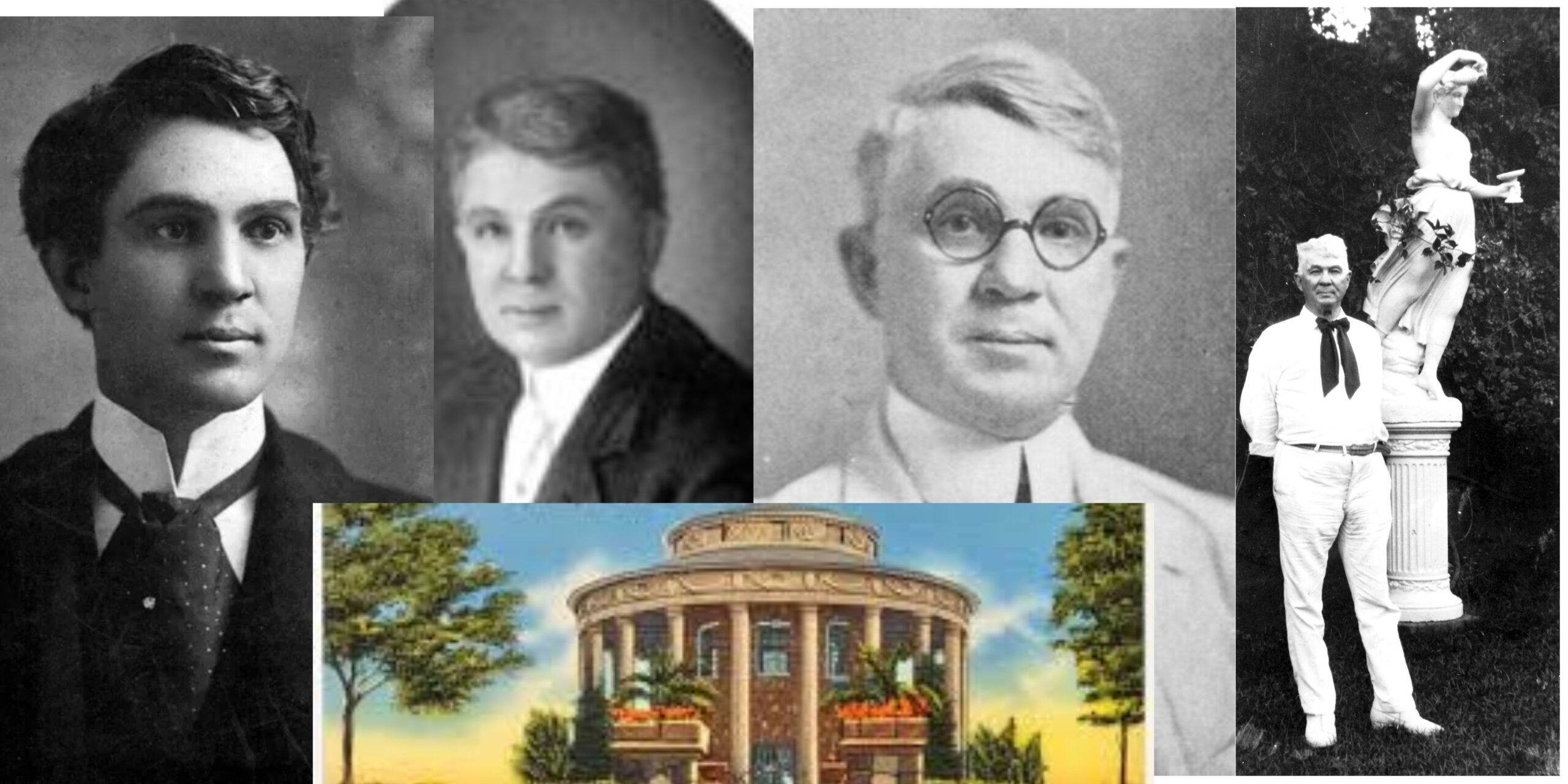
Author’s Note: I became interested in George B. Ward and his unseen influence on this city while working on a screenplay about his life. I have already written a much shorter article on his life, but I wanted to make my research notes for the screenplay available to anyone who wanted a deeper dive. There is not much public information available on Mr. Ward, and the psychological reads that follow are interpretive rather than diagnostic, offered in the spirit of understanding a man whose private papers were burned before anyone could check them. I hope these notes provide a compelling compendium for anyone interested. Taproot Therapy Collective, blog editorial team
The Iron Consul: A Psychological and Historical Portrait of George B. Ward

Read as a downloadable document: The Life of George B. Ward
The Paradox of the Magic City
In the annals of American municipal history, few figures invite the kind of depth-psychological excavation that the life of George Battey Ward (1867–1940) demands. Mayor, investment banker, and self-styled Roman consul, Ward did not merely govern Birmingham; he attempted to curate it. His was a decades-long performance of order imposed upon the chaotic energy of a boomtown, an escalating effort to lay classical symmetry over a city born of coal smoke and iron slag. He wanted to overlay the grit of the “Pittsburgh of the South” with the imperial glory of Augustan Rome, and he wrote that ambition into the landscape itself. From the Temple of Vesta he built on a mountain ridge to the Sibyl Temple that was meant to serve as his tomb, his life reads as a manifesto written in limestone.
To understand this man is to understand a specific strain of interwar political thought, one that found the messiness of industrial democracy distasteful and looked toward the rising Fascist movements of Europe not with horror but with recognition and a certain envy. The evidence suggests that Ward’s entire political and aesthetic project, from the banning of unsightly weeds to the construction of a literal Temple of Vesta, was a response to two governing stimuli. The first was the trauma of the 1888 Hawes Riot, which taught him that society without authoritarian aesthetics devolves into a mob. The second was the indelible influence of his mother, Margaret Ketcham Ward, whose vision of an ordered, hierarchical, benevolent “Old South” he spent his life trying to preserve against modern industrial grit. He was not merely a bachelor mayor. He was the high priest of a maternal cult, keeping the flame of civilization burning in a temple built to exclude the chaos of the world below.
This essay argues that Ward was a man engaged in a lifelong struggle against the disorder of the modern world, using the archetypes of antiquity to construct a protective reality. He likely never read Freud or Jung, yet his life serves as a vivid case study in archetypal possession, specifically the tension between the Senex, the ruler and old man, and the Puer Aeternus, the eternal youth. His paganism was a sacralization of civic order. His sexuality was coded in the aesthetic language of the dandy. His legacy is a complex tapestry of progressive environmentalism stained by the seductive order of Italian Fascism. He did not want to manage Birmingham. He wanted to perfect it, and when it refused to be perfected, he built a smaller, purer city on a mountain and ruled that one instead.
The Historical Crucible: America Between the Wars
The End of Reconstruction and the Rise of the New South
To understand George Ward, one must first understand the world into which he was born and the era through which he navigated his peculiar path. Ward arrived in 1867, two years after the Civil War ended, into a South convulsing through Reconstruction. By the time he reached adulthood in the 1880s, Reconstruction had collapsed and the Redemption period had installed a rigid system of Jim Crow segregation that would define Southern life for nearly a century.
Birmingham itself was a creature of this transitional era. Unlike the antebellum capitals of Richmond or Charleston, it was born of the post-war industrial boom, a city of iron, coal, and unbridled capitalism forged in the upheaval that followed defeat. It was a place of smoke, mud, and raw ambition, christened the “Magic City” for the speed of its growth and plagued by the chaos of its own creation. The city was incorporated in 1871, the same year the Ward family arrived, which makes George quite literally a child of the New South’s industrial experiment. The New South ideology championed by figures like Henry Grady promised that the region could rise from the ashes of defeat through industrialization and Northern capital, and Birmingham was the laboratory for that promise. The geological convergence of iron ore, coal, and limestone in the Jones Valley made it the ideal site for steel production. By the 1890s it was the Pittsburgh of the South, its furnaces belching smoke and its streets teeming with European immigrants, African American laborers (many trapped in the convict lease system), and Appalachian migrants seeking wage labor.
Jim Crow Order: Hierarchy as Civic Religion
The South in which Ward came of age was obsessed with order, specifically the racial and class hierarchies that white Southerners believed were essential to civilization. The collapse of slavery had created what they perceived as chaos, and the restoration of white supremacy through Jim Crow was understood as the restoration of natural order. This context is essential to Ward’s psychology. His obsession with aesthetic order, his belief that the physical environment determined moral character, and his paternalistic governance all drew from the same ideological wellspring that justified segregation. Ward was not a Klansman, and indeed he was defeated politically by proto-Klan nativists, but his worldview was shaped by the same underlying assumptions about hierarchy, civilization, and the need for elite guidance of the masses. The difference was that Ward’s elitism was aesthetic and classical rather than populist and Protestant. He looked to Rome rather than the Confederacy for his model of order, which made him suspect to the fundamentalist majority even as he shared their basic premises about social rank.
The Shadow of Convict Leasing
While Ward is often celebrated as a progressive, his early life was underwritten by one of the darkest chapters in Southern history. The research indicates that his father, George R. Ward, was involved in the convict lease system as early as the 1870s, managing contracts that leased prisoners to industrial concerns. The convict lease system was, in effect, slavery by another name. African American men were arrested for trivial offenses such as vagrancy or loitering and leased to mines and plantations, where they were worked to death in horrific conditions. George B. Ward was a child during his father’s direct involvement, but the wealth and status of his family were partly derived from that exploitation, and this creates a complex psychological inheritance. Ward would later position himself as a benevolent patrician, yet the foundation of his class privilege rested on the forced labor of the very people he would later claim to uplift through civic beautification. This contradiction, the desire for beauty funded by brutality, would haunt the City Beautiful movement in Birmingham.
World War I and the Crisis of Meaning
Ward’s political career reached its zenith just as the First World War erupted in Europe, and the war created a crisis of meaning for the Western world. The optimistic progressivism of the pre-war era, the belief that education, sanitation, and civic improvement would inevitably produce a better society, was shattered in the trenches of the Western Front. The City Beautiful movement Ward championed was itself a product of that pre-war optimism, and the war revealed that beautiful cities could produce not moral citizens but mass murderers, that civilization was a thin veneer over barbarism. Ward’s political defeat in 1917, the same year America entered the war, coincided with this broader collapse of progressive confidence. The “True Americans” who defeated him represented a different response to the crisis, one of nativism, fundamentalism, and the search for enemies within. While Ward retreated to build his Roman temple, the forces that defeated him would soon coalesce into the revived Ku Klux Klan that dominated Alabama politics in the 1920s.
The Roaring Twenties and the Roman Fantasy
The 1920s were a boom time for Birmingham, and Ward was perfectly positioned to capitalize on it. His investment banking firm specialized in public finance, underwriting municipal bonds for cities and counties across Alabama. The irony is sharp: no longer running the government, he was now financing it, becoming an essential cog in the machinery of the state’s infrastructure and amassing a significant personal fortune as the decade reached its peak. This was Ward’s Great Gatsby era. The excess and spectacle of the period provided cover for his eccentricities, and his toga parties at Vestavia were read as the charming hobbies of a wealthy bachelor rather than the symptoms of a man retreating from reality. The decade’s atmosphere of hedonism and experimentation made his Roman masquerades seem almost fashionable.
The Great Depression: The Second Fall
The Depression struck Birmingham with apocalyptic force. President Herbert Hoover once called it the hardest hit city in the nation. The steel mills shut down, the mines closed, and unemployment skyrocketed; the Magic City that had grown so quickly proved equally capable of rapid collapse. For Ward, the Depression was a second fall, less about his personal bank account, since his firm dealt in secured bonds and survived, than about the collapse of his civilizational project. The City Beautiful movement required surplus capital. It required a society that could afford to care about aesthetics, and in the 1930s Birmingham could barely afford to eat.
The most painful symbol of this decline was the fate of the Birmingham Zoo. During his time as Commission President, Ward had nurtured the zoo as a jewel of the park system, a place of education and wonder. By the early 1930s the city’s funds had dried up, the Parks Department could no longer afford to feed the animals, and the city began selling them off. Miss Fancy, the beloved elephant and the star of the zoo, was sold to the Hagenbeck-Wallace Circus. Watching his creation dismantled and sold for scrap value was a profound psychological blow, the undoing of his life’s work, as the city retreated from the cosmopolitan ideal he had championed and slid back into grim survivalism.
From Eccentric to Pagan
As the Depression deepened, the social tolerance of the 1920s evaporated. The South turned inward, embracing a harder, more fundamentalist Christianity as a bulwark against economic chaos, and in this environment Ward’s Vestavia estate looked less like a whimsical hobby and more like a decadent insult. Critics, particularly from the religious right that descended spiritually from the True Americans who had defeated him in 1917, began to whisper about the pagan on the mountain. They viewed his Roman temple, his toga parties, and his Temple of Sibyl mausoleum as un-Christian. Ward grew increasingly isolated, his pagan individualist vision out of step with the conformist achievement culture and religious revivalism of the decade. He became a relic, a man living in a stone fantasy while the city below him starved.
The Approach of World War II and the Question of Allegiance
George B. Ward died on September 11, 1940. At that moment Europe was ablaze, France had fallen, the Battle of Britain was raging, and the United States was ostensibly neutral but drifting toward war. The timing of his death spared him from witnessing the destruction of the Italy he idealized, the bombing of the Rome he would have mourned, and the ultimate discrediting of the Fascism he had flirted with aesthetically. Based on his psychological profile, his political history, and the timeline of his death, we can construct a high-confidence assessment of where his sympathies would have fallen.
Ward would almost certainly have aligned himself with the Isolationists and the newly formed America First Committee, which launched just days before his death. He had no love for the parliamentary democracies of Britain and France. He viewed them as weak and disorderly, the Gauls and Britons who had historically destroyed the Roman order he revered, and he would have seen no value in spilling American blood to save systems he considered inefficient. While he would have advocated neutrality, his private sympathies would have remained deeply pro-Italian, because his identity was so thoroughly fused with the mythos of Rome that he likely viewed Mussolini’s Italy not as an aggressor but as a revanchist power restoring its rightful dignity. He would have cheered Italian efforts to dominate the Mediterranean, the dream of Mare Nostrum, as a return to historical normalcy.
It is critical to differentiate Ward’s Roman Fascism from Hitler’s Nazism. Ward’s obsession was with civic order and classical beauty, not Teutonic racial theory or genocide. Like many American conservatives of the era, he likely regarded Mussolini as a constructive dictator while viewing Hitler as a vulgar, chaotic warlord. He would have sided with Italy but felt ambivalent or hostile toward Germany, casting the Germans as the barbarians at the gate of Roman civilization. Had he lived past December 7, 1941, his allegiance would have faced a crisis. Ward was a patriot of his city and state, a “pioneer of 1871,” and the Roman virtue of patria, loyalty to the fatherland, was central to his worldview. He would have outwardly supported the war effort, driven by nationalism and the attack on American soil, while privately mourning the destruction of Italian architecture. He would have decried the Allied bombing of Rome and Monte Cassino, arguing that the preservation of civilization, meaning the buildings and statues, mattered more than the defeat of a political ideology. He would have remained a reluctant belligerent, fighting for America but weeping for Rome.
Table: Ward’s Probable Political Alignment (1940)
| Conflict Element | Likely Stance | Rationale | Evidence |
|---|---|---|---|
| US Intervention | Opposed (Isolationist) | Distrust of foreign entanglements; belief that US democracy was flawed; desire to protect local stability. | Affinity with America First era conservatism; 1917 withdrawal from “mob” politics. |
| Mussolini / Italy | Sympathetic, supportive | Viewed Mussolini as a restorer of Roman order and City Beautiful ideals. | Hosting Arnaldo Mussolini; use of the Roman salute; Vestavia architecture. |
| Hitler / Germany | Ambivalent, skeptical | Likely viewed Nazism as barbaric chaos compared to Roman order, distinct from his Latin aesthetic. | Focus on Roman and Greek history, not Germanic; City Beautiful is a classical, not gothic, ideal. |
| Britain / France | Hostile, dismissive | Viewed as chaotic, inefficient democracies, historical enemies of the Roman ideal. | Distrust of the mob; elitist governance style. |
The Life of George Battey Ward
A Childhood in the Lobby of History (1867–1888)
George Battey Ward was born on March 1, 1867, in Atlanta, Georgia, a city rising from the ashes of war, the son of George R. Ward and Margaret Edith Ketcham Ward. His identity, however, was not Georgian. In 1871, when Ward was four years old, his family migrated to the newly founded city of Birmingham. Birmingham in 1871 was not a city in the traditional sense but a speculative gamble, a muddy intersection of rail lines and coal seams. The Ward family did not inhabit the periphery of this experiment; they constituted its social core. Along with his grandparents, William and Jane Ketcham, George’s parents operated the Relay House, Birmingham’s first hotel.
The Relay House was more than lodging. In an era before established government buildings or country clubs, the hotel lobby served as the de facto town square, stock exchange, and political forum. Growing up there, George was exposed to the raw, kinetic energy of industrial capitalism, watching railroad barons, land speculators, and carpetbaggers transact the business of building a metropolis out of nothing.
Table: The Relay House Developmental Environment
| Environmental Factor | Description | Impact on Ward’s Psyche |
|---|---|---|
| Transient Population | Constant flow of strangers, businessmen, and laborers through the hotel. | Instilled a need for social sorting and quick judgment of character; reinforced the contrast between the chaos of the outside world and the order of the interior. |
| Matriarchal Authority | The hotel was effectively managed by his mother, Margaret, and grandmother, Jane. | Established the female figure as the primary architect of domestic order and social grace. |
| Civic Genesis | Site of early civic meetings and the founding of institutions like the Church of the Advent. | Taught Ward that institutions are not inherited but created by will and social positioning. |
The psychological impact of growing up in such a place cannot be overstated. For a child, a hotel is a space of permanent transience, a threshold where the public and private spheres collapse into one another. Young George watched the violent, chaotic energy of miners, speculators, and carpetbaggers pass through the lobby. He witnessed the forming of the city in real time, deals struck in cigar smoke, fortunes made in land speculation, the constant influx of strangers trying to extract wealth from the Jones Valley. This environment likely instilled a deep anxiety about chaos, because in a world where the population was transient and the social order fluid, rigid structure becomes a survival mechanism. His later obsession with cleanliness, order, and classical architecture can be read as a reaction against the mud and soot of childhood. If Birmingham was the chthonic underworld of Vulcan, the Roman god of fire and the forge, Ward would spend his life ascending toward the Apollonian heights of Olympus, distancing himself from the dirty reality of the city’s economic engine. He was also a survivor of the 1873 cholera epidemic that decimated early Birmingham, an experience that almost certainly reinforced his later conviction that sanitation was both a public health measure and a moral imperative.
Margaret Ketcham Ward: The Architect of the Soul
The most profound influence on George Ward’s life was his mother. Margaret Ketcham Ward was a woman of formidable intellect and social standing, a founding member of the Episcopal Church of the Advent, and a staunch defender of the Old South social order. The psychological tether between mother and son was forged in the contrast between her genteel worldview and the rough reality of Birmingham. Margaret represented culture, history, and grace; Birmingham represented soot, strikes, and mud. George’s life became a project to make the latter worthy of the former. She was a powerhouse, a suffragette and, as we will see, a star witness in a U.S. Senate hearing, and Ward lived with her until her death. In his psyche, woman was a figure of supreme authority rather than a domestic partner, a precursor to the Vestal Virgins he later worshipped, and her death left a void he eventually filled with a literal temple to the goddess of the hearth.
The 1883 Senate Testimony: The Narrative of Benevolence
A pivotal event in the family history, one George would obsess over for decades, occurred on November 15, 1883, when the United States Senate Committee on Relations Between Labor and Capital convened at the Relay House to take testimony about the state of the post-war South. Margaret Ketcham Ward was called as a star witness. In her testimony she articulated a romanticized defense of the antebellum social order, speaking of the benevolence of the master-slave relationship and the harmony of the plantation system, painting a portrait of a lost civilization superior to the chaotic, free-labor industrialism of the present.
For the sixteen-year-old George, this moment was foundational. Seeing his mother command the attention of U.S. senators validated her worldview as not merely personal opinion but historical truth. It planted the seed of the Lost Cause in his mind, not the violent redemption of the Klan but the aesthetic redemption of the aristocrat. He learned that order was a moral imperative and that the elite had a duty to structure society for the benefit of the lesser classes, a philosophy that would later define his paternalistic mayoralty.
The Primal Trauma: The Hawes Riot of 1888
If Margaret Ward provided the thesis of George’s life, order and beauty, the events of December 8, 1888, provided the antithesis, chaos and the mob. This date marks the primal trauma that crystallized his political philosophy. Birmingham was gripped by what the papers called the Hawes Horror. Richard Hawes, a local engineer, had been accused of the brutal murder of his wife and two daughters, whose bodies were found floating in East Lake. The discovery incited a morbid fury in the populace and a breakdown of civil order. A mob estimated at more than a thousand men stormed the Jefferson County Courthouse, intent on lynching Hawes. George Ward, then a twenty-one-year-old bank runner for the National Bank of Birmingham, was present, likely drawn by the sensation or conducting business near the epicenter.
As the mob surged, sheriff’s deputies opened fire to protect the jail. A bullet whistled past Ward’s head, missing him by inches, and struck the man standing directly beside him, the city postmaster, killing him instantly. Ward was dragged to safety, but the psychological scar was permanent. This brush with death is the Rosebud of his life, the singular event that explains his future politics. For Ward, the mob ceased to be an abstraction and became a murderous, chaotic entity. The experience instilled a lifelong obsession with order and a profound distrust of unchecked democracy. It cemented a belief that society, left to its own devices, devolves into anarchy, and that civilization therefore requires a strong, paternalistic hand. The near-death moment converted his abstract preference for order into a visceral survival mechanism. He had seen for himself that beneath the thin veneer of civilization lay a murderous beast, and he concluded that without strong authoritarian leadership and enforced civic beauty, society would devolve into a murderous mob. This is the hidden logic beneath all his later aesthetics. In Ward’s mind, a beautiful city was a calm city, ugliness and disorder were the breeding grounds of the mob, and to save his own life he would have to manicure the world.
The Financial Foundation (1888–1905)
Following the riot, Ward retreated into the orderly world of finance. His education had followed the standard path for the Southern elite, the Powell School and a preparatory academy, but his true schooling occurred in the financial sector, where he entered the workforce at sixteen as a runner for the First National Bank of Birmingham. Banking in late nineteenth-century Birmingham was a perilous profession, the city’s economy notoriously boom-and-bust and tethered entirely to the price of iron and coal. As a runner and later a paying teller, Ward learned the discipline of the ledger, that a city’s survival required fiscal solvency and rigorous management. This shaped his governing philosophy into that of a business progressive who believed municipal government should be administered with the efficiency and clear lines of authority of a corporation. He rose from runner to paying teller at the National Bank of Birmingham, described as successful, meticulous, and known for a sharp tongue. He briefly resigned from politics to manage a cotton brokerage firm, but his return to public service was always inevitable, because for Ward banking was a means to an end, the accumulation of the social and financial capital necessary to reshape the city in his image.
The Political Ascent (1899–1917)
Ward’s political career began in 1899 with election to the Birmingham Board of Aldermen. This first foray was brief; he resigned in frustration with the inefficiency and corruption of the system, having learned a crucial lesson, that he could not change Birmingham from within a chaotic, multi-headed aldermanic body. He needed executive power. In 1901 he returned to the Board with a more focused strategy, serving a full four-year term and using the position to build political capital and refine his vision for civic improvement. His reputation as a meticulous administrator and his banking background made him a natural candidate for higher office. In 1903 he ran for mayor and was defeated by Mel Drennen. The loss stung but was instructive: Birmingham’s electorate was not yet ready for his brand of patrician progressivism. He retreated, regrouped, and bided his time. On May 4, 1905, at thirty-eight, George B. Ward was inaugurated as mayor, beginning what would later be called the City Beautiful era.
The City Beautiful Movement: Ward’s Masterpiece
The City Beautiful movement was Ward’s true calling, more than urban planning, a comprehensive philosophy of civic life rooted in the belief that physical beauty could elevate moral character. He had been profoundly influenced by the 1893 World’s Columbian Exposition in Chicago, the “White City” whose neoclassical architecture and planned boulevards represented the pinnacle of urban design, and he wanted to bring that vision to Birmingham. His approach was comprehensive and obsessive. He treated sanitation as salvation, viewing cleanliness as both a public health necessity and a moral imperative, and launched aggressive campaigns to eliminate open sewage, regulate garbage disposal, and pave streets, because for Ward filth was not merely unhealthy but uncivilized. He treated parks and playgrounds as instruments of moral and physical health for the working class, championing the creation and expansion of public parks, including what would become George Ward Park, and establishing playgrounds for children on the theory that structured play would prevent juvenile delinquency.
His aesthetic ordinances reached into the minute details of urban life. He banned unsightly weeds, regulated storefronts, mandated building setbacks, and even attempted to ban billboards as visual pollution that degraded the civic landscape. His administration issued pamphlets and directives that functioned as instruction manuals for the citizenry, autocratic in their specificity, commanding residents to “whitewash everything you can’t paint” and to report anybody who tied a horse to a tree. One of his most innovative and most intrusive initiatives was the Block Improvement Society, a neighborhood organization tasked with self-policing aesthetic standards. Neighbors inspected each other’s yards, reported violations of weed ordinances, and collectively beautified their streets. Ward was, in effect, deputizing citizens to enforce his vision of order. Perhaps the most revealing gesture was his eventual removal of “Keep Off the Grass” signs from public parks, a decision whose logic was sophisticated: the signs were ugly, and their necessity indicated a failure of civic education. In an ideal society, citizens would know not to trample the grass without being told, and so the absence of signs became, paradoxically, the sign of a higher civilization. Ward was re-elected in 1907, and in June 1908 he published his seminal City Beautiful pamphlet, a comprehensive codification of his aesthetic laws and civic philosophy, a blueprint for a Birmingham that would rival the great cities of Europe and the classical world.
The Commission Government: A Structure With a Fatal Flaw
Ward’s most enduring and most consequential political achievement was the creation of Birmingham’s Commission form of government. The traditional aldermanic system, with its dozens of officials representing individual wards, was inefficient, corrupt, and prone to gridlock, and Ward despised it. In 1911 he championed a referendum to abolish the Board of Aldermen and replace it with a three-member Commission, each commissioner overseeing a specific domain (Public Safety, Public Works, Public Utilities) with the Commission President serving as executive head. The system promised efficiency, accountability, and expert administration. Voters approved it, and in November 1913 Ward was elected Commission President, the de facto mayor under the new arrangement, defeating the populist poet Clement Wood in a victory that represented the triumph of technocratic order over democratic chaos. The system carried a fatal flaw, however, because it concentrated power in the hands of a few. This worked under Ward’s paternalistic leadership, but it would later enable the autocracy of Eugene “Bull” Connor, a legacy explored in full below.
The Greater Birmingham Merger and the Fatal Expansion
In 1910 Ward orchestrated the annexation of several surrounding suburbs into Birmingham, a move known as the Greater Birmingham merger, which made Birmingham the largest city in Alabama and a major Southern metropolis. Ward viewed it as essential for coordinated planning and infrastructure, but the annexation carried unintended political consequences, bringing in working-class and rural voters who did not share his cosmopolitan vision and who proved more susceptible to the nativist, fundamentalist rhetoric of the True Americans, a proto-Klan movement that viewed Ward as an elitist outsider. That same year Ward ran for Sheriff of Jefferson County and lost, a warning sign that the electorate he had himself created through annexation was turning against him.
The Fall: The 1917 Election and the True Americans
The 1917 election ended Ward’s political career. He was challenged by Nathaniel Barrett, a candidate backed by the True Americans, who represented everything Ward despised: populist demagoguery, religious fundamentalism, nativism, and anti-elitism. They saw his City Beautiful as wasteful extravagance and his classical education as suspect foreignness. The campaign was brutal. His opponents cast him as a spendthrift who wasted tax dollars on parks while working families struggled, an elitist who cared more about flowers than jobs, an eccentric whose toga parties and Roman obsessions made him unfit to lead a Christian city, and a bachelor whose lifestyle was, in the insinuating language of the day, unusual. Ward lost decisively, and the defeat was more than political; it was a narcissistic wound. He interpreted it as a rejection not just of his policies but of his entire worldview. The mob, the same force that had nearly killed him in 1888, had voted him out of office. He resigned immediately, vowed never to seek public office again, retreated from public life, and began planning his most audacious project, a Roman temple on a mountain.
The Harding Motorcade (1921): A Parting Defiance
In 1921 Ward made one final, defiant public gesture. President Warren G. Harding visited Birmingham, and Ward was tasked with organizing the motorcade. In a calculated provocation, he rode in it with Frank McQueen, a prominent African American businessman and civil rights leader. In the Jim Crow South of 1921, a white man and a Black man riding together in a presidential motorcade was scandalous, and Ward knew it. He was using McQueen’s status to provoke his nativist enemies, the True Americans who had defeated him; it was a final “fuck you” to the fundamentalists, coded in the language of racial integration. The gesture revealed Ward’s complicated relationship with race. He was not an egalitarian, and his paternalism extended to African Americans as much as to white workers, but he was willing to weaponize racial integration against his political enemies, demonstrating that his primary allegiance was to his aesthetic vision rather than to the racial codes of the South.
The Retreat to Vestavia (1923–1940)
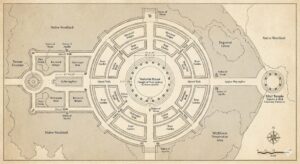

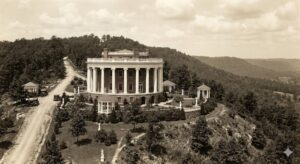
In 1923 Ward purchased twenty acres on Shades Mountain, south of Birmingham, and spent the next two years building Vestavia, a full-scale replica of the Temple of Vesta in Rome. The house was round, ringed by Corinthian columns, and topped with a dome, not a mere architectural homage but a literal temple. He moved in during 1925, furnishing it with reproductions of classical art from the Louvre, installing high-end phonographic equipment, and creating formal gardens modeled after Roman villas. He also built a second, smaller structure on the property, the Temple of Sibyl, which he intended as his tomb. Vestavia was Ward’s temenos, a sacred precinct cut off from the profane world below. If Birmingham had rejected him, he would build his own city on the mountain and serve as keeper of its flame, protecting the soul of the city from the darkness of the True Americans and the industrial chaos beneath him.
Life in the Panopticon
Ward’s life at Vestavia was a performance of imperial control. He installed a high-fidelity public address system across the twenty-acre estate, and from his porch he would watch visitors, since the grounds were open to the public, through binoculars. If someone picked a flower or stepped off a path, his disembodied voice would boom from the trees: “Put that down,” or “Get off the grass.” This was the ultimate realization of the City Beautiful dream, total surveillance and immediate correction of behavior. The Roman masquerade extended to his household, where he renamed his African American servants after Roman figures. His chauffeur became Catiline, often dressed in a gladiator tunic and breastplate; his cook became Lucullus; his gardeners became Pompey and Marcellus. This grotesque pantomime stripped his staff of their identities, reducing them to props in his classical tableau, forced to wear gladiator costume while performing their duties and trained to greet Ward and his guests with the Roman salute, the stiff-armed gesture that by the 1920s and 30s had become the hallmark of Italian Fascism. He communicated his social availability to the city below with colored lights, a green beacon for welcome guests, red for closed gates, white for a private party. His companions were largely animals; he kept peacocks and guinea fowl and built a kennel for his dogs modeled after the Temple of Mars, naming it Villa Cleopatra. At his legendary parties, guests were encouraged to wear togas while an automatic Victrola VE 10-50, a high-end luxury phonograph, provided the soundtrack to piano concerts and listening parties. The context of his Roman life, the Louvre prints and the temple architecture, suggests a taste for the grand classical canon, likely Italian opera and symphonic works, matched to the theatricality of the estate. All of this went beyond eccentricity. It was a manifestation of enforced order, a microcosm of the hierarchical society Ward wished Birmingham could be, in which he controlled the names, clothing, and gestures of everyone around him.
The Fascist Flirtation
Ward’s obsession with Roman order led him into the darkest political current of the twentieth century, Fascism. He hosted Arnaldo Mussolini, the brother of the Italian dictator, at Vestavia, and this was no casual visit. Ward admired Mussolini’s Italy, seeing in it the political realization of his own City Beautiful ideals: a society where the trains ran on time, the streets were clean, and the mob was suppressed by a strong leader. His admiration was rooted in aesthetics and efficiency. He admired Mussolini’s draining of the Pontine Marshes, his monumental train stations, his suppression of the mob Ward so feared. To Ward, Fascism was the City Beautiful armed with a bludgeon, a promise that the streets would be clean and the “Keep Off the Grass” signs unnecessary because the people would be disciplined enough not to trample the sod. For Ward the Roman salute was probably an aesthetic choice, a commitment to historical accuracy in his Roman fantasy, but it reveals a dangerous blindness. He was so enamored with the form of Rome that he ignored the content of the Fascism appropriating it. This is the Shadow of the City Beautiful movement, the truth that when one prioritizes order above all else, one eventually aligns with tyrants. Ward’s progressivism was not liberal but authoritarian. He wanted a better world for the people but did not trust the people to build it themselves.
The Soil Magic
Ward planted a Vineyard of Bacchus and, in what observers described as a fit of madness, imported tons of actual soil from Italy to Alabama, believing the sacred earth of Rome was necessary for his grapes. This is a form of sympathetic magic, the belief that the essence of a place can be physically transplanted through its soil, and it reveals a mystical connection to Rome that transcended mere appreciation. He did not want to admire Rome. He wanted, metaphysically, to be in it.
The Bird Fancier and the Audubon Society
One of the few solaces Ward found in his later years was nature, and he became an obsessive ornithologist, a student and a reader who applied the same meticulousness to birds that he once applied to city ledgers. The catalyst was a 1927 visit by Joseph Dodson, a traveling salesman from Kankakee, Illinois, and a pivotal figure in the early conservation movement, famous for selling elaborate birdhouses and promoting the economic value of birds. Ward was captivated, purchased a significant collection of Dodson’s products for Vestavia, and was encouraged by Dodson to found a local chapter of the National Association of Audubon Societies. Applying the organizing skills honed during his City Beautiful campaigns, Ward convened the founding meeting of the Birmingham Audubon Society on March 16, 1927, in the auditorium of the newly built Alabama Power Company building. He ensured it had gravitas, recruiting Dr. Harry E. Wheeler, curator of the Alabama Museum of Natural History, to present an illustrated talk on the cultural and economic relations of birds to mankind. Forty-nine charter members attended, a gathering of the elite and the intellectual rather than a fringe group, and Ward was elected president, a role he held for thirteen years until his death. In the 1929 Alabama Blue Book and Social Register, he listed his Audubon presidency ahead of his past mayoral title, a telling shift in identity from politician to patriarch of nature. The first regular meeting was held at Vestavia on April 2, 1927, turning his home into the de facto headquarters of the movement.
In May 1927 Ward organized a “gunless bird hunt” at Edgewood Lake, four carloads of members armed with notebooks and field glasses identifying twenty species. The terminology reflects the broader transition from the nineteenth-century model of ornithology, which meant shooting birds to study them, to the twentieth-century model of conservation and observation. His interest was most intensely focused on the Purple Martin (Progne subis), which he documented with the rigor of a Victorian naturalist, keeping a diary distinct from his general scrapbooks devoted to the martins, a form of phenology recording the specific March dates when the scouts arrived and the September dates when the colony migrated south. He maintained four large martin houses, each with forty rooms, supplemented by thirty gourds, a capacity to house nearly two hundred pairs that made Vestavia a significant ecological hub for the species in Jefferson County. His defense of the martins was pragmatic as well as aesthetic, and he frequently justified the hobby by noting that a single female martin could consume up to two thousand mosquitoes a day, a utilitarian argument carried over from his mayoral habit of justifying beauty by its usefulness to public health. He even offered architectural advice to martin landlords, warning against placing houses near bedroom windows because martins begin their song at daybreak, a practical tip from a man who lived in intimate, auditory proximity to his subjects. He dedicated the ten-acre wild garden beneath his temple as a bird refuge and used his remaining political influence to pass local ordinances, securing a wildflower preservation law in 1927 and a wild bird preservation law in 1929. This was the City Beautiful impulse transferred from the urban street to the wild forest. If he could not save the city’s architecture, he would save its wildlife, and remarkably this legislation endures: it remains illegal to kill birds in Homewood and Vestavia Hills because of Ward’s advocacy, a living legacy that has outlasted his temples, his parties, and even the popular memory of his name.
The Interlude: The “Bachelor” Mayor and the Failed Marriage (1924–1926)
George Ward is frequently described in historical summaries as a lifelong bachelor, a designation that fits the narrative of the Vestal priest in solitary devotion. The timeline, however, reveals a brief and discordant interlude. On October 7, 1924, at the age of fifty-seven, Ward married Frances Green, who was thirty-four, and the marriage occurred precisely as Vestavia neared completion. It ended in divorce after roughly twenty months. Why it failed so quickly is a matter of speculation, but the architecture of Vestavia offers a clue. The house was a temple to a virgin goddess and a shrine to a deceased mother, a space designed for a solitary autocrat rather than a shared domestic life, and Frances Green likely found herself an intruder in a psychological space that had no room for a wife. Ward’s bachelorhood was not an accident of fate but a structural necessity of his ego. The marriage is curiously absent from the major biographical narratives, there were no children, and it left little imprint on his public persona as the Man on the Mountain, which raises the possibility that it was a lavender marriage, a companionship arrangement or social shield against scrutiny of his Roman household, or simply an unhappy and practically non-existent union that quickly restored his functional solitude.
The Ghost of the Mother: The Margaret Mitchell Correspondence (1936–1939)
In the final decade of his life, Ward’s fixation on his mother’s legacy found a new outlet in the literary phenomenon of Gone with the Wind. He saw in Margaret Mitchell’s novel a validation of the world his mother had described in her 1883 testimony, and he initiated a correspondence with Mitchell, sending her a copy of that testimony in the belief that it proved the fiction of the novel was actually historical fact. On September 1, 1936, Mitchell wrote thanking him, expressing that she was thrilled and lavishing praise on the humor and charm of Margaret Ketcham Ward, and asking to keep the booklet longer so her husband could read it. On September 11 she wrote again, praising the interesting face of his mother in the photograph he had sent, and on September 19 she discussed the possibility of reproducing the book, showing deep engagement with the material. For Ward this correspondence was not a hobby but a canonization. Mitchell’s approval transformed his mother from a local hotelier into a figure of Southern literature, confirming to him that she was a heroine and that his lifelong defense of her values had been justified.
The Farrar Stone: Preservation Philosophy in Microcosm
Ward’s preservationist philosophy extended beyond urban beautification to a reverence for the genius loci, the spirit of a place, exemplified by his involvement in the controversy over the Thomas Farrar stone at Lover’s Leap on Shades Mountain. In August 1827 Thomas Wadsworth Farrar, a lawyer, War of 1812 veteran, Jefferson County’s first state representative, and a founding father of local Freemasonry, had carved an inscription into a limestone boulder at Sunset Rock, later known as Lover’s Leap. The text he chose was a stanza from Byron’s Childe Harold’s Pilgrimage:
“To sit on the rocks, to muse o’er flood and fell, / To slowly trace the forest’s shady scene, / Where things that own not man’s dominion dwell, / And mortal foot hath ne’er or rarely been.” (Thomas W. Farrar, 1827)
In the early 1930s the Farrar Masonic Lodge sought to honor its founder by claiming the artifact, and in an act that horrified local preservationists, the stone was chiseled out of the solid mountain face and transported to the Lodge’s premises in Elyton. The removal represented a fundamental clash of preservationist philosophies. The Masonic and institutional view held that the object’s value lay in its association with Farrar and belonged inside the institution, while Ward’s contextual view held that its value was inseparable from its location, since the poem about sitting on the rocks became nonsensical once removed from the rocks in question. Ward, joined by Thomas W. Martin, the influential chairman of the Alabama Power Company, became a vocal opponent of the displacement. When their attempt to have the inscription returned failed, the two arranged to have a replica carved on a rock at Lover’s Leap, a philosophical assertion that the text within its context was more authentic than the original artifact out of it.
The Final Years: The Empty Tomb and the Failed Apotheosis (1940)
As Ward approached death, he sought to ensure that his watch over Birmingham would never end, and he planned his burial with the same meticulous detail he had once brought to his parks. He blasted a cavern fifteen feet beneath the Sibyl Temple, deep into the sandstone cliff, installing electric lights, a ventilation system, and a commissioned bronze door. He intended to be sealed in this cave, sitting in his temple forever, a genius loci guarding the city, an attempt at apotheosis, at becoming a god of the mountain. The psychological significance is striking, because to desire burial in a cave is to desire a return to the Earth Mother, to the womb, a chthonic desire that contrasts sharply with the Apollonian sky-temple above it. Ward lived in the sky, in the temple, but wanted to sleep in the earth, in the cave, a longing for wholeness that would unite the heights of his ambition with the depths of the unconscious. On April 13, 1940, he signed a codicil to his will gifting the ten-acre bird sanctuary to the public with the stipulation that it remain a wildflower and bird sanctuary in perpetuity.
Ward died on September 11, 1940, after a battle with throat cancer. His executors moved to fulfill his wish, but the Jefferson County Health Department intervened, since state law strictly prohibited burial on private, unconsecrated ground. The irony is total. The man who had spent his life using the power of the state to enforce order was finally thwarted by the state’s own regulations. He was not buried in his Roman cave but interred in a standard plot at Elmwood Cemetery. The cave remained empty, and in the 1970s it was filled with concrete to prevent local teenagers from using it as a party spot, a final indignity in which the mob he despised claimed his sacred space. The empty cave endures as a symbol of his unfulfilled desire for a mythical death to match his mythical life.
A Depth-Psychological Profile
Having walked the life in sequence, it is worth pausing to read it as a whole, as a structure of recurring archetypes rather than a chain of events. Ward never studied depth psychology, but he lived a life of such intense archetypal projection that he became a living illustration of its central tensions.
The Mother Complex
Ward fits the profile of the Puer Aeternus, the eternal youth, trapped in the orbit of a Great Mother. His devotion to Margaret precluded a traditional marriage, and in his psyche woman functioned as a figure of supreme authority, akin to the Vestal Virgins he later worshipped, rather than as a domestic partner. In the psychological theories of his time, and in later Jungian analysis, a strong mother complex in men is often associated with the Puer archetype and a highly developed aesthetic sense, frequently correlating with a lack of interest in conventional marriage. The maternal relationship was the psychological core around which his entire identity organized itself, from the temple to the virgin goddess to the canonizing correspondence with Margaret Mitchell.
The Senex and the Puer
Ward’s life illustrates the tension between two dominant archetypes. The Senex, the old man, Saturn, is the archetype of order, structure, law, and time, and Ward’s City Beautiful ordinances, his authoritarian microphone commands, and his desire to be the father of the city are pure Senex, an attempt to freeze time and impose a rigid grid on reality. Yet he also embodied the Puer Aeternus. His toga parties, his refusal to accept the reality of 1920s Birmingham, and his retreat into a fantasy of make-believe are the traits of a man who refused to grow up; Vestavia was his Neverland. The tension between these archetypes explains the internal contradictions of his life: the efficient banker who built a temple to a pagan goddess, the sanitation reformer who imported Roman soil for his vineyard, the autocratic mayor who removed “Keep Off the Grass” signs to invite the public into nature.
The Trauma Response
The Hawes Riot functions as the organizing trauma of Ward’s psyche. The near-death experience created a permanent hypervigilance around disorder, and his entire political career can be understood as an elaborate attempt to prevent the conditions that produced the riot. His implicit logic ran like this: ugly cities create ugly citizens, ugly citizens form mobs, mobs kill, therefore beautiful cities prevent murder. This is not entirely irrational. There is empirical support for the idea that physical environments shape behavior, the broken-windows hypothesis being one example. But Ward took the insight to a pathological extreme, believing that aesthetic control could substitute for democratic deliberation.
The Control Obsession
Ward exhibited classic features of what might today be called a controlling personality, or obsessive-compulsive traits, expressed across several registers. He had a need for total information, satisfied by the binoculars and PA system at Vestavia that let him observe and correct behavior in real time. He was intolerant of deviation, so that even minor aesthetic violations such as picking a flower or stepping on grass triggered immediate correction. He was a compulsive creator and enforcer of rules, from the City Beautiful pamphlets to the block improvement societies, and he tended to deputize others to enforce them. And his cognition ran in stark binaries, order against chaos, beauty against ugliness, Rome against barbarism, with no middle ground.
The Aesthetic Defense
Ward’s obsession with aesthetics served a defensive psychological function. By focusing on external beauty, clean streets, manicured parks, classical architecture, he could avoid confronting internal chaos; the external order became a container for internal disorder. This is a common pattern in individuals who experienced early environmental chaos, such as the transient world of the Relay House, or trauma, such as the Hawes Riot. The creation of external order provides a sense of mastery and predictability that compensates for the felt absence of those qualities in the inner world.
The Queer Dimension
Regardless of the brief marriage, Ward’s life exhibits strong patterns of queer coding. He fits the archetype of the aesthetic bachelor or dandy, a figure who rejects the reproductive imperatives of the heteronormative family in favor of a life dedicated to art, beauty, and artificiality. He lived with his mother for the majority of his life. Vestavia was a male-dominated fantasy in which his closest companions were the male servants he renamed and dressed in military garb, an aestheticization of the male body, specifically the Roman soldier, that taps into a long tradition of Uranian imagery in which classical antiquity provided a safe lexicon for same-sex desire. Whether he was a gay icon is a more modern question; he is not explicitly claimed as such in mainstream LGBTQ history, but his life can be read through the lens of power and performance as a specific type of queer history, that of the wealthy, eccentric recluse who builds a closet so large and ornate that it becomes a castle. The historical record offers no smoking gun, no letter or named partner, but his life was structured around a rejection of normative heterosexual domesticity. In the broad sense he lived a queer life, one defined by non-normative relationships, performative identity, and retreat into a homosocial aesthetic fantasy.
Civil Paganism
Ward did not worship Zeus or Apollo in a literal theological sense, and he never renounced Christianity, remaining an Episcopalian, but his worldview was fundamentally pagan in the classical sense, focused on the sacralization of the civic order and the immanence of the divine in nature. The importation of Italian soil for his vineyard is a form of sympathetic magic. By placing his intended tomb beneath a temple to the Sibyl, a prophetess, he positioned himself as the sleeping prophet of the city. His parties were ritual reenactments that, however playful, blurred the line between fantasy and religious practice, because for Ward the Roman world was more real than the Alabama reality around him. This was a civil religion taken to its extreme, a replacement of the Protestant austerity of the South with the lush, sensory, imperial pageantry of Rome.
The Two Falls
Ward experienced two major psychological falls. The first, in 1917, was political rejection by the voters, and it triggered a shift from public life into private fantasy. The second, in the 1930s, was the economic and cultural collapse of the City Beautiful dream during the Depression, and it completed his retreat into the archetypal realm. Each fall was a deeper regression. The first was narcissistic injury, the wound of rejection. The second was existential despair, the wound of meaninglessness. By the end of his life Ward was no longer living in 1940 Alabama; he was living in an eternal Rome that existed only in his mind.
The Structural Legacy: Infrastructure, Territory, and the Architecture of Order
The urban morphology of the Birmingham District, a tapestry weaving the industrial grit of the Jones Valley together with the pastoral affluence of the Over-the-Mountain suburbs, bears the almost genetic imprint of George Ward. He functioned less as a municipal administrator than as a curatorial autocrat, and the fixtures that remain today, from the monumental Rainbow Viaduct to the classical rotunda of the Sibyl Temple, are the architectural residue of the tension between Southern industrialism and his imperial imagination. To understand the permanent attributes of modern Birmingham, Vestavia Hills, Mountain Brook, and Homewood is to dissect the philosophical engine that drove his administration.
The City of Roses: Botanical Infrastructure
One pervasive yet overlooked attribute of the region is its botanical identity. Ward’s most immediate visual legacy, and one that fundamentally altered the horticultural character of the city, was his relentless campaign to rebrand Birmingham as the City of Roses, not merely a cosmetic initiative but a social engineering project meant to foster civic pride among a transient workforce accustomed to soot and grime. His administration coordinated the mass planting of roses, crepe myrtles, and native tea olives throughout public and private spaces, which required the creation of a municipal nursery infrastructure and the mobilization of women’s clubs and schoolchildren to maintain public beds. The proliferation of the crepe myrtle in older neighborhoods, specifically in Highland Park, Avondale, and Fountain Heights, is a botanical remnant of this era. These plantings were strategic urban interventions intended to screen the unsightly realities of the industrial city; Ward’s directives explicitly advised the use of hardy shrubs or quickly growing vines to block unsightly views. The legacy is institutionalized in the density of garden clubs that define the social fabric of Mountain Brook and Vestavia Hills, and the prevalence of formal rose gardens, such as the restored garden in Avondale Park, traces directly to the civic culture Ward cultivated.
Sanitary Reforms and the Paving of the City
Ward’s beautification was inextricably linked to sanitation. The fixtures of the city’s sewer and drainage systems were expanded under his tenure to combat the pestilence of the industrial camp. He enforced strict sanitary laws, compelling the removal of livestock from city streets and the cleaning of private lots, and the transition from a muddy frontier town to a paved, regulated municipality required extensive storm drains and the paving of the downtown grid. These largely unseen fixtures form the backbone of the modern city, the healthy aspect of his vision for a place that was, in his own words, healthy and happy to live in.
The Annexed Municipalities and the Debt Burden
The 1910 annexation brought distinct municipalities into the fold, each contributing specific infrastructure that became a City of Birmingham asset. Elyton, the historic West End and original county seat of Jefferson County, possessed a historic courthouse site and an established street grid that predated Birmingham, bringing significant historical gravity and territory to the west side. Woodlawn contributed its City Hall, a primary fixture later converted into a library on the second floor and retail space below, along with an independent fire station integrated into the Birmingham Fire Department. Avondale brought Avondale Park, the Avondale Mills housing grid, and a distinct commercial row along 41st Street, its volunteer fire department requiring the standardization of equipment and hydrants. East Lake contributed East Lake Park and its surrounding recreational infrastructure, formerly a private resort, bringing the largest body of water in the city into the public park system and including the original campus of Howard College, now Samford University. Ensley, a distinct industrial city founded by Enoch Ensley, brought heavy industrial infrastructure and the massive U.S. Steel works into the tax base, though with significant tax concessions, and retained a separate, dense commercial downtown that rivaled Birmingham’s central business district. North Birmingham brought crucial rail depots and industrial zones north of the city center; Pratt City, a mining community, brought its own civic structures, schools, and commercial center; Graymont, a residential area west of downtown, provided housing stock for the growing middle class; and Wylam was another industrial satellite absorbed to consolidate the western mining districts.
The physical result was the immediate necessity to connect these disparately governed towns. Ward’s administration oversaw the unification of utility grids, forcing the consolidation of water, fire, and police services, the physical connection of sewer lines, and the paving of connecting roads that had previously been county highways. A critical and less visible attribute of the annexation, however, was the massive debt it placed on the city. In anticipation of being absorbed, many independent cities had undertaken large public works projects, issuing bonds that Birmingham was forced to assume. This debt, totaling over $600,000 in 1910 currency, shaped Birmingham’s fiscal policy for decades. The debt service limited the city’s ability to maintain the very parks and amenities Ward championed, contributing to the closure of the zoo and recreation departments during subsequent financial crises. This debt legacy is a hidden structural attribute of the city, explaining the historical underfunding of certain civic assets despite the grand visions of the era.
Table: The 1910 Annexation Impact
| Metric | Pre-Annexation (1900–1909) | Post-Annexation (1910) |
|---|---|---|
| Population | ~45,000 | 132,685 |
| Area | Compact grid | Sprawling metropolis (Woodlawn, Ensley, etc.) |
| Civic Identity | “Magic City” (industrial) | “Greater Birmingham” (metropolitan) |
| Fiscal Status | Moderate debt | Heavy debt (absorbed satellite bonds) |
The Viaducts and the Elimination of Grade Crossings
Perhaps the most imposing physical fixtures attributed to Ward’s era are the viaducts spanning the Railroad Reservation in downtown Birmingham. Ward recognized that for the city to function as a modern metropolis it had to separate pedestrian and vehicular traffic from the lethal chaos of the rail lines bisecting the center, and his administration aggressively pursued the elimination of grade crossings, leveraging state laws and city ordinances to compel the powerful railroad companies to fund viaducts and underpasses.
The Rainbow Viaduct, at Richard Arrington Jr. Boulevard and 21st Street, is the crown jewel of these projects and remains a defining downtown landmark. An earlier iron structure existed at the location, built in 1891, but it was insufficient for the growing city, and Ward led the campaign for a massive concrete replacement capable of handling modern automobile traffic. Delayed by the First World War, construction began in 1918 and was completed in 1919 at a cost of approximately $200,000. The bridge was formally dedicated on May 19, 1919, as the Rainbow Viaduct to honor the 167th Infantry Regiment, the Rainbow Division, a unit comprised largely of Alabamians who had distinguished themselves in France. The Ward-era viaduct increased the span by nearly a hundred feet and widened it to seventy, and it features classical concrete balustrades and was historically adorned with memorial plaques topped with eagles. In 2012 the deteriorating memorials were replaced with iron replicas cast by Sloss Metal Arts, an enduring commitment to Ward’s original commemorative vision. Owing to structural concerns, the viaduct was closed to vehicular traffic in January 2022 and currently serves as a pedestrian and cyclist corridor.
The Terminal Station Underpass at 5th Avenue North was built in conjunction with the construction of the monumental Birmingham Terminal Station, which opened in 1909, to allow traffic to flow beneath the extensive rail yard without interruption. Ward’s administration was instrumental in enforcing the grade separation requirements that made this tunnel necessary. For decades the underpass served as the gateway to the city, and in 1926 a massive electric sign reading “Welcome to Birmingham, The Magic City” was erected at its west end. The sign was dismantled in the 1950s, a replica now standing at the Rotary Trail, but the tunnel itself remains the only surviving remnant of the Terminal Station complex, which was tragically demolished in 1969. The 22nd Street and 24th Street viaducts further reflect Ward’s policy. While the current structures may be later replacements, such as the 1977 replacement of the 22nd Street bridge, the right-of-way and the urban planning decision to maintain these as major vertical separations were solidified during the grade elimination campaigns of the 1910s and 1920s, and collectively they form a bridge district that defines the visual experience of entering downtown from the south.
Mountain Brook and the Warren Manning Connection
While Ward is most visually associated with Vestavia, his intellectual influence on Mountain Brook is profound through his patronage of the landscape architect Warren H. Manning. In 1914, and again for the 1919 City Plan of Birmingham, Mayor Ward commissioned Manning to envision the future of the district, and Manning’s plan reached beyond the city limits, recognizing the potential of the Red Mountain Reservation and the Shades Valley and introducing the concept of residential areas that respected rugged topography rather than imposing a grid. Robert Jemison Jr., the developer of Mountain Brook, later used Manning for the design of the Mountain Brook Estates subdivision between 1927 and 1929, largely because of Manning’s familiarity with the region gained through Ward’s commission. Manning’s plan prioritized preservation of the Shades Creek floodplain, designing the parkway system to run alongside the creek but separate from it, creating the linear park known today as Jemison Park, and the Old Mill in that park was a specific Manning suggestion to add picturesque, rustic elements to the landscape.
The curvilinear street patterns of Mountain Brook, specifically Montevallo Road, Old Leeds Road, and the Beechwood Road bridges, follow Manning’s designs, crafted to hug the hogback ridges and valleys rather than impose a grid, a distinctive City Beautiful characteristic that differentiates Mountain Brook from the gridiron of early Birmingham. The extensive network of bridle trails was a Manning feature meant to enhance the country-estate feel, and remnants of those trails and the stone bridges crossing the creeks at Canterbury Road and Watkins Road are permanent fixtures of the community. Ward’s collaboration with Manning also emphasized protection of the Shades Creek watershed, realized today in the Shades Creek Greenway, the Lakeshore Trail, which follows the alignment Manning identified as crucial for drainage and recreation, preserving a green corridor through Homewood and Mountain Brook as a legacy of that early planning ethos.
Homewood and the Streetcar Legacy
Ward’s influence in Homewood is tied to transportation and the streetcar-suburb model. As both a city leader and a private investor, he was involved in granting franchises and supporting the electric streetcar lines that made the Over-the-Mountain area accessible. The Birmingham and Edgewood Electric Railway was organized to connect downtown to the Shades Valley, and Ward’s administration facilitated the right-of-way grants that allowed the line to pierce Red Mountain. This transit line was the catalyst for the communities that became Homewood, with the neighborhoods of Rosedale, Edgewood, and Grove Park, which merged to form Homewood in 1926, developing as nodes along it. The density and walkability of Old Homewood are attributes of this transit-oriented development. During recent repaving projects on Broadway Street in Homewood, the original trolley tracks of the Edgewood Electric Railway were unearthed, and sections of those tracks and the original brick pavers have been preserved, a tangible fixture of the era and a reminder of the network Ward helped authorize.
The Red Mountain Viewshed
While the massive cut through Red Mountain was completed later, in the 1970s, the concept of a direct breach connecting the city with the southern suburbs was prefigured in Ward’s and Manning’s transportation plans. The Red Mountain Gap was the city’s first protected viewshed, enacted in 1929, a policy lineage traceable to Ward’s preservationist instincts. This legal protection prevents commercial clutter from destroying the scenic entry into the city, a permanent aesthetic attribute of the region.
Table: Key Ward-Era Infrastructure and Current Status
| Infrastructure | Original Purpose | Ward’s Role | Current Status |
|---|---|---|---|
| Rainbow Viaduct | Span rail lines at 21st St | Championed funding and design; dedicated to WWI vets | Pedestrian and cyclist bridge; awaiting restoration |
| George Ward Park | “Green Springs” nature park | Purchased land; added athletic fields | Active municipal park (disc golf, softball) |
| Sibyl Temple | Garden gazebo / tomb entrance | Commissioned for private estate | Gateway landmark for Vestavia Hills |
| Avondale Rose Garden | Civic beautification | Ordered planting (1915) | Restored garden in Avondale Park |
| Terminal Station Tunnel | Grade separation | Enforced grade crossing laws | Active underpass (5th Ave N) |
| Mountain Brook Parkway | Scenic drive and drainage | Commissioned Manning Plan (1919) | Major scenic artery; Jemison Park |
| Edgewood Trolley Line | Transit to suburbs | Granted franchise and right-of-way | Remnant tracks under Homewood streets |
The Mystery of the Burned Papers
The Fact of the Destruction
Upon Ward’s death in 1940, his family, specifically the Spain family who served as his executors, reportedly burned his personal diaries and letters, preserving only the public scrapbooks that survive in the Birmingham Public Library. The survival of the public record alongside the destruction of the private one suggests a calculated effort to sanitize a legacy that was too queer, too pagan, and too radically eccentric for the Christian, capitalist moral order of mid-century Birmingham. The destruction of personal papers in the South in 1940 was not routine. It required deliberate effort and served a purpose. The question is what those diaries contained that required incineration, and four overlapping theories present themselves.
Theory A: The Lavender Secret
This is the most likely single reason for the total destruction of diaries in the South in 1940. Ward was a confirmed bachelor who lived with his mother until her death, obsessed with aesthetics, flowers, birds, and fashion. His parties featured men in gladiator tunics, his one brief marriage lasted less than two years and produced no children, and Vestavia was a male-dominated fantasy space in which his closest companions were the male servants he renamed and dressed in military and gladiatorial garb, an aestheticization of the male body that draws on the Uranian tradition. In 1940 Alabama, homosexuality was not merely a sin but a crime and a social death sentence, and if his diaries contained any expression of same-sex desire, the Spain family, prominent socialites, would have burned them immediately to protect the family name and the public legacy.
Theory B: The Pagan Manifesto
Ward built a temple to a Roman goddess, wanted to be buried in a cave beneath his Sibyl Temple rather than in a Christian cemetery, imported sacred soil from Rome, and let his ritual play blur the line between fantasy and religious practice. By placing his tomb beneath a temple to the Sibyl, a prophetess and conduit of divine knowledge, he positioned himself as the sleeping prophet of the city, and he dedicated his estate to a virgin goddess of the hearth. If his diaries revealed that he had actually renounced Christianity for a personal form of Roman paganism, or even expressed serious religious doubts, the revelation would have scandalized the Bible Belt. The family forced him into a Christian burial at Elmwood and likely burned the evidence of his heresy.
Theory C: The Political Black Book
Ward hated the True Americans and the dry Protestant politicians who defeated him, and he was a vicious satirist with a sharp tongue. His 1917 defeat was a narcissistic injury he never forgave, and his later years were marked by increasing bitterness and isolation. His diaries likely contained scathing, libelous attacks on the powerful men of Birmingham, the bankers, deacons, and politicians who had turned on him, and the Spains, wanting to continue doing business in the city, would have destroyed the bridge-burning writings.
Theory D: The Fascist Connection
Ward hosted Arnaldo Mussolini, the dictator’s brother, trained his staff in the Roman salute, and openly admired Fascist Italy. By 1940 America was drifting toward war with the Axis powers, and documentation of Ward’s pro-Fascist sympathies could have been acutely embarrassing, even legally dangerous, after Pearl Harbor. The family may have destroyed any correspondence or diary entries revealing the depth of his sympathy for Mussolini’s regime.
The Most Likely Synthesis
The truth is probably a combination of all four theories. Ward’s diaries likely contained evidence of same-sex desire or relationships, expressions of religious heterodoxy or pagan belief, bitter attacks on political enemies, and pro-Fascist sympathies. Any one of these would have been damaging; together they would have been catastrophic to the family’s standing in mid-century Birmingham. The Spain family made a calculated decision to preserve the Mayor, the safe, public, respectable figure documented in the scrapbooks, and to erase the Pagan and the Lover, the complex, dangerous, fully human individual who wrote the diaries.
What Survives: The Scrapbooks
The surviving collection consists of twenty-four volumes of scrapbooks plus specific subject files. Ward unwittingly assisted the writing of his own history by compiling these bursting-at-the-seams volumes of newspaper clippings, correspondence, pamphlets, and ephemera that document his career, the history of Birmingham, and his personal interests.
Table: Inventory of Ward Scrapbook Volumes
| Vol. | Archive File | Date Range | Primary Content Focus |
|---|---|---|---|
| 1 | 12.3.1 | June 1899 – Apr 1900 | Early aldermanship, entry into politics. |
| 2 | 12.4.1 | May 1900 – Aug 1901 | Board of Aldermen activities. |
| 3 | 12.5.1 | Aug 1901 – Apr 1903 | Rising political profile. |
| 4 | 12.6.1 | Feb 1904 – Aug 1905 | Mayoral campaign and victory. |
| 5 | 12.7.1 | Aug 1905 – Nov 1906 | Early mayoral term; City Beautiful launch. |
| 6 | 12.8.1 | Nov 1906 – Oct 1907 | The Greater Birmingham merger era. |
| 7 | 12.9.1 | Oct 1907 – June 1908 | Peak City Beautiful activity. |
| 8 | 12.10.1 | June 1908 – Mar 1909 | End of first mayoral term. |
| 9 | 12.11.1 | Sept 1909 – Oct 1910 | Campaign for Sheriff (failed). |
| 10 | 12.12.1 | Mar 1911 – Sept 1913 | Return to City Commission presidency. |
| 11 | 12.13.1 | Mar 1913 – Jan 1915 | Commission President years. |
| 12 | 12.14.1 | Jan 1914 – May 1917 | Pre-war era; increasing political tension. |
| 13 | 12.15.1 | Jan 1915 – Dec 1916 | Municipal administration. |
| 14 | 12.16.1 | Dec 1915 – May 1917 | The 1917 election campaign build-up. |
| 15 | 12.17.1 | May 1917 – Nov 1917 | The defeat; detailed clippings of the loss. |
| 16 | 12.18.1 | 1870 – 1940 | A retrospective “life review” volume. |
| 17 | 12.19.1 | Feb 1930 – Apr 1932 | Vestavia years; Depression era. |
| 18 | 12.20.1 | Dec 1932 – July 1934 | Garden club activities. |
| 19 | 12.21.1 | Aug 1935 – Nov 1935 | Short period focus (likely a specific event). |
| 20 | 12.22.1 | May 1937 – Apr 1939 | Late life; Audubon presidency. |
| 21 | 12.23.1 | Jan 1859 – Apr 1939 | Historical retrospective clippings. |
| 22 | 12.24.1 | July 1892 – Apr 1893 | Early business career (bank). |
| 23 | 12.25.1 | May 1939 – May 1941 | Final year and posthumous clippings. |
| 24 | 12.26.1 | 1935 – 1936 | Mid-1930s events. |
Legacy and Afterlife
The legacy of George B. Ward is a complex tapestry of visible monuments and invisible structural imprints, and it extends into the political and ecological fabric of the region in ways often contradictory to his original intent.
The Physical Legacy: A City Named for a Temple
Ward’s most visible legacy is the city of Vestavia Hills itself. Incorporated in 1950, it bears the name of his Roman estate, a triumph of his aesthetic vision over the rural landscape, yet the current city, a conservative modern suburb known for excellent schools, low crime, and meticulously maintained neighborhoods, stands in stark contrast to the pagan fantasy he constructed. In that sense his City Beautiful vision triumphed, but in a sanitized, suburban version stripped of the Roman soul, the dream of order without the prophet, the toga parties replaced by soccer practices and homeowners’ association meetings. The Sibyl Temple, originally the entrance to his bird sanctuary and intended to crown his burial cave, was saved from the estate’s demolition in 1971 and relocated in 1976 to a traffic island at the intersection of U.S. Highway 31 and Montgomery Highway, where it now serves as the official logo and municipal brand of Vestavia Hills, appearing on city vehicles, letterheads, and welcome signs. Few residents know the story of the eccentric mayor who built it or the pagan prophetess it was meant to honor; a sacred object of Ward’s private cult has become a secular icon of suburban identity, a fate he would have found both gratifying and horrifying. The original mansion was demolished in 1971, and the site where the temple once stood is now occupied by the Vestavia Hills Baptist Church, a sprawling complex serving one of the largest congregations in Alabama. The irony is almost too perfect, the pagan temple of a cosmopolitan bachelor replaced by a fundamentalist Baptist megachurch, and for a brief time the congregation used the pagan temple as a library before its eventual demolition, a supreme cultural irony in which a space dedicated to Vesta housed a Baptist institution. The empty burial cave remains, filled with concrete in the 1970s, symbolizing the ultimate limit of his control over the city.
The Political Legacy: Bull Connor and the Commission System
Ward’s most consequential and most problematic legacy is the Commission form of government he championed in 1911. Designed to impose technocratic order and efficiency, it concentrated power in the hands of a few commissioners, and while this worked under Ward’s paternalistic style, the structure lacked sufficient checks and balances. It eventually enabled the autocracy of Eugene “Bull” Connor, who used the consolidated power of the Commissioner of Public Safety to enforce segregation and suppress the Civil Rights Movement. In the 1960s, as Birmingham erupted in protest, Connor turned police dogs and fire hoses on peaceful demonstrators, images that shocked the world and galvanized support for the Civil Rights Act of 1964. In 1963 the citizens of Birmingham voted to abolish the Commission system and return to a mayor-council form of government, specifically to dismantle Connor’s power. The structure Ward had designed to save the city from the mob had instead empowered a demagogue, and its abolition was, in a sense, the final repudiation of his vision. The city chose democratic messiness over technocratic efficiency. The mob, in the end, won.
The Ecological Legacy: The Birds Still Sing
Ward’s Green Mansion fantasy left a tangible legal framework. His obsessive advocacy for nature produced local ordinances protecting wildflowers in 1927 and wild birds in 1929, and these laws remain in effect in Homewood and Vestavia Hills, protecting the purple martins he meticulously chronicled. This environmental legacy anticipated modern conservation by decades, validating his belief that the built environment and nature must coexist for civic health. If Ward returned to Birmingham today, much of what he saw would horrify him: the Commission system gone, Vestavia demolished, his zoo animals long ago sold, his City Beautiful paved over by suburban sprawl. But if he walked into the woods of Vestavia Hills or Homewood in spring, he would hear the purple martins singing, returning each March just as his diary predicted, protected by ordinances he wrote nearly a century ago. In this sense he achieved a form of immortality, not as a statue or a building, though the Sibyl Temple endures, but as an ecological inheritance. The land remembers him even though the people do not.
The Cultural Legacy: The Forgotten Prophet
Ward is largely forgotten today. Ask a random resident of Birmingham or Vestavia Hills who he was and you will likely get a blank stare. His name survives on George Ward Park and in the corporate name of Vestavia Hills, but the man himself has faded from collective memory, and this amnesia is partly deliberate, since the burning of his private papers ensured that the full complexity of his life, his sexuality, his Fascist sympathies, his religious heterodoxy, would remain hidden. What survived was the safe version, the eccentric mayor who built a round house and liked birds. His ideas live on even where his name does not. The City Beautiful emphasis on parks, green spaces, and aesthetic regulation is now standard urban planning, and every zoning law that mandates setbacks, every ordinance that protects trees, every park system that claims to improve public health is a descendant of his vision. He was ahead of his time in recognizing the connection between environmental quality and mental health, a proto-psychological insight that the built environment shapes human consciousness.
The Psychological Legacy: A Case Study in Archetypal Possession
From a depth-psychological perspective, Ward’s life is a textbook case of archetypal possession. He did not merely admire Rome; he tried to become Rome. He did not just honor his mother; he built her a temple. He did not simply fear the mob; he structured his entire reality to prevent its return. His story illustrates the danger of archetypal identification, because when the ego identifies too strongly with an archetype, in his case the Senex and the King, it loses its flexibility and humanity and becomes a caricature, a walking myth unable to adapt to a changing world. His tragedy is that his vision was not entirely wrong. Cities do need beauty. Parks do improve mental health. Environmental protection is essential. But his methods, autocratic, elitist, aesthetically obsessed, were incompatible with democracy. He wanted to impose order from above, when order must ultimately come from within.
The Curator of a Lost World
George B. Ward’s life was a grand, tragic performance of the tension between the Old South’s aristocratic ideals and the New South’s industrial realities. He attempted to impose the classical order of the 1893 World’s Fair onto a city forged in the chaotic fires of iron and steel. His first fall in 1917 was political, a rejection of his cosmopolitanism by a newly annexed working class. His second fall in the 1930s was cultural and psychological, because the Great Depression did not bankrupt him but it bankrupted the idea of the city he loved, stripping Birmingham of the surplus wealth necessary to sustain the City Beautiful, turning his beloved parks into neglected lots and his zoo into a liquidation sale. He retreated to Vestavia and built a Roman fortress against a world increasingly hostile to his vision, and in the end he is remembered not just for the round house and the toga parties but for the structural legacy he left behind, a Commission government that promised efficiency and delivered the autocracy of Bull Connor, and a City Beautiful dream that lies buried, like his intended tomb, beneath the concrete of suburban sprawl.
The destruction of Vestavia in 1971 was the final victory of the Christ-haunted South over Ward’s Rome-haunted dream. The pagan anomaly was erased, yet the Sibyl Temple was saved and moved to the roadside, where it stands today as the logo of Vestavia Hills, a circular, perfect structure watching over the sprawling, sign-cluttered suburbs, a silent monument to a man who preferred the silence of stone to the noise of freedom.
The two questions that haunt his legacy, his proclivities and the burned papers, are linked by a single unbreakable thread, the obsession with control. Ward removed “Keep Off the Grass” signs because they represented bad control, petty bureaucratic rules that prevented the proper enjoyment of the parks he had curated. He planted vines over billboards because they represented chaos, unregulated commerce destroying the visual order he had mandated. He admired Mussolini because Mussolini promised a world in which the state controlled everything, the economy, the architecture, the behavior of the citizen. His Fascism was not political in the modern sense; it was aesthetic. He wanted a world that looked like Rome, white columns, green gardens, disciplined servants, and no ugly signs, and he failed to see, or chose to ignore, that the price of this aesthetic was liberty. His family burned his papers to save his reputation, but in doing so they destroyed the man, leaving us the Mayor, safe and boring, and erasing the Pagan and the Lover, complex and dangerous. The fire that consumed his diaries was the final victory of Birmingham’s conformity over Ward’s individuality.
Table: The Ward Dossier, Summary of Findings
| Category | Finding | Evidence | Insight |
|---|---|---|---|
| Sexuality | Ambiguous; queer-coded | Marriage to Frances Green (1924); bachelor reputation; homosocial temple life. | Likely a dandy or lavender marriage; lifestyle privileged male beauty and rejected normative domesticity. |
| Paganism | Civil religion / aesthetic paganism | Temple of Vesta replica; imported Italian sacred soil; Vesta as protector of the city. | Not theological polytheism but a mystical belief in Roman symbols to order the chaotic modern world. |
| Psychology | Archetypal Senex / Puer | Obsessive order (Senex); fantasy play and togas (Puer); cave and womb desire. | Acted out the King archetype to compensate for the trauma of the Hawes Riot mob. |
| Fascism | Sympathetic; aesthetic alignment | Hosted Arnaldo Mussolini; used the Roman salute. | Saw Fascism as the political equivalent of City Beautiful; blinded by aesthetics to its morality. |
| Progressivism | Environmental visionary | 1927 wildflower law; Audubon Society founder; bird laws still in force. | Ahead of his time in ecology; understood the mental-health link to nature. |
| Race | Aristocratic paternalism | Ride with Frank McQueen (1921); family convict-lease history. | Used Black status to provoke white nativist rivals; a complex mix of elitism and defiance. |
| Mother Complex | Central organizing influence | Lived with his mother; built a temple to a virgin goddess; Mitchell correspondence. | The maternal relationship was the psychological core around which his entire identity organized. |
| Trauma | Hawes Riot (1888) | Near-death experience; postmaster killed beside him. | Crystallized his fear of the mob; drove the obsession with order and aesthetic control. |
George Ward stood at the intersection of the Iron City and the Garden City. Through the preservation of a single stone and the consolidation of an entire district, he ensured that Birmingham would be defined not only by the coal beneath its feet but by the view from its mountains. Was he gay? He lived a queer-coded, homosocial life that defied the normative bachelorhood of his day, though a late marriage complicates the label. Was he pagan? He practiced a civil paganism, worshipping the sacred fire of the city and the soil of Rome. Was he mystical? Yes, in his belief that architecture and soil possessed the power to transmute the soul. Was he interested in depth psychology? No, but he lived a life of such intense archetypal projection that he became a living avatar of the Senex and Puer conflict. Was he ahead of his time? As an environmentalist, yes, since his bird protection laws still stand in Homewood and Vestavia Hills. As a politician, he was a relic of an imperial past trying to build a Caesar’s palace in a coal miner’s town.
In the end the Iron Consul remains what he always was, a paradox: a man who loved order so much he became chaos, a progressive who flirted with fascism, a nature lover who sought total control over nature, a solitary bachelor who built a temple to domesticity, a man who wanted to be buried in the earth but was denied even that final union with the land he tried so desperately to shape. The empty tomb beneath the Sibyl Temple, now filled with concrete, stands as the ultimate symbol of his life, a grand gesture thwarted by the very civilization he spent his life building. The man who wielded municipal ordinances like weapons was finally defeated by a municipal ordinance, and the city he could not conquer in life refused to let him rest in death on his own terms. And yet Birmingham still bears his mark. Every curving street in Redmont, every green acre in George Ward Park, every zoning regulation in Vestavia Hills is in some sense a continuation of his vision. The City Beautiful did not die with him; it merely became invisible, embedded in the infrastructure and the aesthetic expectations of a city that forgot where those expectations came from. Perhaps that is his truest legacy, not the temple that was demolished but the standards that survived. He taught Birmingham to want beauty, even if the city never quite understood, or wanted to understand, the complex, troubled, magnificent soul of the man who taught them.
Comprehensive Timeline of Events
| Date | Event | Significance |
|---|---|---|
| 1867 Mar 1 | Born in Atlanta, GA. | Birth of George Battey Ward. |
| 1871 | Moves to Birmingham, AL. | Family establishes the Relay House. |
| 1873 | Cholera epidemic. | Ward survives; reinforces sanitation obsession. |
| 1883 Nov 15 | Mother testifies to U.S. Senate. | Absorbs the Lost Cause narrative. |
| 1888 Dec 8 | Hawes Riot. | Near-death experience; crystallizes fear of the mob. |
| 1893 | World’s Columbian Exposition. | Inspired by the “White City” vision. |
| 1899 | Elected Alderman. | Enters politics; resigns shortly after. |
| 1901 | Returns to Board of Aldermen. | Serves a four-year term. |
| 1903 | Loses mayoral race. | Defeated by Mel Drennen. |
| 1905 May 4 | Inaugurated as Mayor. | Begins the City Beautiful era. |
| 1907 | Re-elected Mayor. | Consolidates power. |
| 1908 Jun | Publishes City Beautiful pamphlet. | Codifies aesthetic laws. |
| 1910 | Greater Birmingham merger. | Annexes suburbs; alters the electorate. |
| 1910 | Loses Sheriff race. | Rejection of his style in law enforcement. |
| 1911 | Commission government established. | Ward’s structural achievement. |
| 1913 Nov 13 | Elected Commission President. | Defeats Clement Wood; zenith of political power. |
| 1917 | Defeated by N. Barrett. | End of political career; retreat begins. |
| 1921 | Harding motorcade with Frank McQueen. | Final act of defiance against nativists. |
| 1923 | Buys Shades Mountain land. | Starts the Vestavia project. |
| 1924 Oct 7 | Marries Frances Green. | Brief attempt at marriage. |
| 1925 | Vestavia completed. | Moves into the temple. |
| 1926 | Divorce from Frances Green. | Returns to solitary life. |
| 1927 | Joseph Dodson visits. | Catalyst for the bird obsession. |
| 1927 Mar 16 | Founds Birmingham Audubon Society. | 49 charter members; elected first President. |
| 1927 Apr 2 | First regular Audubon meeting at Vestavia. | Estate becomes headquarters. |
| 1927 May | “Gunless bird hunt” at Edgewood Lake. | 20 species identified. |
| 1927 | Wildflower preservation law passed. | Ecological politics begins. |
| 1929 | Wild bird preservation law passed. | Still in force in Homewood and Vestavia. |
| 1930 Dec 5 | Bird diary begins (File 12.2.9). | Phenology records. |
| Early 1930s | Farrar Stone controversy. | Replica carved after original removed. |
| 1936 Sept | Letters to Margaret Mitchell. | Canonization of his mother’s legacy. |
| 1937 | Bull Connor elected to Commission. | Ward’s structure enables tyranny. |
| 1939 May 17 | Bird diary ends. | Final phenology entry. |
| 1940 Apr 13 | Signs codicil. | Gifts 10-acre bird sanctuary to the public. |
| 1940 Sept 11 | Dies of cancer. | Buried at Elmwood; tomb left empty. |
| 1958 | Vestavia purchased by Baptist church. | Pagan temple becomes church property. |
| 1963 | Commission system abolished. | Ward’s structure dismantled to remove Connor. |
| 1971 | Vestavia house demolished. | End of the physical temple. |
| 1976 | Sibyl Temple relocated. | Becomes symbol of Vestavia Hills. |
Bibliography
Primary Archival Collections
- George B. Ward Papers, 1859–1974 (Collection AR12). Department of Archives and Manuscripts, Birmingham Public Library, Birmingham, Alabama.
- Series I: Correspondence (1927–1940). Includes letters to and from Margaret Mitchell Marsh.
- Series II: Subject Files. “Birds” (File 12.2.9), “Flowers” (File 12.2.8), “Music” (File 12.2.7), “Vestavia” (File 12.2.4).
- Series III: Scrapbooks (Volumes 1–24). Containing newspaper clippings, campaign literature, and personal ephemera from 1899 to 1941. (Source of user-uploaded images.)
- George Ward Collection. Vestavia Hills Historical Society.
- Vulcan Clippings File. Linn-Henley Research Library, Birmingham Public Library.
- Minutes of the City Commission of Birmingham (1913–1917). City of Birmingham Archives.
Books and Monographs
- Armes, Ethel. The Story of Coal and Iron in Alabama. Birmingham: Chamber of Commerce, 1910.
- Burnham, Daniel H., and Edward H. Bennett. Plan of Chicago. Chicago: The Commercial Club, 1909. (Context for City Beautiful.)
- Cruikshank, George. A History of Birmingham and Its Environs. Chicago: Lewis Publishing Company, 1920.
- Hudson, W. H. Green Mansions: A Romance of the Tropical Forest. London: Duckworth, 1904. (Literary influence on Ward’s nature philosophy.)
- Hudson, W. H. The Naturalist in La Plata. London: Chapman and Hall, 1892.
- LaMonte, Edward S. George B. Ward: Birmingham’s Urban Statesman. Birmingham: Birmingham Public Library, 1974. (The definitive biography.)
- McKiven, Henry M. Iron and Steel: Class, Race, and Community in Birmingham, Alabama, 1875–1920. Chapel Hill: University of North Carolina Press, 1995.
- Price, G. Ward. I Know These Dictators. London: Harrap, 1937. (Context for Ward’s Fascist sympathies.)
- White, Marjorie L. Birmingham: The City Beautiful, Compliments of G. Ward. Birmingham: Birmingham Historical Society, 2021.
- White, Marjorie L. The Birmingham District: An Industrial History and Guide. Birmingham: Birmingham Historical Society, 1981.
Articles, Journals, and Reports
- Blackstock, Joel. “The Man on the Mountain: George Ward and the Psychological Portrait of George Ward.” Get Therapy Birmingham, November 10, 2025.
- Feldman, Lynne B. “A Sense of Place: Birmingham’s Black Middle-Class Community, 1890–1930.” Alabama Review, 1999.
- Gillette, Aaron. “The Origins of the ‘Manifesto of Racial Scientists.'” Journal of Modern Italian Studies, 2002. (Context for Italian Fascist racial theories.)
- Jefferson County Historical Association. “A History of Mayor George B. Ward: ‘Holding a vision of this city.'” The Jefferson Journal, Winter 2017 and Quarter 1, 2024.
- Markham, Madoline. “The Legendary Lore of the Vestavia Temple.” Vestavia Hills Magazine, September 30, 2017.
- Ward, George B. “Birmingham: The City Beautiful.” (Campaign pamphlet.) Birmingham: City of Birmingham, 1908.
- White, Marjorie. “Birmingham becomes a Bird and Wildflower Sanctuary in 1927 thanks to Mayor George Ward.” Birmingham Historical Society Newsletter, November 2021.
Government Documents and Legal Records
- U.S. Senate. Report of the Committee of the Senate Upon Relations Between Labor and Capital. Vol. 4. Testimony of Margaret Ketcham Ward. Washington, D.C.: Government Printing Office, 1885.
- U.S. Congressional Record. “Neutrality Act of 1939.” (Context for Ward’s isolationism.)
- Alabama Supreme Court. State ex rel. Ward et al. v. Martin (1909). (Legal challenge regarding the Greater Birmingham merger.)
- City of Vestavia Hills. Comprehensive Master Plan. 2004.
Web Resources and Digital Encyclopedias
- Alabama NewsCenter. “New book shines light on Mayor George Ward and his ‘Birmingham Beautiful’ campaign.” (2021.)
- Bhamwiki. Entries for “George B. Ward,” “Vestavia (estate),” “Vulcan,” “Greater Birmingham,” “Temple of Sibyl,” and “Farrar, Thomas W.”
- Hoover Historical Society. “Hoover Pioneer: Honorable Thomas or Good Time Tommy?” (Regarding the Farrar Stone and Lover’s Leap incident.)
- The Cultural Landscape Foundation. “Birmingham City Parks Plan.” (Details on Olmsted Brothers’ work.)


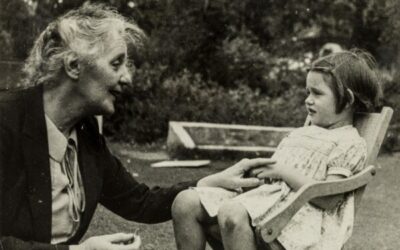
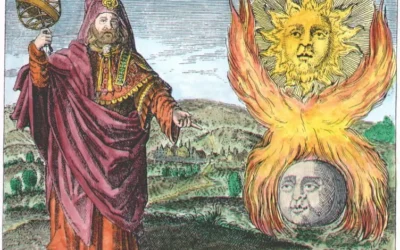
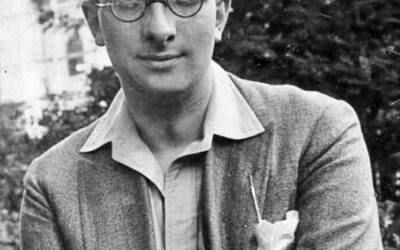












0 Comments