
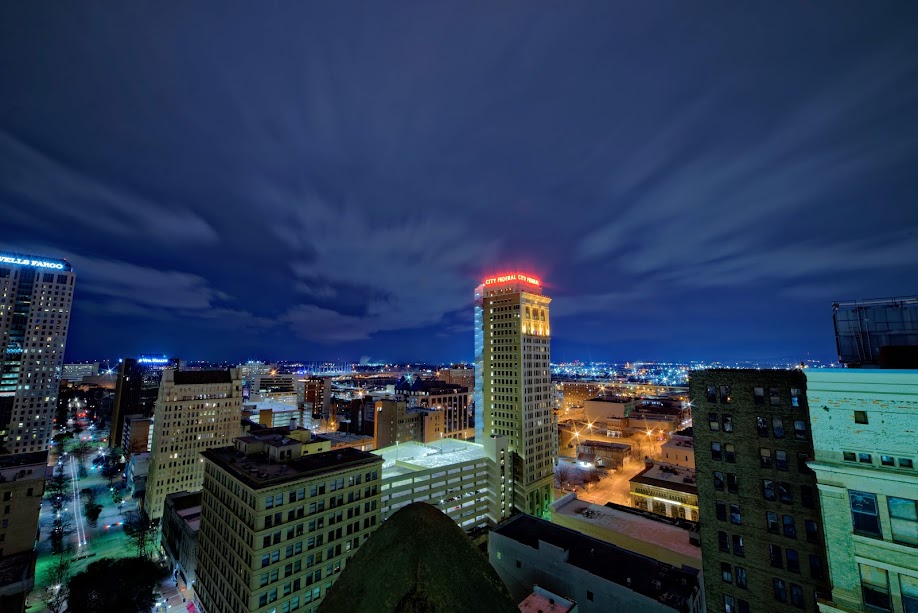
The Geology of the Grotesque
The folklore of Birmingham, Alabama, occupies a unique stratum within the broader canon of Southern Gothic narrative. Unlike the coastal haunts of Charleston or Savannah, which are steeped in the aristocratic decay of the antebellum rice and cotton economies, Birmingham’s spectral landscape is forged in iron, coal, and the violent, rapid urbanization of the post-Civil War “New South.” Founded in 1871—well after the surrender at Appomattox—Birmingham does not fit the traditional mold of the moonlight-and-magnolias ghost story. Instead, it offers an “Industrial Gothic” mythology: a gritty, soot-stained collection of legends where the restless spirits are not merely heartbroken belles, but maimed furnace workers, murdered civil rights martyrs, and the displaced dead of a city that expanded with reckless abandon.
To understand the hauntings of Birmingham, one must first understand its geology. The city sits at the unique geological convergence of limestone, coal, and iron ore—the three essential ingredients for steel production. This serendipitous geography transformed Jones Valley from a quiet cornfield into an industrial inferno practically overnight, earning it the moniker “The Magic City.” However, this magic exacted a heavy human toll. The rapid influx of labor, the brutal conditions of the convict-lease system, and the socioeconomic stratifications of the Jim Crow era created a bedrock of trauma that continues to resonate in the region’s oral history.
This report presents a comprehensive, fifty-stop tour of the Greater Birmingham area, analyzing the city’s folklore through the lens of cultural history. By examining these fifty locations—ranging from the subterranean depths of iron mines to the manicured lawns of elite suburbs—we can trace the evolution of the city’s psyche. These stories serve as cultural repositories for the region’s anxieties regarding labor exploitation, racial violence, and the disruption of the sacred. The ghosts of Birmingham do not merely haunt houses; they haunt the machinery of the city itself.
Part I: The Iron Heart – Industrial Gothic in the City Center
The industrial core of Birmingham serves as the epicenter of its most violent and enduring legends. Here, the “Southern Gothic” transitions into a narrative of mechanical brutality, where the grotesque is defined by the mangling of the human body by industrial machinery.
1. Sloss Furnaces National Historic Landmark
Location: 20 32nd St N, Birmingham
Sloss Furnaces stands as the cathedral of Birmingham’s Industrial Gothic lore. Producing pig iron from 1882 until 1971, the site was notorious for the grueling, often fatal conditions faced by its predominantly African American workforce. The complex, a tangle of rusting pipes and towering smokestacks, is widely cited as one of the most haunted industrial sites in the United States, a reputation cemented by two distinct but converging narratives: the legend of Slag Wormwood and the history of Theophilus Jowers.
The legend of James “Slag” Wormwood is the most pervasive piece of folklore attached to the site. According to oral tradition, Wormwood was a tyrannical foreman who oversaw the graveyard shift in the early 1900s. Lore dictates that he forced workers to take exorbitant risks to speed up production, resulting in forty-seven deaths during his tenure and countless injuries, including workers blinded by explosions. The legend culminates in October 1906, when Wormwood supposedly lost his footing at the top of “Big Alice”—the largest blast furnace—and plummeted into the molten iron below. It is widely whispered that he did not slip, but was pushed by his own crew, a collective act of retribution for his cruelty. Paranormal claims at the site are often violent; visitors report being shoved by unseen hands, hearing voices commanding them to “get back to work,” and encountering the apparition of a badly burned man in the tunnels.
However, the “Slag” legend is likely a folkloric amalgamation of various cruel foremen and the general harshness of the era. The historical reality is perhaps more disturbing. Theophilus Calvin Jowers, an assistant foundryman at the nearby Alice Furnace (whose machinery and legends were often conflated with Sloss after Alice was dismantled), died in a horrific accident in 1887. While attempting to dislodge a bell at the top of the furnace, Jowers fell into the molten iron. His body was instantly incinerated; the only remains recovered were his head, bowels, and hip bones, which were fished out of the iron ladle. The transference of Jowers’ spirit to the Sloss site represents the migratory nature of industrial ghosts in Birmingham—as furnaces closed, the stories of their dead did not vanish but relocated to the surviving structures, consolidating the trauma of the entire district into one location.
2. Red Mountain Park (Mine No. 13)
Location: 2011 Frankfurt Dr, Birmingham
Red Mountain Park encompasses the land formerly mined by U.S. Steel to feed furnaces like Sloss. The park’s trails lead past the sealed entrances of iron ore mines, including the notorious Mine No. 13. The haunting here is auditory and atmospheric. Hikers and urban explorers report the distinct sound of pickaxes striking rock emanating from behind the concrete seals of the mine entrances, as well as inexplicable cold spots near the ventilation shafts.
The “creepy vibe” reported by visitors is underscored by the discovery of artifacts like hundreds of decaying leather shoes inside abandoned mining structures—literal remnants of the workers who toiled underground. The folklore here functions as a memorial to the thousands of miners who died in rock falls and explosions, many of whom were part of the convict-lease system, a form of neo-slavery that persisted in Alabama well into the 20th century. The mountain is essentially a necropolis, and the “ghosts” are the sonic echoes of labor that built the city’s wealth.
3. Ruffner Mountain Nature Preserve
Location: 1214 81st St S, Birmingham
Similar to Red Mountain, Ruffner Mountain is honeycombed with abandoned mining infrastructure from the Sloss-Sheffield Steel and Iron Company. The preserve is home to the ruins of massive rock crushers and mine entrances that have been reclaimed by the forest. The “Crusher Ridge” trail passes directly by skeletal ironworks and limestone quarries, where hikers frequently report the sensation of being watched from the tree line.
The specific lore of Ruffner involves “ghost miners” seen wandering the trails at twilight, their headlamps flickering in the distance before vanishing. This location perfectly embodies the Southern Gothic trope of nature reclaiming the artifacts of man; the vines choking the iron crushers symbolize the inevitable collapse of industrial ambition and the persistence of the land’s memory.
4. The Ramsay-McCormack Building Site
Location: Ensley, Birmingham
The Ramsay-McCormack building, an Art Deco skyscraper completed in 1929, stood for decades as a hollow shell in the center of Ensley, a neighborhood that suffered catastrophic economic decline following the collapse of the steel industry. Although demolished in 2020/2021, the site remains a focal point for local lore regarding “abandoned atmospheres”.
For forty years, the building was a “ghost skyscraper,” with a tree famously growing from its roof. Locals reported lights flickering in the windowless upper floors and the sensation of the building “watching” the decaying neighborhood. The haunting here was architectural; the building itself was a specter of Ensley’s former prosperity, a constant reminder of economic death. Its demolition has not erased the stories; rather, it has transformed the site into a “phantom limb” of the community, where the absence of the tower is felt as keenly as its presence.
5. The Terminal Station Site
Location: 26th Street North (Red Mountain Expressway Interchange)
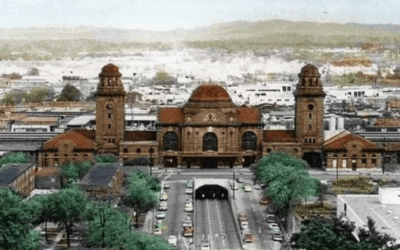
The 1969 demolition of the Great Temple of Travel, the Birmingham Terminal Station, is widely considered the city’s greatest architectural tragedy. This Byzantine-inspired masterpiece was razed during a period of aggressive urban renewal, leaving a psychological scar on the city’s preservationist movement.
While no physical structure remains, the site is the subject of a specific type of residual haunting. Folklore suggests that on quiet nights, the phantom sounds of steam engines, the screech of brakes, and the bustle of a non-existent crowd can be heard near the underpass where the station once stood. This auditory phenomenon represents the collective guilt of the city for destroying its own heritage, a “ghost” created by the trauma of modernization.
6. The “Ghost” of the Republic Steel Mill
Location: Near the Alabama/Jefferson County border
Though less accessible than Sloss, the ruins of the Republic Steel operations contribute to the industrial haunted landscape. Legends tell of a “headless switchman” on the rail lines that serviced these mills, a worker decapitated by a coupling accident who swings a lantern to warn oncoming trains. This archetype—the spectral railroad worker—is common in Southern folklore but takes on a specific grit in Birmingham, linked directly to the volume of rail traffic required to move iron ore.
Part II: Specters of the Magic City – Downtown Hotels and Theaters
As Birmingham revitalizes its downtown, renovating historic structures into luxury accommodations and entertainment venues, it has reawakened interest in the “high society” ghosts of the Jazz Age. These locations blend the glamour of the roaring twenties with the tragic ends of famous figures.
7. The Redmont Hotel
Location: 2101 5th Ave N, Birmingham
The Redmont, Birmingham’s oldest operating hotel (opened in 1925), is intimately tied to the death of country music legend Hank Williams. Williams spent his last night alive in the Redmont (or the Tutwiler, depending on the specific oral tradition, though the Redmont is the widely accepted location of his final stay before dying in his car en route to West Virginia).
Guests staying in the suite associated with Williams (often cited as Room 906 or the penthouse) report hearing phantom guitar strumming and smelling whiskey and cigarette smoke. Beyond the celebrity haunting, the hotel is home to Clifford Stiles, a former owner who lived in the penthouse. Stiles is said to haunt the upper floors, moving furniture and slamming doors to assert his continued ownership. Additionally, a spectral small dog is frequently sighted trotting through the hallways, believed to be Stiles’ pet, adding a domestic, albeit eerie, touch to the hotel’s lore.
8. The Tutwiler Hotel
Location: 2021 Park Pl, Birmingham
The current Tutwiler Hotel, located in the historic Ridgely Apartments building, inherited the name and, apparently, the ghosts of the original demolished Tutwiler. The primary entity is known as “The Knocker,” a spirit active on the sixth floor, specifically targeting Room 604. “The Knocker” bangs rapidly on guest doors in the middle of the night; when guests open the door to confront the prankster, the hallway is empty.
Another resident spirit is Colonel Edward Tutwiler himself. Legend posits that the Colonel causes mischief in the kitchen and restaurant area if the space is left messy. Staff reportedly bid him “Goodnight, Colonel” at the end of shifts to prevent disturbances, a ritual that speaks to the persistence of social hierarchies even in death.
9. The Alabama Theatre
Location: 1817 3rd Ave N, Birmingham
Built in 1927, the Alabama Theatre is a Showplace of the South and a centerpiece of the theater district. It is also a hotspot for paranormal activity, centering on the figure of Stanleigh Malotte, the house organist from 1936 to 1955.
Malotte is often seen or heard near the Mighty Wurlitzer organ. In a famous 1986 incident, longtime organist Cecil Whitmire and a singer saw a solid apparition walk across the stage during a rehearsal, which they identified as Malotte inspecting the performance. Other phenomena include doors opening, windows slamming, and curtains moving without drafts. The haunting here is protective; Malotte acts as a guardian of the theatre’s legacy.
10. The Lyric Theatre
Location: 1800 3rd Ave N, Birmingham
Across the street from the Alabama, the Lyric (1914) was a Vaudeville house that fell into disrepair before a recent glorious renovation. A former staff member is said to haunt the theatre, often moving brooms and cleaning equipment. The lore suggests the spirit wants to ensure the theatre remains tidy. During its years of abandonment, construction workers reported hearing the sounds of a full audience—clapping and laughter—in the empty auditorium, a residual playback of the thousands of shows performed there.
11. The Pickwick Hotel (Hotel Indigo)
Location: 1023 20th St S, Birmingham (Five Points South)
This Art Deco building in the Five Points South district has a dual history as a medical building and a hotel, creating a layered haunting. The most prominent spirit is “The Nurse,” a residual haunting from the building’s time as a medical facility, frequently seen making rounds on the upper floors.
More disturbingly, the hotel’s basement gym was allegedly the site of the building’s morgue. Guests report sudden freezing temperatures and the overwhelming scent of funeral flowers while working out. A child spirit is also heard bouncing a ball and playing jacks in the lobby area, perhaps a child who died in the medical facility.
12. The Linn-Henley Research Library
Location: 2100 Park Pl, Birmingham
This beautiful 1927 building connects to the main public library and houses the city’s archives. It is the domain of Fant Thornley, a former library director who died of a heart attack in 1970. Staff and visitors often smell his distinctive Chesterfield cigarettes in the non-smoking building and see an apparition resembling him in the archives.
Folklore adds a layer of sexual politics to the haunting: Thornley is said to be particularly active when attractive young men are present, reflecting rumors about his personal life during his tenure and adding a queer subtext to the building’s ghost lore.
13. St. Paul’s Cathedral
Location: 2120 3rd Ave N, Birmingham
This location is the site of one of Birmingham’s most notorious sectarian murders. On August 11, 1921, Father James E. Coyle was shot and killed on the rectory porch by Rev. E.R. Stephenson, a Methodist minister and KKK member. Stephenson was enraged that Coyle had married his daughter to a Puerto Rican man, an act that violated the Klan’s racial and religious codes.
While less “ghostly” in the sense of apparitions, the site is a pilgrimage point for those interested in the city’s dark history of violence. Reports suggest feelings of immense sadness and cold spots on the rectory porch where Coyle fell, marking the spot where religious bigotry turned lethal.
14. Cobb Lane
Location: Cobb Ln, Birmingham (Five Points South)
This historic cobblestone alleyway, once the site of speakeasies and carriage houses, preserves a gas-lit, 19th-century atmosphere that feels unstuck in time. Locals report the sound of a woman weeping near the alley entrance and the clattering of phantom carriage wheels on the cobblestones. It is a favorite stop for local ghost walks due to its atmospheric preservation and the lingering energy of the Prohibition era.
15. The Virginia Samford Theatre
Location: 1116 26th St S, Birmingham
Originally a Works Progress Administration (WPA) project, this theatre is rumored to be haunted by a “gentleman” spirit who inhabits the upper balcony. Actors and stagehands report equipment being moved and the sensation of being observed from the empty balcony during late-night rehearsals. The spirit is generally considered benign, a patron of the arts who refuses to leave his favorite seat.
16. The Carver Theatre
Location: 1631 4th Ave N, Birmingham
Located in the historic Fourth Avenue District (the Black business district during segregation), the Carver is a hub for African American history. Renovated in the 1980s, the theatre is said to host spirits from its heyday as a cinema and jazz venue. Unlike the “tragic” ghosts of Sloss, these spirits are often described as residual energy—phantom music and laughter that celebrate the cultural vibrancy of the district despite the oppression of the era.
17. The Empire Building (Elyton Hotel)
Location: 1928 1st Ave N, Birmingham
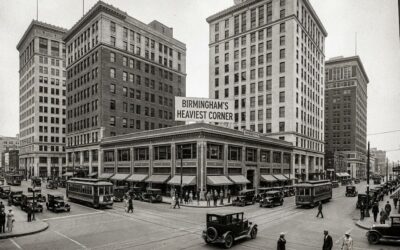
One of the “Heaviest Corner on Earth” buildings, the Empire Building features terra cotta busts of the architects who built it. Legends persist that the spirits of these architects watch over the city from the cornice. During its conversion into the Elyton Hotel, workers reported strange noises and tool displacements, common tropes in renovation hauntings where the disturbance of the structure “wakes” the history.
18. The Jemison-Van de Graaff Mansion
Location: (Tuscaloosa/Regional context for Birmingham tours)
While located in Tuscaloosa, this mansion is frequently included in Birmingham-area regional folklore tours due to its architectural significance and the high volume of reports. It serves as a comparative site for the “Old South” haunting style versus Birmingham’s industrial style.
Part III: The Sacred and the Profane – Cemeteries and Churches
Birmingham’s cemeteries are segregated not just by race and class, but by the nature of their ghosts. The folklore here deals with displacement, lost graves, and the unrest of those buried in the “wrong” soil.
19. Oak Hill Cemetery
Location: 1120 19th St N, Birmingham
As the city’s oldest cemetery, Oak Hill is the resting place of Birmingham’s founders and its outcasts. It is the setting for the legend of Louise Wooster, a famous madam who cared for the sick during the 1873 cholera epidemic when many wealthy citizens fled. Her grave is a focal point of local reverence, and she is said to appear as a comforting figure.
The cemetery also houses the Erswell Vault. Edward Erswell, an undertaker, is buried here. Legend says his wife, Catherine, bickers with him from beyond the grave because she wanted to be buried in the more fashionable Elmwood Cemetery. Visitors report hearing murmuring voices from the vault. Furthermore, the victims of the infamous Hawes Murders (Emma, May, and Irene) are buried here in unmarked graves, their restless spirits tied to the violence of their deaths.
20. Elmwood Cemetery
Location: 600 Martin Luther King Jr Dr, Birmingham
Elmwood is the massive, rolling cemetery where the city’s elite (and Paul “Bear” Bryant) are buried. Due to its immense size, Elmwood has numerous “urban legend” style hauntings, including statues that weep and shadow figures seen darting between the mausoleums at dusk. It represents the “proper” society death, contrasting with Oak Hill’s pioneer grit.
21. Bass Cemetery
Location: Ruffner Rd, Irondale
Hidden in the woods of Irondale, this cemetery dates back to the early 19th century and is reputed to be a hotspot for occult rituals. Visitors report screaming banshees, floating orbs, and the feeling of being touched. It contains the graves of Revolutionary and Civil War soldiers, adding a layer of military haunting lore to the occult panic narratives.
22. The “Pauper’s Cemetery” at Legion Field
Location: 400 Graymont Ave W, Birmingham
Historical logs indicate that the west parking lot of Legion Field (and parts of the Birmingham Zoo/Botanical Gardens) was built over a pioneer/pauper cemetery containing over 300 graves. The asphalt sealing these forgotten dead creates a narrative of the “restless earth,” with reports of uneven ground and strange cold spots in the heat of summer. It is a potent symbol of how the city’s entertainment infrastructure literally paved over the poor.
23. 16th Street Baptist Church
Location: 1530 6th Ave N, Birmingham
The tragic 1963 bombing that killed four young girls—Addie Mae Collins, Cynthia Wesley, Carole Robertson, and Carol Denise McNair—is the defining wound of the city. While respectful tours focus on history, sensitive visitors and staff have reported an overwhelming sense of presence in the basement ladies’ lounge area where the bomb detonated. The clock frozen at 10:22 AM serves as a macabre memento mori, and the site functions as a “thick place” where the barrier between the past and present is porous.
24. Bethel Baptist Church
Location: 3233 29th Ave N, Birmingham
Bombed three times during the Civil Rights era, Bethel Baptist stands as a fortress of resistance. The “Ghost Frame” of the parsonage stands as a monument to the violence. Legend suggests that Reverend Fred Shuttlesworth, who miraculously survived the bombings unscathed (once being blown out of his bed), was protected by divine or ancestral spirits. The site holds a heavy, electrically charged atmosphere, celebrated not for ghosts of terror, but for a “Holy Ghost” protection.
25. Forest Hill Cemetery
Location: 431 60th St N, Birmingham
Located near the airport, this cemetery is known for its sloping hills and old monuments. It is the final resting place of many industrial titans, but also holds a reputation for “creepy” atmospheres due to its proximity to the declining industrial zones of North Birmingham. Videos of explorations here often highlight the contrast between the grand monuments and the surrounding decay.
26. Village Falls Cemetery
Location: Mulga
Located near Bayview Lake, this cemetery is rumored to have graves that were disturbed or flooded during the creation of the reservoir. It links to the Bayview Bridge lore, suggesting that the “bride” of the bridge legend may be buried here, or that her grave was lost to the waters, causing her restless wandering.
27. Pratt City Cemeteries (Hidden)
Location: Pratt City (Wooded areas)
Local genealogists speak of over 100 forgotten African American cemeteries in Jefferson County, with a concentration in the wooded areas of Pratt City. These sites, containing potentially 4,000 graves, are the source of “bad vibes” and feelings of being watched reported by hikers and developers. They represent the ultimate erasure of Black history in the industrial period.
Part IV: The Suburban Gothic – Over the Mountain & Wealth
The “Over the Mountain” suburbs represent white flight and accumulated wealth. The folklore here shifts from industrial accidents to eccentricity, murder, and high-society tragedy.
28. The Temple of Sibyl (Vestavia Hills)
Location: US Hwy 31, Vestavia Hills
Originally the garden folly of eccentric mayor George Ward’s estate (Vestavia), this Roman-style temple was moved to its current perch overlooking the highway. Ward dressed his servants as Romans and held pagan-style parties. The haunting legend claims the temple is a suicide spot where a woman (sometimes identified as a lover of Ward or a later resident) jumped to her death. Drivers on Hwy 31 report seeing a figure standing at the edge of the temple looking down, a “Prom queen” ghost frozen in time.
29. Shades Mountain (The Willie Peterson Location)
Location: Shades Mountain/Vestavia Area
In 1931, three white women were attacked on Shades Mountain (Augusta Williams was killed). Willie Peterson, a Black man, was falsely accused and victimized by a “legal lynching” atmosphere. The area is cited in Southern Gothic literature (“Murder on Shades Mountain”) as a place where the racial trauma of the Jim Crow era lingers in the landscape. It is a “psychogeographical” haunt rather than a traditional ghost story, representing the terror of the manhunt that scoured these woods.
30. The Club
Location: 1 Robert S Smith Dr, Birmingham
Sitting atop Red Mountain, The Club offers a view of the city but hides secrets beneath. Legends state that the property sits over abandoned mine shafts (specifically the “Product” mines). Staff have reported elevators moving on their own and the spirits of former high-society patrons who refuse to leave the party. There are also rumors of a “resident drug dealer” ghost from the disco era.
31. Homewood Public Library
Location: 1721 Oxmoor Rd, Homewood
The library was formerly the site of a church, and paranormal investigators claim up to nine distinct spirits reside here. Phenomena include books flying off shelves, the sound of a woman screaming, and a “mock sermon” heard in the empty auditorium. One spirit is said to be a former librarian who takes her job too seriously, organizing books after hours.
32. Rhodes Park
Location: Highland Ave, Birmingham
Located in the historic Highland Park neighborhood, this park is surrounded by Victorian mansions. Locals report seeing apparitions in period clothing strolling the park at night, residuals of the neighborhood’s early 20th-century elite. The park serves as a stage for the “memory” of the city’s gilded age.
33. The Jordan Home (Dr. Mortimer Jordan)
Location: 2834 Highland Ave, Birmingham
Owned by Dr. Mortimer Jordan III, a WWI hero who died in France, this home is said to be haunted by his spirit. The lore suggests he returned to his beloved home in spirit after dying in a French hospital. It is a classic “soldier returning home” narrative adapted to the local aristocracy.
34. Forest Park Neighborhood
Location: Forest Park, Birmingham
Known for its elaborate Halloween decorations, Forest Park also harbors genuine lore. A “Top Hat Man” is reported in the carriage houses along the historic streets, a shadow figure that watches residents from corners. The neighborhood’s winding roads and deep tree cover create an atmosphere conducive to sightings of shadow people.
35. Samford University
Location: 800 Lakeshore Dr, Homewood
The university moved to this location in the 1950s, but brought its ghosts with it—or created new ones. The theatre department commissioned an opera called “The Ghosts of Gatsby” regarding Zelda Fitzgerald (who lived in Montgomery but has Alabama ties). More traditionally, legends of Civil War hospital spirits persist, transferred from the school’s previous location which was used as a hospital, manifesting now in the modern dorms as cold spots and moving objects.
36. Birmingham-Southern College
Location: 900 Arkadelphia Rd, Birmingham
The theater on campus is haunted by a ghost named “Charlie,” a friendly but mischievous spirit blamed for missing props and lighting glitches. Dormitory hauntings are also common, with students reporting footsteps in empty hallways, a staple of collegiate folklore.
37. Arlington Antebellum Home & Gardens
Location: 331 Cotton Ave SW, Birmingham
As the only surviving antebellum home in Birmingham (the city was founded post-war, but this house predates it), Arlington is a magnet for “Old South” ghosts. The ghost of a young woman named Mary is seen peering from the upper windows. Additionally, the presence of Union General Wilson, who used the house as headquarters while planning the burning of the University of Alabama, is said to linger, creating a tension in the atmosphere.
Part V: The Rust Belt & The Fringe – Bessemer, Mulga, and Industrial Decay
To the west lies the “Rust Belt” of the district, where the collapse of industry has left behind physical and spiritual ruins.
38. Memorial Mound
Location: Bessemer (off I-20/59)
A quintessential Southern Gothic nightmare. Built in 1992 by Clyde Booth, this “underground” mausoleum failed financially. When Booth died in 2009, the facility was abandoned with bodies still inside in varying states of decomposition. Urban explorers discovered caskets and remains left to rot in a scene of grotesque neglect. Though cleared in 2015, the site remains a scar on the community psyche, smelling of death and dread. It is the ultimate symbol of the “forgotten dead”.
39. Bessemer Hall of History (The Depot)
Location: 1905 Alabama Ave, Bessemer
For years, the museum displayed “Hazel,” a mummified body of a woman said to be an outlaw who died in the early 1900s. Though Hazel was eventually cremated, staff report that her energy remains. The building, an old depot, also experiences poltergeist activity attributed to a train agent who died there, with typewriters typing on their own.
40. The Bright Star Restaurant
Location: 304 19th St N, Bessemer
Alabama’s oldest family-owned restaurant (1907) is haunted by the protective ancestors of the Koikos family. Staff report seeing the apparitions of the founders watching over the dining room, ensuring service standards are met. It is a “benevolent” haunting, representing the continuity of immigrant success in the industrial city.
41. Bayview Bridge
Location: Mulga Loop Road, Mulga
A classic “woman in white” legend. A bride, fleeing her wedding or murdered on her wedding night, is said to run across the bridge. Witnesses claim to see a white figure dart in front of cars, and some report handprints appearing on foggy windows. The legend persisted even after the original bridge was replaced.
42. Tannehill Ironworks Historical State Park
Location: 12632 Confederate Pkwy, McCalla
This park contains the ruins of Civil War-era furnaces. The Slave Cemetery is a site of intense heaviness, where hikers report hearing spirituals hummed in the woods. A ghost named “Sadie” is said to preach to the spirits of the workers. The massive stone furnaces themselves are hotspots for cold spots and apparitions of laborers.
43. Cry Baby Bridge (Cahaba Beach Road)
Location: Off Highway 280 near Inverness (Old Cahaba Beach Road iron bridge)
A mother, unable to care for her child, threw the baby into the Cahaba River and jumped in after. Locals claim that if you park on the bridge, you can hear a baby crying. Some report finding baby powder handprints on their cars. This is the Birmingham iteration of a common urban legend, anchored to the treacherous geography of the Cahaba River.
44. The Cahaba River National Wildlife Refuge
Location: Bibb County/Jefferson Border
The river is known for the rare Cahaba Lilies. Folklore suggests the lilies bloom where Native American women drowned themselves to avoid capture. Mysterious lights (Will-o’-the-wisps) are seen along the riverbanks, attributed to the spirits of the indigenous peoples displaced by settlers.
45. Rickwood Field
Location: 1137 2nd Ave W, Birmingham
The oldest ballpark in America is a time capsule. Players and visitors claim to hear the crack of a bat and cheering when the field is empty. The ghost of a catcher is sometimes seen behind the plate, and the spirit of a groundskeeper is said to still tend the diamond. It represents the “Field of Dreams” aspect of Birmingham folklore.
46. Miles College
Location: 5500 Myron Massey Blvd, Fairfield
As a Historic Black College (HBCU) in the industrial suburb of Fairfield, Miles College has its own oral traditions. Legends often center on the struggle for civil rights and the spirits of educators who dedicated their lives to the institution. The campus is a repository of memory for the Black middle class of the steel era.
47. Garage Cafe
Location: 2304 10th Terrace S, Birmingham
An antique-cluttered courtyard in Southside, this venue is visually Southern Gothic, filled with stone statuary and overgrown vines. Patrons report seeing shadow figures moving among the statues, blending in with the stone artifacts. It is a place where the distinction between the animate and inanimate blurs.
48. OvenBird / Pepper Place
Location: 2810 3rd Ave S, Birmingham
Located in the Dr. Pepper syrup plant complex, this area represents the gentrification of industrial spaces. The restaurant OvenBird, with its live fire cooking, evokes the city’s relationship with fire and ash. While newer in terms of ghost lore, the reuse of industrial spaces often leads to reports of “residual” activity—sounds of machinery and workers from the past.
49. Billy Goat Hill
Location: Outlying Birmingham/Rugged terrain
A rugged terrain area with legends of hidden Confederate gold and hermits. The name itself evokes a rural, trickster folklore. Stories persist of a “goat man” or hermit who guards the area, a common trope in Appalachian-adjacent folklore that filtered down to Birmingham.
50. Lakeview Park (Highland Park Golf Course)
Location: 3300 Highland Ave, Birmingham
This is the site where Emma and Irene Hawes’ bodies were found in the lake (now drained to form the golf course). Golfers report unexplained mists on the fairways and the feeling of walking over a grave. It completes the “Hawes Loop” of hauntings in the city, connecting the courthouse, the jail, Oak Hill, and this final resting place of the victims.
Conclusion: The Sociology of the Scare
The density of ghost stories in Birmingham is not merely a product of superstition but a sociological mechanism for processing rapid, traumatic change. The legends of the Erswell Vault and the Temple of Sibyl deal with the anxiety of displacement—of being in the “wrong place,” just as the city itself displaced the natural landscape. The industrial haunts of Sloss and Tannehill serve as memorials for the nameless workers who died building the city, forcing the modern observer to acknowledge the human cost of iron and steel. Finally, the hauntings of 16th Street Baptist and the Hawes Murders preserve the memory of violence that official histories often sanitized prior to the Civil Rights reckoning. Birmingham’s ghosts are the keepers of its uncomfortable truths, ensuring that the Magic City never forgets the darkness that fuels its light.






0 Comments