
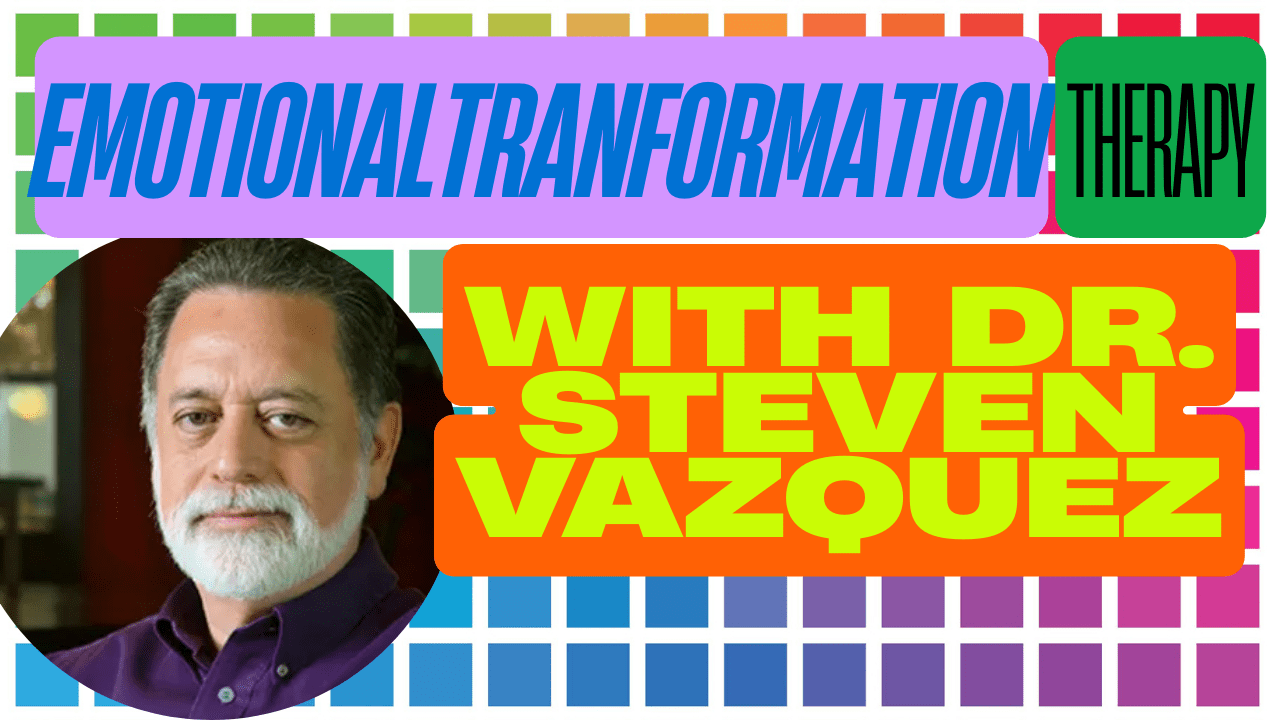
Emotional Transformation Therapy (ETT), developed by Dr. Steven Vazquez over more than 25 years of practice, uses light, color and eye movement to reach emotional patterns that talk therapy often struggles to touch. That sounds unusual until you look at how light actually travels through the brain. Some of the light that enters the eye never becomes a picture at all. It goes straight to the systems that run mood, alertness and the body’s threat response.
How light reaches emotion
In 2002, researchers discovered a third kind of light-sensing cell in the eye. These cells respond to light on their own and send signals directly to the brain’s master clock.1 Their pigment, melanopsin, is most sensitive to blue light.2 These cells carry feeling as well as brightness. When melanopsin alone is stimulated, people describe an unpleasant, blurry brightening with no image attached.3 In blind migraine patients who can still sense light through these cells, light makes the headache worse.4
Light also reaches the emotional brain fast. Electrodes in the human amygdala have recorded responses to fearful faces within about 74 milliseconds, before conscious recognition.5 And the color of light matters: blue rather than green light strengthened the brain’s response to emotional voices and the link between the amygdala and the hypothalamus.6 None of these studies tested ETT. They show that the channel ETT works through is real.
The four tools of ETT
Vazquez developed ETT by building and testing devices that change light direction, color, eye movement and flicker, and keeping what worked for his patients.78 His book on ETT’s applications describes four tools:9
- Eye movement: a distinctive pattern of guided eye movements.
- Peripheral light: goggles that let light into the edge of vision from different angles while the client rates their distress.
- Color: a chart of intense colors. Clients often notice a color fading, darkening or blurring while they talk about something painful, and clearing as it resolves.
- The light device: a tunable light that combines color, angle and flicker for complicated problems such as complex grief.
All four rest on an attuned, attachment-focused relationship between client and therapist.
The color model
In ETT, each color carries an emotional theme. Red holds passion and drive, yellow holds anger, hope and control, green holds love and sadness, blue holds communication, violet holds trust and doubt, and magenta brings safety. Each theme can show up shut down, activated, regulated or transcendent, so the same color can bring numbness in one person and agitation in another. The color series on this site walks through each one, starting with the psychology of color.
Who ETT helps
Clinicians use ETT with complex trauma, anxiety and panic, grief, and problems that feel too big or too wordless to talk through. Vazquez has also written about using it for sleep problems, chronic pain and addiction.9 Patients who have already done EMDR or Brainspotting often find that ETT can reach specific responses those methods left behind.
Research and safety
ETT has not yet been tested in randomized controlled trials. Its support comes from Vazquez’s books and case reports and from the clinical experience of the practitioners he has trained. A 2026 paper in the Journal of Psychological Experience lays out a theoretical framework for how ETT works through sensory salience regulation.10 The strongest related evidence that light can change mood comes from bright light therapy, which raises remission rates in depression.11
Flashing light can trigger seizures in people with photosensitive epilepsy, so clinicians screen for it before any flicker work.12
To learn what a session involves, see our Emotional Transformation Therapy page and how color and light can help heal trauma, or contact Taproot Therapy Collective in Hoover. Clinicians interested in training can find it at etttraining.com.
References
- Berson, D. M., Dunn, F. A., & Takao, M. (2002). Phototransduction by retinal ganglion cells that set the circadian clock. Science, 295(5557), 1070–1073. https://doi.org/10.1126/science.1067262
- Hattar, S., Liao, H.-W., Takao, M., Berson, D. M., & Yau, K.-W. (2002). Melanopsin-containing retinal ganglion cells: Architecture, projections, and intrinsic photosensitivity. Science, 295(5557), 1065–1070. https://doi.org/10.1126/science.1069609
- Spitschan, M., Bock, A. S., Ryan, J., Frazzetta, G., Brainard, D. H., & Aguirre, G. K. (2017). The human visual cortex response to melanopsin-directed stimulation is accompanied by a distinct perceptual experience. Proceedings of the National Academy of Sciences, 114(46), 12291–12296. https://doi.org/10.1073/pnas.1711522114
- Noseda, R., Kainz, V., Jakubowski, M., Gooley, J. J., Saper, C. B., Digre, K., & Burstein, R. (2010). A neural mechanism for exacerbation of headache by light. Nature Neuroscience, 13(2), 239–245. https://doi.org/10.1038/nn.2475
- Méndez-Bértolo, C., Moratti, S., Toledano, R., Lopez-Sosa, F., Martínez-Álvarez, R., Mah, Y. H., Vuilleumier, P., Gil-Nagel, A., & Strange, B. A. (2016). A fast pathway for fear in human amygdala. Nature Neuroscience, 19(8), 1041–1049. https://doi.org/10.1038/nn.4324
- Vandewalle, G., Schwartz, S., Grandjean, D., Wuillaume, C., Balteau, E., Degueldre, C., Schabus, M., Phillips, C., Luxen, A., Dijk, D.-J., & Maquet, P. (2010). Spectral quality of light modulates emotional brain responses in humans. Proceedings of the National Academy of Sciences, 107(45), 19549–19554. https://doi.org/10.1073/pnas.1010180107
- Vazquez, S. R. (2005). Peripheral light stimulation for rapid emotional, somatic and transpersonal regulation. Subtle Energies & Energy Medicine, 16(3), 225–249.
- Vazquez, S. R. (2012). Emotional transformation therapy: An interactive ecological psychotherapy. Jason Aronson. https://doi.org/10.5040/9798216510253
- Vazquez, S. R. (2012). Accelerated ecological psychotherapy: ETT applications for sleep disorders, pain, and addiction. Jason Aronson. https://doi.org/10.5040/9798216510048
- Bruno, J. (2026). Sensory-salience regulation in Emotional Transformation Therapy: A clinical-theoretical framework. Journal of Psychological Experience. https://doi.org/10.64484/jpsyexp-x4s8m0l2c8n1y8z0
- Menegaz de Almeida, A., Aquino de Moraes, F. C., Cavalcanti Souza, M. E., Cavalcanti Orestes Cardoso, J. H., Tamashiro, F., Miranda, C., Fernandes, L., Kreuz, M., & Alves Kelly, F. (2025). Bright light therapy for nonseasonal depressive disorders: A systematic review and meta-analysis. JAMA Psychiatry, 82(1), 38–46. https://doi.org/10.1001/jamapsychiatry.2024.2871
- Fisher, R. S., Acharya, J. N., Baumer, F. M., French, J. A., Parisi, P., Solodar, J. H., Szaflarski, J. P., Thio, L. L., Tolchin, B., Wilkins, A. J., & Kasteleijn-Nolst Trenité, D. (2022). Visually sensitive seizures: An updated review by the Epilepsy Foundation. Epilepsia, 63(4), 739–768. https://doi.org/10.1111/epi.17175











0 Comments