
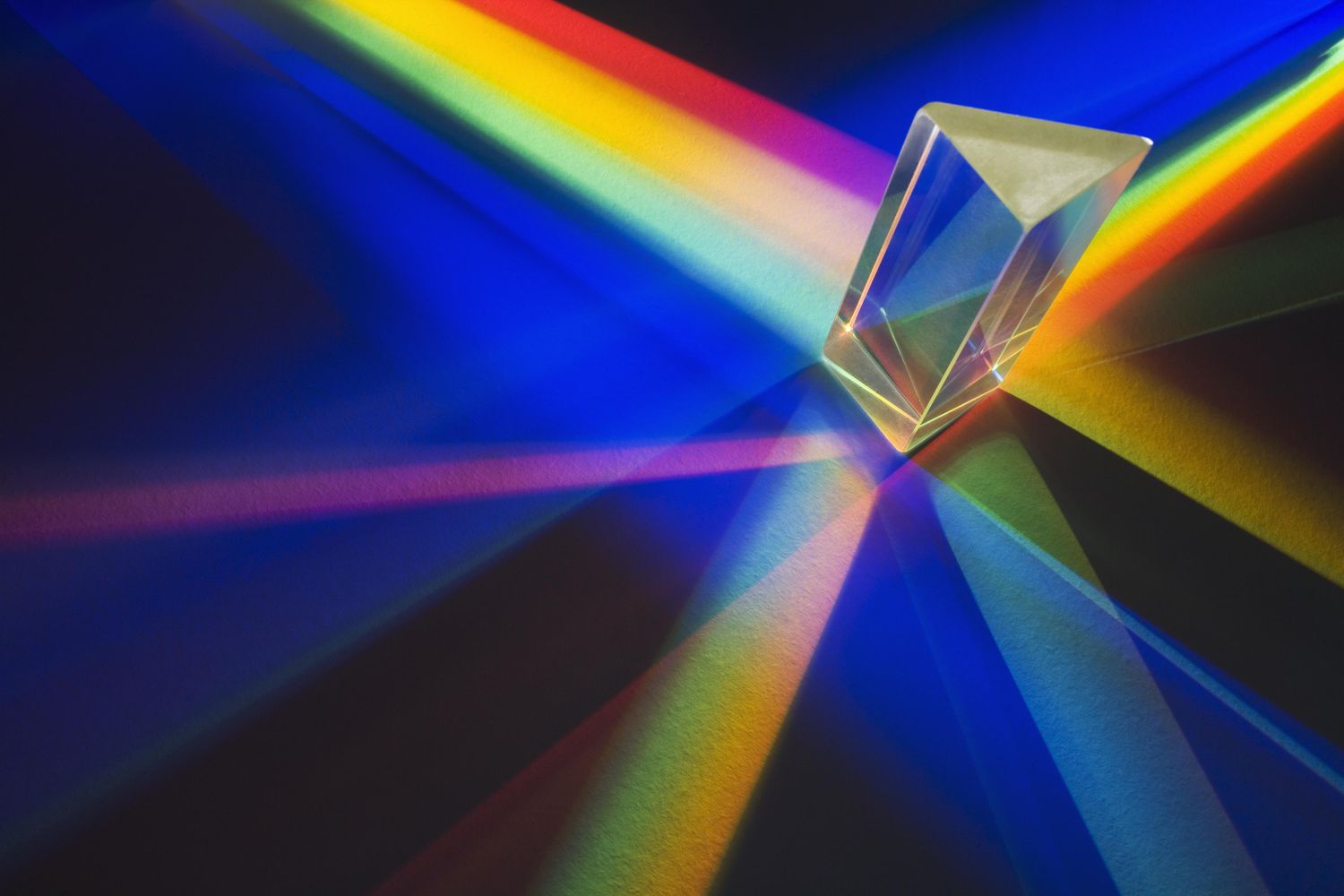
Color and light can help heal trauma because trauma is not stored mainly as a story. It lives in the body: a racing heart, a frozen chest, a flinch at a certain sound or color. Emotional Transformation Therapy (ETT), developed by Dr. Steven Vazquez, uses specific colors and angles of light while a therapist tracks how the body responds. That lets people work with fear, grief or shame they can feel but cannot easily put into words.
Why light can reach trauma
Some of the light that enters the eye never becomes a picture. Special cells in the retina send it straight to the brain systems that run the body clock, alertness and the threat response.1 Those are the same systems trauma keeps on high alert. ETT is built to work through that route.2 For the science in more detail, see the science of light and color in trauma therapy.
What an ETT session is like
A session starts like ordinary therapy, with a conversation about what you want to work on. When it is time for the visual work, you might:
- look at a chart of intense colors while you talk about a problem, and notice which colors seem to fade, darken or blur;
- wear goggles that let light in from the side, rating your distress as the angle changes;
- follow a wand through a particular pattern of eye movements;
- or sit with a light device set to a specific color.
Vazquez’s book on ETT’s applications describes these four tools in detail.3 Throughout, the therapist watches your breathing, posture and eyes, and checks in about what you feel and where. You stay awake and in control, and you can stop at any time. Many people describe feelings rising and passing quickly, sensations moving through the body, or memories surfacing and then losing their charge. A color that looked dim or strange at the start often looks clear by the end.
How the colors are used
In ETT, each color carries an emotional theme, and the therapist chooses colors to match what you are working on. Red relates to drive and the body, yellow to control and feeling trapped, green to love and grief, blue to communication, violet to trust and meaning, and magenta to safety. When a feeling is easier to locate than to name, the therapist can ask where you feel it and choose the color ETT links to that part of the body. Research supports the idea that emotions are felt in typical places in the body, shared across cultures.4
Who it helps
ETT is most often used with people who feel stuck in responses that talk therapy has not changed. That includes complex trauma, anxiety and panic held in the body, grief full of contradictory feelings, and problems so big they are hard to even begin describing. People who have already done EMDR or Brainspotting often find that ETT reaches responses those methods left behind. Vazquez has also written about using ETT for sleep, pain and addiction, and about healing spiritual and religious wounds.35
Evidence and safety
ETT has not yet been tested in randomized controlled trials. Its support comes from the clinical experience of trained practitioners and their patients, from Vazquez’s books and case reports, and from a 2026 theoretical framework paper in the Journal of Psychological Experience.6 We use it inside trauma therapy, alongside talk therapy and Brainspotting. If you have epilepsy or have ever had a seizure with flashing lights, tell your therapist first, because flickering light can trigger seizures in people who are photosensitive.7
To find out whether ETT fits what you are carrying, read about Emotional Transformation Therapy at Taproot or contact us in Hoover.
References
- Hattar, S., Liao, H.-W., Takao, M., Berson, D. M., & Yau, K.-W. (2002). Melanopsin-containing retinal ganglion cells: Architecture, projections, and intrinsic photosensitivity. Science, 295(5557), 1065–1070. https://doi.org/10.1126/science.1069609
- Vazquez, S. R. (2012). Emotional transformation therapy: An interactive ecological psychotherapy. Jason Aronson. https://doi.org/10.5040/9798216510253
- Vazquez, S. R. (2012). Accelerated ecological psychotherapy: ETT applications for sleep disorders, pain, and addiction. Jason Aronson. https://doi.org/10.5040/9798216510048
- Nummenmaa, L., Glerean, E., Hari, R., & Hietanen, J. K. (2014). Bodily maps of emotions. Proceedings of the National Academy of Sciences, 111(2), 646–651. https://doi.org/10.1073/pnas.1321664111
- Vazquez, S. R. (2017). Spiritually transformative psychotherapy: Repairing spiritual damage and facilitating extreme wellbeing. Rowman & Littlefield.
- Bruno, J. (2026). Sensory-salience regulation in Emotional Transformation Therapy: A clinical-theoretical framework. Journal of Psychological Experience. https://doi.org/10.64484/jpsyexp-x4s8m0l2c8n1y8z0
- Fisher, R. S., Acharya, J. N., Baumer, F. M., French, J. A., Parisi, P., Solodar, J. H., Szaflarski, J. P., Thio, L. L., Tolchin, B., Wilkins, A. J., & Kasteleijn-Nolst Trenité, D. (2022). Visually sensitive seizures: An updated review by the Epilepsy Foundation. Epilepsia, 63(4), 739–768. https://doi.org/10.1111/epi.17175







0 Comments