
The child who changed overnight
Most childhood anxiety and OCD builds slowly. PANDAS and PANS look different. A parent describes a seven-year-old who went to bed fine and woke up terrified of contamination, refusing food, wetting the bed again, raging, unable to write her own name. Sometimes there was a strep throat two weeks earlier. Sometimes nobody remembers an illness at all.
If you are a parent living this, or a therapist who has had a family like this walk into your office, you have probably already gone down the internet rabbit hole and found qEEG brain mapping and neuromodulation among the things people are trying. This post is our attempt to sort out what those tools are, what the research does and does not support, and how they fit alongside standard treatment. We are a psychotherapy practice, not an immunology clinic, so consider this orientation rather than medical advice.
What PANDAS and PANS are
PANDAS (Pediatric Autoimmune Neuropsychiatric Disorders Associated with Streptococcal infections) was first described by Dr. Susan Swedo’s group at the NIMH in the late 1990s. PANS (Pediatric Acute-onset Neuropsychiatric Syndrome) is the broader category, defined by consensus criteria in 2012 and refined in 2015, that does not require a strep trigger.
The core picture is abrupt, dramatic onset of OCD or severely restricted eating, plus at least two of the following: anxiety (often separation anxiety), emotional lability or depression, irritability or aggression, behavioral or developmental regression, deterioration in school performance, sensory or motor abnormalities (tics, handwriting collapse), and sleep disturbance or urinary symptoms.
The leading hypothesis is that an infection triggers an immune response that cross-reacts with the basal ganglia, the deep brain structures involved in movement, habit, and threat detection. The result is inflammation in exactly the circuitry that generates OCD and tics. This model is still debated in pediatrics, but the treatment guidelines published by the PANS Research Consortium in 2017 give clinicians a framework built on three legs: treat the infection, treat the immune dysregulation (anti-inflammatories, steroids, and for severe cases IVIG or plasmapheresis), and treat the symptoms (cognitive behavioral therapy with exposure and response prevention, family support, and cautious medication).
Everything below sits on the third leg. Nothing here replaces the first two.
What a qEEG is, and what it isn’t
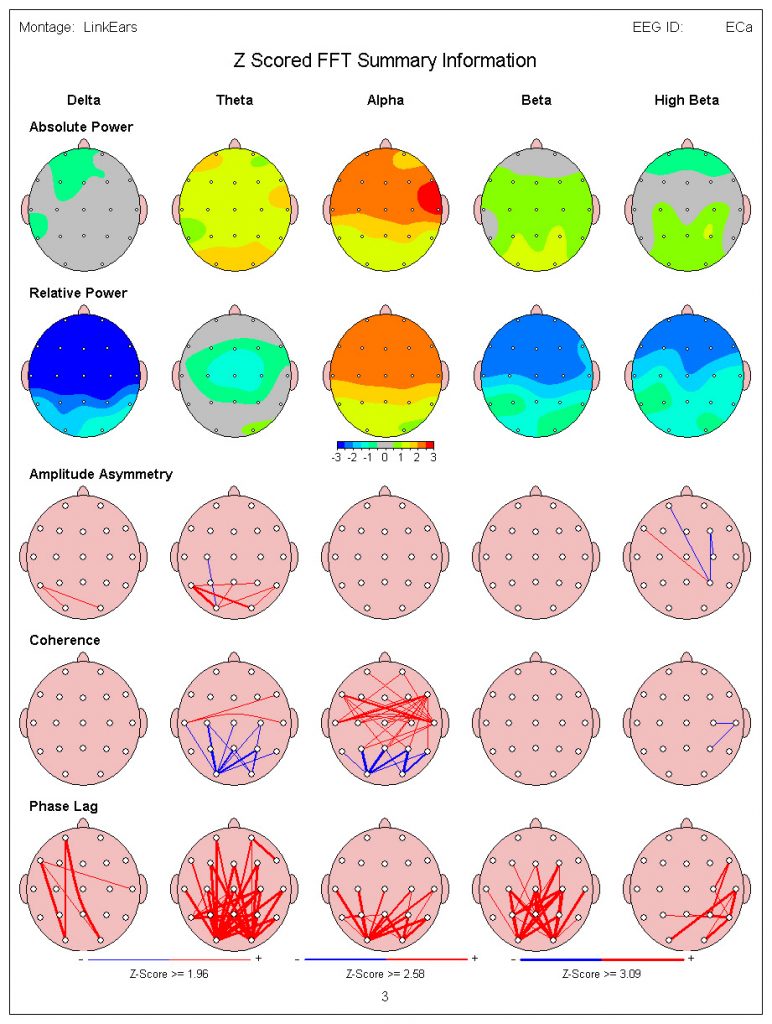
A quantitative EEG is a standard EEG recording, usually 19 electrodes, that is run through software to compare the child’s brainwave patterns against a normative database of same-age peers. The output is a set of color-coded brain maps showing where activity in each frequency band (delta, theta, alpha, beta) is higher or lower than expected, and how well different regions are communicating.
What it is not: a diagnostic test for PANDAS or PANS. There is no validated “PANDAS signature” on a qEEG. Diagnosis remains clinical, based on the criteria above and a medical workup. Any provider who tells a family that a brain map confirmed or ruled out PANDAS is overstating what the tool can do.
What the qEEG research shows
The evidence base here is small and mostly consists of case reports, small clinical series, and studies using conventional EEG rather than qEEG. A few consistent threads:
- Children in active flares often show excess slow-wave activity (theta and delta), frequently over frontal and central regions. This is a pattern seen in many encephalopathic and inflammatory states, which is why it is meaningful but not specific.
- A 2016 NIMH sleep study found REM sleep motor disinhibition and other sleep architecture abnormalities in PANDAS children, which fits both the basal ganglia model and the sleep complaints parents report.
- Some children with PANS have epileptiform activity or subclinical seizure-like discharges, which is one reason a conventional EEG is part of a thorough medical workup when there are concerning features.
The practical value of qEEG in this population is therefore less about diagnosis and more about three things: establishing a baseline, tracking whether the brain’s electrical picture is normalizing as immune treatment works, and guiding a neurofeedback protocol if the family pursues one.
Neuromodulation: the options and their evidence
“Neuromodulation” just means changing brain activity from the outside. Four approaches come up in PANDAS/PANS conversations, with very different levels of support.
Neurofeedback (EEG biofeedback). The child’s brainwaves are measured in real time and turned into a game, video, or sound that rewards the brain for shifting toward a target pattern, often less slow-wave activity and steadier regulation. It is non-invasive and low-risk. The evidence in PANDAS/PANS specifically is limited to case reports and clinical series describing improvements in sleep, emotional regulation, and residual anxiety. The broader neurofeedback literature in ADHD and anxiety is larger but still mixed on how much benefit comes from the training itself versus attention and expectancy. Honest summary: plausible, safe, and promising for the “after the flare” phase, but not proven.
Transcranial magnetic stimulation (TMS). Magnetic pulses stimulate targeted cortical regions. Deep TMS is FDA-cleared for OCD in adults, and adolescent research is growing, but there are no controlled trials in PANDAS/PANS. It requires a physician and is generally considered only for older, treatment-resistant cases.
Transcranial direct current stimulation (tDCS). Weak electrical current through scalp electrodes. Almost entirely experimental in children with OCD; nothing PANDAS-specific worth citing.
Vagus nerve stimulation (VNS), including non-invasive ear-clip versions. This is the most theoretically interesting because the vagus nerve regulates inflammation through what researchers call the cholinergic anti-inflammatory pathway. Early trials exist in rheumatoid arthritis and other autoimmune conditions. In PANS this is a hypothesis, not a treatment.
How to think about timing
A useful rule: during an active flare, the priority is medical. Inflammation drives the symptoms, and no amount of brain training will out-train an ongoing immune attack. Neurofeedback and other regulation-based work tend to be most helpful once the child is medically stabilized and the family is dealing with what is left behind: lingering anxiety, sleep disruption, a nervous system that learned to live on high alert, and a child who is frightened of their own brain.
For parents: questions to ask any provider offering qEEG or neuromodulation
- Are you coordinating with my child’s pediatrician or PANS specialist?
- What specifically are you measuring, and how will we know if it is helping?
- What does this cost, how many sessions, and what happens if we see no change by session ten?
- Are you presenting this as a supplement to medical and psychological treatment, or as a replacement? (The second answer is a red flag.)
For therapists: what to watch for and how to help
You may be the first professional to see a PANDAS/PANS child, because the presenting complaint is OCD or anxiety. Sudden onset, especially with regression, handwriting deterioration, food refusal, new urinary symptoms, or a recent illness, warrants a referral for a medical evaluation before or alongside therapy. Document the timeline carefully; parents’ recollections of when things started are clinically valuable.
Exposure and response prevention still works in this population, but pace it to the child’s medical status. During a flare, the child’s capacity may be a fraction of what it was a month ago, and pushing standard ERP intensity can look like treatment failure when it is really inflammation. Much of the therapeutic work is with the parents: managing the fear and grief of watching their child change, holding structure without punishing symptoms that are neurological rather than willful, and coordinating a care team that often includes a pediatrician, an immunologist, a psychiatrist, and you. Somatic and regulation-focused approaches have a natural role in helping the child rebuild a sense of safety in their body after the flare.
The bottom line
qEEG can be a useful map of what a child’s brain is doing during and after a PANDAS/PANS episode, but it does not diagnose the condition. Neurofeedback is a reasonable, low-risk adjunct once medical treatment is underway, with encouraging but thin evidence. TMS, tDCS, and vagus nerve stimulation are, for now, research directions rather than standard care. The families who do best tend to have a coordinated team, a clear medical plan, and a therapist who understands that this is an illness of the immune system that happens to show up in the psychology office.
Taproot Therapy Collective serves the Birmingham metro from our Hoover office and the rest of Alabama by teletherapy. If your family is navigating a sudden-onset case, we are glad to talk about how psychotherapy can fit into your child’s larger care plan. Call (205) 598-6471 or schedule a consultation online.
References
- Swedo et al. 1998, original PANDAS paper — https://doi.org/10.1176/ajp.155.2.264
- Chang et al. 2015, PANS consensus criteria — https://doi.org/10.1089/cap.2014.0084
- Thienemann et al. 2017, PANS treatment guidelines Part I (psychiatric) — https://doi.org/10.1089/cap.2016.0145
- Frankovich et al. 2017, Part II (immunomodulatory) — https://doi.org/10.1089/cap.2016.0148
- Cooperstock et al. 2017, Part III (infections) — https://doi.org/10.1089/cap.2016.0151
- Gaughan et al. 2016, REM sleep abnormalities in PANDAS — https://doi.org/10.5664/jcsm.5896
- PANDAS Network — https://pandasnetwork.org/
- Documenting Hope, PANS/PANDAS page — https://documentinghope.com/
- Pediatric autoimmune neuropsychiatric disorders associated with streptococcal infections (review) — PMC, pmc.ncbi.nlm.nih.gov
- Pediatric Acute-Onset Neuropsychiatric Syndrome — PMC, pmc.ncbi.nlm.nih.gov
- Diagnostic Approach to Pediatric Autoimmune Neuropsychiatric Disorders — PMC, pmc.ncbi.nlm.nih.gov
- Pediatric Autoimmune Neuropsychiatric Disorders Associated With Streptococcal Infections (Bookshelf/StatPearls entry) — ncbi.nlm.nih.gov
- Modifying the PANDAS Criteria to Describe PANS — researchgate.net
- Persistence of Basal Ganglia Dysfunction in PANS/PANDAS — researchgate.net
- Prevalence of Neurological Soft Signs at Presentation in Pediatric Acute-Onset Neuropsychiatric Syndrome (preprint) — medrxiv.org
- Pediatric acute-onset neuropsychiatric syndrome and [title truncated in your paste] — researchgate.net
- PANDAS and Comorbid Kleine–Levin Syndrome — PMC, pmc.ncbi.nlm.nih.gov
- Artificial Neural Networks Analysis of Polysomnographic and Clinical Features — PMC, pmc.ncbi.nlm.nih.gov
- Combined transcranial photobiomodulation and neurofeedback (case report/study) — frontiersin.org (also mirrored on researchgate.net)















0 Comments