
Have you ever caught yourself anxiously rereading a text message, wondering why someone hasn’t replied yet? Or noticed that the moment a relationship starts to feel close, you feel an urge to pull away? Maybe you find yourself explaining your reasons again and again when you try to say no to someone, hoping that if they just understand, they won’t be upset with you.
These experiences are common, and they often aren’t random. They can reflect something psychologists call your attachment style: a deeply learned pattern for how you seek closeness, handle conflict, and protect yourself from emotional pain. Understanding attachment is one of the most useful tools in modern psychotherapy, both for making sense of old patterns and for building new ways of relating.
In this post, we’ll explore where attachment theory comes from, what the different attachment styles look like, and, most importantly, how therapists use this framework to help people build more secure, satisfying relationships.
Where Attachment Theory Comes From
For much of early psychology’s history, human behavior was explained mainly through biological drives and internal instinctual conflicts. That began to change in the mid-twentieth century, when clinicians started paying closer attention to the relational environment people grow up in.
One of the pioneers of this shift was psychoanalyst Karen Horney. She argued that people are shaped less by instinct and more by their need for security, warmth, and acceptance within their families and communities. When a child’s early environment feels inconsistent, emotionally distant, or unsafe, Horney believed the child develops what she called “basic anxiety,” a pervasive sense of being alone and helpless in an unpredictable world. To cope, people develop relational strategies: moving toward others to secure affection, moving against others to gain control, or moving away from others to protect their independence.
A few decades later, British psychoanalyst John Bowlby, working alongside developmental psychologist Mary Ainsworth, developed what we now know as attachment theory. Bowlby observed that human infants, like many other mammals, are born with an attachment system designed to keep them close to caregivers for protection and survival. Crucially, he proposed that the emotional bond itself is a primary need, not simply a byproduct of being fed or cared for physically. Ainsworth’s research then showed how differences in caregiving were linked to different patterns of attachment in young children.
Later researchers extended these ideas to adult relationships, showing that the patterns we develop early in life often continue to show up in friendships, romantic partnerships, work relationships, and even in the therapy room.
Internal Working Models: The Blueprint We Carry
One of Bowlby’s most important contributions was the idea of the “internal working model.” Based on early experiences with caregivers, each of us builds a mental template that answers two basic questions: Am I worthy of love and care? and Can other people be trusted to be there for me?
When caregivers are consistently responsive and emotionally available, a child tends to develop a positive model of both self and others. They come to expect that their needs matter and that people will generally show up for them. When caregiving is inconsistent, dismissive, or frightening, a child may develop a more negative model of themselves, of others, or of both.
These models act like a lens. They shape what we notice, how we interpret ambiguous situations, and what we expect from relationships. Someone who learned early that closeness is unreliable may scan for signs of rejection and read even neutral behavior, like a partner being quiet after a long day, as evidence that something is wrong. This helps explain why attachment patterns can feel so automatic and so persistent, even when we intellectually know better.
The Four Adult Attachment Styles
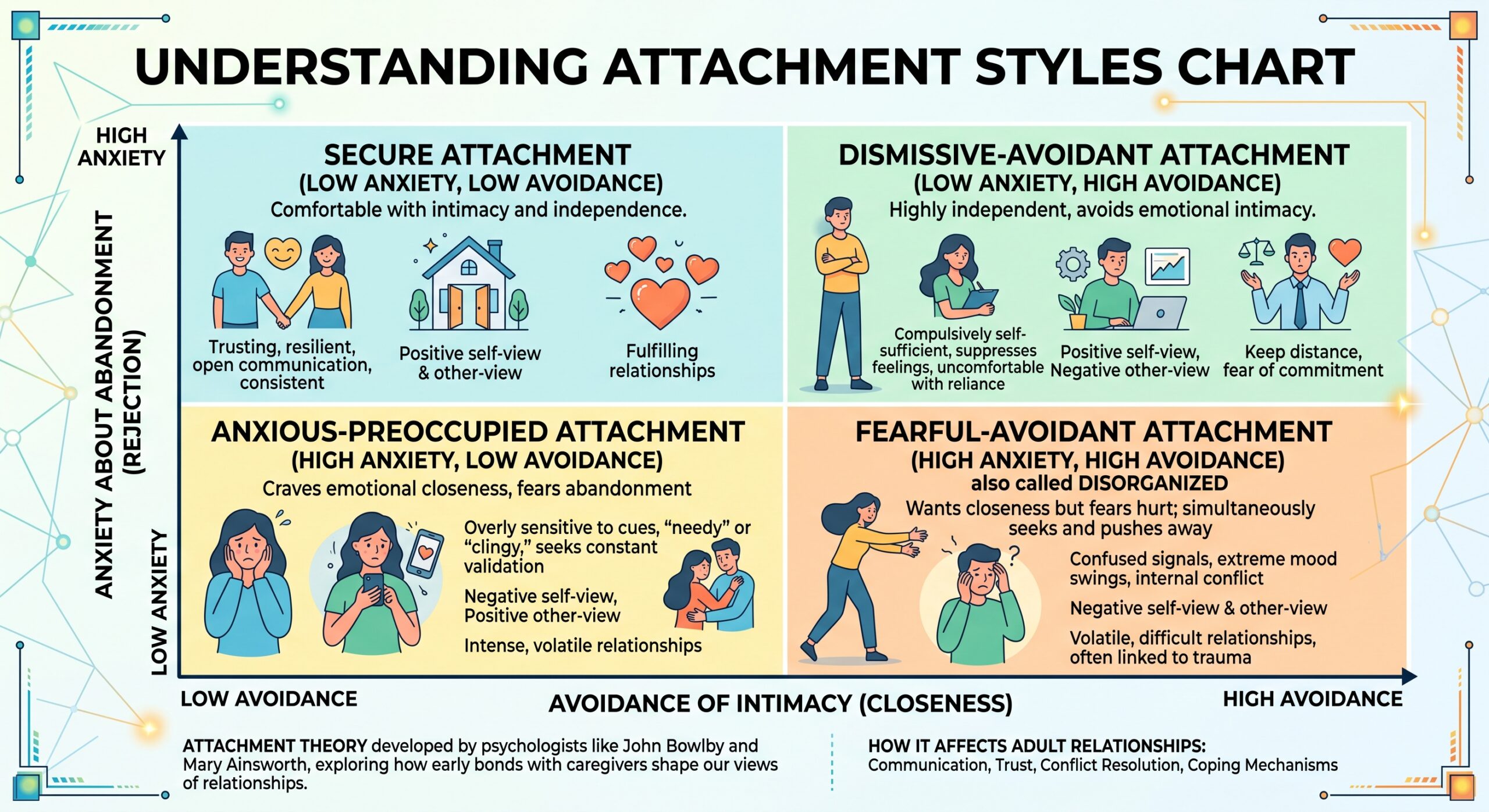
In 1991, researchers Kim Bartholomew and Leonard Horowitz proposed a model of adult attachment that remains widely used today. They organized attachment along two dimensions: a person’s model of self (how worthy and lovable they feel) and their model of others (how trustworthy and available they believe other people are). Combining these produces four attachment styles.
Secure Attachment
People with a secure attachment style generally have a positive view of both themselves and others. They are comfortable with closeness but don’t lose themselves in it, and they can also be independent without feeling threatened. When conflict arises, they’re usually able to express their needs, listen to the other person, and repair after a rupture. Secure attachment doesn’t mean a person never struggles; it means they have a relatively stable foundation to return to when things get hard.
Preoccupied (Anxious) Attachment
People with a preoccupied style tend to crave closeness and connection but worry deeply about rejection or abandonment. Their sense of self-worth often depends heavily on others’ approval, and they may be highly attuned to any sign that a relationship is in trouble. This pattern closely mirrors Horney’s “moving toward” strategy: an unspoken belief that if I can keep you close and keep you happy, I’ll be safe. People with this style are often warm, generous, and deeply caring, but they may sacrifice their own needs to maintain connection.
Dismissing (Avoidant) Attachment
People with a dismissing style tend to value independence and self-sufficiency very highly. They may downplay the importance of close relationships and feel uncomfortable when others want more emotional intimacy or rely on them too much. This parallels Horney’s “moving away” strategy: if I don’t need anyone, no one can hurt me. People with this style are often capable, self-reliant, and calm under pressure, but they can find it hard to let others in or to recognize their own emotional needs.
Fearful (Disorganized) Attachment
People with a fearful style often want close relationships but also distrust others and fear being hurt. This creates a painful internal conflict: the very closeness they long for also feels dangerous. As a result, they may move toward others and then pull away, sometimes in quick succession. This style frequently develops in environments where the people who were supposed to provide safety were also a source of fear or unpredictability.
Two Dimensions: Anxiety and Avoidance
Today, many researchers and clinicians think about attachment less as four fixed boxes and more as two sliding scales: attachment anxiety and attachment avoidance.
Attachment anxiety reflects how much a person fears rejection and abandonment. People higher in anxiety tend to use what researchers call hyperactivating strategies when they feel stressed in a relationship. They amplify their distress, seek reassurance, and pursue closeness more intensely in the hope of getting their needs met.
Attachment avoidance reflects how uncomfortable a person feels with emotional closeness and dependence. People higher in avoidance tend to use deactivating strategies. They suppress their feelings, create distance, and minimize the importance of the relationship to keep themselves feeling in control.
Thinking in terms of dimensions is helpful in therapy because most people don’t fit neatly into a single category. You might be fairly secure with friends but more anxious in romantic relationships, or more avoidant under stress than you are when life feels calm.
Attachment Styles Are Strategies, Not Flaws
One of the most important things to understand about attachment styles is that they are not diagnoses or character defects. They are adaptations. Every insecure attachment pattern once made sense. A child who learned to cling tightly to an unpredictable caregiver was doing exactly what they needed to do to stay connected. A child who learned to need nothing from a dismissive caregiver was protecting themselves from repeated disappointment.
The problem isn’t that these strategies exist. It’s that they may continue running on autopilot long after the original circumstances have changed. A strategy that once protected you as a child might now keep you stuck in relationships that don’t meet your needs, or keep you from the closeness you genuinely want.
Approaching attachment this way allows for compassion rather than shame. In therapy, the goal is never to label someone as “broken.” It’s to help them understand the logic behind their patterns so they can choose what to keep and what to update.
How Attachment Theory Is Used in Therapy
Attachment theory informs therapy in many ways, from how a therapist understands a client’s history to how they show up in the relationship with that client. Here are some of the most common ways it guides the therapeutic process.
Understanding Your Relational Blueprint
Early in therapy, a clinician informed by attachment theory will often be curious about your relationships, both past and present. This might include questions about your early family environment, how emotions were handled at home, who you turned to when you were upset, and what tends to happen in your adult relationships when things get difficult.
Some therapists use structured tools such as the Relationship Questionnaire (RQ) or the Relationship Scales Questionnaire (RSQ), which are designed to measure attachment patterns. More often, though, attachment patterns reveal themselves naturally through the stories clients tell and the themes that repeat across different relationships. The aim isn’t to assign a label but to understand the internal working model you’re carrying and how it shapes your expectations of yourself and others.
The Therapeutic Relationship as a Secure Base
Bowlby used the phrase “secure base” to describe the role a responsive caregiver plays: a safe place to return to, and a foundation from which a person can explore the world. In attachment-informed therapy, the therapist aims to provide something similar.
This means being consistent, reliable, emotionally attuned, and non-judgmental. For many clients, especially those whose early relationships were unpredictable or dismissive, experiencing a relationship where their feelings are taken seriously and where the other person stays steady through difficult moments can be deeply healing. Over time, this experience can begin to challenge old assumptions such as “people always leave” or “my needs are too much.”
Noticing Patterns as They Happen in Session
Attachment patterns don’t stay outside the therapy room. They often show up in how clients relate to their therapist, and this can be one of the richest sources of insight.
A client with a more anxious pattern might worry that they’re talking too much, apologize frequently, or feel unsettled if the therapist seems distracted or has to reschedule. A client with a more avoidant pattern might keep conversations focused on facts rather than feelings, say “I’m fine” when something is clearly bothering them, or feel an urge to cancel the session after sharing something vulnerable. A client with a more fearful pattern might feel very connected one week and guarded or distant the next.
A skilled therapist doesn’t treat these reactions as problems. Instead, they gently notice them together with the client, in real time. Exploring what’s happening in the moment (“I noticed you got quieter after you told me that, what was that like?”) gives clients a chance to understand their patterns from the inside and to try something different in a safe setting.
Working with Emotions Rather Than Around Them
Because attachment strategies are ultimately ways of managing difficult feelings, therapy often focuses on helping people relate to their emotions differently. For someone who tends toward anxiety, this may mean learning to soothe themselves without relying entirely on reassurance from others. For someone who tends toward avoidance, it may mean learning to notice and name feelings they’ve long pushed aside, and discovering that having needs is not the same as being weak.
In both cases, the goal is emotional flexibility: being able to stay connected to yourself and to others at the same time.
Couples Therapy and Attachment
Attachment theory has also had a major influence on couples therapy, most notably through Emotionally Focused Therapy (EFT), developed by Dr. Sue Johnson. Many couples find themselves stuck in a painful cycle where one partner pursues (often a more anxious pattern) and the other withdraws (often a more avoidant pattern). The more one pushes for closeness, the more the other pulls away, and vice versa.
Attachment-informed couples work helps partners see that this cycle, rather than either person, is the problem. Underneath the criticism or the silence, both partners are usually trying to protect themselves and hold on to the relationship in the only way they know how. Recognizing this can soften conflict and open the door to more honest, vulnerable conversations.
Attachment in Everyday Life: The Boundary Example
Attachment patterns show up in countless everyday situations, and one of the clearest examples is setting boundaries.
Setting a boundary requires two things: a willingness to assert your own needs, and a willingness to tolerate the possibility that the other person won’t like it. For people with a more anxious or “moving toward” style, that second part can feel almost unbearable, because it risks the very connection that helps them feel safe.
As a result, many people with this pattern over-explain. They offer long justifications, list past examples, and try to walk the other person through their reasoning in detail. The hope, often unconscious, is that if the other person truly understands, the boundary can be set without any conflict or loss of closeness. In effect, the person is trying to create separation and seek approval at the same time.
The difficulty is that this approach rarely works when the other person doesn’t want to accept the boundary. Someone with a more controlling or competitive style may treat a long explanation as an invitation to debate, picking apart each reason until the boundary itself gets lost. Someone with a more avoidant style may experience the flood of words as overwhelming and withdraw even further.
Horney also observed that we often place unfair expectations on others without realizing it. She described the “tyranny of the shoulds,” a set of rigid internal rules about how we should behave, which we then project onto the people around us. Someone who believes “I should always anticipate others’ needs” may also quietly expect that others should always anticipate theirs, and feel deeply hurt when that doesn’t happen.
In therapy, clients working on these patterns often learn a different approach. A boundary is a statement about your own limits, not a proposal that requires the other person’s agreement. That often means stating it clearly and briefly (“I’m not available to talk about this right now”), tolerating the discomfort of someone else’s disappointment without rushing to fix it, and following through with action if the boundary is crossed rather than offering more explanations. Learning to do this is, in many ways, practice in moving toward a more secure way of relating.
Working with Insecure Attachment at Our Practice
If you recognize yourself in any of the patterns described above, you’re not alone, and you don’t have to untangle them by yourself. At our practice, Marie Danner works with patients with insecure attachment, helping them understand where their relational patterns come from and how those patterns show up in their lives today. Whether you tend to cling tightly, keep people at arm’s length, or find yourself caught between the two, therapy can offer a steady, supportive space to explore what’s happening and try new ways of connecting.
Can Attachment Styles Really Change?
Yes. Although attachment patterns tend to be stable over time, they are not set in stone. Researchers use the term “earned security” to describe adults who experienced difficult early relationships but have gone on to develop a secure way of relating. This often happens through meaningful relationships later in life, such as a supportive partner, a close friendship, a mentor, or a therapeutic relationship.
Change doesn’t usually happen through insight alone. Understanding your attachment style is a valuable first step, but lasting change typically comes from repeated new experiences: being vulnerable and not being rejected, stating a need and having it respected, or tolerating someone’s disappointment and discovering that the relationship survives. Therapy provides a place where these experiences can happen intentionally and safely, and where the lessons learned can gradually carry over into the rest of your life.
Moving Toward a More Secure Self
Horney believed that beneath our protective strategies lies what she called the “real self,” the authentic, alive center of a person that is capable of growth, spontaneity, and genuine connection. Attachment-informed therapy shares that hope. The goal isn’t to erase your history or become a different person. It’s to understand the strategies you developed to stay safe, honor the role they once played, and gently loosen their grip so you can relate to others from a place of choice rather than fear.
Whatever your attachment style, the patterns you carry made sense at one point in your life. With curiosity, compassion, and support, it’s possible to build relationships that feel more secure, more balanced, and more truly your own.
This article is for educational purposes and is not a substitute for professional mental health care. If you’re struggling, please reach out to a licensed mental health professional.




















0 Comments