
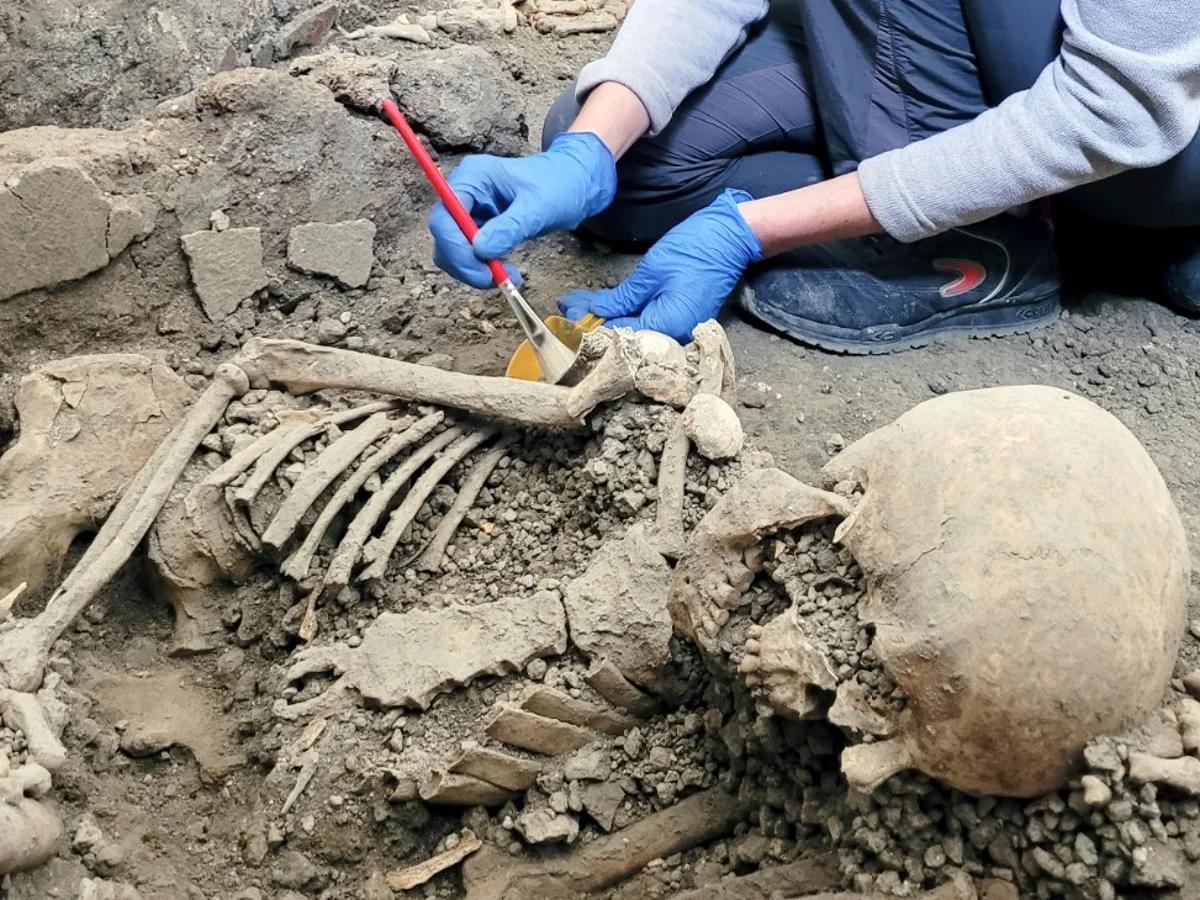
Somatic archeology is a metaphor for body-centred therapy that treats the body as a layered record of a person’s history. Posture, breath, chronic tension and reflexive movement carry the traces of what a person lived through, often below conscious memory. The therapist and client “excavate” those layers slowly, through sensation and movement, so that stored survival responses can finish and old experience can be integrated.
Key takeaways
- Somatic archeology is a metaphor for body-centred therapy that reads posture, breath and tension as layered traces of a person’s past.
- Its roots run through Wilhelm Reich’s character armor, Alexander Lowen’s Bioenergetic Analysis, osteopathy, Rolf, Feldenkrais, Rosen and modern trauma research.
- The body does not store literal stories in its cells; the nervous system keeps implicit, non-verbal learning that shows up as bodily patterns.
- The work moves in phases: building safety and resources, approaching difficult sensation in small doses, letting defensive responses complete, then integrating what emerges.
- Methods such as Somatic Experiencing and Brainspotting apply the same principles to trauma, anxiety, dissociation and unexplained chronic tension.
What does it mean to say the body holds history?
The image is borrowed from field archeology. An archeologist does not dig straight down to the deepest layer; she removes soil a little at a time, records what each stratum holds, and reads the site as a sequence. Somatic therapists use the same picture for the body. What sits on the surface is recent: this week’s stress in the jaw. Underneath may sit older patterns, such as a habit of bracing the shoulders that began in a childhood home where nobody could be relied on.
“Somatic archeology” is not the name of a school with a founder, a training body or a manual. It is a useful way of describing what several body-centred traditions share: the conviction that experience leaves a physical trace, and that therapy can reach that trace by attending to the body rather than only talking about the past. The traditions that feed it, from Wilhelm Reich to Somatic Experiencing, are real and well documented, and they are where the substance lies.
The traces in question are mostly not stories. Trauma, strong emotion and long stretches of relational strain show up as muscular holding patterns, restricted or shallow breathing, a startle that fires too easily, a gut that clenches before a meeting, or a part of the body that feels numb or absent. These patterns usually run outside awareness, yet they shape how a person moves, how much contact they can bear and how quickly they become overwhelmed.
Tissue memory, read accurately
Popular writing often says that muscles, fascia or individual cells “remember” events. Taken literally, that is not how memory works: autobiographical memories are encoded and retrieved by the brain. What is well established is a second kind of memory that does not need words. Psychologists call it implicit memory: prior experience changes later behaviour and perception without the person consciously recalling the experience.12 Conditioned fear, procedural habits and the bodily patterns of attachment all belong here. When a body therapist says the shoulders “hold” a history, the accurate translation is that the nervous system has learned a pattern of bracing and keeps running it through those muscles.
This is why the metaphor still earns its place. The tissues are where the learning shows, and where it can be felt and changed, even though the learning itself lives in the nervous system as a whole. Research on the immune and stress systems also shows that chronic threat changes inflammation, hormone levels and gene expression, so the body is genuinely altered by what it endures, even if no cell keeps a diary.
The body as an information system
The second principle is that physical symptoms can carry psychological meaning. A tight throat may be a held-back cry; a collapse in the chest may be the posture of someone who learned that standing tall drew attack. Somatic therapists treat such signals as information to be explored, not as proof of a particular event. Antonio Damasio‘s work on emotion gives this a neuroscientific frame: feelings are built from the brain’s mapping of the body’s state, so the body is part of how we know what we feel.13
Depth psychology made a similar move long before neuroscience did. Arnold Mindell, a Jungian analyst, argued in Dreambody (1982) that body symptoms can be approached like dreams, as images the psyche is trying to bring forward. His process-oriented psychology treats a migraine or a twitch as something to follow and amplify rather than suppress.
“Body time” and the time capsule
A third idea is that the body keeps a different clock from the thinking mind. Thoughts jump from yesterday to next year in a second. A traumatised nervous system can stay organised around a moment that ended decades ago, still braced for the car that is about to hit, still frozen in the room where the shouting happened. A helpful way to picture this is a time capsule: a pocket of the body where a past moment remains active and keeps colouring the present.
The observation itself is old. Pierre Janet, writing in 1889, described traumatic memories that stay split off from ordinary consciousness and keep replaying as fixed ideas, sensations and actions instead of becoming part of a person’s narrative. His work on dissociation and unintegrated memory is the earliest clinical description of what later somatic therapists call “body time.” Bessel van der Kolk built on Janet’s view when he argued that traumatic memory is stored as fragments of sensation and emotion rather than as a coherent story.4
Where does the idea of body-held history come from?
The excavation image draws on at least four lineages: Reich’s psychoanalytic body work, the manual therapies of osteopathy, the movement and touch methods of the mid twentieth century, and modern trauma research and neuroscience.
Wilhelm Reich and character armor
Wilhelm Reich was a Viennese psychoanalyst in Freud’s circle. In Character Analysis, first published in 1933, he argued that a person’s defences are not only ideas but a whole style of being: a way of speaking, holding the face and carrying the body.1 During his years in Scandinavia in the mid and late 1930s he went further and described “muscular armor,” chronic tension that holds back feelings the person could not afford to have. He began working directly on the body, through breath and touch, in a method he called vegetotherapy.
Reich mapped how armor tends to organise in bands across the body, from the eyes and jaw down through the throat, chest, diaphragm, belly and pelvis, and he linked different patterns of holding to different character styles. That is the first clear statement of the core of somatic archeology: the past is present in how the body is held now. His later orgone theories and legal troubles are a separate story, but his clinical insight about armor survived him.
Alexander Lowen and Bioenergetic Analysis
Alexander Lowen studied with Reich in New York from 1940 and was in therapy with him in the early 1940s. After qualifying in medicine in Geneva, he founded the Institute for Bioenergetic Analysis in 1956 with John Pierrakos. In The Physical Dynamics of Character Structure (1958, later reissued as The Language of the Body) and Bioenergetics (1975), Lowen described how specific character patterns show up in posture and tension, and he added the idea of grounding: helping a person feel their legs and feet and their weight on the earth.2 His stress positions, breathing and expressive exercises were designed to bring held feeling into movement and voice. Pierrakos later developed Core Energetics from the same root.
Osteopathy, William Sutherland and craniosacral work
A quieter lineage came from osteopathy. William Garner Sutherland, a student of osteopathy’s founder Andrew Taylor Still, became convinced around 1900 that the bones of the skull allow slight motion, and spent decades developing what he called the cranial concept. He presented it to the profession in The Cranial Bowl (1939), and it became cranial osteopathy. Craniosacral therapy as a named method came later: the osteopathic physician John Upledger developed it in the 1970s and founded the Upledger Institute in 1985.
What this lineage contributed is an attitude rather than an anatomy lesson. Practitioners are trained to use very light touch, to listen to subtle rhythms in the tissues and to follow the body’s own direction of release rather than force a correction. That stance of following, not pushing, runs through every gentle somatic method that came after.
Rolf, Feldenkrais, Rosen and the human potential movement
Ida Rolf, a biochemist with a doctorate from Columbia, developed Structural Integration from the 1940s onward: deep manual work on the fascia intended to reorganise the body around gravity. Clients often reported strong emotion and old memories surfacing during sessions. She taught at the Esalen Institute in Big Sur, founded in 1962, and established the Rolf Institute in Boulder in 1971.
Moshe Feldenkrais, a physicist and judo teacher, approached the body through learning rather than manipulation. His Body and Mature Behavior (1949) linked anxiety to habitual patterns of flexion and bracing, and Awareness Through Movement (1972) set out lessons in slow, attentive movement that help the nervous system find new options. Marion Rosen, a German-born physical therapist trained in breath and relaxation work in Munich before she emigrated in 1939, developed the Rosen Method in Berkeley: gentle touch and words at the places where breath and muscle are held, so that the feelings bound up in them can come to awareness.
The human potential movement of the 1960s and 1970s, with Esalen as its hub, brought these methods together with Gestalt therapy, meditation and other contemplative practices, and with a wide interest in non-Western and indigenous healing. Eugene Gendlin‘s work belongs to this period as well. In Focusing (1978) he described the “felt sense,” a vague but bodily sense of a whole situation that can be attended to until it opens into words and change.7 A profile of Gendlin and felt sensing shows how directly his method feeds current trauma work.
Trauma research and neuroscience
From the 1990s onward, trauma researchers gave the old body-armor intuition a firmer footing. Peter Levine, drawing on animal behaviour, argued in Waking the Tiger (1997) that trauma symptoms arise when the body’s defensive responses of fight, flight and freeze are mobilised but never completed, leaving the energy of that mobilisation bound in the nervous system.3 Bessel van der Kolk gathered research on how trauma reshapes brain and body in a 1994 paper and later in The Body Keeps the Score (2014).4 Stephen Porges introduced polyvagal theory in 1994, describing how the autonomic nervous system shifts between states of social engagement, mobilisation and shutdown depending on whether it detects safety or danger.5
Pat Ogden, a founding trainer of Ron Kurtz’s Hakomi Institute, combined these strands in Sensorimotor Psychotherapy, which works with posture, gesture and movement impulses as directly as with words.6 Together with the research on implicit memory and neuroplasticity, these approaches give the archeological picture its modern form: careful, paced work with sensation, guided by an understanding of how a frightened nervous system behaves.
What techniques does somatic archeology use?
The methods vary by tradition, but they share three features: close attention to what is happening in the body right now, respect for the body’s own pace and direction, and a gentle approach that honours a client’s defences while inviting a little more range. Nothing is ripped open. Defences exist for good reasons, and a defence that is overpowered tends to return stronger.
Body scanning and micro-movement
Most somatic work begins with interoception, the sense of the body’s internal state: heartbeat, breath, gut, temperature and muscle tone. Neuroscientist A. D. Craig showed that this information has its own pathways to the brain and is mapped in the insular cortex, where it feeds directly into how we feel.14 The therapist helps the client slow down and notice small sensations, a tightness here, an absence there, an impulse to turn the head or curl the hand. Areas of numbness, chronic tension or a sense of congestion often mark places where experience was never fully processed. Given patient attention, these places tend to “speak” through sensation, image, emotion or a small spontaneous movement.
Listening touch
Where touch is part of the work, its purpose differs from massage or structural correction. The hand listens. A practitioner trained in Rosen work or craniosacral methods attends to how tissue responds, where it softens and where it guards, and uses that as a form of dialogue. In psychotherapy settings touch is used far more sparingly and only with clear consent, and much of the same listening can be done through the client’s own attention and the therapist’s tracking of breath, colour and posture.
Breath as bridge
Breathing is both a measure and an intervention. Breath held high in the chest, breath that stops at moments of feeling, and long collapsed exhalations each tend to accompany particular emotional states and defences. Breath sits at the meeting point of voluntary and automatic control, which is why it is so useful with trauma: a client can learn to influence their own state through it. Reich watched breath closely for this reason, and so does every somatic method descended from him.
Movement and completion
Movement and expressive techniques let the body finish what it started. Levine’s work centres on this: a protective movement that was frozen in the moment of danger, such as pushing away or turning to run, is allowed to unfold slowly, in safety, until the body registers that it is over. Other methods follow spontaneous movement, give form to a sensation through drawing or sound, or use Authentic Movement, the practice developed by Mary Starks Whitehouse and Janet Adler, in which a mover follows inner impulse while a witness watches. The emphasis is always on movement that arises from inside rather than on prescribed exercises.
How does the excavation unfold in layers?
Like an excavation, the work proceeds in phases, and the first phase is preparation of the site. Many clients start with little capacity to sense their bodies at all, especially after trauma or long disconnection. Early sessions focus on building resources: places in the body that feel neutral or good, memories of support, ways of settling. The aim is a felt sense of safety and the ability to come back down after activation. Clinicians often describe this as widening the window of tolerance, the range of arousal in which a person can stay present.
As somatic literacy grows, the work can go deeper. A client might start with the surface layer of muscular tension, then find under it a more global pattern of posture and guarding, and under that a feeling-state that belongs to an earlier time. Picture a chronic tightness across the shoulders. At first it is about a demanding job. With attention, it becomes the feeling of a child who carried a parent’s moods. Further down, it may connect with a family pattern in which everyone bore hardship silently. Each layer carries a different time and theme, and each is met at the pace the client can manage.
Pacing matters more than depth. Levine calls the skill of touching a difficult sensation briefly and then returning to a resource “titration,” and the rhythm of moving between the two “pendulation.” Going too far, too fast tends to flood the client or drive them into shutdown, the state known as functional freeze.
The last phase is integration. What surfaces has to be digested, not just uncovered. That may happen through further somatic practice, writing, drawing, ritual, or changes in daily life such as how a person sleeps, sets limits or lets others close. Integration is complete when the old pattern no longer runs automatically and the new way of being feels like one’s own. Research on memory reconsolidation suggests one reason this works: when an old emotional learning is activated and met with a sharply different present experience, the learning itself can be revised.
Can trauma be carried across generations and communities?
Somatic work has widened from the individual to families and communities. The intuition is that the impact of slavery, colonisation, war and forced displacement lives not only in individual memories but in the bodies of descendants and in the felt atmosphere of whole communities. Resmaa Menakem’s My Grandmother’s Hands (2017) is the best-known statement of this view in the United States: he argues that racialised trauma is held in the bodies of Black, white and police communities alike, and that healing has to include settling the body, not only changing beliefs.9 Group methods allow shared witnessing and slow, shared work with grief and fear.
How the transmission happens is a real research question. Much of it is plainly behavioural and relational: a frightened parent raises a child in a frightened household, and the child’s nervous system calibrates accordingly. Rachel Yehuda’s work with Holocaust survivors and their adult children has also explored whether stress-related changes in gene regulation, called epigenetic marks, may play a part. Her 2018 review with Amy Lehrner sets out the findings and the mechanisms that might carry effects from one generation to the next.10 In mice, Brian Dias and Kerry Ressler found that when males were conditioned to fear a particular smell, their offspring and grand-offspring were more sensitive to that smell, with matching changes in the olfactory system and in DNA methylation in sperm.11 Mark Wolynn’s It Didn’t Start with You (2016) brought the idea of inherited family trauma to a wide readership. More on the biology is in a separate post on epigenetics and behaviour.
What these studies show is inherited sensitivity, a nervous system set to react more strongly, not inherited memories of specific events. That distinction is useful clinically. A client does not need to recover an ancestor’s story to work with the hypervigilance they carry; the work happens in the body they live in now.
How is the approach applied to developmental trauma and early life?
Developmental trauma, meaning neglect, chaotic care or misattunement in early life, leaves patterns that predate language, so body-based methods are especially suited to it. Therapists look for missing foundations: the infant movements of reaching, pushing, yielding and grasping that build a sense of agency, and the early experience of being held and soothed that underlies secure attachment. Laurence Heller’s NARM model, discussed in a profile of Laurence Heller, works with how these early adaptations shape identity as well as physiology.
Some practitioners in pre- and perinatal psychology go further, working with what they see as imprints from birth and the time before it. This is the practitioners’ own view of their work, and the more modest form of it holds up well: early stress does shape the developing stress system, and adults can still work with the bodily patterns that early life set in motion.
Technology has also found a place. Heart rate variability biofeedback lets a client see, in real time, how their breathing and attention shift their autonomic state. Virtual reality is being used to build controlled settings for revisiting frightening situations. Most somatic clinicians treat such tools as supports for the relationship, not substitutes for it: the regulating presence of another person is part of what heals.
What are the hard questions in body-based memory work?
The first is the claim about cellular memory. Statements that cells store specific memories, or that a practitioner can read a client’s exact history by touching the tissue, go beyond what research shows. The careful version, which most experienced body therapists hold, is that the body shows patterns, and that patterns suggest themes to explore together, not facts to announce.
The second is memory accuracy. Work with implicit, non-verbal material can stir images and sensations that feel like memories. Elizabeth Loftus and Jacqueline Pickrell demonstrated in 1995 that people can come to remember, wholly or in part, events that never happened when those events are suggested by trusted others: in their study, 6 of 24 adults recalled being lost in a shopping mall as children after being told it had happened.15 Good somatic practice responds by treating what surfaces as the body’s present experience of the past, valuable for the meaning and feeling it carries, without turning it into a literal historical claim. The therapist follows rather than suggests.
The third is training. Body-centred work draws on so many traditions that standards differ widely between methods. Licensed psychotherapists trained in a specific somatic method, such as Somatic Experiencing or Sensorimotor Psychotherapy, work under professional ethics and supervision, which matters when the work touches on trauma, touch and memory. Gustl Marlock and Halko Weiss’s Handbook of Body Psychotherapy and Somatic Psychology (2015) gathers the field’s theory and methods in one place and shows how much shared ground there is.8
Where is somatic work heading?
The direction is toward closer ties with neuroscience, trauma-informed care and an awareness of social context. Polyvagal theory’s account of the social engagement system has given clinicians a language for how relationships calm or alarm the body, and the same lens is now applied to how chronic discrimination and poverty keep bodies on alert.
Research on interoception and embodied cognition is beginning to describe the mechanisms behind body-based therapy: how attention to inner sensation changes emotional regulation, how posture and movement shape thought, and how pain is constructed by the brain from bodily signals and expectations. Work such as pain reprocessing therapy shows how far the brain’s interpretation of body signals can be changed, which supports the somatic view that symptoms are partly learned.
There is also growing care about cultural context. Many somatic techniques draw on indigenous, Asian and other non-Western practices of breath, movement and touch, and practitioners increasingly ask how to credit and respect those sources rather than repackage them. Body meaning is also cultural: what a lowered gaze or a still posture means differs between families and communities, so a good somatic therapist asks rather than assumes.
How do we use the archeology of the body in therapy?
At Taproot we use the archeological picture as a working map rather than a technique. In practice a session often starts with what the body is doing right now: where the client feels the problem, what happens in the chest when they speak about their mother, what the hands want to do. We track the small signals of activation and settling and slow the conversation down when the body signals that something important is near. The aim is steady: build safety first, approach difficult material in small doses, let the body complete what it could not complete at the time, and integrate what emerges.
This kind of work suits problems where talk alone keeps circling: trauma and PTSD, chronic anxiety and panic, dissociation, the after-effects of a chaotic childhood, chronic pain and tension that medical tests do not explain, and the sense of being stuck in a reaction one understands but cannot change. Our post on processing trauma stored in the body describes what clients can expect in those sessions.
Several methods we use put the body at the centre. Somatic Experiencing works directly with titration, pendulation and the completion of defensive responses. Brainspotting uses fixed eye positions that correspond to strong bodily activation, then lets the brain and body process from that spot with the therapist attuned and present. Parts work adds another layer: a clenched stomach or a dead-feeling limb can be met as a protective part with its own history and job.
The depth-psychological side of our work treats the body as a source of images as well as sensations. Jungian analyst Marion Woodman brought bodywork into analysis and taught that the body often carries what the conscious mind has refused. Donald Kalsched showed how the psyche builds protective defences around early trauma, defences that clients frequently feel physically as numbness, heaviness or a wall. Holding both views, body and image, lets us respect the defence while helping the person grow beyond it.
The body records how a person learned to survive, and it can learn something new. That is the hope inside the archeological image: careful excavation, at the client’s pace, turns buried survival patterns into lived history that no longer runs the present. If that kind of work sounds right for you, you can read about our somatic therapy in Birmingham or reach us through our contact page.
Frequently asked questions
Is somatic archeology a formal type of therapy?
No. Somatic archeology is a descriptive image rather than a school with its own founder or training. It names what several body-centred traditions share: the view that experience leaves physical traces in posture, breath and tension, and that therapy can reach those traces by attending to bodily sensation. Somatic Experiencing, Sensorimotor Psychotherapy and Bioenergetic Analysis are the established methods behind the idea.
Can the body store memories of trauma?
The body does not store narrative memories in muscles or cells, but the nervous system keeps implicit memory: learned patterns of fear, bracing and shutdown that run without conscious recall. These patterns are expressed through the body, as chronic tension, a quick startle or shallow breathing, which is why body-based trauma therapy can work with them directly.
What is character armor?
Character armor is Wilhelm Reich’s term for the chronic muscular tension and habitual bodily style that hold back feelings a person once could not afford to have. Reich described it in Character Analysis (1933) and his later Scandinavian work, mapping armor in bands from the eyes and jaw to the pelvis. It is the earliest clinical form of the idea that the body holds history.
Can trauma be inherited from parents or ancestors?
Trauma effects can pass between generations, mostly through parenting and family atmosphere, and research by Rachel Yehuda and animal studies by Dias and Ressler suggest epigenetic changes may add heightened stress sensitivity. What appears to pass on is a more reactive nervous system, not memories of specific events, and that sensitivity can be worked with in the present body.
What happens in a somatic therapy session?
A somatic therapy session usually starts with what the body is doing now: where a problem is felt, how breath changes, what small movements want to happen. The therapist helps the client build a sense of safety, touch difficult sensations briefly and return to calm, and let interrupted protective responses finish, so old patterns lose their grip without the client being overwhelmed.
Related reading
- Terror Management Theory: What It Can Teach Us About How Trauma Is Created and Healed
- Discernment Counseling: A New Approach for Couples on the Brink
- The Interpersonal Theory of Psychiatry: Harry Stack Sullivan’s Vision of the Social Self
- Murray Stein: Bridging Jungian Psychology and Contemporary Thought
- Sensorimotor Art Therapy: Integrating Body, Mind, and Creativity for Holistic Trauma Healing
- Joseph LeDoux and the Revolution in Trauma Therapy:
References
- Reich, W. (1972). Character analysis (3rd ed., V. R. Carfagno, Trans.). Farrar, Straus and Giroux. (Original work published 1933)
- Lowen, A. (1975). Bioenergetics. Coward, McCann & Geoghegan.
- Levine, P. A. (1997). Waking the tiger: Healing trauma. North Atlantic Books.
- van der Kolk, B. (2014). The body keeps the score: Brain, mind, and body in the healing of trauma. Viking.
- Porges, S. W. (2011). The polyvagal theory: Neurophysiological foundations of emotions, attachment, communication, and self-regulation. W. W. Norton.
- Ogden, P., Minton, K., & Pain, C. (2006). Trauma and the body: A sensorimotor approach to psychotherapy. W. W. Norton.
- Gendlin, E. T. (1981). Focusing (Rev. ed.). Bantam Books. (Original work published 1978)
- Marlock, G., & Weiss, H. (Eds.). (2015). The handbook of body psychotherapy and somatic psychology. North Atlantic Books.
- Menakem, R. (2017). My grandmother’s hands: Racialized trauma and the pathway to mending our hearts and bodies. Central Recovery Press.
- Yehuda, R., & Lehrner, A. (2018). Intergenerational transmission of trauma effects: Putative role of epigenetic mechanisms. World Psychiatry, 17(3), 243-257. https://doi.org/10.1002/wps.20568
- Dias, B. G., & Ressler, K. J. (2014). Parental olfactory experience influences behavior and neural structure in subsequent generations. Nature Neuroscience, 17(1), 89-96. https://doi.org/10.1038/nn.3594
- Schacter, D. L. (1987). Implicit memory: History and current status. Journal of Experimental Psychology: Learning, Memory, and Cognition, 13(3), 501-518. https://doi.org/10.1037/0278-7393.13.3.501
- Damasio, A. (1999). The feeling of what happens: Body and emotion in the making of consciousness. Harcourt Brace.
- Craig, A. D. (2002). How do you feel? Interoception: The sense of the physiological condition of the body. Nature Reviews Neuroscience, 3(8), 655-666. https://doi.org/10.1038/nrn894
- Loftus, E. F., & Pickrell, J. E. (1995). The formation of false memories. Psychiatric Annals, 25(12), 720-725. https://doi.org/10.3928/0048-5713-19951201-07







0 Comments