

Carl Gustav Jung (1875-1961) was a Swiss psychiatrist who built analytical psychology out of his own life: a lonely, dream-filled childhood, séances and philosophy at university, asylum work under Eugen Bleuler, six years beside Freud, a near-breakdown he turned into The Red Book, and decades of study of types, myth, alchemy and synchronicity. Following that sequence explains why his ideas look the way they do.
Key takeaways
- Jung’s analytical psychology grew directly out of his life, from childhood dreams and student séances to asylum research, the friendship with Freud and his own crisis after 1913.
- His early word association research produced the theory of feeling-toned complexes, which later became the bridge between his clinical work and his theory of archetypes.
- Wandlungen und Symbole der Libido (1911-1912) redefined libido as general psychic energy and began the break with Freud that became final in 1913.
- The Red Book, written between about 1915 and 1930 and published in 2009, records the visions from which individuation, active imagination and the Self emerged.
- Jung’s later work on psychological types, alchemy, religion and synchronicity extended one question: how the psyche moves toward wholeness and meaning.
Where did Jung’s psychology begin?
Jung was born on 26 July 1875 in Kesswil, on the Swiss shore of Lake Constance, the son of Paul Achilles Jung, a pastor in the Swiss Reformed Church, and Emilie Preiswerk, who came from a family of Basel clergy with a strong interest in spirits and second sight. The family moved to Laufen near the Rhine Falls and then, in 1879, to Kleinhüningen outside Basel. The parents’ marriage was unhappy, and the boy spent long stretches alone.1
His memoir, Memories, Dreams, Reflections, dictated to Aniela Jaffé late in life and published in 1962 in German and 1963 in English, opens with the sentence “My life is a story of the self-realization of the unconscious.” It describes a childhood dream of an underground throne room holding a towering ritual phallus, a small manikin he carved and hid in the attic with a painted stone, and a growing sense that he had two selves: “No. 1,” the ordinary schoolboy, and “No. 2,” an old, timeless personality who belonged to nature and to God.1 Jung later read these memories as his first meetings with the objective psyche, the part of the mind that is not made by personal history. The memoir is shaped by hindsight, but it shows what Jung himself thought had formed him.
He took the pastor’s faith of his father as a set of answers that no longer answered anything. That disappointment is one root of his lifelong question: what religious experience actually is, psychologically, once inherited doctrine stops carrying it.
Basel: philosophy, Swedenborg and the séances
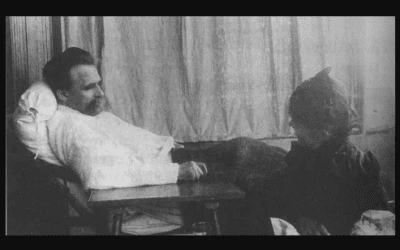
Jung studied medicine at the University of Basel from 1895 to 1900. Outside the medical syllabus he read widely. Immanuel Kant gave him the idea that the mind brings its own forms to experience, a model he later echoed when he described archetypes as inborn forms of perception. Arthur Schopenhauer gave him a blind, striving will beneath reason and a frank account of suffering. Friedrich Nietzsche, whose Thus Spoke Zarathustra struck him as the work of a man seized by his own “No. 2,” gave him a warning about what happens when someone identifies with the contents of the unconscious instead of relating to them.110
He also read spiritualist literature and Emanuel Swedenborg’s visionary writings, and he lectured to the Zofingia student society on the soul, religion and the limits of materialist science. From 1895 he took part in séances in which his young cousin Hélène Preiswerk acted as a medium. Those sessions became his doctoral dissertation, On the Psychology and Pathology of So-Called Occult Phenomena (1902), which treated the medium’s “spirits” as split-off personalities of her own psyche.11 That reading of the spirits as autonomous fragments of a person is the seed of his later theory of complexes.
The Burghölzli and the word association test
Reading Richard von Krafft-Ebing’s textbook of psychiatry convinced Jung that psychiatry was where nature and spirit met. In December 1900 he joined the Burghölzli, the psychiatric hospital of the University of Zurich, under Eugen Bleuler, who was then reshaping the understanding of dementia praecox (he coined “schizophrenia” in 1908). Jung spent the winter of 1902-1903 in Paris attending Pierre Janet‘s lectures, married Emma Rauschenbach in 1903, and became senior physician at the hospital in 1905.10
His first scientific reputation came from the word association experiment. A patient hears a list of stimulus words and answers each with the first word that comes to mind while the examiner times the reply. Jung and Franz Riklin found that slow answers, odd answers, repetitions and forgotten replies cluster around emotionally charged themes. Jung called these clusters “feeling-toned complexes”: knots of memory, image and emotion that behave like small independent personalities and disturb conscious intention.10 His 1907 monograph on the psychology of dementia praecox argued that even psychotic speech has meaning once its complexes are understood. Reading Freud’s The Interpretation of Dreams (1900), he saw that his experimental complexes and Freud’s repressed wishes described the same territory.
How did Jung meet Freud, and why did they split?
In April 1906 Jung sent Freud a copy of the Diagnostic Association Studies, and Freud’s letter of thanks on 11 April opened a correspondence of some 360 letters. When the two first met in Vienna in March 1907 they reportedly talked for about thirteen hours.2 Freud, isolated and anxious that psychoanalysis would be dismissed as a Viennese Jewish affair, saw in the Swiss psychiatrist from a respected university clinic his “crown prince.” In 1909 both travelled to Clark University in Massachusetts to lecture, and in 1910 Jung became the first president of the International Psychoanalytic Association.
The disagreements were there from the start. Jung never accepted that every neurosis traced back to sexual trauma or sexual wishes, and he resisted Freud’s demand that sexual theory be held as a dogma, “an unshakable bulwark,” as Jung later recalled the request in his memoir.1 He was also uneasy with the way Freud handled authority, an unease sharpened by a famous moment during the 1909 voyage when Freud declined to share details of a dream on the grounds that it would cost him his authority. The letters show the friendship cooling through 1912, as each began to read the other’s behaviour as neurosis, and in January 1913 they agreed to end their personal relationship. Jung resigned as president of the association in 1914.2 The split is the subject of a long-running argument about how Jung and Freud understood the unconscious.
Transformations and Symbols of the Libido
The theoretical break was Wandlungen und Symbole der Libido, published in two parts in 1911 and 1912 (English translation 1916 as Psychology of the Unconscious; revised in 1952 as Symbols of Transformation).3 Working from the fantasies of an American woman published under the name “Miss Frank Miller,” Jung read her poems and visions against a huge range of hero myths, sun myths and rebirth rites. Two moves set him apart from Freud. He redefined libido as psychic energy in general, which can flow into hunger, sexuality, work, art or religion, rather than as sexual energy alone. And he argued that some fantasy material repeated mythological motifs the dreamer could not have learned, which pointed to a layer of the mind older than personal history. He did not yet use the term “collective unconscious”; that phrase appears in his writing from 1916, in “The Structure of the Unconscious.”10
After 1913 Jung called his approach analytical psychology to distinguish it from psychoanalysis. The separation cost him most of his professional allies, and it came at the same moment his inner life began to break open.
What happened during Jung’s confrontation with the unconscious?
In late 1913 Jung began to have overwhelming waking visions, including a repeated vision of Europe flooded with blood, which he at first feared were signs of psychosis. In 1914 he gave up his lecturing post at the University of Zurich, and he spent the following years in what he later called his “confrontation with the unconscious.”1 Rather than suppress the images, he deliberately let them come. He would let a mood become an image, step into it as if descending into a fantasy, and then talk with the figures he met. Among them were Elijah, the blind Salome and later Philemon, a winged old man whom Jung experienced as a teacher with knowledge he himself did not have.
This method became active imagination, a technique distinct from passive daydreaming: the ego stays awake and takes part, answering the figures and taking an ethical position toward what they say. Jung described it in “The Transcendent Function,” written in 1916 and published in 1957, as the way conscious and unconscious attitudes are brought together to produce a third, new attitude.8
The Red Book
Jung first recorded these experiences in a set of private journals, the “Black Books,” and then copied and elaborated them in calligraphy and paintings into a large red leather folio he titled Liber Novus. He worked on it from about 1915 until around 1930, then stopped. The family kept it private for decades; it was finally published in 2009, edited and translated by Sonu Shamdasani.4 The Red Book shows in raw form the ideas that his published books later present in clinical language: the reality of the psyche, the dialogue with inner figures, the reconciliation of opposites, and a God image reborn within the individual rather than handed down by a church. Jung said in old age that everything he did afterwards was an elaboration of what broke through in those years.1
Individuation and the Self
From this period came the idea Jung placed at the centre of human development: individuation, the lifelong process by which a person becomes the specific whole individual they are, by bringing unconscious contents into relationship with consciousness rather than living them out blindly. Individuation is not perfection and not self-improvement. It means holding opposites that the ego would rather split apart, such as strength and need, or reason and feeling, until a new position forms. Jung believed this process was guided by the Self, the archetype of wholeness and the regulating centre of the whole psyche, of which the ego is only one part. In 1916 he painted his first mandala, and he later saw these circular images, which his patients also drew spontaneously, as pictures of the Self ordering a disturbed mind.1
The archetypes
The visions also gave Jung his theory of archetypes. He distinguished the archetype itself, an inherited readiness to form certain kinds of images and responses, from the archetypal image, the culturally coloured form it takes in a dream or myth. The persona is the social mask a person presents. The shadow is everything a person does not want to know about themselves, good and bad. The anima and animus are contrasexual figures that mediate between the ego and the deeper unconscious. The wise old man, which Philemon embodied for Jung, is the image of meaning and guidance that appears when a person’s own resources are exhausted. Jung developed these figures in essays later gathered in The Archetypes and the Collective Unconscious.6
What are Jung’s psychological types?
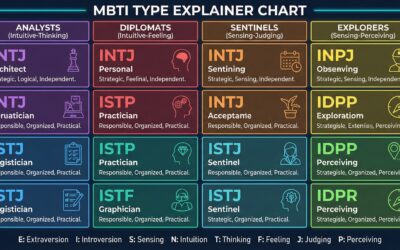
The first large book to come out of the years of crisis was Psychological Types (1921). Jung said it grew from his need to understand why he, Freud and Alfred Adler could look at the same patient and reach incompatible conclusions. His answer was that people differ in temperament. Some people orient chiefly to the outer object and others to their inner, subjective response: extraversion and introversion, two attitudes. People also rely on different functions. Thinking and feeling are judging functions that weigh experience; sensation and intuition are perceiving functions that take it in, sensation through the concrete senses and intuition through possibilities and hunches.5
In Jung’s scheme each person has a dominant function used in one attitude, supported by an auxiliary function, which gives eight basic types. The function opposite the dominant one stays largely unconscious. This “inferior function” is clumsy, touchy and emotional, and it is often where the unconscious breaks through in a crisis: the logical thinker flooded by raw feeling, the intuitive who suddenly cannot manage money or the body.5 Jung meant the typology as a compass for orientation, not a set of boxes. Later writers built tests on it, the Myers-Briggs Type Indicator being the best known, and analysts such as John Beebe extended it into the Beebe model of eight function-archetypes.
The structure of the psyche
Through the 1920s and 1930s Jung set out a map with three layers. Consciousness is organised around the ego, the centre of personal identity, memory and choice. The personal unconscious holds forgotten and repressed material and the complexes. The collective unconscious holds the archetypes, which are common to human beings because they belong to the inherited structure of the human mind, much as instincts belong to the body.6
He described the psyche as self-regulating. In “On Psychic Energy” (1928) he applied the physics of energy to libido: energy withdrawn from one side of life does not vanish but reappears elsewhere, often as a symptom or a compelling dream. One-sided conscious attitudes provoke compensating material from the unconscious. A neurosis, on this view, is not only damage but also an attempt by the psyche to correct its own imbalance, and depression may be the price of a life lived too narrowly.8
Why did Jung study symbols, myths and alchemy?
Jung treated myths, fairy tales, religious rituals and dreams as expressions of the same archetypal patterns. A symbol, for him, was not a disguise for something already known, as he believed a Freudian sign was, but the best possible expression of something not yet fully known. Comparing symbols across cultures, a method he called amplification, let him place a patient’s dream image in the wider family of images it belonged to.6 To gather that material he travelled to North Africa in 1920, to the Taos Pueblo in New Mexico in 1925, and to Mount Elgon in Kenya and Uganda in 1925-1926.1
The decisive key came in 1928, when the sinologist Richard Wilhelm sent him The Secret of the Golden Flower, a Chinese text of inner alchemy. Its images resembled the mandalas he had been painting, and Jung turned to European alchemy and its psychology for the next three decades. In Psychology and Alchemy (1944), built on his 1935 and 1936 Eranos lectures, he argued that alchemists, working alone with substances they did not understand, projected their own unconscious processes into the retort. Their opus of turning base matter into gold could therefore be read as a symbolic record of psychological transformation. The stages of nigredo (blackening), albedo (whitening) and rubedo (reddening) correspond to phases of individuation: the dark disintegration of an old attitude, a cooling clarity, and a living union of opposites.7 His last great work, Mysterium Coniunctionis (1955-1956), returned to the same theme.
Religion and the numinous
Jung’s writings on God and religion took a word from the theologian Rudolf Otto. In Das Heilige (1917; English The Idea of the Holy, 1923), Otto described the numinous, the experience of the holy as a mystery that both terrifies and fascinates (mysterium tremendum et fascinans).12 Jung adopted the term for the overpowering quality of archetypal experience. From William James, whom he met at Clark University in 1909 and admired, he took the pragmatic and empirical attitude of The Varieties of Religious Experience (1902): religious experiences are to be studied for what they do in a life, not dismissed or proved.13 Jung held that the religious function is a natural part of the psyche. He wrote in “Psychotherapists or the Clergy” (1932) that among his patients in the second half of life, every problem came down in the last resort to finding a religious outlook on life, in the broad sense of a living relation to meaning.
What did Jung mean by synchronicity?
Jung’s interest in strange coincidences was not a late turn. It runs from the séances of his student years and his dissertation through his whole career.11 He first used the word “synchronicity” in public in 1930, in his memorial address for Richard Wilhelm, connecting it with the Chinese oracle of the I Ching. His full statement came in 1952, in the essay “Synchronicity: An Acausal Connecting Principle,” published in one volume with the physicist Wolfgang Pauli’s study of Kepler (English 1955, The Interpretation of Nature and the Psyche).8
Jung defined synchronicity as the meaningful coincidence of an inner state and an outer event that are not causally connected. His best-known example comes from his practice: a highly rational patient was telling him a dream about a golden scarab when a rose-chafer beetle tapped at the window, and he caught it and handed it to her, an event that he said broke through her defensive rationalism.8 He argued that such events cluster where an archetype is activated, during crises, deaths and turning points. To support the idea he drew on the statistical card-guessing experiments of J. B. Rhine at Duke University and ran a small astrological study of married couples, while saying himself that its results could not be read as proof.11
Many scientists of his day dismissed these ideas, and Jung knew it. He answered that a psychology faithful to experience could not exclude what patients actually reported. The synchronicity work also changed his picture of the collective unconscious. In “On the Nature of the Psyche” (1947/1954) he called the archetype “psychoid”: at its deepest level it is neither simply mental nor simply physical. With Pauli he speculated that mind and matter may be two aspects of one underlying reality, which he called, borrowing from the alchemist Gerhard Dorn, the unus mundus, or one world.89 The religious scholar Roderick Main has shown that synchronicity was, for Jung, also a critique of a modern culture that had cut meaning off from nature.9
How has analytical psychology spread, and what are the criticisms?
Jung’s influence runs well beyond the consulting room. The Psychological Club in Zurich (1916), the C. G. Jung Institute in Zurich (1948) and the Eranos conferences at Ascona drew together analysts, historians of religion and physicists. Writers and artists from Hermann Hesse to Joseph Campbell took up his ideas, and words he coined or popularised, such as complex, introvert, extravert and shadow, entered ordinary speech. Within psychotherapy his legacy includes the idea that a dream speaks for itself, the use of art and imagination in treatment, the focus on the second half of life, and the analyst’s own analysis as part of training, which Jung was among the first to insist on.10
His legacy also has real shadows, which informed admirers name. Critics have found his theories hard to test and his writing on women and on non-European peoples marked by the assumptions of his time. His long relationship with Toni Wolff, who was also his colleague, was conducted openly alongside his marriage. The heaviest charge concerns the 1930s: in 1933 Jung became president of the General Medical Society for Psychotherapy, whose German branch was brought into line with the Nazi state, and in 1934 he published remarks contrasting “Jewish” and “Germanic” psychology. He also changed the society’s rules so that Jewish doctors expelled from the German branch could stay on as individual members, and in the war years he shared his observations of Hitler with Allied intelligence. Historians still argue about how to weigh these facts.10
After his death in Küsnacht on 6 June 1961, analytical psychology divided into schools. The classical school stayed close to Jung’s own method; the developmental school in London joined his ideas with infant research and object relations; James Hillman‘s archetypal psychology focused on the image itself. Each school revises Jung in the light of newer knowledge, and Jungian analysis today is taught and practised on every continent.
What does Jung’s development mean for therapy today?
The order of Jung’s life explains the shape of his method. Because his ideas grew out of his own crisis, a Jungian therapist treats a breakdown as possibly meaningful, not only as a malfunction to be removed. Because he found complexes in reaction times before he found archetypes in myth, his psychology starts from what is observable in the session: a hesitation, a charged word, a change in the body, a recurring dream.
In practice, this means a therapist working in the Jungian way does several concrete things. They take dreams seriously and work with the dreamer’s own associations before reaching for myth. They help a person notice when a complex has taken over, the moment when someone hears their father’s contempt in a manager’s mild comment. They look for the shadow in what a person most hates in others, and for the inferior function in the area of life that keeps breaking down. They use active imagination, drawing or dialogue with inner figures to let the psyche speak in its own images. This work suits people in midlife transitions, people with recurring dreams or depression that has no obvious cause, and people whose religious or moral frame has collapsed.
At Taproot we see a direct line from Jung’s complexes to modern trauma work. A complex is an emotionally charged pattern that lives partly in the body and fires before thought, and approaches such as Brainspotting for trauma work with those patterns at the level of attention, sensation and the nervous system. Jung’s view that the psyche moves on its own toward balance, given the right conditions, is close to what body-based trauma therapists observe when stuck experiences begin to resolve.
Jung spent his life treating the psyche as a living system that seeks wholeness and meaning, and he worked that out first on himself. At Taproot we bring that attitude into the room: dreams, images, the body and the hard question of what a life is for all belong in therapy. If that is the kind of work you are looking for, our Jungian depth therapy in Hoover is a place to start.
Frequently asked questions
When and where was Carl Jung born?
Carl Gustav Jung was born on 26 July 1875 in Kesswil, a village on the Swiss shore of Lake Constance. His father, Paul Achilles Jung, was a Swiss Reformed pastor and his mother, Emilie Preiswerk, came from a Basel family of clergy. He grew up mostly near Basel, studied medicine there from 1895 to 1900, and died in Küsnacht near Zurich on 6 June 1961.
Why did Carl Jung and Sigmund Freud fall out?
Jung and Freud corresponded from 1906 and were close collaborators until 1912. Jung rejected Freud’s insistence that sexuality was the root of all neurosis and that sexual theory be held as dogma. His book Wandlungen und Symbole der Libido (1911-1912) redefined libido as general psychic energy. Personal tensions grew, and in January 1913 they ended their friendship; Jung left the psychoanalytic association in 1914.
What is Jung’s Red Book?
The Red Book, or Liber Novus, is a large illuminated manuscript in which Carl Jung recorded and painted the visions and inner dialogues of his confrontation with the unconscious, which began in 1913. He worked on it from about 1915 to 1930. It stayed private until W. W. Norton published it in 2009, edited and translated by Sonu Shamdasani.
How did Jung’s interest in the occult start?
Jung’s interest began in his family and student years in Basel. From 1895 he attended séances in which his cousin Hélène Preiswerk acted as a medium, and he made them the subject of his 1902 medical dissertation, On the Psychology and Pathology of So-Called Occult Phenomena. He read the medium’s spirits as split-off parts of her personality, an early form of his theory of complexes.
Did Jung believe in synchronicity as a scientific fact?
Carl Jung presented synchronicity, the meaningful coincidence of an inner state and an unrelated outer event, as an empirical observation that a complete psychology had to include. He set out the idea in a 1952 essay published with the physicist Wolfgang Pauli, cited J. B. Rhine’s card-guessing experiments, and linked it to his concept of the psychoid archetype and the unus mundus.
Related reading
- Medard Boss and Daseinsanalysis
- Otto Rank: Pioneer of Birth Trauma Theory and the Will in Psychoanalysis
- Helena Blavatsky and the Theosophical Legacy: Charlatanry, Wisdom, and the Unconscious Mind
- Carl Jung: Explorer of the Soul A Comprehensive Examination of His Life, Work, and Legacy
- The Trial of Carl Jung: Assessing a Legacy
- How Did Jung and Freud’s Parents Effect Their Psychology
References
- Jung, C. G. (1963). Memories, dreams, reflections (A. Jaffé, Ed.; R. Winston & C. Winston, Trans.). Pantheon Books.
- McGuire, W. (Ed.). (1974). The Freud/Jung letters: The correspondence between Sigmund Freud and C. G. Jung (R. Manheim & R. F. C. Hull, Trans.). Princeton University Press.
- Jung, C. G. (1912). Wandlungen und Symbole der Libido: Beiträge zur Entwicklungsgeschichte des Denkens. Franz Deuticke.
- Jung, C. G. (2009). The red book: Liber novus (S. Shamdasani, Ed.; M. Kyburz, J. Peck, & S. Shamdasani, Trans.). W. W. Norton.
- Jung, C. G. (1971). Psychological types (H. G. Baynes, Trans., rev. R. F. C. Hull; Collected Works Vol. 6). Princeton University Press. (Original work published 1921)
- Jung, C. G. (1968). The archetypes and the collective unconscious (2nd ed.; R. F. C. Hull, Trans.; Collected Works Vol. 9, Part 1). Princeton University Press.
- Jung, C. G. (1968). Psychology and alchemy (2nd ed.; R. F. C. Hull, Trans.; Collected Works Vol. 12). Princeton University Press. (Original work published 1944)
- Jung, C. G. (1969). The structure and dynamics of the psyche (2nd ed.; R. F. C. Hull, Trans.; Collected Works Vol. 8). Princeton University Press.
- Main, R. (2004). The rupture of time: Synchronicity and Jung’s critique of modern Western culture. Brunner-Routledge. https://doi.org/10.4324/9780203501467
- Shamdasani, S. (2003). Jung and the making of modern psychology: The dream of a science. Cambridge University Press.
- Main, R. (Ed.). (1997). Jung on synchronicity and the paranormal. Princeton University Press.
- Otto, R. (1923). The idea of the holy (J. W. Harvey, Trans.). Oxford University Press. (Original work published 1917)
- James, W. (1902). The varieties of religious experience: A study in human nature. Longmans, Green.









0 Comments