
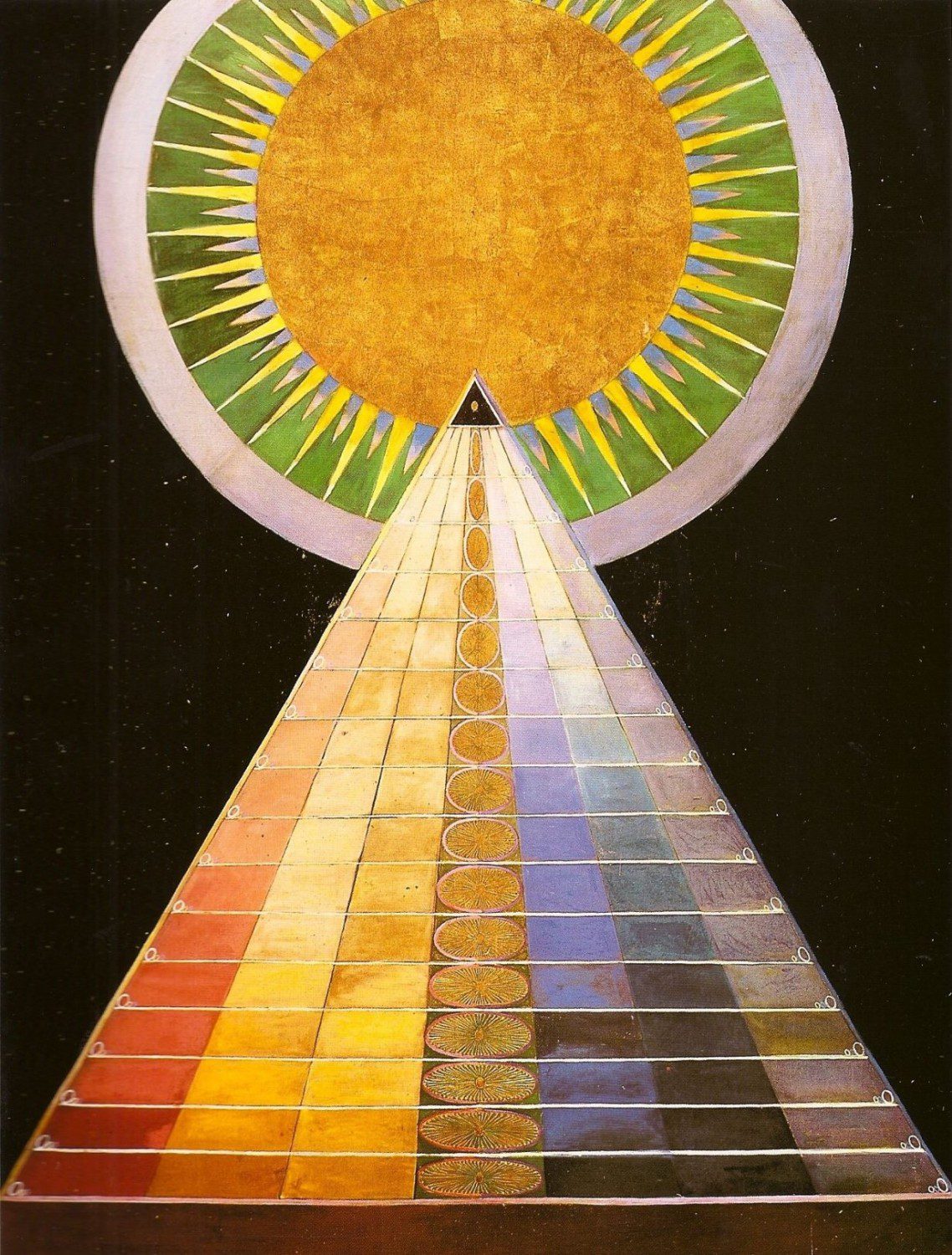
Gerhard Dorn (born around 1530, died after 1584) was a Paracelsian physician and alchemist from Mechelen who translated Paracelsus into Latin in Basel.1 His alchemy aimed less at gold than at healing and self-knowledge. In Carl Jung’s reading, he described the work as three unions: of soul and spirit apart from the body, of that united mind with the body, and of the whole person with the unus mundus.2
That three-step scheme is why Jung kept coming back to Dorn, and it is the part of Dorn a therapist can still use. The point, as Jung read it, is that insight is only the first stage. Understanding that stays in the head, cut off from the body and from the world a person lives in, is a halfway house. It also makes Dorn unusual among alchemists: he is good evidence for how one sixteenth-century Christian Paracelsian thought about the inner life, and weak evidence for the popular idea that all alchemy was secretly psychology.
Who Gerhard Dorn was
The documented facts are few. Carlos Gilly’s entry in the Swiss historical dictionary gives his birth as around 1530 in Mechelen, then a town of the Habsburg Netherlands and now in Belgium; Thomas Willard puts it nearer 1535.1, 3 Dorn studied at Tübingen in 1559, was in Besançon in 1565 and in Lyon in 1566 and 1567.1 His first book, the Clavis totius philosophiae chymisticae (Key to the whole chymical philosophy), was printed at Lyon in 1567 by the heirs of Jacques Giunta. Its dedication, dated 1 August 1566, goes to Adam von Bodenstein, the Basel physician who had been bringing Paracelsus’s manuscripts into print, and credits Bodenstein and Paracelsus with what Dorn knew.4, 5
From 1568 he lived for about thirteen years in Basel, translating Paracelsus’s German writings into Latin for the printer Pietro Perna and publishing his own books on spagyric, that is chemical, medicine.1 Latin carried Paracelsus to learned readers across Europe. Dorn’s editions for Perna include the Pyrophilia (1568), the Philosophiae magnae collectanea (1568–69), a surgical book on wounds (1569) and the ten books of the Archidoxis (1570).4 After a falling-out with Perna, Dorn took his work to the Basel printer Thomas Guarin, and from about 1581 he lived in Frankfurt.1 The Frankfurt years produced the Congeries Paracelsicae chemiae on the transmutation of metals (1581), De naturae luce physica (1583), a Dictionarium Theophrasti Paracelsi (1583) and an edition of Paracelsus’s De vita longa (1583).4 He died in Frankfurt some time after 1584.1
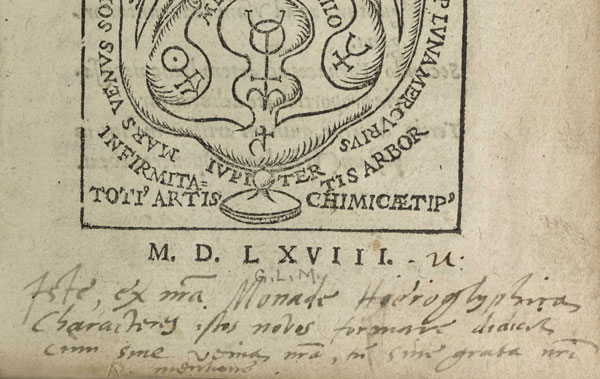
Two details show his world. Gilly notes that Dorn never escaped the suspicion of passing off his own writing as Paracelsus’s, especially the Aurora philosophorum he published in 1577.1 And the woodcut above, dated 1568, adapts the monad glyph John Dee had published four years earlier in Monas Hieroglyphica (Antwerp, 1564); a handwritten Latin note under it names Dee’s book. After his death the first volume of Lazarus Zetzner’s Theatrum Chemicum (1602) reprinted a run of his treatises, among them the Speculativa philosophia and the Philosophia meditativa.
Alchemy as moral medicine
Dorn’s prefaces are the best guide to what he thought alchemy was for. In the 1567 Clavis he tells readers he learned more from his own mistakes and failures than from reading, warns them off using the art to transmute common metals, and argues that its real value lies in healing the body. He adds that its principles carry moral implications and that a reader has to climb through philosophical stages to understand it.5 Willard sums up the book as turning alchemy into an allegory of good living, with moral as well as medical uses.3
He was also a polemicist. In a 1568 dedication to Margrave Karl II of Baden-Durlach he attacks the scholastic and pagan philosophy of the schools and presents Paracelsus as chosen by God to reform both philosophy and medicine. The preface to his Chymisticum artificium naturae (1568) traces the true philosophy back to the Egyptians and to Hermes Trismegistus, the legendary sage behind the Hermetic writings.5 Gilly writes that Dorn’s blend of alchemical philosophy, number symbolism and Paracelsian doctrine, in the Clavis of 1567 and the Monarchia triadis of 1577, had a wide influence and impressed modern scholars, Jung among them.1
At the center of his thought is self-knowledge. In the Philosophia meditativa Dorn argues that no one can know himself without knowing what, and not who, he is, on whom he depends and to what end he was made, and he ties that knowledge tightly to knowledge of God.2 For a clinician that is the useful distinction: “who” is the story the ego tells, and “what” includes the drives, moods and dependencies the story leaves out.
The strangest passage Jung analyzed is a recipe. Dorn describes a preparation called the caelum (heaven), made with honey, celandine, rosemary, dog’s mercury, the lily and human blood, which he identified with a celestial substance: the hidden truth, the treasure concealed in the human being.2 Jung did not treat the recipe as chemistry gone wrong. He argued that the alchemists worked with herbs and with psychic states at the same time, naming the states after the substances, so that honey carried the sweetness of life and rosemary the power to bind.2
The three stages of union
Jung reconstructs Dorn’s scheme in the long chapter of Mysterium Coniunctionis called “The Conjunction.”2 Laid out plainly, it runs like this.
First, the unio mentalis. Soul and spirit join each other and withdraw from the body. The alchemists experienced this as a voluntary death. Jung compared it to a dissociation of the personality: the parts of the personality are taken apart and seen separately, a violation of the merely natural man.2
Second, the return to the body. The united mind is joined to the body again, the chymical marriage of the texts. Jung credits Dorn with grasping what is at stake psychologically: the insight gained in the first stage has to be made real, lived by a person who now knows his own contradictions. Jung treated that realization as the crux of individuation and said it was not yet fully understood. For this second union Dorn says a balsam or quintessence hidden in the human being has to be drawn out, and the caelum recipe belongs here.2
Third, union with the unus mundus. The whole person, body included, is united with the one world, which Jung glosses as the undivided world before creation, before psyche and matter came apart. Jung called mandala symbolism its psychological equivalent and synchronicity its parapsychological one, and he called Dorn’s idea the Western counterpart of the Chinese union of yang and yin in the Tao.2 Marie-Louise von Franz carried the psyche and matter question further in Number and Time (1974).6
Two corrections to the way Dorn is often presented follow from this. The unus mundus is the goal of his third stage, not the foundation of a monist system, and its modern fame owes as much to Jung as to Dorn. And Dorn’s method does not begin with oneness at all. The first stage is a deliberate separation of mind from body. Wholeness comes at the end, after a split made on purpose.
Why Jung kept returning to Dorn
Jung did not come to alchemy cold. In the mythological reading that led to Transformations and Symbols of the Libido (1911–1912), he came across Friedrich Creuzer’s Symbolik und Mythologie der alten Völker, which, he later wrote, fired him; he found himself treating its gods and nymphs as though they were patients.7 Creuzer, the Heidelberg mythographer whose symbol theory fed early psychology, taught him to read old symbol systems as evidence about the mind. In 1914 the Austrian analyst Herbert Silberer published a psychoanalytic reading of an alchemical parable, and at the close of Mysterium Coniunctionis Jung credits Silberer with first finding the link between alchemy and modern psychology.2
Dorn turns up across the alchemical volumes of the Collected Works. “Paracelsus as a Spiritual Phenomenon” contains a long section on Dorn’s commentary on Paracelsus’s De vita longa, where Jung reads the half-fish Melusina as a figure of the anima. “The Philosophical Tree” works through Dorn’s picture of a tree whose branches run through the earth like veins and whose blood-like sap sets into fruit.8 Mysterium Coniunctionis draws on Dorn’s Speculativa philosophia for its account of the conjunction.7, 2
With most alchemical texts Jung had to argue that psychological content had been projected into the recipes. Dorn says it outright: the art has moral uses, self-knowledge is where it starts, and gold is not the point. For a psychologist looking for old evidence of inner transformation pictured in chemical images, Dorn was the most cooperative witness available.
Willard draws a useful line between Dorn and his modern readers. Paracelsians treated imagination as a faculty of the mind, an aid to divination and to finding correspondences between inner and outer worlds. Jung and his school treat it as a process. Von Franz, in lectures later published as Alchemical Active Imagination, found something close to Jung’s active imagination in Dorn’s tract on speculative philosophy.3, 9 It is a productive reading, but “active imagination” is Jung’s term, not Dorn’s.
What historians of alchemy dispute
Historians have spent decades pulling alchemy back from the psychological reading. In a 2001 essay Lawrence Principe and William Newman traced the idea that alchemy was really about transforming the alchemist’s soul to nineteenth-century occultism, especially Mary Anne Atwood in England and Ethan Allen Hitchcock in the United States, and showed how Jung and Mircea Eliade carried it into twentieth-century scholarship. Their objection is that the reading flattens a complicated tradition and imposes anachronistic categories, when many alchemical images simply describe laboratory operations.10 Newman has since summarized what closer reading of the sources found: alchemists ran experiments alongside theory, argued for stable “chymical atoms” and were among the first to state the principle of mass balance.11
Christopher Wagner’s 2018 Cambridge dissertation on how Jung built his alchemical studies does not support using Jung’s findings to write the history of Western alchemy, though it takes Jung seriously as the maker of a distinctive “psycho-alchemical” art of his own.7 The argument is not closed. Hereward Tilton’s study of the Lutheran alchemist Michael Maier sets itself inside the continuing debate over how far early modern alchemy was a spiritual practice.12
Dorn sits in an odd place in that argument. He is the case the psychological reading handles best, because his own prefaces moralize the art. He was also a working Paracelsian who edited books on metallic transmutation and wound surgery and wrote a practical section on furnaces and manual work into his Chymisticum artificium.4, 5 He shows that some alchemists understood the work as moral and spiritual discipline, not that the metallurgists, assayers and apothecaries behind many alchemical texts were secretly doing depth psychology.
Jungians have their own doubts about the third stage. Ladson Hinton, introducing a panel published in the Journal of Analytical Psychology in 2011, argued that the longing for unchanging foundations behind the concept of the unus mundus can turn totalizing, with ethical costs that reach as far as utopian projects that eliminate whoever is deemed “impure.”13 A similar caution applies to filing Dorn under a universal perennial philosophy, the frame often brought to Ibn ‘Arabi and other mystics of divine unity. Dorn’s convictions were specific: Christian, Paracelsian and hostile to the schools, and folding him in with every mystic of oneness loses that.
What this looks like in therapy
Dorn’s sequence works better as a map of where people get stuck in therapy than as a ladder to enlightenment.
The first stage is getting enough distance to see. Much early work in depth-oriented therapy is unio mentalis in Dorn’s sense: stepping back from what moods and reflexes are doing long enough to notice the pattern, name it and connect it to its history. Daily self-examination is far older than alchemy; Marcus Aurelius’s notebooks to himself are one ancient model. A 2018 meta-analysis of 23 effect sizes across therapy types found a moderate correlation, r = 0.31, between patients’ insight and treatment outcome.14 A correlation does not prove that insight causes change, and it leaves most of the variation in outcome unexplained.
The second stage is where many people stall. A person can describe an attachment pattern precisely and still flood with panic when a partner goes quiet. In Dorn’s terms they have the mental union without the return to the body. Work at this stage brings insight down into sensation, breathing and behavior, and back into relationships, where it can be tested. Body-oriented approaches are built for this, though the evidence is younger than the enthusiasm: a 2021 scoping review of Somatic Experiencing found preliminary evidence of benefit for PTSD symptoms, judged the study quality mixed and called for unbiased randomized trials.15 Our somatic therapy in Birmingham is aimed at this second stage, with that evidence in view.
The same stall has a spiritual form. Someone uses meditation, prayer or a metaphysical vocabulary to stay above grief and anger rather than move through them. Clinicians call this spiritual bypass, and researchers have built a scale to measure it.16 Dorn would recognize it as the first stage mistaken for the whole work.
The third stage is relationship to something larger than the self. Read clinically, the unus mundus is not a merger with the cosmos. It is the point at which a changed inner life starts to show in work, love, obligation and meaning, and the sense of being split off from the world eases. Here depth work borders on existential therapy and its questions of meaning and mortality. Jung’s discussion of the first two stages carries a warning that applies here as well: the analyst can supply the first insight, but the experience of the self belongs to the patient alone, and the step from appreciating one’s fantasies to judging them morally and intellectually is essential for some people and also dangerous.2 Hinton’s critique is a useful check on any therapist tempted to promise wholeness.13
Jung’s own clinical tool for this territory was active imagination, in which a person lets a series of images arise from the unconscious and then engages them, shadow figures included.2 The evidence for Jungian therapy as a whole is real but modest. It comes mostly from naturalistic studies in Germany and Switzerland, without randomized control groups, which report lasting improvement over courses averaging about 90 sessions.17 That supports offering it as one option, not as a proven treatment for any particular condition.
If the idea of insight that has to be carried back into the body and into a life sounds familiar, that is the work Jungian depth therapy at Taproot is organized around. You can read how we approach it there, or contact us with questions.
References
- Gilly, C. (2004). Dorn, Gerhard. In Historisches Lexikon der Schweiz (HLS) (version of 2001, edited 14 April 2004). https://hls-dhs-dss.ch/de/articles/042845/2004-04-14/
- Jung, C. G. (1970). Mysterium coniunctionis: An inquiry into the separation and synthesis of psychic opposites in alchemy (R. F. C. Hull, Trans.; 2nd ed.; The Collected Works of C. G. Jung, Vol. 14). Princeton University Press. (Original work published 1955–1956)
- Willard, T. (2021). The star in man: C. G. Jung and Marie-Louise von Franz on the alchemical philosophy of Gerard Dorn. Psychological Perspectives, 64(1), 9–36. https://doi.org/10.1080/00332925.2020.1852812
- Theatrum Paracelsicum. (n.d.). Bibliographia Paracelsistarum: Gerhard Dorn. Retrieved November 8, 2026, from https://www.theatrum-paracelsicum.com/Bibliographia_Paracelsistarum/Gerhard_Dorn
- Theatrum Paracelsicum. (n.d.). Authors: Gerhard Dorn (summaries of his dedications and prefaces). Retrieved November 8, 2026, from https://www.theatrum-paracelsicum.com/Authors/Gerhard_Dorn
- von Franz, M.-L. (1974). Number and time: Reflections leading toward a unification of depth psychology and physics. Northwestern University Press.
- Wagner, C. F. (2018). Of books and fire: Approaching the alchemy of Carl Gustav Jung (Doctoral dissertation, University of Cambridge). Apollo. https://doi.org/10.17863/CAM.37801
- Jung, C. G. (1967). Alchemical studies (R. F. C. Hull, Trans.; The Collected Works of C. G. Jung, Vol. 13; Bollingen Series XX). Pantheon Books.
- von Franz, M.-L. (1997). Alchemical active imagination (Rev. ed.). Shambhala. (Original work published 1979)
- Principe, L. M., & Newman, W. R. (2001). Some problems with the historiography of alchemy. In W. R. Newman & A. Grafton (Eds.), Secrets of nature: Astrology and alchemy in early modern Europe. MIT Press.
- Newman, W. R. (2011). What have we learned from the recent historiography of alchemy? Isis, 102(2), 313–321. https://doi.org/10.1086/660140
- Tilton, H. (2003). The quest for the phoenix: Spiritual alchemy and Rosicrucianism in the work of Count Michael Maier (1569–1622). De Gruyter. https://doi.org/10.1515/9783110896572
- Hinton, L., III. (2011). Introduction: Fragmentation of the unus mundus. Journal of Analytical Psychology, 56(3), 375–380. https://doi.org/10.1111/j.1468-5922.2011.01915_1.x
- Jennissen, S., Huber, J., Ehrenthal, J. C., Schauenburg, H., & Dinger, U. (2018). Association between insight and outcome of psychotherapy: Systematic review and meta-analysis. American Journal of Psychiatry, 175(10), 961–969. https://doi.org/10.1176/appi.ajp.2018.17080847
- Kuhfuß, M., Maldei, T., Hetmanek, A., & Baumann, N. (2021). Somatic experiencing – effectiveness and key factors of a body-oriented trauma therapy: A scoping literature review. European Journal of Psychotraumatology, 12(1), Article 1929023. https://doi.org/10.1080/20008198.2021.1929023
- Fox, J., Cashwell, C. S., & Picciotto, G. (2017). The opiate of the masses: Measuring spiritual bypass and its relationship to spirituality, religion, mindfulness, psychological distress, and personality. Spirituality in Clinical Practice, 4(4), 274–287. https://doi.org/10.1037/scp0000141
- Roesler, C. (2013). Evidence for the effectiveness of Jungian psychotherapy: A review of empirical studies. Behavioral Sciences, 3(4), 562–575. https://doi.org/10.3390/bs3040562







0 Comments