
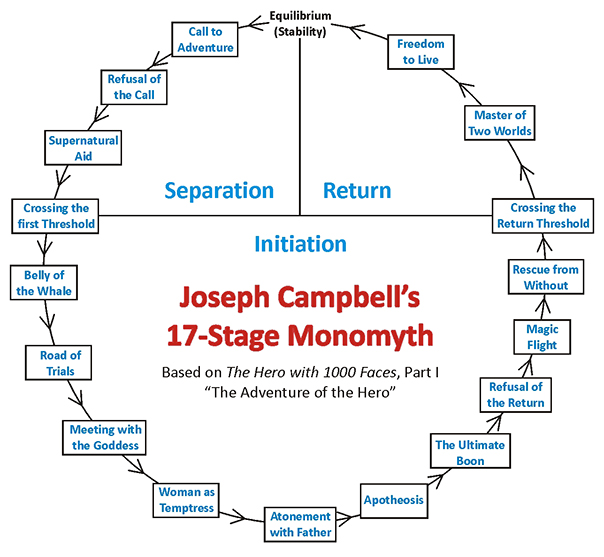
In therapy, the hero’s journey works as a map, not a treatment. Joseph Campbell’s 1949 pattern of separation, initiation and return describes a shape that change often takes. Something calls, the person resists, a guide helps them approach what they have been avoiding, and the hardest part is bringing what they learned back into ordinary life. Used carefully, the map helps people see where they are stuck.
My argument is narrower than most writing on the subject. The monomyth does not earn its place in a therapy room by making clients feel heroic. It earns it because its hinge points match what clinicians actually see. The refusal of the call is ambivalence that is protecting something. The ordeal is contact with what has been avoided, made inside a relationship steady enough to hold it. And the return, a stage Campbell said heroes often refuse, is where change either becomes part of ordinary life or quietly fades. Popular versions of the hero’s journey tend to stop at the victory. Therapy spends most of its time on the road home.
What Campbell actually described
Campbell published The Hero with a Thousand Faces in 1949 through Pantheon Books, as the seventeenth title in the Bollingen Series. He borrowed the word “monomyth” from James Joyce’s Finnegans Wake and boiled the pattern down to one sentence: “A hero ventures forth from the world of common day into a region of supernatural wonder: fabulous forces are there encountered and a decisive victory is won: the hero comes back from this mysterious adventure with the power to bestow boons on his fellow man.”1
He did not invent the three-part skeleton. In Les rites de passage (1909), the ethnographer Arnold van Gennep divided rites of passage into a preliminary phase of separation, a liminal phase of transition and a post-liminal phase of incorporation, when the person rejoins the community in a new status.2 Campbell turned that into departure, initiation and return, and hung seventeen stages on it, shown in the diagram above, from the call to adventure to freedom to live. Our piece on initiation rites and what they offer therapy follows those ritual roots.
Many of the stage names people quote today come from somewhere else. “The Ordinary World,” “Meeting with the Mentor,” “The Ordeal” and “Return with the Elixir” belong to Christopher Vogler. At Disney, Vogler wrote a seven-page memo called “A Practical Guide to The Hero with a Thousand Faces,” then expanded it into The Writer’s Journey (1992; third edition 2007), which compresses Campbell into twelve stages for screenwriters.3 He later contributed story material to The Lion King, and George Lucas has said openly that Campbell shaped Star Wars. Writers use the pattern well, as in our piece on how parts-based psychology helps writers build characters, but Vogler’s version is a plot template. Campbell was making a claim about the psyche.
Much of that claim came from psychoanalysis. Campbell drew on Freud and on Jung’s archetypes, and he cited the psychoanalyst Otto Rank’s The Myth of the Birth of the Hero (1909), an earlier attempt to find one pattern in hero legends. Lord Raglan proposed a similar list of hero traits in 1936. Jung’s 1911–12 book, later revised as Symbols of Transformation, read one young woman’s fantasies against a vast range of myth, and Jung later said its publication cost him his friendship with Freud.4 Reading myth as symbol rather than as primitive error is older still, running back to nineteenth-century mythographers like Friedrich Creuzer, author of Symbolik und Mythologie der alten Völker (1810–12), and continued alongside Campbell in Karl Kerényi, who wrote Essays on a Science of Mythology with Jung. For Campbell’s wider thought, see our longer piece on Joseph Campbell’s mythic wisdom and what it offers psychotherapy.
Why a myth can map a therapy at all
Psychologists who study narrative identity treat the life story as part of personality: an internalized, evolving account that gives a life some unity and purpose. Reviewing that research, Dan McAdams and Kate McLean report that people who find redemptive meaning in adversity, and whose stories feature personal agency, tend to show better mental health and well-being, though the causal direction is not settled.5 Jonathan Adler followed 47 adults through psychotherapy, collecting a written narrative before treatment and after every session across 12 assessment points. Themes of agency grew over the course of therapy, and the rise in agency came before the related improvement in mental health, not after it.6
The hero’s journey itself has now been tested. Across eight studies, Benjamin Rogers, Kurt Gray and colleagues distilled it into seven elements (protagonist, shift, quest, allies, challenge, transformation and legacy) and built a scale to measure how strongly a life story contains them. Higher scores went with more meaning in life, in online samples and in a community sample of older adults. A “restorying” exercise, in which people retold their own lives along those lines, raised meaning in life and, in the final study, resilience.7 These were not therapy patients, and meaning is not symptom relief. But the work supports a modest claim: how a person organizes their story changes what they can do with it. Narrative therapy, which Michael White and David Epston set out in 1990, rests on a similar idea.8
The hero’s journey in therapy, stage by stage
What follows maps Campbell’s stages onto a course of therapy. These are common patterns, not any one person’s story, and real therapy rarely runs in order.
The call
The call usually arrives as a symptom: panic that starts in a meeting, a marriage gone quiet, drinking that has stopped working, a promotion that should feel good and does not. Sometimes it is simply a life that no longer fits. The symptom is the herald, announcing that the old arrangement has stopped working whether or not the person is ready to hear it.
Refusal of the call
Campbell was blunt: “Refusal of the summons converts the adventure into its negative.”1 In therapy, refusal looks like cancelled first appointments, a request for “just some coping skills,” or a long account of why nothing can change. Psychotherapy has long called this resistance. It is more useful to read it as information. Refusal is ambivalence, and the ambivalence is usually guarding something: a relationship, a role, a self-image, or a feeling the person is not sure they can survive. How the therapist responds matters. In a meta-analysis of 12 studies with 1,102 patients, clients high in trait reactance did better with less directive treatment and clients low in reactance did better with more directive treatment, a large effect (d = .82).9 Pushing a reluctant hero through the gate tends to backfire.
The mentor and the threshold
The hero who answers the call meets what Campbell called “supernatural aid,” a protective figure who equips them for what lies ahead. The therapy equivalent is the working alliance: the bond between client and therapist and their agreement about goals and tasks. Across 295 studies and more than 30,000 patients, alliance quality correlated with outcome at about r = .28, and the link held across treatment approaches.10 That is a correlation, not proof of cause, but it is one of the steadiest findings in the field. The mentor’s job is to make the crossing possible, not to make it for the hero.
At the threshold, in Campbell’s words, “the powers that watch at the boundary are dangerous.” Past it lies the belly of the whale, the hero swallowed by the unknown, which he read as “a transit into a sphere of rebirth.”1 Clinically, this is the stretch where old coping strategies have been named and loosened but nothing has replaced them yet. Some people feel more raw here, not less. That is part of the passage and a reason to slow down, not a sign the work is failing.
The road of trials and the ordeal
The middle of the journey is where the hero meets what was avoided. Many of the problems that bring people to therapy are kept going, at least in part, by avoidance of memories, feelings, bodily sensations and thoughts. Steven Hayes and colleagues proposed this experiential avoidance as a common process running across many diagnoses.11 Exposure therapy, acceptance and commitment therapy and trauma processing all ask the person, in different ways, to turn toward what they have been fleeing. In Jungian terms, the ordeal is the meeting with the shadow: disowned parts of the self, often met first in projected form as an enemy, a rival or a monster.
Parts-based therapy adds a refinement the dragon-slaying stories miss. The inner villain is often a protector, like the critic that tries to prevent humiliation or the numbness that once made an unbearable situation survivable. In parts-based therapy, the aim is not to kill the monster but to learn what it guards, which is closer to Jung’s idea of integrating the shadow than to slaying it. Trauma work also has to respect pacing. A hero sent into the cave without a lamp does not come back with a boon. They come back flooded.
The boon, and the refusal to go home
The boon is whatever the ordeal yields: a memory that finally makes sense, a grief that can finally be felt, the ability to say no. Then comes the stage most people skip. Campbell wrote that the hero “still must return with his life-transmuting trophy,” yet “the responsibility has been frequently refused. Even the Buddha, after his triumph, doubted whether the message of realization could be communicated.”1 The clinical version is familiar: the breakthrough session, retreat or workshop that felt life-changing and has evaporated by the following Tuesday. Insight in the consulting room is not yet change in a marriage, an office or a family that preferred the old arrangement, and the people at home often push back.
Master of the two worlds
Campbell’s last stages describe a hero who can pass back and forth between worlds, “not contaminating the principles of the one with those of the other,” and who is no longer run by fear of the next moment.1 In therapy this looks less like enlightenment and more like range. The person can feel the old pull of panic or shame, recognize it, and still choose. When that holds in ordinary life without the therapist in the room, it is time to talk about ending.
A documented case: Rowland Hazard, Jung and Bill Wilson
The early history of Alcoholics Anonymous is a documented illustration, and in it the return decides the outcome.
Rowland Hazard III (1881–1945), an American businessman from a prominent Rhode Island family, went to Zurich to be treated by Jung for his drinking. Bill Wilson later placed that treatment around 1930 or 1931. Working from previously unexamined family and Jung correspondence, Amy Colwell Bluhm showed that it began in 1926.12 Hazard drank again after coming home and went back to Jung. In the account later printed in AA’s basic text, which does not name him, Jung judged him “utterly hopeless” and said the only exceptions he knew of were alcoholics who had “what are called vital spiritual experiences.” Hazard went looking for one in the Oxford Group, an evangelical Christian movement.
In 1934, Hazard and other Oxford Group members helped Ebby Thacher, an old drinking friend of Wilson’s, get sober, and in November Thacher visited Wilson in Brooklyn. Shortly afterward, during his last stay at Charles B. Towns Hospital in New York under William Duncan Silkworth, Wilson had the experience he described as a bright light, ecstasy and then serenity. His sobriety dates from December 11, 1934. In Akron, Ohio, in 1935, on a failing business trip, he found the surgeon Robert Smith, whose last drink, on June 10, 1935, is the date AA counts as its beginning. The book Alcoholics Anonymous, which first published the Twelve Steps, followed in 1939.
The direct exchange between Wilson and Jung came much later. In 1961 Wilson wrote to thank Jung, and Jung, who died that June, replied that Hazard’s “craving for alcohol was the equivalent, on a low level, of the spiritual thirst of our being for wholeness, expressed in medieval language: the union with God.” He closed: “You see, ‘alcohol’ in Latin is spiritus, and you use the same word for the highest religious experience as well as for the most depraving poison. The helpful formula therefore is: spiritus contra spiritum.” The AA Grapevine published the letters in January 1963.13 The earlier version of this post said Jung’s letter shaped the Twelve Steps. It could not have. The letters were written 22 years after the Steps were published.
Read as a hero’s journey, the story turns less on the bright light than on what came after. Hazard’s call came as a verdict from his doctor, and his first return failed. Wilson’s hospital experience was not the end of it either. In Akron, tempted to drink, he decided that staying sober depended on helping another alcoholic. That is the return with the boon, and AA wrote it into the Twelfth Step, which reads in part: “we tried to carry this message to alcoholics.” That is a reading of the story, not a mechanism anyone has tested. The outcome research on AA itself is a separate question. A 2020 Cochrane review of 27 studies with 10,565 participants found high-certainty evidence, from two trials, that manualized AA and Twelve-Step Facilitation produced more continuous abstinence at 12 months than established treatments such as cognitive behavioral therapy, and appeared to do about as well on most other drinking outcomes, where the evidence was less certain.14 A single longitudinal study, which needs replication, connects this to the narrative research above: newly sober alcoholics whose story of their last drink contained self-redemption, a bad experience followed by positive personal change, were more likely to stay sober over the following months (83 percent versus 44 percent), even after controlling for recovery-program involvement.15
None of this makes AA the right path for everyone, and a mythic frame is no substitute for medical care. Anyone stopping heavy drinking should talk with a physician first, because alcohol withdrawal can be medically serious. We have written separately about how Jungian psychology is shaping addiction recovery.
What this looks like in therapy
The map is more useful in the therapist’s head than in the client’s hands. What it offers is a set of questions. Is this person still refusing the call, and if so, what is the refusal protecting? Are they in the belly of the whale, raw and disoriented, needing steadiness more than technique? Have they brought something back from a session, a retreat or a crisis that has not yet survived contact with home?
Each stage calls for different work. Refusal calls for curiosity about what is being protected, not pressure. The threshold calls for a solid alliance and a clear agreement about pacing. The ordeal is where trauma processing, exposure, shadow work or parts work belongs, and where the therapist watches whether the person is integrating material or being overwhelmed by it. The return calls for unglamorous work: practicing new responses in specific relationships, anticipating how a spouse or coworkers will react, and noticing the pull back toward old roles. Writing one’s own story through the seven elements Rogers and colleagues used can show what a person emphasizes and what they leave out.7
Sometimes the frame has to be set down. Not every kind of suffering is a quest. Grief, chronic illness and depression can be made worse by a story implying the person should be heading toward triumph and is failing if they are not. For some losses, Viktor Frankl’s view that meaning can come from the attitude a person takes toward suffering they cannot change fits better, and we discuss it in our piece on Viktor Frankl’s existential psychology. Critics have also faulted Campbell’s model for centering a masculine journey, and Maureen Murdock’s The Heroine’s Journey (1990) set out a different arc.16
Where the monomyth misleads
Campbell’s scholarship has serious critics. Folklorists have argued that he built the monomyth by citing the stories that fit it and leaving out the many that do not. In an invited plenary address to the American Folklore Society in 2004, published the following year, Alan Dundes treated Campbell as a non-specialist whom the public, and public television, had mistaken for an authority on folklore, and he singled out the popular idea of the archetype as especially damaging to serious folklore study.17
Those criticisms set the map’s limits without making it useless. The hero’s journey is not a law of the psyche or evidence that any treatment works. It is a story shape many people recognize in their own lives, which makes it a good tool for noticing where someone is stuck. What a client needs from the myth is not a promise of victory. It is the knowledge that refusal, disorientation and a hard road home are ordinary parts of change, not proof that they are doing it wrong.
If you recognize yourself somewhere on this map, especially stuck at a threshold or struggling to bring something home, Jungian depth therapy in Hoover is one place to do that work. You can contact Taproot Therapy Collective to talk about whether it fits what you are dealing with.
References
- Campbell, J. (1949). The hero with a thousand faces. Pantheon Books.
- van Gennep, A. (1960). The rites of passage. University of Chicago Press. (Original work published 1909)
- Vogler, C. (2007). The writer’s journey: Mythic structure for writers (3rd ed.). Michael Wiese Productions.
- Jung, C. G. (1967). Symbols of transformation (Collected Works of C. G. Jung, Vol. 5). Princeton University Press. (Original work published 1912)
- McAdams, D. P., & McLean, K. C. (2013). Narrative identity. Current Directions in Psychological Science, 22(3), 233–238. https://doi.org/10.1177/0963721413475622
- Adler, J. M. (2012). Living into the story: Agency and coherence in a longitudinal study of narrative identity development and mental health over the course of psychotherapy. Journal of Personality and Social Psychology, 102(2), 367–389. https://doi.org/10.1037/a0025289
- Rogers, B. A., Chicas, H., Kelly, J. M., Kubin, E., Christian, M. S., Kachanoff, F. J., Berger, J., Puryear, C., McAdams, D. P., & Gray, K. (2023). Seeing your life story as a Hero’s Journey increases meaning in life. Journal of Personality and Social Psychology, 125(4), 752–778. https://doi.org/10.1037/pspa0000341
- White, M., & Epston, D. (1990). Narrative means to therapeutic ends. W. W. Norton.
- Beutler, L. E., Harwood, T. M., Michelson, A., Song, X., & Holman, J. (2011). Resistance/reactance level. Journal of Clinical Psychology, 67(2), 133–142. https://doi.org/10.1002/jclp.20753
- Flückiger, C., Del Re, A. C., Wampold, B. E., & Horvath, A. O. (2018). The alliance in adult psychotherapy: A meta-analytic synthesis. Psychotherapy, 55(4), 316–340. https://doi.org/10.1037/pst0000172
- Hayes, S. C., Wilson, K. G., Gifford, E. V., Follette, V. M., & Strosahl, K. (1996). Experiential avoidance and behavioral disorders: A functional dimensional approach to diagnosis and treatment. Journal of Consulting and Clinical Psychology, 64(6), 1152–1168. https://doi.org/10.1037/0022-006X.64.6.1152
- Bluhm, A. C. (2006). Verification of C. G. Jung’s analysis of Rowland Hazard and the history of Alcoholics Anonymous. History of Psychology, 9(4), 313–324. https://doi.org/10.1037/1093-4510.9.4.313
- The Bill W.–Carl Jung letters. (1963, January). AA Grapevine. https://www.aagrapevine.org/magazine/1963/jan/bill-w-carl-jung-letters
- Kelly, J. F., Humphreys, K., & Ferri, M. (2020). Alcoholics Anonymous and other 12-step programs for alcohol use disorder. Cochrane Database of Systematic Reviews, Article CD012880. https://doi.org/10.1002/14651858.CD012880.pub2
- Dunlop, W. L., & Tracy, J. L. (2013). Sobering stories: Narratives of self-redemption predict behavioral change and improved health among recovering alcoholics. Journal of Personality and Social Psychology, 104(3), 576–590. https://doi.org/10.1037/a0031185
- Murdock, M. (1990). The heroine’s journey. Shambhala.
- Dundes, A. (2005). Folkloristics in the twenty-first century (AFS invited presidential plenary address, 2004). Journal of American Folklore, 118(470), 385–408. https://doi.org/10.1353/jaf.2005.0044









0 Comments