
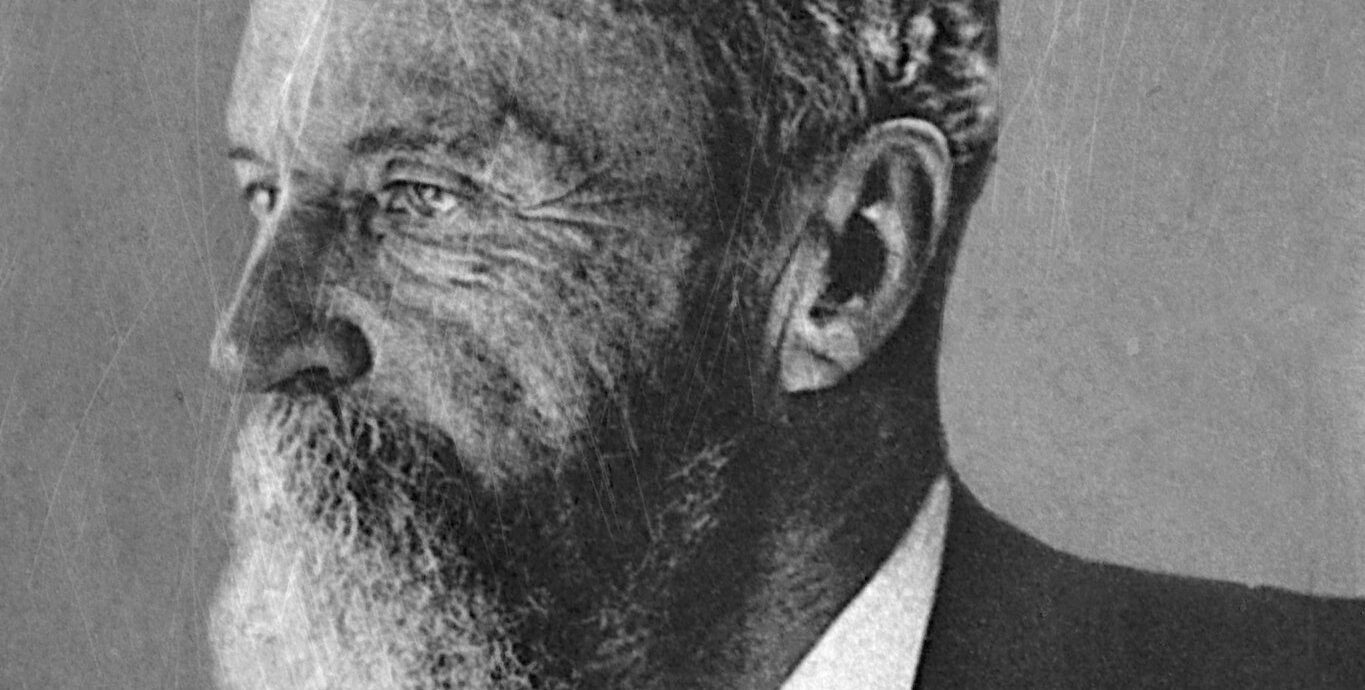
William James (1842–1910) gave psychology five ideas it still works with: the stream of consciousness, the James-Lange theory that bodily changes are part of emotion, a practical science of habit and attention, a self made of several selves, and a psychology of religious and mystical experience. He set them out in The Principles of Psychology (1890) and The Varieties of Religious Experience (1902).
The label “father of American psychology”1 is the least interesting thing about him. His deeper contribution was a rule of evidence. Anything a person actually experiences counts as data, including the feel of the body in fear, the dim margins of awareness, and visions or conversions, and the worth of an experience is judged by what it does in a life, not by where it came from. Alongside Frederic Myers and Théodore Flournoy, James used that rule to treat the hidden, “subliminal” region of the mind as a research problem, a step that anticipated the depth psychology of Freud and Jung. It is still the stance a good therapist takes toward the experiences people are most afraid to mention. That clinical reading is mine; James never wrote a manual for therapists.
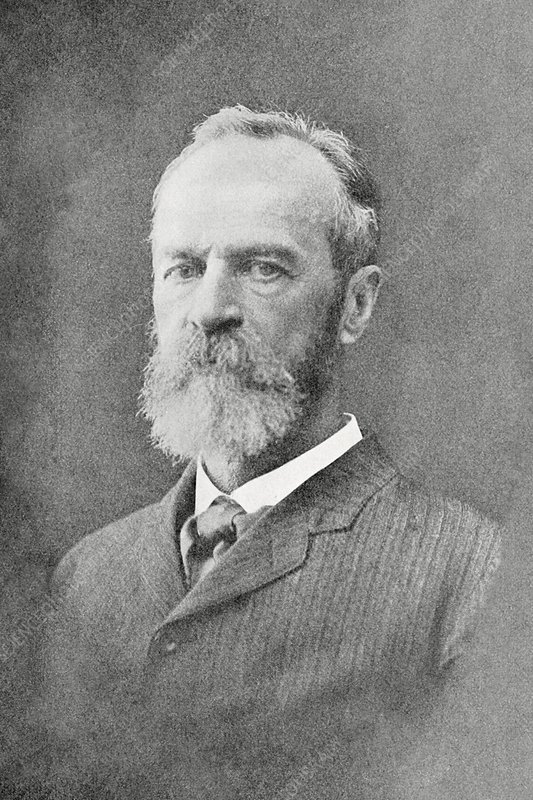
Who William James was
James was born on January 11, 1842, at the Astor House in New York City. His father, Henry James Sr., was an independently wealthy theologian devoted to the Swedish mystic Emanuel Swedenborg; the novelist Henry James was his younger brother.1 William studied painting before entering Harvard’s Lawrence Scientific School in 1861 and its medical school in 1864, joined Louis Agassiz’s Amazon expedition in 1865, and took his M.D. in 1869. He never practiced.2
He was depressed, at times suicidally, in 1866 and again in 1869 and 1870.2 In the “sick soul” lectures of the Varieties, he printed an anonymous French correspondent’s account of “a horrible fear of my own existence” and of waking “morning after morning with a horrible dread at the pit of my stomach.” He later admitted to Frank Abauzit, his French translator, that the case was his own.3, 4 American psychotherapy grew up in an age of nervousness that shaped how doctors treated the mind, and its founders were not always observing from the outside.
James recorded a turning point in a notebook entry dated April 30, 1870. Reading the French philosopher Charles Renouvier, James decided that free will, “the sustaining of a thought because I choose to when I might have other thoughts,” need not be an illusion. “My first act of free will shall be to believe in free will,” he wrote.3 It is the closest thing in his writings to a line shared everywhere under his name, “The greatest weapon against stress is our ability to choose one thought over another,” which I could not find in his books or published letters.
Harvard hired him in 1872 to teach physiology. In 1874–75 he began teaching psychology and set up what the Stanford Encyclopedia of Philosophy counts as the first American psychology laboratory.2 He became a full professor in 1885 and retired in 1907.1 He was president of the American Psychological Association in 1894 and 19045 and of the British Society for Psychical Research in 1894–95.6 He died of heart failure at Chocorua, New Hampshire, on August 26, 1910.1
The stream of consciousness, and a textbook myth
Chapter IX of the Principles, “The Stream of Thought,” argued that the mind cannot be chopped into atoms of sensation. Consciousness “is nothing jointed; it flows. A ‘river’ or a ‘stream’ are the metaphors by which it is most naturally described.”7 He did not coin the phrase: Alexander Bain wrote of “one common stream of consciousness” in 1855. May Sinclair first applied the term to fiction in 1918, reviewing Dorothy Richardson, and critics later stretched it to Joyce and Woolf.8
The textbook contrast between Wundt’s “structuralism” and James’s “functionalism” also needs care. “Structural psychology” was the label of Wundt’s student Edward Titchener, in an 1898 paper, and the historian Thomas Leahey has argued that Titchener’s system was not a faithful copy of Wundt’s.9 In 1909 James summed up the interests he shared with Flournoy as “‘Functional psychology,’ and the twilight region that surrounds the clearly lighted centre of experience.”3 Consciousness science still argues over that border, as in Stanislas Dehaene’s work on how conscious access “ignites” in the brain. A companion piece covers James’s pragmatism and the roots of modern psychotherapy.
Emotion and the body
James first published his theory of emotion in Mind in 1884, as “What Is an Emotion?”, not in the Principles.10 The Danish physician Carl Lange published a similar theory in 1885, hence the double name.7 In the Principles James put it bluntly: “we feel sorry because we cry, angry because we strike, afraid because we tremble.” Without the bodily changes, a perception “would be purely cognitive in form, pale, colorless, destitute of emotional warmth.”7
Walter Cannon’s 1927 critique was the best-known early objection: cutting visceral feedback did not abolish emotional behavior in his cats, the same visceral changes occur in fear, rage, fever and cold, and the viscera are too insensitive and too slow to tell one emotion from another.11 Schachter and Singer’s 1962 experiments added a second step: how a person labels the arousal.12
The present picture is a qualified win for James. Interoception research treats signals from inside the body as a real contributor to emotional feeling, including fear-specific effects tied to the heartbeat.13 The shortcut version has fared worse: when 17 labs repeated the 1988 pen-in-the-teeth study, the original difference of 0.82 points in cartoon ratings shrank to 0.03.14 A meta-analysis of 138 facial-feedback studies found effects that are “small and variable,”15 and a preregistered study of 3,878 people in 19 countries found that deliberately posing or mimicking a smile could nudge happiness, while the pen method stayed inconclusive.16 The body is part of emotion. It is not a switch that produces a feeling on demand.
Habit, attention and the many selves
“Habit is thus the enormous fly-wheel of society,” the Principles says, and its first lesson is to “make our nervous system our ally instead of our enemy.” James’s second maxim was severe: “Never suffer an exception to occur till the new habit is securely rooted in your life,” because “a single slip undoes more than a great many turns will wind again.”7 One modern study is kinder. Among 96 volunteers building a daily habit, the time to reach 95 percent of each person’s automaticity plateau ranged from 18 to 254 days in those whose data could be modelled, and missing one opportunity “did not materially affect the habit formation process.”17
On attention he wrote that “the faculty of voluntarily bringing back a wandering attention, over and over again, is the very root of judgment, character, and will,” and admitted that “it is easier to define this ideal than to give practical directions for bringing it about.” His chapter on the self divided it into the material self, the social self, the spiritual self and the “pure Ego.” “A man has as many social selves as there are individuals who recognize him and carry an image of him in their mind,” he wrote, and he offered a formula, “Self-esteem = Success/Pretensions,” with a clinical moral: “To give up pretensions is as blessed a relief as to get them gratified.”7
The subliminal self: James, Myers, Flournoy and Jung
James came to the hidden mind through the clinic and the séance room at once. In the Principles he reported Pierre Janet’s and Alfred Binet’s finding that hysterical patients with numb limbs still registered sensation there, “in the form of a secondary consciousness,” and concluded that “in certain persons, at least, the total possible consciousness may be split into parts which coexist but mutually ignore each other.” He also studied a case himself: Ansel Bourne, a Rhode Island preacher who vanished in 1887 and woke two months later in Pennsylvania running a shop as “A. J. Brown.” Under hypnosis in 1890 the Brown memories returned, but “no artifice would avail” to join the two personalities.7
The name for the hidden region came from Frederic Myers, a founder of the Society for Psychical Research: the “subliminal self.” After Myers died in 1901, James called the question “What is the precise constitution of the Subliminal” “the problem of Myers,” praised his methods as “so many ways of putting the Subliminal on tap,” and warned that Myers’s belief in its great extent “will demand a far larger number of facts than sufficed to persuade him.”18 In the Varieties he called the “discovery, first made in 1886,” of feelings and memories “outside of the primary consciousness altogether” “the most important step forward that has occurred in psychology since I have been a student of that science,” while conceding that the subjects studied so far were “rather limited and, in part at least, eccentric.”4
His closest ally abroad was the Geneva psychologist Théodore Flournoy, who recorded a medium he called Hélène Smith for five years and published From India to the Planet Mars (1900). In 1911 Flournoy argued that mediumship could be explained by suggestion, telepathy and the medium’s subconscious with no evidence for spirits, and published a book on James’s philosophy.19 Sonu Shamdasani, who edited the 1994 Princeton edition, titled his introduction “Encountering Hélène: Théodore Flournoy and the Genesis of Subliminal Psychology”; the volume opens with a foreword by Jung.20
Jung met James at the Clark University conference in 1909. James told Flournoy he had met “Yung of Zürich, who professed great esteem for you.” Freud’s ideas, he wrote, “can’t fail to throw light on human nature,” but Freud “made on me personally the impression of a man obsessed with fixed ideas.”3 In Psychological Types (1921) Jung discussed James’s “tender-minded” and “tough-minded” temperaments from Pragmatism and broadly equated them with introversion and extraversion.21, 22 The collective unconscious is not Myers’s subliminal self, but Jung’s early psychology drew on the material James, Myers and Flournoy insisted on studying. His 1902 dissertation studied a medium, his cousin Hélène Preiswerk, and his Psychology of the Unconscious (German original 1911–12) started from the fantasies of a Miss Frank Miller, which Flournoy had published with his own introduction.19, 23 How the vocabulary later divided is told in the split between subconscious and unconscious. The historian Andreas Sommer has described how American psychologists, Hugo Münsterberg among them, then worked to push psychical research out of the discipline.24
The most shared line from this side of James is a misquotation: “We are like islands in the sea, separate on the surface but connected in the deep” is not in his work.25 What he wrote, in the American Magazine in October 1909 (reprinted in Memories and Studies, 1911), was that “we with our lives are like islands in the sea, or like trees in the forest,” whose roots “commingle” underground, so that “there is a continuum of cosmic consciousness, against which our individuality builds but accidental fences.” In the same essay he called himself “a psychical researcher waiting for more facts before concluding.”18
The Varieties and radical empiricism: experience as evidence
James gave the Varieties as the Gifford Lectures at Edinburgh in 1901–02, introducing himself as “neither a theologian, nor a scholar learned in the history of religions, nor an anthropologist.”4 He separated what an experience is and where it came from, an “existential judgment,” from what it is worth, a “spiritual judgment”: “Neither judgment can be deduced immediately from the other.” He mocked “medical materialism,” which “finishes up Saint Paul by calling his vision on the road to Damascus a discharging lesion of the occipital cortex,” and judged experiences instead by “immediate luminousness,” “philosophical reasonableness” and “moral helpfulness”: “By their fruits ye shall know them, not by their roots.”4
The lectures then sort the material: the “healthy-minded” and the “sick soul,” conversion, saintliness, and mysticism, marked by ineffability, a “noetic quality,” transiency and passivity. His own hypothesis was cautious: “the ‘more’ with which in religious experience we feel ourselves connected is on its hither side the subconscious continuation of our conscious life.” Anything further he labeled “over-belief.”4
He then made the method a philosophy. “To be radical, an empiricism must neither admit into its constructions any element that is not directly experienced, nor exclude from them any element that is directly experienced,” he wrote in 1904.26 Pragmatism (1907) made theories “instruments, not answers to enigmas, in which we can rest,”22 and A Pluralistic Universe (1909) pictured a world “more like a federal republic than like an empire or a kingdom.”27 Together these commit a psychologist to treating a vision, a dread or a felt presence as a fact to be described, while holding both the patient’s explanation and the clinician’s as hypotheses.
What this looks like in therapy
Some people hold back the experience that frightens them most, such as a presence after a death or hours they cannot account for, expecting to be diagnosed or humored. James’s two questions give a third option. The clinician asks the existential questions (when it happens, what the body is doing, what came before, whether anyone is at risk) and keeps them apart from the question of worth (what the experience has done in this life). Medical causes still have to be considered; James said only that origin does not settle meaning. DSM-IV added “religious or spiritual problem” as a focus of clinical attention, which its proposers argued would reduce harm from misdiagnosis.28, 29 A 2018 meta-analysis of 97 studies found that therapy adapted to clients’ religious or spiritual beliefs did as well as standard therapy on distress in the more rigorous comparisons, and better on spiritual well-being.30 That is a reason to make room for the subject, not to promise more.
James’s emotion theory anticipates a familiar move in somatic therapy: asking what the body is doing, a tight throat or a held breath, before asking what a feeling means. The evidence supports attending to those signals, not promising that changing posture will reliably change a feeling.
For work between sessions, the habit chapter still holds up, minus its harshest maxim. Lally’s finding that one missed day did not derail habit formation is worth passing on to anyone who treats a single lapse as total failure.17
“As many social selves” fits the way parts-based therapy approaches a person. Someone confident at work and frozen at a parent’s table is not a fraud in one place; different audiences call up different selves. Parts work does not come from James, and nothing here is evidence for it, but the stance carries over: describe each self before deciding which is “real.” The Bourne case adds a caution: even James could not merge Bourne’s two personalities by suggestion, and dissociated experience is not something to force together.
Pragmatism is also a sound rule for choosing among therapies: a model is an instrument, and a therapist should drop a favorite theory when it is not helping.
If you want this way of listening, with unusual experiences taken seriously and no single theory forced onto your life, our Jungian depth therapy in Hoover comes out of the same tradition. You can contact Taproot Therapy Collective to ask whether it fits what you need.
References
- William James. (2026, October 28). In Wikipedia. https://en.wikipedia.org/wiki/William_James
- Goodman, R. (2021). William James. In E. N. Zalta (Ed.), The Stanford Encyclopedia of Philosophy. Stanford University. https://plato.stanford.edu/entries/james/
- James, H. (Ed.). (1920). The letters of William James (Vols. 1–2). Atlantic Monthly Press. https://www.gutenberg.org/ebooks/40307
- James, W. (1902). The varieties of religious experience: A study in human nature. Longmans, Green, and Co. https://www.gutenberg.org/ebooks/621
- American Psychological Association. (2026, November 2). In Wikipedia. https://en.wikipedia.org/wiki/American_Psychological_Association
- Society for Psychical Research. (2026, September 3). In Wikipedia. https://en.wikipedia.org/wiki/Society_for_Psychical_Research
- James, W. (1890). The principles of psychology (Vols. 1–2). Henry Holt and Company. https://www.gutenberg.org/ebooks/57628
- Stream of consciousness. (2026, October 31). In Wikipedia. https://en.wikipedia.org/wiki/Stream_of_consciousness
- Leahey, T. H. (1981). The mistaken mirror: On Wundt’s and Titchener’s psychologies. Journal of the History of the Behavioral Sciences, 17(2), 273–282. https://doi.org/10.1002/1520-6696(198104)17:2%3C273::AID-JHBS2300170216%3E3.0.CO;2-G
- James, W. (1884). What is an emotion? Mind, 9(34), 188–205. https://doi.org/10.1093/mind/os-IX.34.188
- Cannon, W. B. (1927). The James-Lange theory of emotions: A critical examination and an alternative theory. The American Journal of Psychology, 39(1/4), 106–124. https://doi.org/10.2307/1415404
- Schachter, S., & Singer, J. E. (1962). Cognitive, social, and physiological determinants of emotional state. Psychological Review, 69(5), 379–399. https://doi.org/10.1037/h0046234
- Critchley, H. D., & Garfinkel, S. N. (2017). Interoception and emotion. Current Opinion in Psychology, 17, 7–14. https://doi.org/10.1016/j.copsyc.2017.04.020
- Wagenmakers, E.-J., Beek, T., Dijkhoff, L., Gronau, Q. F., Acosta, A., Adams, R. B., Albohn, D. N., Allard, E. S., Benning, S. D., Blouin-Hudon, E.-M., Bulnes, L. C., Caldwell, T. L., Calin-Jageman, R. J., Capaldi, C. A., Carfagno, N. S., Chasten, K. T., Cleeremans, A., Connell, L., DeCicco, J. M., … Zwaan, R. A. (2016). Registered replication report: Strack, Martin, & Stepper (1988). Perspectives on Psychological Science, 11(6), 917–928. https://doi.org/10.1177/1745691616674458
- Coles, N. A., Larsen, J. T., & Lench, H. C. (2019). A meta-analysis of the facial feedback literature: Effects of facial feedback on emotional experience are small and variable. Psychological Bulletin, 145(6), 610–651. https://doi.org/10.1037/bul0000194
- Coles, N. A., March, D. S., Marmolejo-Ramos, F., Larsen, J. T., Arinze, N. C., Ndukaihe, I. L. G., Willis, M. L., Foroni, F., Reggev, N., Mokady, A., Forscher, P. S., Hunter, J. F., Kaminski, G., Yüvrük, E., Kapucu, A., Nagy, T., Hajdu, N., Tejada, J., Freitag, R. M. K., … Liuzza, M. T. (2022). A multi-lab test of the facial feedback hypothesis by the Many Smiles Collaboration. Nature Human Behaviour, 6(12), 1731–1742. https://doi.org/10.1038/s41562-022-01458-9
- Lally, P., van Jaarsveld, C. H. M., Potts, H. W. W., & Wardle, J. (2010). How are habits formed: Modelling habit formation in the real world. European Journal of Social Psychology, 40(6), 998–1009. https://doi.org/10.1002/ejsp.674
- James, W. (1911). Memories and studies (H. James, Ed.). Longmans, Green, and Co. https://www.gutenberg.org/ebooks/20768
- Théodore Flournoy. (2026, August 29). In Wikipedia. https://en.wikipedia.org/wiki/Th%C3%A9odore_Flournoy
- Flournoy, T. (2015). From India to the planet Mars: A case of multiple personality with imaginary languages (S. Shamdasani, Ed.; foreword by C. G. Jung). Princeton University Press. https://doi.org/10.1515/9781400872831 (Original work published 1900; Shamdasani edition first published 1994)
- Jung, C. G. (1971). Psychological types (H. G. Baynes, Trans., rev. by R. F. C. Hull; Collected Works, Vol. 6). Princeton University Press. (Original work published 1921)
- James, W. (1907). Pragmatism: A new name for some old ways of thinking. Longmans, Green, and Co. https://www.gutenberg.org/ebooks/5116
- Psychology of the unconscious. (2026, November 7). In Wikipedia. https://en.wikipedia.org/wiki/Psychology_of_the_Unconscious
- Sommer, A. (2012). Psychical research and the origins of American psychology: Hugo Münsterberg, William James and Eusapia Palladino. History of the Human Sciences, 25(2), 23–44. https://doi.org/10.1177/0952695112439376
- William James. (n.d.). In Wikiquote. Retrieved November 8, 2026, from https://en.wikiquote.org/wiki/William_James
- James, W. (1912). Essays in radical empiricism (R. B. Perry, Ed.). Longmans, Green, and Co. https://www.gutenberg.org/ebooks/32547
- James, W. (1909). A pluralistic universe: Hibbert lectures at Manchester College on the present situation in philosophy. Longmans, Green, and Co. https://www.gutenberg.org/ebooks/11984
- Lukoff, D., Lu, F. G., & Turner, R. P. (1992). Toward a more culturally sensitive DSM-IV: Psychoreligious and psychospiritual problems. The Journal of Nervous and Mental Disease, 180(11), 673–682. https://doi.org/10.1097/00005053-199211000-00001
- Turner, R. P., Lukoff, D., Barnhouse, R. T., & Lu, F. G. (1995). Religious or spiritual problem: A culturally sensitive diagnostic category in the DSM-IV. The Journal of Nervous and Mental Disease, 183(7), 435–444. https://doi.org/10.1097/00005053-199507000-00003
- Captari, L. E., Hook, J. N., Hoyt, W. T., Davis, D. E., McElroy-Heltzel, S. E., & Worthington, E. L. (2018). Integrating clients’ religion and spirituality within psychotherapy: A comprehensive meta-analysis. Journal of Clinical Psychology, 74(11), 1938–1951. https://doi.org/10.1002/jclp.22681














0 Comments