
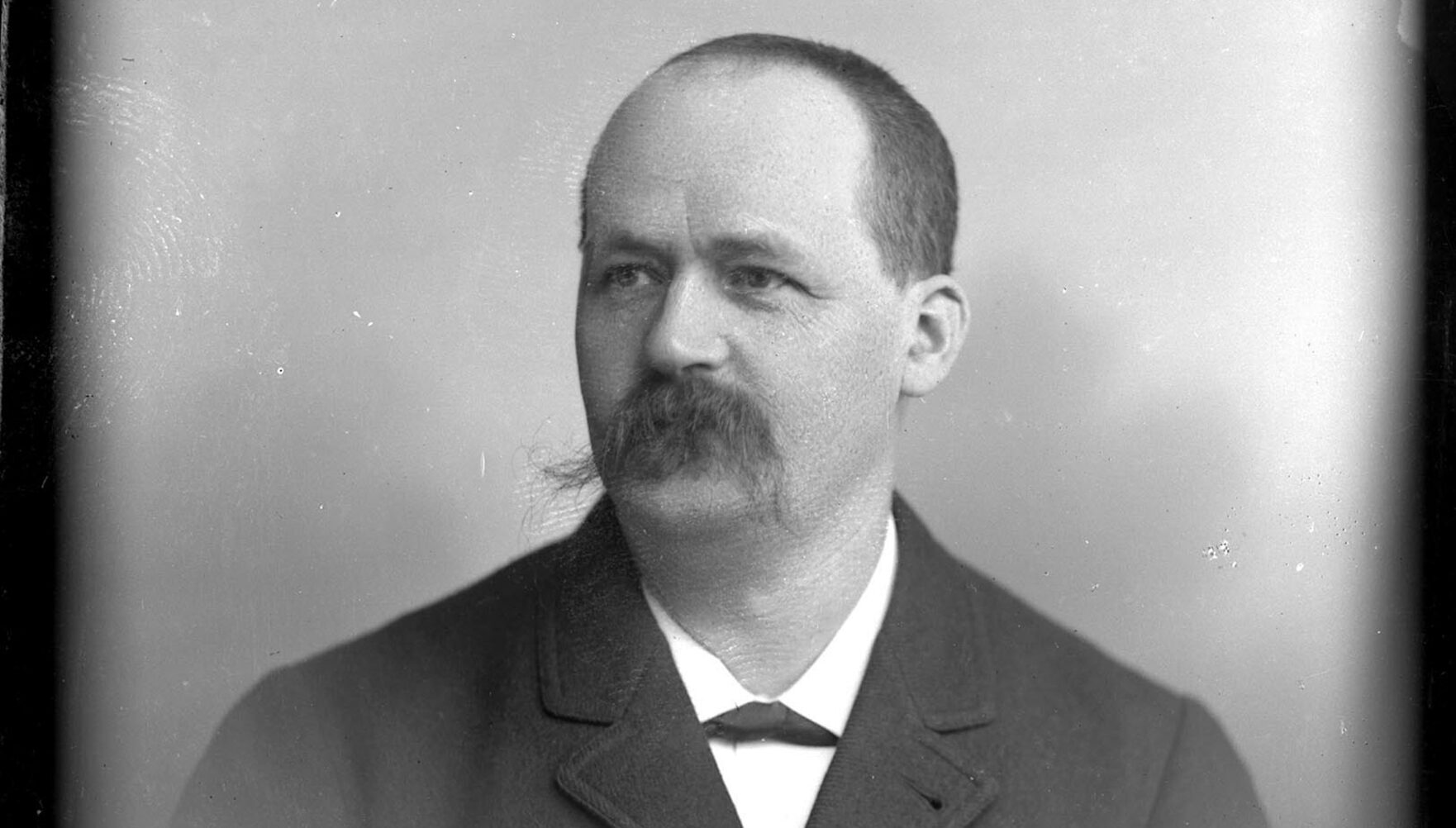
Théodore Flournoy (1854-1920) was a Swiss psychologist at the University of Geneva who studied mediums, mystics and religious experience with the patience of a laboratory scientist. His 1900 book From India to the Planet Mars traced a medium’s visions of past lives and Martian speech back to forgotten memory and creative unconscious imagination, and that work shaped Carl Jung’s early picture of the psyche.
Key takeaways
- Théodore Flournoy (1854-1920) was a Geneva psychologist who studied mediums, mystics and religious experience by long, careful observation of individual cases.
- His 1900 book From India to the Planet Mars traced the medium Hélène Smith’s Martian language and past lives to hidden memory and creative unconscious imagination.
- Flournoy described a subliminal mind that was creative, protective and compensatory, an idea Carl Jung took up in his dissertation and in Symbols of Transformation.
- His 1903 principle of the exclusion of the transcendent lets psychologists study religious experience as a real psychological fact without affirming or denying its metaphysical claims.
Who was Théodore Flournoy?
Flournoy was born in Geneva on 15 August 1854 and died there on 5 November 1920. He trained in medicine at Strasbourg, finishing his degree in 1878, but never practised. Instead he went to Leipzig to study with Wilhelm Wundt, whose laboratory was then the model for anyone who wanted psychology to become an experimental science.6
Back in Geneva he wrote on philosophy before he wrote on mediums. His first book, Métaphysique et psychologie (1890), argued that psychology should describe mental facts and leave metaphysical questions about the soul to philosophy. That line between describing an experience and ruling on its ultimate truth runs through everything he did later.6
In 1891 the University of Geneva gave him a chair in physiological psychology, placed in the Faculty of Sciences rather than in philosophy, and he set up one of the first psychology laboratories in the French-speaking world. In 1901 he and his younger colleague Édouard Claparède founded the journal Archives de Psychologie, and in 1909 he presided over the International Congress of Psychology held in Geneva. The Geneva tradition he started later became the home of Jean Piaget, who worked at the institute Claparède founded.6
He was also the closest European friend of William James. The two met at the 1889 International Congress of Physiological Psychology in Paris and wrote to each other until James died in 1910. Their letters, edited by Robert Le Clair in 1966, are one of the best records of how psychology, philosophy and psychical research were argued over at the turn of the century.5
What was Flournoy’s empirical approach to psychology?
The principle of empirical psychology
For Flournoy, “empirical” meant something closer to a naturalist’s field method than to a lab protocol. He watched, recorded and compared. He took notes during séances, collected written testimonies, checked a medium’s statements against archives and libraries, and asked people about their histories. The aim was to build an explanation from the facts of one person’s life rather than from a theory brought in from outside.6
This put him between two camps. Spiritualists of the 1890s read trance speech as messages from the dead. Many physicians read the same speech as a symptom of hysteria. Flournoy refused both shortcuts. He treated the medium’s productions as real psychological events that deserved a full explanation, which meant tracking where each detail came from and what it did for the person who produced it.2
The study of individual differences
Flournoy’s interest in how minds differ shows in one of his first empirical studies, Des phénomènes de synopsie (1893), a questionnaire survey of people who saw colours when they heard sounds or letters. Today this is called synesthesia. Flournoy treated it as a normal variation in how imagination links the senses, not as a disease, and he catalogued how widely the pairings varied from one person to the next.6
He carried the same attention into the séance room. He noticed which people were highly suggestible, who slipped easily into absorbed or dissociated states, and whose imagination ran to elaborate story. He argued that a mediumistic phenomenon could only be understood once you knew the temperament, education and emotional history of the particular medium. That is a case-centred psychology, and it is close to the way a depth therapist listens.
What is From India to the Planet Mars about?
The case of Hélène Smith
Des Indes à la planète Mars: Étude sur un cas de somnambulisme avec glossolalie appeared in Geneva in 1900 and in English the same year, translated by Daniel Vermilye. It describes about five years of sittings with a Geneva medium Flournoy called Hélène Smith. Her real name was Catherine-Élise Müller (1861-1929), and she worked as a shop employee by day. Flournoy began attending her séances in 1894.19
Smith’s trances produced three large “romances,” as Flournoy called them. In the Martian cycle she described the landscapes, houses and people of Mars, drew them, and spoke and wrote a Martian language. In the Hindu cycle she relived a life as Simandini, a fifteenth-century Arab princess married to an Indian prince, Sivrouka, and Flournoy himself was cast as Sivrouka’s reincarnation. In the royal cycle she was Marie Antoinette. A guiding spirit named Léopold, whom she identified as the eighteenth-century adventurer Cagliostro, presided over the sittings and sometimes spoke through her in a deep male voice.1
Flournoy did not treat any of this as fraud. Smith was sincere and was not paid for her sittings. His question was where the material came from and why it took the shape it did.
How did Flournoy explain the Martian language?
Flournoy collected the Martian texts and their translations, which Smith gave in trance. He showed that the language had French sounds, French word order and French grammar, with new words substituted almost one for one. The linguist Victor Henry analysed it further in Le langage martien (1901), and Ferdinand de Saussure, the founder of modern linguistics, examined the Sanskrit-like speech of the Hindu cycle. Smith’s “Martian” turned out to be a child’s invention built on her mother tongue, which is exactly what one would expect from an imagination working below awareness.19
The Hindu cycle was harder. Smith gave names and places Flournoy could not at first trace. After long searching he found a passage in an old history of India by de Marlès that mentioned the region of Kanara and a fortress called Tchandraguiri, built in 1401. He could not prove Smith had read it, but he argued that she very likely had seen it, or heard it discussed, and forgotten.1
Cryptomnesia and the subliminal self
The term Flournoy made central here is cryptomnesia, “hidden memory.” Cryptomnesia means a memory that returns without being recognised as a memory, so it feels new, inspired or foreign. A forgotten childhood book, a conversation overheard years ago, or a picture glimpsed once can reappear in a trance or a dream as a revelation. Flournoy argued that much of Smith’s apparently supernatural knowledge was this kind of recombined memory.9
Cryptomnesia did not stay a séance-room idea. Memory researchers now study it in the laboratory as “inadvertent plagiarism.” In a set of experiments, Alan Brown and Dana Murphy had people take turns generating examples of a category, then asked them to recall only their own items or produce new ones. Participants repeatedly offered items another person had produced as if they were their own, even when told to avoid it.10
Flournoy placed cryptomnesia inside a larger theory of the subliminal self, a term from the English classicist and psychical researcher Frederic Myers. Myers described a wide region of mental life beneath the threshold of ordinary consciousness, capable of its own intelligence and creativity. Flournoy accepted the region but described it in strictly psychological terms. For him the subliminal was a workshop where memories, wishes and childhood fantasies were reworked into new characters and stories.122
The functions of the unconscious
Flournoy’s most original move was to ask what Smith’s romances did for her. He saw a creative or mythopoetic function: the subliminal invented whole worlds with consistent landscapes and languages. He saw a protective function: Léopold scolded her, warned her and steered her away from people and situations that could hurt her, acting like a guardian built from her own good sense. He saw a compensatory function: a woman of modest means and narrow prospects became a princess and a queen. And he saw the romances as a kind of play that let an adult keep alive the reveries of childhood.28
This was a different picture from the one Freud was building in Vienna at the same moment. Freud’s unconscious was mainly a store of repressed wishes. Flournoy’s subliminal was also inventive, protective and forward-looking. Historians such as Sonu Shamdasani have argued that this creative and purposive unconscious, more than Freud’s, is the one Jung took up.8
The book had a cost. Smith came to resent Flournoy’s naturalistic reading of her visions and broke with him after 1900. Flournoy kept recording the case and published Nouvelles observations sur un cas de somnambulisme avec glossolalie in 1902, covering newer “ultra-Martian” and other cycles. Smith later devoted herself to religious painting, which she produced in trance-like states until her death in 1929.2
How did Flournoy influence Carl Jung?
The young Carl Jung read From India to the Planet Mars soon after it appeared. His 1902 medical dissertation, On the Psychology and Pathology of So-Called Occult Phenomena, studied a teenage medium in his own family circle and used Flournoy’s ideas throughout: cryptomnesia, the subliminal personality, and the trance personality as a forward-looking attempt at a fuller self.14
The link became personal. In 1906 Flournoy published in Archives de Psychologie the fantasies of a young American woman, Frank Miller, written in a half-dreaming state, with his own short commentary. Jung built his 1911-1912 book Wandlungen und Symbole der Libido (later revised as Symbols of Transformation) around these “Miller fantasies,” and the book’s argument for a symbol-making, myth-creating unconscious was a main cause of his break with Freud.87
Flournoy was an older Geneva colleague whose open, undogmatic judgement gave Jung a counterweight to Freud’s circle. Shamdasani’s work has placed this Geneva connection, together with James and Pierre Janet, at the centre of the story of who influenced Carl Jung, correcting the older habit of reading Jung only as a dissident Freudian.87
What did Flournoy contribute to the psychology of religion?
An empirical approach to religious phenomena
Flournoy’s best-known statement on religion is “Les principes de la psychologie religieuse,” published in Archives de Psychologie in 1903. He set out two rules. The first, the principle of the exclusion of the transcendent, says the psychologist neither affirms nor denies the reality of what the believer experiences: God, spirits or grace are bracketed. The second, the principle of biological interpretation, says religious experience should be studied as a living function, asking how it arises, how it develops and what it does in a person’s life.7
The two rules together make a non-reductive stance. A conversion or a mystical vision is a real psychological fact with real effects, whatever its ultimate source. The psychologist describes it, traces its history and observes its consequences without either debunking it or preaching it.
Flournoy built here on two American predecessors rather than leading them. Edwin Starbuck’s questionnaire study The Psychology of Religion (1899) had already gathered conversion accounts, and William James’s The Varieties of Religious Experience (1902), given as the Gifford Lectures in Edinburgh, appeared the year before Flournoy’s essay. James drew on testimonies from Flournoy’s own collection in Varieties, and Flournoy in turn wrote a sympathetic study, La philosophie de William James (1911), translated into English in 1917.134
The variety of religious experiences
Like James, Flournoy held that religious life could not be reduced to one mechanism. Temperament, upbringing, culture and state of consciousness all shape what a person experiences and how they understand it. A quiet, gradual deepening of faith and a sudden, overwhelming conversion are both religious experiences, and they need different descriptions.
His fullest single study in this field is Une mystique moderne (1915), a long account in Archives de Psychologie of a contemporary woman he called Cécile Vé, who experienced an intimate sense of divine presence. Flournoy recorded her states over many years and read them alongside her emotional history, with the same mixture of respect and psychological explanation he had brought to Smith. He compared her experiences with those of the classic Christian mystics, such as Teresa of Ávila, while treating her as a modern woman with a modern biography.6
This attention to visionary and altered states links Flournoy to a longer European line of interest that includes Emanuel Swedenborg’s visions and runs forward through Jung to transpersonal psychology. What Flournoy added was a method: take the experience seriously, document it carefully, and explain its psychological work without pretending to settle its metaphysical status.
What did Flournoy contribute to psychical research?
Scientific investigation of anomalous phenomena
Psychical research in the 1890s grew out of earlier controversies over Mesmer and animal magnetism, hypnotism and spiritualism. The Society for Psychical Research, founded in London in 1882, included James and Myers, and later counted Henri Bergson among its presidents. Flournoy belonged to this international network, but his own work was mostly long-term observation of individual mediums rather than controlled experiment.6
His standard was simple. Before reaching for a supernatural explanation, exhaust the psychological ones: memory, suggestion, dissociation, unconscious inference, the expectations of the circle around the medium. In Esprits et médiums (1911), translated by Hereward Carrington as Spiritism and Psychology the same year he set out these explanations and discussed a range of cases drawn from his own inquiries into spiritism.3
He also stayed open. He thought telekinesis and telepathy were possible and said so, and he refused to dismiss a claim simply because it was strange. That combination, rigorous about ordinary explanations and unwilling to declare the question closed, became a model for later researchers, including those discussed in our piece on J. B. Rhine and Eugène Osty.3
The survival hypothesis and mediumship research
The great question for psychical research was survival: does any part of a person persist after death and communicate through mediums? Myers’s Human Personality and Its Survival of Bodily Death (1903) argued that it might. Flournoy did not find survival in Smith’s case. Léopold was not Cagliostro but a part of Smith, and the princess Simandini was a story her subliminal mind had assembled.121
His analysis of trance personalities as organised parts of one mind, each with its own voice, memory and purpose, is close to what later clinicians described as dissociation. It parallels Pierre Janet’s work on dissociated “secondary” personalities in Paris during the same years. Psychologists of mediumship still return to Flournoy’s framework of cryptomnesia, suggestion and subconscious creativity, which is why his conclusion was reprinted as a classic text in History of Psychiatry in 2018.9
Why does Flournoy still matter?
Influence on psychology and parapsychology
Henri Ellenberger’s history The Discovery of the Unconscious (1970) gave Flournoy a central place among the founders of dynamic psychiatry, alongside Janet, Freud, Adler and Jung. Ellenberger stressed that Flournoy’s idea of a creative, purposive unconscious, which he called the mythopoetic function, was as important for the history of psychology as Freud’s repression.6
In parapsychology, Flournoy’s habit of exhausting ordinary explanations before considering anomalous ones became standard method. In psychology of religion his principle of the exclusion of the transcendent is still the working rule for researchers who want to describe belief without endorsing or debunking it.
Relevance to contemporary debates
Current research on implicit memory, source monitoring and absorption keeps arriving at Flournoy’s observations: people can know things they do not know they know, can misattribute where a memory came from, and can build vivid experiences out of fragments. The 2007 volume Irreducible Mind, by Edward Kelly and colleagues, returned to Myers, James and Flournoy as the starting point for a psychology that takes unusual experience seriously.11
The split Flournoy described between the subliminal and the conscious self also bears on old arguments about what to call the hidden mind, a question explored in our piece on subconscious vs unconscious. His answer was practical: whatever name you use, it is a working, inventive part of the person, not merely a basement of forgotten things.
His non-reductive treatment of religious and mystical experience also offers a model for clinicians and scientists today. It allows a person’s most important experiences to be studied without being reduced to brain noise and without being turned into dogma.
How does Flournoy’s work apply in therapy?
At Taproot we find Flournoy useful because he shows how to sit with experiences that are strange, vivid and meaningful without rushing to label them. Clients sometimes bring visions, voices in dreams, spiritual experiences or a sense of a guiding presence. Flournoy’s stance is to take the experience as a real psychological event, learn its history, and ask what it is doing for the person, while leaving its ultimate meaning to them.
His idea of the protective trance personality, Léopold watching over Smith, maps well onto parts work. In parts-based therapy, a stern inner voice or a guardian figure is often understood as a part that formed to keep the person safe. Clinicians such as Janina Fisher describe trauma-related parts in much the way Flournoy described subliminal personalities: organised, purposive and worth getting to know.
His mythopoetic function sits at the root of Jungian therapy. When a client works with a dream image or uses active imagination, the therapist treats the image as the psyche’s own creative statement, much as Flournoy treated Smith’s Martian landscapes.
Cryptomnesia matters too. In brain-based work such as Brainspotting, images and body memories can surface that the client does not recognise at first. Flournoy’s work reminds the therapist that such material may be old memory in new form, and that its emotional meaning can be processed without first settling whether every detail is literally accurate.
What is Théodore Flournoy’s legacy?
Flournoy joined careful observation with open-minded curiosity and psychological insight. He showed that a medium’s visions, a mystic’s sense of presence and a child’s invented language could all be studied as products of a creative mind, without contempt and without credulity.
His questions are still open: how much of what we experience as new is remembered, how the mind invents figures to protect itself, and how a psychologist should treat experiences people call sacred. His answers, recorded in From India to the Planet Mars, Spiritism and Psychology and his essays on religion, remain a working method for anyone who studies consciousness and unusual experience.
For those who want to explore the images, parts and memories that shape their own inner life, Taproot’s clinicians work in this depth tradition. You can read about our therapists and how they approach this kind of work.
Frequently asked questions
What is cryptomnesia?
Cryptomnesia is hidden memory: a memory that comes back without being recognised as one, so it feels original or inspired. Théodore Flournoy made the idea central to his study of the medium Hélène Smith, arguing that much of her apparently supernatural knowledge came from forgotten reading and conversation. Memory researchers now study it in the laboratory as inadvertent plagiarism.
Who was Hélène Smith?
Hélène Smith was the pseudonym Théodore Flournoy gave to Catherine-Élise Müller (1861-1929), a Geneva medium. In trance she produced a Martian language, a past life as the Indian princess Simandini, a life as Marie Antoinette, and a spirit guide called Léopold. Flournoy studied her from 1894 and published the case in 1900. She later turned to religious painting.
How did Théodore Flournoy influence Carl Jung?
Carl Jung read Flournoy’s From India to the Planet Mars and used its ideas of cryptomnesia and the subliminal personality in his 1902 dissertation on a medium. Flournoy also published the Miller fantasies in 1906, which Jung analysed in Wandlungen und Symbole der Libido. After Jung’s break with Freud, Flournoy was an older friend and an alternative model of the creative unconscious.
Did Flournoy believe in spirits?
Théodore Flournoy found no evidence of spirits in the Hélène Smith case and explained her guide Léopold as a part of her own mind. He still kept an open mind on some anomalous phenomena, accepting telepathy and telekinesis as possible, and he insisted that ordinary psychological explanations be exhausted before any extraordinary one was considered.
What did Flournoy write about the psychology of religion?
In a 1903 essay in Archives de Psychologie, Théodore Flournoy proposed two rules: exclude the transcendent, meaning the psychologist neither affirms nor denies the objects of faith, and interpret religion biologically, as a living function in a person’s life. His 1915 study Une mystique moderne applied these rules to a contemporary woman’s mystical experiences.
Related reading
- The Theories and Ideas of Rollo May
- Max Weber: The Architect of Modern Sociology
- Diane Poole Heller: From Trauma Survivor to Pioneer of Attachment Healing
- Herbert Silberer: Exploring the Frontiers of Psychoanalysis and Alchemy
- Ivan Pavlov: Pioneer of Classical Conditioning
- Gerhard Dorn: Alchemist, Philosopher, Visionary
References
- Flournoy, T. (1900). From India to the planet Mars: A study of a case of somnambulism with glossolalia (D. B. Vermilye, Trans.). Harper & Brothers. https://doi.org/10.1037/10911-000
- Shamdasani, S. (1994). Encountering Hélène: Théodore Flournoy and the genesis of subliminal psychology. In T. Flournoy, From India to the planet Mars: A case of multiple personality with imaginary languages (S. Shamdasani, Ed.). Princeton University Press.
- Flournoy, T. (1911). Spiritism and psychology (H. Carrington, Trans.). Harper & Brothers.
- Flournoy, T. (1917). The philosophy of William James (E. B. Holt & W. James Jr., Trans.). Henry Holt and Company.
- Le Clair, R. C. (Ed.). (1966). The letters of William James and Théodore Flournoy. University of Wisconsin Press.
- Ellenberger, H. F. (1970). The discovery of the unconscious: The history and evolution of dynamic psychiatry. Basic Books.
- Shamdasani, S. (2003). Jung and the making of modern psychology: The dream of a science. Cambridge University Press.
- Shamdasani, S. (1998). From Geneva to Zürich: Jung and French Switzerland. Journal of Analytical Psychology, 43(1), 115-126. https://doi.org/10.1111/1465-5922.00012
- Maraldi, E. de O., & Alvarado, C. S. (2018). Final chapter, From India to the Planet Mars: A study of a case of somnambulism with glossolalia, by Théodore Flournoy (1900). History of Psychiatry, 29(1), 110-125. https://doi.org/10.1177/0957154×17734782
- Brown, A. S., & Murphy, D. R. (1989). Cryptomnesia: Delineating inadvertent plagiarism. Journal of Experimental Psychology: Learning, Memory, and Cognition, 15(3), 432-442. https://doi.org/10.1037/0278-7393.15.3.432
- Kelly, E. F., Kelly, E. W., Crabtree, A., Gauld, A., Grosso, M., & Greyson, B. (2007). Irreducible mind: Toward a psychology for the 21st century. Rowman & Littlefield.
- Myers, F. W. H. (1903). Human personality and its survival of bodily death (2 vols.). Longmans, Green, and Co.
- James, W. (1902). The varieties of religious experience: A study in human nature. Longmans, Green, and Co.
- Jung, C. G. (1970). On the psychology and pathology of so-called occult phenomena. In Psychiatric studies (R. F. C. Hull, Trans.; Collected Works Vol. 1, 2nd ed.). Princeton University Press. (Original work published 1902)











0 Comments