
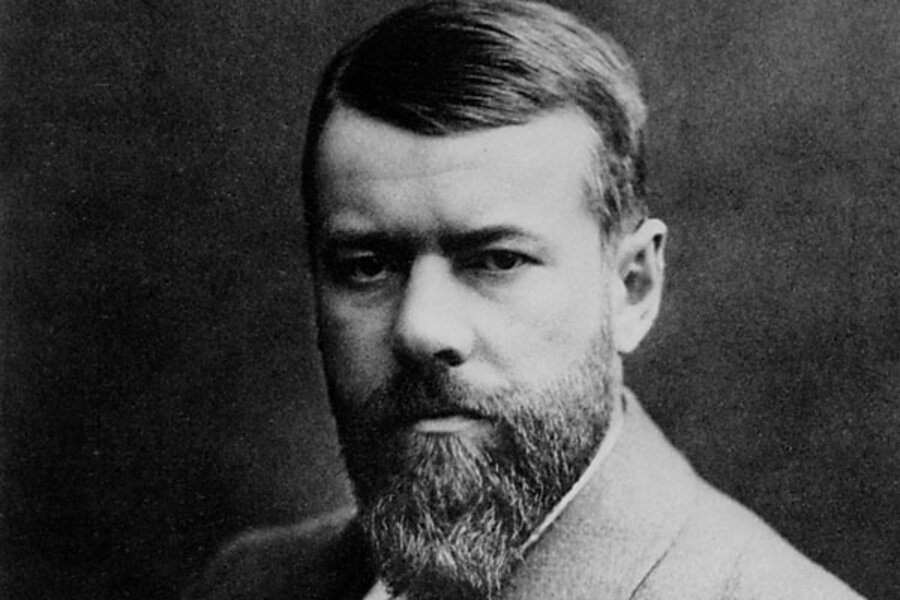
Max Weber (1864-1920) was a German sociologist, economist and historian who, with Karl Marx and Émile Durkheim, laid the foundations of modern sociology. He explained how Protestant religious anxiety helped produce the modern work ethic, how bureaucracy and calculation came to rule daily life, and how this “disenchantment of the world” leaves people efficient, exhausted and short of meaning.
Key takeaways
- Max Weber (1864-1920) founded modern sociology with Marx and Durkheim and asked how rational calculation came to organize modern life.
- In The Protestant Ethic (1904-1905) Weber argued that Calvinist anxiety about salvation turned disciplined work into a moral calling that outlived its faith.
- Weber’s iron cage and disenchantment of the world describe a society of efficient rules and specialists that can no longer say what all the effort is for.
- Burnout research on values mismatch at work describes, at the level of one person, the loss of meaning Weber traced across a whole civilization.
- In therapy, Weber’s ideas help clients see compulsive overwork as an inherited pattern they can examine, and reopen the question of what they want to serve.
Who was Max Weber?
Weber was born on 21 April 1864 in Erfurt and grew up in Berlin, the eldest son of a National Liberal politician, Max Weber Sr., and Helene Fallenstein Weber, a devout and self-sacrificing Protestant. He studied law, history and economics at Heidelberg, Berlin and Göttingen, and wrote dissertations on medieval trading companies and on Roman agrarian history. By 1894 he held a chair in economics at Freiburg, and in 1896 he moved to Heidelberg.6
His career then broke in two. After a bitter quarrel in 1897 in which he defended his mother against his father, his father died weeks later. Weber collapsed into years of insomnia, exhaustion and inability to work, which shaped everything he later wrote about work, duty and the cost of a driven life. He returned to writing in 1903 and produced most of his major work in the seventeen years that remained. He died of pneumonia in Munich on 14 June 1920, during the influenza pandemic, aged 56.5
Weber never wrote a single system. His work runs across law, economics, religion, music and politics, held together by one question: how did the modern West come to organize life around rational calculation, and what does that do to the people who live inside it? That question is why he still appears in lists of sociology theories every therapist should know.
How did Weber study society?
Weber worked in the climate of German neo-Kantian philosophy, close to Heinrich Rickert and Wilhelm Windelband, the same intellectual world that later produced Ernst Cassirer’s philosophy of symbolic forms. That tradition asked how the human sciences, which deal with meaning, differ from the natural sciences, which deal with causes. Weber’s answer was that sociology needs both.
Verstehen and interpretive sociology
Weber defined sociology at the start of Economy and Society as a science that seeks the interpretive understanding of social action in order to explain its course and effects causally. “Social action” means behaviour to which the actor attaches a subjective meaning and which takes account of other people. The method he called Verstehen, understanding: the researcher must grasp what an action means to the person doing it, and then test that reading against evidence.3
He sorted action into four pure kinds. Instrumentally rational action (zweckrational) chooses efficient means to a goal. Value-rational action (wertrational) follows a conviction whatever the cost. Affectual action is driven by feeling, and traditional action by habit. Most real conduct mixes them. Alfred Schutz built his phenomenological sociology on this foundation in 1932, and it fed symbolic interactionism, ethnomethodology and the qualitative research methods used across the social sciences today.
Ideal types and conceptual analysis
An ideal type is a concept built by deliberately exaggerating certain features of reality into a consistent picture. Weber set out the method in his 1904 essay on “objectivity” in social science. An ideal type is not an average, and it is not “ideal” in the sense of desirable. It is a measuring stick: by comparing a real case with the pure type of bureaucracy, charismatic authority or the Protestant ethic, a researcher can see exactly where and why the case departs from it.4
Ideal types remain a working tool in comparative historical sociology, organizational studies and the analysis of social change. They also carry a warning that matters in clinical work: the type is a lens, and the person in front of you never matches it perfectly.
Value freedom and the fact-value distinction
Weber argued that science can tell us what is the case and what means will achieve a given end, but it cannot tell us which ends to choose. He pressed this point in the value-judgment dispute in the Verein für Socialpolitik, the German association of social economists, and in his 1917 essay on the meaning of “ethical neutrality.” Values legitimately guide which questions a scholar asks; they should not decide what the evidence is taken to show, and professors should not use the lecture hall to preach politics.4
The principle has been both widely adopted and argued over. Later critical theorists held that value-free research quietly serves whatever values already rule. For Weber the point was moral as much as methodological: refusing to let science make our choices for us forces each person to own the values they live by.
What is the Protestant ethic thesis?
The Protestant Ethic and the Spirit of Capitalism appeared in two parts in 1904 and 1905 in the Archiv für Sozialwissenschaft und Sozialpolitik, the journal Weber co-edited, written partly after his 1904 trip to the United States. He revised it heavily in 1920, and Talcott Parsons’s English translation followed in 1930.1
Religious origins of capitalist values
Weber’s question was why a methodical, restless devotion to earning money for its own sake, which earlier cultures had treated as greed, became a moral duty in parts of Western Europe and North America. He traced it to the “this-worldly asceticism” of Calvinism, Pietism, Methodism and the Baptist sects. Medieval asceticism withdrew to the monastery; Puritan asceticism brought monastic discipline into ordinary trade and labour. Work became a “calling” (Beruf), a task set by God.1
The engine of the thesis is psychological. The Calvinist doctrine of predestination taught that God had already chosen the saved and the damned, and nothing a person did could change it. Weber argued that this produced “a feeling of unprecedented inner loneliness of the single individual.” No priest or sacrament could help. Pastoral advice offered a way to bear the anxiety: treat yourself as one of the elect, and work tirelessly in your calling, because disciplined, successful labour was a sign of election. Work did not earn salvation; it quieted the fear of not having it.1
The unintended consequences of religious ideas
The reformers wanted to save souls, not to build capitalism. Yet their teaching, combined with frugality and the ban on spending wealth on pleasure, produced capital accumulation and a disciplined workforce. Weber called the fit between a religious outlook and an economic form an “elective affinity,” a term borrowed from Goethe. Once the system ran on its own, it no longer needed the faith that had started it.
Weber summed up his view of ideas and interests with a railway image: material and ideal interests drive conduct directly, but the “world images” created by ideas have often, “like switchmen,” set the tracks along which interest pushes action.2 Looking past people’s stated aims to the effects their beliefs actually produce is now a basic move in social analysis.
The cultural foundations of economic systems
Weber’s thesis is often read as a reply to Marx. He did not deny the power of material conditions, and he said plainly that he did not want to replace a one-sided materialist account with an equally one-sided spiritual one. His point was that culture and belief also shape economic life. That argument still runs through economic sociology, development studies and the comparative study of economic systems, and it opened a psychological question that later writers took up: what inner pressures keep people working long after they need to?
What did Weber mean by rationalization and the iron cage?
The process of rationalization
Rationalization, for Weber, is the long historical spread of calculation, rule, method and technical control into more and more areas of life: law, accounting, science, music, administration, even religion. Action guided by tradition, feeling or a binding faith gives way to action guided by efficient means. The gains are real: predictable law, reliable science, productive industry. The loss is that the question of ends, what all this efficiency is for, drops out of view.3
Weber saw this most clearly in architecture, accounting and the factory, and the twentieth century carried it further, from assembly lines to the glass-and-steel grid of Mies van der Rohe’s modernism. In 1993 the sociologist George Ritzer gave the process four names, efficiency, calculability, predictability and control, in The McDonaldization of Society, his updating of Weber for a world of fast food and franchises.12
Bureaucracy and formal organizations
Weber’s ideal type of bureaucracy lists its features: fixed areas of jurisdiction, a hierarchy of offices, written files, officials appointed for expert training, full-time salaried careers, and the application of general rules without regard to persons. He judged it technically superior to every other form of administration, comparing it to a machine set against non-mechanical methods of production.3
He was just as clear about the price. Bureaucracy treats people as cases, rewards conformity over initiative and concentrates power in the hands of trained officials who are hard for elected politicians to control. In a 1909 debate at the Verein für Socialpolitik he described officials who become small cogs in a machine and then want only to become bigger cogs, and asked how any remnant of humanity could be saved from this parcelling of the soul and from the sole rule of bureaucratic ideals.
The “iron cage” of rationality
At the end of The Protestant Ethic Weber wrote: “The Puritan wanted to work in a calling; we are forced to do so.” The ascetic discipline that once served a faith had become the machinery of an economic order that decides the life of everyone born into it. Weber’s German phrase for that order was stahlhartes Gehäuse, a casing or shell as hard as steel. Parsons rendered it “iron cage,” and the phrase took on a life of its own; the sociologist Peter Baehr has shown that “shell” captures Weber’s sense better, since the casing becomes part of the creature that lives in it.9
Weber closed with his bleakest lines, written with Friedrich Nietzsche’s “last men” in mind: “Specialists without spirit, sensualists without heart; this nullity imagines that it has attained a level of civilization never before achieved.”1 Nietzsche’s influence on Weber was real; Weber once remarked that a scholar’s honesty could be measured by how he stood toward Marx and Nietzsche. Nietzsche’s impact on psychology and Weber’s iron cage run along the same line: what happens to people when the old sources of meaning die and only technique remains.
The image shaped later social theory. The Frankfurt School turned Weber’s rationalization into a critique of “instrumental reason” in Horkheimer and Adorno‘s Dialectic of Enlightenment, and Lawrence Scaff’s study of Weber’s thought reads his whole career as an attempt to find ways out of the cage.8
What is the disenchantment of the world?
In his lecture “Science as a Vocation,” delivered in Munich on 7 November 1917 and published in 1919, Weber said: “The fate of our times is characterized by rationalization and intellectualization and, above all, by the ‘disenchantment of the world.'”2 The German word, Entzauberung, means literally the removal of magic.
Disenchantment does not mean that modern people know more about how their world works. Weber pointed out that a streetcar passenger usually has no idea how the car moves. It means we believe that, in principle, everything can be mastered by calculation, so there are no mysterious forces left to reckon with. The world becomes a mechanism, and a mechanism cannot tell you how to live.
Weber took that last point from Leo Tolstoy: science gives no answer to the only question that matters to us, “What shall we do and how shall we live?” Science can map the means; it is silent on ends. In place of one sacred order, Weber said, modern people face a plurality of competing values, a new polytheism, and each person has to choose which god to serve. Freedom and loneliness arrive together.2
This is where Weber’s sociology becomes a psychology. Carl Jung, working in the same decades, saw the same loss from the consulting room, and wrote in 1929 that about a third of his cases suffered not from any clinically definable neurosis but from the senselessness and emptiness of their lives. Jung’s exploration of God and religion is in part a response to the disenchanted world Weber described.
What are Weber’s three types of authority?
Types of legitimate authority
Weber distinguished power, the ability to get one’s way against resistance, from authority (Herrschaft), the probability that commands will be obeyed because people believe them legitimate. He described three pure types of legitimacy. Traditional authority rests on the sanctity of long-standing custom, as with a patriarch or hereditary king. Charismatic authority rests on devotion to the extraordinary qualities of a person, a prophet, war hero or revolutionary. Legal-rational authority rests on belief in impersonal, correctly enacted rules, and its typical staff is a bureaucracy.3
Charisma is unstable. When the leader dies or the movement must feed and organize itself, charisma is “routinized” into tradition or rules. Weber traced a long historical drift toward legal-rational authority, while expecting charismatic figures to keep breaking through it. The typology remains standard in political sociology, organizational studies and leadership research.
The sociology of politics and the state
Weber’s best-known definition describes the state as “a human community that (successfully) claims the monopoly of the legitimate use of physical force within a given territory.”2 He insisted on studying how politics actually works: parties as machines run by professional politicians, the power of officials, and the problem of keeping a bureaucracy accountable to elected leaders. He took part in drafting proposals for the Weimar constitution and argued for a strong, directly elected president as a counterweight to bureaucratic rule.
The ethics of politics and the vocation of science
“Politics as a Vocation,” delivered on 28 January 1919, distinguishes the ethic of conviction (Gesinnungsethik), which acts on principle and leaves the results to God, from the ethic of responsibility (Verantwortungsethik), which answers for the foreseeable consequences of one’s actions. Weber did not ask politicians to give up conviction. He asked them to join passion to responsibility and a sense of proportion, and described politics as “a strong and slow boring of hard boards.”2
The two lectures read as a pair: one about how to act when no higher authority guarantees the outcome, the other about how to work honestly when science cannot supply meaning. That stance, choosing and answering for one’s choice without cosmic guarantees, brings Weber close to the existentialists who came after him, including Jean-Paul Sartre on freedom and responsibility.
What are Max Weber’s key works?
- The Protestant Ethic and the Spirit of Capitalism (1904-1905, revised 1920). The study of how Puritan asceticism shaped the modern work ethic, and the source of the “iron cage.”1
- “‘Objectivity’ in Social Science and Social Policy” (1904) and “The Meaning of ‘Ethical Neutrality'” (1917). The essays on ideal types and value freedom, collected in English as The Methodology of the Social Sciences.4
- The Religion of China: Confucianism and Taoism (1915, revised 1920). The first study in Weber’s series on the economic ethics of the world religions, asking why China, despite its trade and learning, did not produce the same methodical capitalism.
- The Religion of India (1916-1917) and Ancient Judaism (1917-1919). The later studies in the series, tracing how Hinduism, Buddhism and the Hebrew prophets shaped very different attitudes to the world, and how prophetic Judaism began the long rejection of magic in the West.
- “Science as a Vocation” (lecture 1917, published 1919) and “Politics as a Vocation” (1919). The lectures on disenchantment, meaning and the ethics of action.2
- Economy and Society (published posthumously, 1921-1922). The unfinished treatise, edited by his widow, Marianne Weber, containing his theories of social action, authority, bureaucracy, law, religion and social stratification.3
How has Weber shaped social science?
The continuing influence of Weberian sociology
Weber’s habit of multi-causal explanation, his attention to culture and his insistence on historical comparison run through comparative-historical sociology, economic sociology and the sociology of religion. Parsons brought him to American sociology, and Reinhard Bendix’s 1960 intellectual portrait made his scattered work readable as a whole.7 Researchers still use Weberian concepts to study globalization, religious fundamentalism and the changing nature of work in a digital economy.
Weber and the challenges of late modernity
The tensions Weber described at the start of the twentieth century have sharpened. Algorithms, metrics and performance dashboards extend rationalization into areas Weber could not have imagined, while expert rule and democratic accountability pull against each other in debates about technocracy. Weber’s work on the cultural roots of economic behaviour and on unintended consequences helps explain events such as financial crises and the rise of populist, charismatic politics against bureaucratic establishments. Jürgen Habermas built his 1981 Theory of Communicative Action on a rereading of Weber, describing how system logic “colonizes” the everyday lifeworld.
Weber and interdisciplinary social science
Weber refused to stay inside one discipline. He moved between law, history, economics, politics and religion, and even wrote a study of the rational foundations of Western music. That range made him a model for historical sociology, political economy and cultural studies, and it is why psychologists and psychotherapists can read him with profit.
Weber’s own breakdown: what he knew about exhaustion
Weber did not write about the costs of driven work from a distance. After his father’s death in 1897 he suffered a collapse that his doctors called neurasthenia: sleeplessness, exhaustion, anxiety and an inability to read, lecture or write. He spent time in sanatoria and travelled for months in Italy, and in 1903 he resigned his Heidelberg chair.5
His wife, Marianne Weber, whose 1926 biography remains a main source on his life, described a man raised to relentless self-discipline who had driven himself through years of overwork before he broke.6 Joachim Radkau’s 2005 biography goes further, reading Weber’s illness and his struggle with his own nature as a key to his sociology, including his fascination with ascetic self-control.5
Weber also took a direct interest in the psychology of work. In 1908-1909 he published a long study on the psychophysics of industrial labour, drawing on Emil Kraepelin’s experiments on fatigue and studying productivity in a textile mill. The same study of fatigue and discipline ran alongside his own long struggle with nervous exhaustion.5 The man who described the iron cage had lived inside it, collapsed in it and spent the rest of his life asking what it does to the soul.
Why does Weber matter for psychology and burnout?
Read through a psychological lens, Weber’s argument has three steps. First, the modern work ethic began as a way to manage anxiety about one’s ultimate worth. Second, that ethic outlived its faith, so the compulsion to prove oneself through work remained while the meaning that once justified it disappeared. Third, rationalized institutions now demand that discipline from everyone, whether or not they believe in it. The result is a person who works harder than any Puritan without the Puritan’s reason for doing so.
Erich Fromm made the psychological reading explicit. In Escape from Freedom (1941) he argued that Calvinist doctrine bred anxiety, powerlessness and self-doubt, and that compulsive activity became a way to escape that unbearable insecurity.13 Fromm’s legacy for depth psychology owes a clear debt to Weber’s account of inner loneliness.
The clinical word for what Weber described is burnout. The psychoanalyst Herbert Freudenberger introduced the term in 1974 to describe the exhaustion of dedicated volunteers in a New York free clinic, people who had started with idealism and ended depleted and cynical.10 Christina Maslach and Michael Leiter define burnout by three dimensions: overwhelming exhaustion, cynicism and detachment from the job, and a sense of ineffectiveness. Their research finds it grows from mismatches between people and their work in six areas: workload, control, reward, community, fairness and values.11
The last of those, values, is the Weberian one. A calling that no longer means anything is still a calling in its demands. People who arrive in executive burnout, or in medicine, law and teaching, often describe not only too much work but work that has been emptied of the purpose that drew them to it, managed by metrics that measure everything except what they care about. That is disenchantment experienced at the level of a single nervous system.
The existential psychologists named the same condition in their own terms. Viktor Frankl’s existential vacuum describes a boredom and emptiness that appears when tradition no longer tells people what to do. Paul Tillich named the anxiety of meaninglessness as the characteristic anxiety of the modern age in The Courage to Be (1952), and Rollo May wrote of people who had lost an inner centre and lived by outer demands. Weber supplies the history behind all three: how a culture arrived at the place where meaning has to be found by each person alone.
How does Weber’s thinking show up in therapy?
Weber gives a therapist a way to see a client’s exhaustion as more than a personal failing. Someone who cannot stop working, who feels worthless on a day off, or who measures every hour by output, is often living out a cultural inheritance that began as religious anxiety. Naming that history can loosen shame. The drive is real, but it was installed, and what was installed can be examined.
Several of Weber’s ideas translate directly into clinical practice:
- Verstehen as a clinical stance. Weber’s interpretive understanding is close to what a good therapist does: grasp what a behaviour means from the inside before judging or correcting it. A compulsion to overwork usually makes emotional sense once its meaning is understood.
- Ideal types and diagnosis. A diagnostic category works like an ideal type, a useful benchmark that no actual person fits exactly. Treating the label as a lens rather than an identity keeps the person in view.
- The calling and its loss. Burnout is often a values problem. Therapy can ask what originally drew a person to their work, what has been lost, and whether it can be recovered or must be grieved.
- Conviction and responsibility. Clients torn between acting on principle and answering for consequences, at work or in a family, can use Weber’s two ethics to think through choices without pretending either side is free of cost.
- Disenchantment and the body. A life run by calculation tends to lose contact with feeling and bodily signals. Exhaustion often registers in the body long before the mind admits it.
At Taproot we see this pattern often in high-functioning adults who look successful and feel hollow. In existential therapy we work with the questions Weber left open: what you value, what you are willing to answer for, and how to choose a life when no outside authority settles it for you. Because the iron cage is also lived in the nervous system, we often pair that work with somatic therapy and Brainspotting, which help people notice and process the chronic activation that driven work leaves behind.
Weber’s analysis also applies to psychotherapy itself. A field that reduces treatment to manuals, session counts and outcome scores is undergoing exactly the rationalization he described, and we have written about that in the evidence-based practice paradigm. Good therapy keeps room for the parts of a person that calculation cannot capture.
Weber did not offer a way out of the iron cage, but he insisted that each person can still decide what to serve and take responsibility for that choice. That is the ground therapy works on. If driven work, burnout or a loss of meaning has brought you to that question, you can contact Taproot Therapy Collective to talk with one of our therapists.
Frequently asked questions
What is Max Weber best known for?
Max Weber is best known for The Protestant Ethic and the Spirit of Capitalism, which linked Calvinist religious anxiety to the modern work ethic, and for his analyses of bureaucracy, rationalization and the three types of legitimate authority: traditional, charismatic and legal-rational. He also coined the phrase the disenchantment of the world and defined the state as holding a monopoly on legitimate force.
What does iron cage mean in Max Weber?
The iron cage is Talcott Parsons’s 1930 translation of Weber’s phrase stahlhartes Gehäuse, more literally a shell as hard as steel. Weber used it at the end of The Protestant Ethic for an economic and bureaucratic order that began in religious devotion but now compels everyone born into it to work and conform, whether or not they share the original faith.
What did Weber mean by disenchantment of the world?
In his 1917 lecture Science as a Vocation, Max Weber described disenchantment as the modern belief that everything can, in principle, be mastered by calculation, leaving no mysterious forces in the world. The cost is that science cannot answer how we should live, so each person must choose their own values without a shared sacred order.
How is Max Weber connected to burnout?
Weber described a work ethic that began as a way to calm religious anxiety and survived as a compulsion after its meaning faded. Modern burnout research, from Herbert Freudenberger in 1974 to Christina Maslach and Michael Leiter, finds that exhaustion and cynicism grow when work no longer fits a person’s values, which echoes Weber’s account of the iron cage.
Did Max Weber have a nervous breakdown?
Yes. After a quarrel with his father in 1897 and his father’s death weeks later, Max Weber collapsed into years of insomnia, exhaustion and anxiety, diagnosed at the time as neurasthenia. He resigned his Heidelberg chair in 1903 and wrote most of his major work after recovering enough to return to scholarship.
Related reading
- The Pragmatic Turn: William James, the Architecture of Consciousness, and the Roots of Modern Psychotherapy
- Otto Rank: Pioneer of Birth Trauma Theory and the Will in Psychoanalysis
- Charles Eames: Pioneering Designer of the Modern Era
- B.F. Skinner and Operant Conditioning
- Pierre Janet: Pioneer of Dissociation Theory and Psychological Analysis
- Zosimos of Panopolis: The Alchemical Philosopher and His Legacy
References
- Weber, M. (1958). The Protestant ethic and the spirit of capitalism (T. Parsons, Trans.). Charles Scribner’s Sons. (Original work published 1904-1905, revised 1920)
- Weber, M. (1946). From Max Weber: Essays in sociology (H. H. Gerth & C. W. Mills, Eds. & Trans.). Oxford University Press.
- Weber, M. (1978). Economy and society: An outline of interpretive sociology (G. Roth & C. Wittich, Eds.). University of California Press. (Original work published 1921-1922)
- Weber, M. (1949). The methodology of the social sciences (E. A. Shils & H. A. Finch, Eds. & Trans.). Free Press.
- Radkau, J. (2009). Max Weber: A biography (P. Camiller, Trans.). Polity Press. (Original work published 2005)
- Weber, Marianne. (1975). Max Weber: A biography (H. Zohn, Trans.). Wiley. (Original work published 1926)
- Bendix, R. (1960). Max Weber: An intellectual portrait. Doubleday.
- Scaff, L. A. (1989). Fleeing the iron cage: Culture, politics, and modernity in the thought of Max Weber. University of California Press.
- Baehr, P. (2001). The “iron cage” and the “shell as hard as steel”: Parsons, Weber, and the stahlhartes Gehäuse metaphor in The Protestant Ethic and the Spirit of Capitalism. History and Theory, 40(2), 153-169. https://doi.org/10.1111/0018-2656.00160
- Freudenberger, H. J. (1974). Staff burn-out. Journal of Social Issues, 30(1), 159-165. https://doi.org/10.1111/j.1540-4560.1974.tb00706.x
- Maslach, C., & Leiter, M. P. (2016). Understanding the burnout experience: Recent research and its implications for psychiatry. World Psychiatry, 15(2), 103-111. https://doi.org/10.1002/wps.20311
- Ritzer, G. (1993). The McDonaldization of society. Pine Forge Press.
- Fromm, E. (1941). Escape from freedom. Farrar & Rinehart.


















0 Comments