
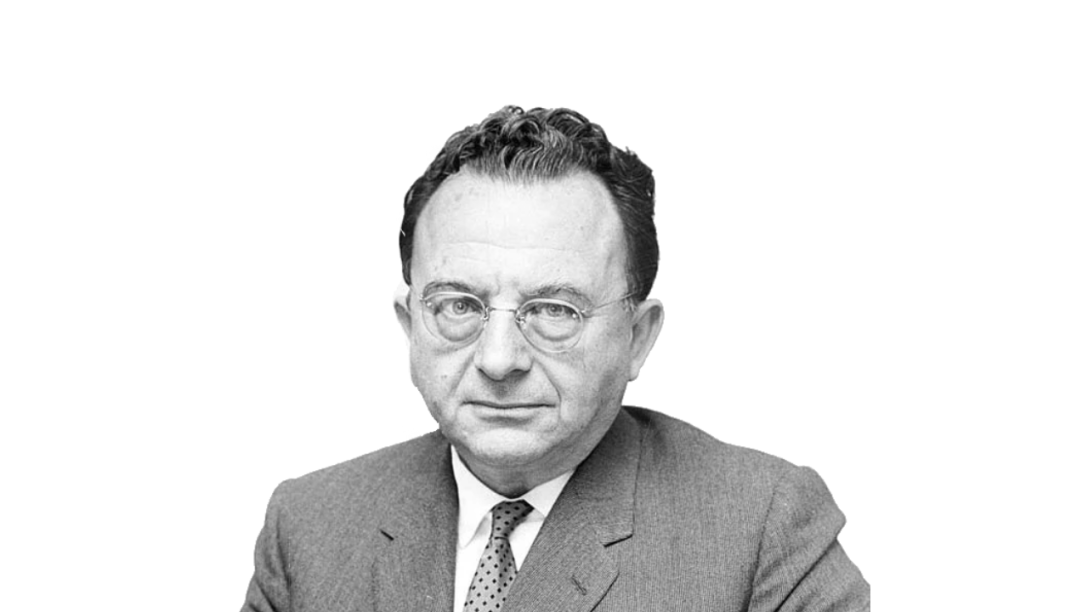
Erich Fromm (1900–1980) was a German-born psychoanalyst and social psychologist who argued that personality is shaped by the economy and culture a person lives in, not only by family and instinct. His core ideas are social character, the escape from freedom, the marketing orientation, the pathology of normalcy, and the difference between having and being. Start with Escape from Freedom (1941) and The Sane Society (1955).
The idea of his that matters most in a therapy room is the question he put at the head of a chapter in The Sane Society: can a society be sick? He said yes. When a whole culture shares a defect and rewards it, the people who carry it do not feel ill. They feel normal, often successful. That gives therapy an awkward job. Sometimes the adaptation itself, the ease with which a person fits, is the symptom, and the distress that finally brings them in may be the healthiest thing about them. The rest of this piece follows that argument through Fromm’s books and into practice.
Who was Erich Fromm?
Fromm was born in Frankfurt am Main on March 23, 1900, the only child of Naphtali Fromm, an Orthodox Jewish wine merchant, and Rosa Krause. He studied Talmud into his twenties, much of it with Rabbi Salman Baruch Rabinkow, and in 1922 took a doctorate in sociology at Heidelberg under Alfred Weber with a dissertation on Jewish law in the diaspora. He was first psychoanalyzed in the mid-1920s by Frieda Reichmann, whom he married in 1926, and completed his training at the Berlin Psychoanalytic Institute, where his training analyst was Hanns Sachs.1
In 1930 he joined the Institute for Social Research in Frankfurt, the group later called the Frankfurt School, as the member responsible for psychoanalysis and social psychology. There he directed a social-psychological study of German workers and employees; it stayed unpublished until 1980 and appeared in English as The Working Class in Weimar Germany in 1984.2 The Nazi regime forced him out, and he arrived in New York on May 31, 1934. He broke with the Institute in 1939, after Max Horkheimer, Theodor Adorno, Herbert Marcuse and Leo Löwenthal rejected his revision of Freud’s drive theory.1
In America he became one of the so-called neo-Freudians. Karen Horney, whose psychoanalytic theories ran close to his, brought him to lecture in Chicago in 1933 and stayed a close friend until their break in 1943. He worked with Clara Thompson and with Harry Stack Sullivan, author of the interpersonal theory of psychiatry, and in 1943 helped found the William Alanson White Institute in New York. In 1950 he moved to Mexico City, taught in the medical faculty of the National Autonomous University of Mexico, founded a Mexican psychoanalytic society in 1956, held a 1957 seminar with D. T. Suzuki on Zen and psychoanalysis, and later published a field study of a Mexican village with Michael Maccoby. From the late 1950s he was active in the American peace movement and helped found the anti-nuclear group SANE in 1957. He campaigned for Eugene McCarthy in 1968 and died in Muralto, in Switzerland’s Ticino, on March 18, 1980, five days short of eighty.1
Escape from Freedom: why people hand freedom back
Escape from Freedom, published in Britain as The Fear of Freedom, asks why people who win freedom so often give it away. Fromm’s answer turns on two senses of the word. “Freedom from” is release from the old ties of church, guild, rank and clan. “Freedom to” is the capacity to use that release: to love, work and think as oneself. The first can arrive without the second. When the economic and social conditions for real individuality are missing, he wrote, “this lag makes freedom an unbearable burden,” and people seek relief in submission.3
He traced the pattern from the Reformation, reading Luther and Calvin as theologies for a newly isolated individual, to the insecure middle class that found Hitler appealing. And he named three ways of escaping. Authoritarianism fuses submission and domination: the person wants to be absorbed by something larger and to rule over someone smaller. Destructiveness tries to abolish whatever cannot be controlled. Automaton conformity is the quietest. The person takes on the thoughts and wishes they are expected to have and experiences them as their own. Fromm did not think democracies were immune; free of dictators, their citizens were still steered by experts and advertising.3
The attribution here is often garbled. Fromm published his concept of the “authoritarian character,” a sado-masochistic structure, in the Frankfurt Institute’s Studies on Authority and the Family in 1936, five years before Escape from Freedom.1 The Authoritarian Personality, the 1950 Berkeley study that introduced the F-scale, was written by Adorno, Else Frenkel-Brunswik, Daniel Levinson and Nevitt Sanford.4 Fromm was not an author. His own later summary of the authoritarian character is still the clearest: “By being part of the ‘big’ (whatever it is), he becomes big; if he were alone, by himself, he would shrink to nothing.”5
Social character: wanting what the system needs
Underneath all of this is social character, Fromm’s attempt to join Marx’s account of how a way of producing shapes ideas with Freud’s account of character. A society needs its members to behave in certain ways, and it cannot leave that behavior to conscious choice. Social character does the work. In a 1949 essay he described its function as shaping human energy so that “people want to act as they have to act and at the same time find gratification in acting according to the requirements of the culture.”6 Thrift suits one economy. Eager spending suits another.
In Man for Himself (1947) he sorted character into orientations: four he called nonproductive (receptive, exploitative, hoarding and marketing) and one productive.7 The marketing orientation was his portrait of the modern market personality. When success depends less on what a person can do than on how well they sell their personality, he wrote later, “one experiences oneself as a commodity or, rather, simultaneously as the seller and the commodity to be sold.” Such people are not especially selfish, he argued. Their ties are thin: nobody is close to them, and “neither are they close to themselves.”8
Beside social character sits the social unconscious. Each society, Fromm argued, “determines which thoughts and feelings shall be permitted to arrive at the level of awareness and which have to remain unconscious.”9 Some of what a person cannot feel is not private repression. It is what the surrounding culture has no words for.
These ideas have been tested only modestly. In four Australian studies with modest samples, Saunders and Munro built a questionnaire for the marketing character and found that scores went with conformity, authoritarianism, anxiety and depression, as Fromm would predict, but not with lower life satisfaction.10
The Sane Society and the pathology of normalcy
The Sane Society builds its case in a chapter titled “Can a Society Be Sick? The Pathology of Normalcy.” Fromm credits Freud’s Civilization and Its Discontents with assuming that a whole society can be sick, then pushes further. The usual test of sanity is agreement with others. Fromm rejects it: “Consensual validation as such has no bearing whatsoever on reason or mental health. Just as there is a folie à deux there is a folie à millions.”11
Then he draws the distinction the book depends on. A neurosis belongs to an individual, who feels it as conflict. A socially patterned defect is shared. The person “is not aware of it as a defect,” and “his very defect may have been raised to a virtue by his culture, and thus may give him an enhanced feeling of achievement.” Culture supplies the anesthetic too. Shut off movies, radio, television, sports and newspapers for four weeks, he guessed, and thousands of breakdowns would follow: “If the opiate against the socially patterned defect were withdrawn, the manifest illness would make its appearance.”11 By 1973 he put it more starkly: “it is the fully sane person who feels isolated in the insane society.”12
If not consensus, what is sanity measured against? Fromm’s answer is a set of needs rooted in the human situation rather than in Freud’s libido stages: relatedness, transcendence, rootedness, a sense of identity, and a frame of orientation and devotion. Each can be met well or badly. Relatedness is met fully only by love, which unites a person with others while keeping “the separateness and integrity of one’s own self.” Transcendence goes toward creating or destroying, rootedness toward brotherliness or what he called incest, identity toward individuality or herd conformity, orientation toward reason or irrationality.11 His political conclusion, in the same book, was what he called “communitarian socialism,” which he set against both Western capitalism and Soviet communism.1, 11
Psychiatry supplies its own example of consensual validation. Homosexuality was listed as a mental disorder in the first two editions of the DSM, and the American Psychiatric Association removed it from DSM-II only in 1973.13 A year earlier, the psychiatrist John Fryer addressed the APA’s annual meeting in a mask, billed as “Dr. H. Anonymous,” because he had no tenure and would likely have lost his post if identified. John Fryer’s story and the 1973 DSM decision show a profession mistaking a social norm for a clinical finding, the error Fromm was describing.
Love, destructiveness, and having versus being
The Art of Loving (1956) was Fromm’s bestseller, and it is tougher than its reputation. Love, he argued, is a capacity to practice, not an object to find. In the preface he wrote that satisfaction in individual love cannot be attained “without true humility, courage, faith and discipline.” It always includes care, responsibility, respect and knowledge.14 One distinction from the book holds up well in practice: “Immature love says: ‘I love you because I need you.’ Mature love says: ‘I need you because I love you.'”14
The darker books came next. The Heart of Man (1964) set biophilia, the love of life, against necrophilia in a characterological sense, and applied narcissism to whole groups.15 He later defined that necrophilia as “the passionate attraction to all that is dead, decayed, putrid, sickly,” including “the exclusive interest in all that is purely mechanical.”12 The Anatomy of Human Destructiveness (1973) split aggression in two. Benign aggression is the defensive impulse humans share with other animals; it serves survival and stops when the threat stops. Malignant aggression, cruelty and destructiveness, is “specific to the human species” and serves no adaptive purpose.12 It is easy to read Fromm as denying any innate aggression. He did not. He denied that cruelty was innate.
To Have or to Be? (1976) stated the late argument plainly. Having and being are “two fundamental modes of existence.” In the having mode “my relationship to the world is one of possessing and owning, one in which I want to make everybody and everything, including myself, my property.” The being mode means aliveness and authentic relatedness.8 This is the part of Fromm that psychology can test most directly, under the name of materialism. A 2014 meta-analysis of 259 samples found materialistic values and beliefs linked to lower well-being (r = −.19 for the most widely used measures), with larger links to negative self-appraisal and risky health and consumer behavior. The data are mostly correlational, and the authors call for more experimental and longitudinal work. Their mediation analyses suggested that poorly met psychological needs may explain the link. That is in the spirit of Fromm’s argument, though the study was not designed as a test of his theory.16
What this looks like in therapy
Most therapy, reasonably, aims at function: sleeping, working, keeping relationships, getting through the week. Fromm adds a second question that is easy to skip. What is the functioning costing, and who taught the person that the cost was normal?
The people this question fits are often well adapted by every outside measure. They describe feeling flat, performing their lives, or watching themselves from a slight distance. Fromm’s marketing orientation names one version of this: experiencing oneself as a product. The work is not to polish the product. It is to find out what the person wants when nobody is buying. In Jungian depth therapy the same territory is the persona, Jung’s term for the social face a person shows the world, and the trouble that starts when someone mistakes that face for the whole self.
Fromm’s split between neurosis and socially patterned defect also changes how a clinician reads symptoms. Burnout, irritability, or a low mood that arrives at the height of a career can be real conditions that need proper assessment, including a medical one where that fits. They can also be the part of the person that will not keep adjusting. A clinician can take the suffering seriously without treating the refusal as the disorder. In existential therapy this is close to home ground: freedom, meaning and the life that no longer fits. Fromm’s need for a frame of orientation and devotion sits near what Viktor Frankl called the will to meaning.
Fromm also asked something of the therapist. The analyst, he wrote in a 1969 paper published after his death, has to give up “the illusion that he is ‘well’ and the patient is ‘sick.'” Later in the same passage: “the patient has no problem but is a person who is suffering from his way of being.”17 A therapist entirely at home in the culture shares its blind spots. Research does not test Fromm’s stance directly, but it supports the weight he gave the relationship: across 295 studies and more than 30,000 patients, the strength of the therapeutic alliance correlated with outcome at about r = .28.18 That is a correlation, not proof that the alliance causes change.
Fromm drew the limit himself. As early as 1929 he warned against “wanting to give psychoanalytic answers where economic, technical, or political facts provide the real and sufficient explanation of sociological questions.”19 A person exhausted by two jobs does not need their character analyzed. They need the economic fact named as a fact, and then help living inside it.
Where Fromm overreaches
The strongest attack came from a former colleague at the Frankfurt Institute. In the epilogue to Eros and Civilization (1955), Marcuse argued that Fromm, Horney and Sullivan had dropped Freud’s libido theory and turned psychoanalysis into an idealist ethics that fits people to the status quo. Fromm, he wrote, “revives all the time-honored values of idealistic ethics as if nobody had ever demonstrated their conformist and repressive features.”20 The charge stings because it turns Fromm’s own weapon on him: a theory of health built on love and productiveness can become a new norm to adjust to. The two men fought it out in the magazine Dissent, and Daniel Burston gives the debate a chapter in The Legacy of Erich Fromm.21
The evidence is the second problem. “Folie à millions” is a powerful phrase and a hard hypothesis to test, and diagnosing a whole society hands a weapon to anyone who wants to call their opponents sick. Fromm did attempt empirical work, in the Weimar survey and the Mexican village study, but most of his books argue from clinical impression, history and scripture rather than data.
He is also part of a longer line of dissidents who pulled psychoanalysis away from pure drive theory, a line that runs through Alfred Adler’s social vision of psychology and Otto Rank’s psychology of will. The sociologist Neil McLaughlin has traced Fromm’s rise as a major intellectual figure in the 1940s and 1950s, his later fall, and a current revival of interest in his theories. McLaughlin argues that Trumpism and right-wing nationalism have opened new space for psychosocial ideas like Fromm’s.22 The revival makes sense. Escape from Freedom was written to explain why people choose submission, and the question has not gone away.
If your life works on paper and still feels like someone else’s, that is worth talking through with a therapist who will not simply help you fit back in. Taproot offers existential therapy in Birmingham for these questions, and you can contact us to ask which of our therapists would suit you.
References
- Fromm-Online. (n.d.). Important dates. Literary Estate of Erich Fromm. https://fromm-online.org/en/life/important-dates/
- Fromm, E. (1984). The working class in Weimar Germany: A psychological and sociological study (W. Bonss, Ed.; B. Weinberger, Trans.). Berg.
- Fromm, E. (1941). Escape from freedom. Farrar & Rinehart.
- Adorno, T. W., Frenkel-Brunswik, E., Levinson, D. J., & Sanford, R. N. (1950). The authoritarian personality. Harper & Brothers.
- Fromm, E. (1963). The dogma of Christ and other essays on religion, psychology and culture. Holt, Rinehart and Winston.
- Fromm-Online. (n.d.). Erich Fromm glossary: Social character, quoting Fromm, E. (1949), Psychoanalytic characterology and its application to the understanding of culture. https://fromm-online.org/wp-content/uploads/glossar/048-278.pdf
- Fromm, E. (1947). Man for himself: An inquiry into the psychology of ethics. Rinehart.
- Fromm, E. (1976). To have or to be? Harper & Row.
- Fromm, E. (1962). Beyond the chains of illusion: My encounter with Marx and Freud. Simon and Schuster.
- Saunders, S., & Munro, D. (2000). The construction and validation of a consumer orientation questionnaire (SCOI) designed to measure Fromm’s (1955) “marketing character” in Australia. Social Behavior and Personality, 28(3), 219–240. https://doi.org/10.2224/sbp.2000.28.3.219
- Fromm, E. (1955). The sane society. Rinehart.
- Fromm, E. (1973). The anatomy of human destructiveness. Holt, Rinehart and Winston.
- Drescher, J. (2015). Out of DSM: Depathologizing homosexuality. Behavioral Sciences, 5(4), 565–575. https://doi.org/10.3390/bs5040565
- Fromm, E. (1956). The art of loving. Harper & Brothers.
- Fromm, E. (1964). The heart of man: Its genius for good and evil. Harper & Row.
- Dittmar, H., Bond, R., Hurst, M., & Kasser, T. (2014). The relationship between materialism and personal well-being: A meta-analysis. Journal of Personality and Social Psychology, 107(5), 879–924. https://doi.org/10.1037/a0037409
- Fromm, E. (1992). The revision of psychoanalysis. Westview Press.
- Flückiger, C., Del Re, A. C., Wampold, B. E., & Horvath, A. O. (2018). The alliance in adult psychotherapy: A meta-analytic synthesis. Psychotherapy, 55(4), 316–340. https://doi.org/10.1037/pst0000172
- Fromm, E. (2020). Psychoanalysis and sociology (M. Ritter, Trans.). In S. E. Bronner & D. M. Kellner (Eds.), Critical theory and society: A reader (pp. 37–39). Routledge. (Original work published 1929) https://doi.org/10.4324/9781003059509-4
- Marcuse, H. (1955). Eros and civilization: A philosophical inquiry into Freud. Beacon Press.
- Burston, D. (1991). The legacy of Erich Fromm. Harvard University Press. https://doi.org/10.4159/harvard.9780674731707
- McLaughlin, N. G. (2019). The coming triumph of the psychosocial perspective: Lessons from the rise, fall and revival of Erich Fromm. Journal of Psychosocial Studies, 12(1–2), 9–22. https://doi.org/10.1332/147867319X15608718110871
















0 Comments