
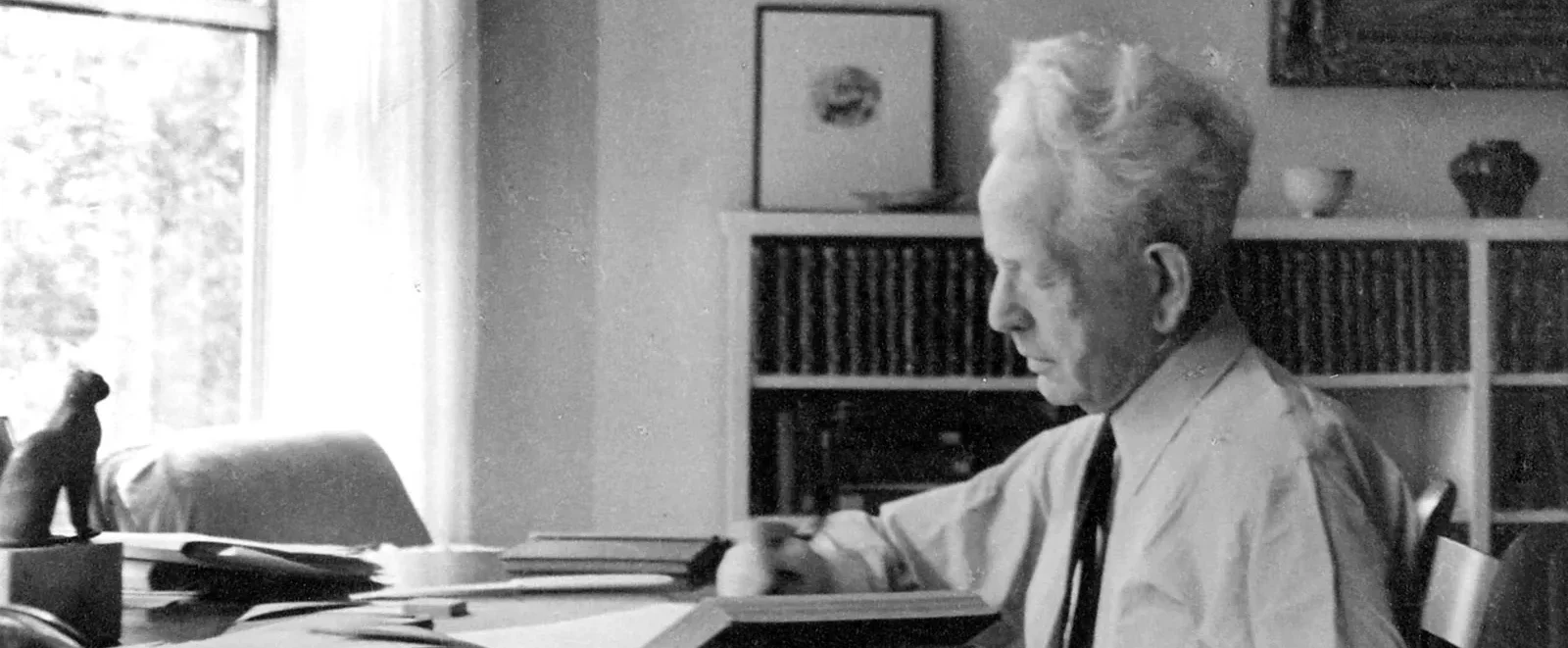
Ernst Cassirer’s philosophy of symbolic forms holds that human beings never meet the world raw. We meet it through symbolic forms, chiefly myth, language, art, religion, history and science, and each form builds its own kind of world, with its own sense of space, time, cause and self. He set the theory out in the three-volume Philosophy of Symbolic Forms (1923–1929).1
For a therapist this is more than a theory of knowledge. If people live inside symbolic forms, then a good deal of suffering is a problem of form rather than of information. A fear held in what Cassirer called the expressive or mythic mode is not a belief about the world that can be argued down. For the person having it, it is the world. Much of what therapy does, when it helps, can be described as helping experience move between forms: from raw expression, to a story placed in time, to a meaning that can be thought about, without draining a living symbol of its force. Cassirer’s own reading of research on brain-injured patients, Susanne Langer’s account of feeling and Carl Jung’s distinction between a sign and a symbol each supply part of that argument.
What the philosophy of symbolic forms claims
Cassirer began as a neo-Kantian of the Marburg School, which read Kant’s question about the conditions that make knowledge possible as a question about the “fact of science.” His first systematic book, Substance and Function (1910), argued that scientific concepts are not abstracted from piles of sensory particulars but are relational structures, closer to a mathematical function than to a summary of things seen.1, 2 His 1921 study of Einstein’s relativity then announced a wider project: just as relativity treats many frames of reference as valid, Cassirer would treat art, ethics, religion and science as so many frames through which the mind builds a world.1
The Philosophy of Symbolic Forms carried that idea from the “fact of science” to the “fact of culture.” Volume one (1923) treats language, volume two (1925) mythical thinking and volume three (1929) the phenomenology of knowledge. A symbolic form is not a copy of a reality already there. It is a way of giving shape to experience so that there is a stable reality to have at all, and myth and mathematics do this in different but legitimate ways. In An Essay on Man (1944), his concise English introduction to the system, Cassirer proposed replacing the old definition of the human being as animal rationale, the rational animal, with animal symbolicum, the symbolic animal: the creature that puts systems of signs and expression between itself and the world.1, 3
He did much of this work at Hamburg, drawing on Aby Warburg’s private library of cultural history, ritual and myth, which published his first studies on symbolic forms between 1922 and 1925.1
Who Ernst Cassirer was
Cassirer was born on 28 July 1874 in Breslau, now Wrocław in Poland, into a wealthy Jewish family. He entered the University of Berlin in 1892, where Georg Simmel pointed him to Hermann Cohen’s books on Kant, and went to Marburg to study with Cohen, finishing a dissertation on Descartes in 1899. He taught as a Privatdozent in Berlin from 1906 to 1919, when the new University of Hamburg gave him a chair. In 1929–30 he served as Hamburg’s rector, the first Jew to hold that office at a German university.1
In the spring of 1929 he met Martin Heidegger at Davos, Switzerland, in a public disputation over how to read Kant. Heidegger pressed the finitude of human existence; Cassirer defended truths in mathematics and morality that hold beyond any one finite life. Peter Gordon’s Continental Divide (2010) is a book-length study of the encounter.1, 4 Cassirer left Germany in 1933, lectured for two years at Oxford and six at Göteborg in Sweden, and moved to the United States in 1941, teaching at Yale and then Columbia. He died of a heart attack on a New York street on 13 April 1945. The Myth of the State, his account of how fascism harnessed mythic thinking, appeared the following year.1
Expression, representation and signification
The third volume names three functions that run through all symbolic forms.1, 5 The expressive function (Ausdruck) gives us a world charged with feeling: things and events show up as comforting or threatening, hateful or desired, before they show up as objects. The representative function (Darstellung), carried mainly by ordinary language, sorts that flux into stable things with properties, located in space and time relative to a speaker’s here and now, so that appearance and reality can finally be told apart. The significative function (Bedeutung) frees relations from the senses altogether, as in mathematics and physics. In Cassirer’s sketch, religion and art grow out of myth, and theoretical science grows out of language. His term symbolic pregnance (symbolische Prägnanz), introduced in that third volume, names the fact that a perception arrives already carrying meaning rather than as bare sensation to which meaning is later attached.5
The expressive layer is where myth lives, and Cassirer’s description of it reads like a clinical note. In mythic consciousness, image and thing, dream and waking, name and object, the living and the dead are not held apart. In Steve Lofts’s recent translation of volume two, the mythic world is concrete “because in it the two elements of thing and of signification merge undifferentiatedly into each other.” It runs on a logic of the part for the whole: the part does not stand for the whole, it is the whole.1, 6 This mode deserves to be understood on its own terms: the problem of myth, he wrote in the preface to volume two, “expands beyond the narrow limits of psychology and psychologism.”6 He took the word phenomenology in Hegel’s dialectical sense, as the study of how each form of mind develops out of the one beneath it without simply cancelling it.1
He did rank the forms. An Essay on Man opens its chapter on science with the sentence “Science is the last step in man’s mental development and it may be regarded as the highest and most characteristic attainment of human culture.”3 Yet he never thought the higher forms abolish the lower. The Myth of the State argues that National Socialism used modern mass communication to wake and exploit mythic functions of thought that remain present in every human being.1, 7 Nobody grows out of the expressive layer. It is the ground floor of everyone’s experience.
When symbolic forms break down
Cassirer had a close source on what happens when the symbolic function fails. The neurologist Kurt Goldstein was his cousin: Goldstein’s mother, Rosalie Cassirer, was the philosopher’s aunt.8 In 1916, while treating brain-injured soldiers in Frankfurt, Goldstein and the Gestalt psychologist Adhémar Gelb founded an institute there to study the consequences of brain injury. His holism later fed into Gestalt therapy: Fritz Perls worked as his assistant in 1926, and Laura Perls took her doctorate with Gelb.8 A long chapter of Cassirer’s third volume, “On the Pathology of Symbolic Consciousness,” works through the history of aphasia theory and through disorders of perception, of space, time and number, and of action.5 The historian Alexandre Métraux has written on two of Cassirer’s letters to Goldstein about this material.9
On Cassirer’s reading, what these patients had lost was less a store of information than a symbolic attitude: the ability to take a step back from the immediate situation and treat it as one possibility among others. Goldstein and Martin Scheerer later formalized the contrast as “abstract” versus “concrete” behavior and built tests for it.10 Maurice Merleau-Ponty returned to one of the Gelb and Goldstein patients, known in the literature as Schneider, in Phenomenology of Perception (1945), and his account of the lived body grows partly out of it.11 The lesson for psychology is plain: holding an experience at a distance, as a representation rather than a total presence, is an achievement of a living organism, and it can be lost.
The 1920s also brought a more personal meeting between symbolic forms and psychiatry. Warburg himself was hospitalized from 1921 to 1924 in Ludwig Binswanger’s clinic at Kreuzlingen in Switzerland, and Cassirer visited him there.12 In 1923, still a patient, Warburg lectured at Kreuzlingen on the serpent ritual of the Hopi, drawing on notes from his 1895–96 travels in the American Southwest.12, 13 Binswanger went on to found existential analysis, one of the main roots of existential psychotherapy.
Langer and Jung: feeling that has not yet found its form
The American philosopher Susanne Langer carried Cassirer’s ideas into aesthetics and the study of feeling. She translated his Language and Myth into English (1946), and her Philosophy in a New Key (1942) calls him “that pioneer in the philosophy of symbolism.”14, 15 Langer made the claim in a form a clinician can use: “This basic need, which certainly is obvious only in man, is the need of symbolization. The symbol-making function is one of man’s primary activities, like eating, looking, or moving about.”14
She then split symbolism in two. Discursive symbols, chiefly language, string ideas out one after another, and whatever cannot be laid out that way is, for language, ineffable. Presentational symbols, such as an image, a ritual or a piece of music, are grasped as a whole, all at once. There is, she wrote, “a kind of symbolism peculiarly adapted to the explication of ‘unspeakable’ things,” and music is its most developed type.14 Much of what people bring to therapy is presentational before it is discursive: a heaviness in the chest, a recurring dream image, a posture that collapses when a parent is mentioned. Langer gives us a reason to treat these as meanings rather than as noise waiting to be translated.
Carl Jung drew a parallel line in the definitions at the back of Psychological Types (1921; English 1923). “An expression that stands for a known thing always remains merely a sign and is never a symbol,” he wrote, and “the symbol is alive only in so far as it is pregnant with meaning.” Once a better formulation is found, the symbol dies into a sign. He also separated symbol from symptom: a symptom points back to a known underlying process, while a living symbol comes from the cooperation of conscious and unconscious and expresses something not yet known.16 In English, Jung’s “pregnant with meaning” and Cassirer’s later “symbolic pregnance” sound alike, but that is a convergence at most, not a documented line of influence, and the two differ on a basic point: Jung read myth psychologically, while Cassirer refused to let psychology explain it away. For Jung’s wider philosophical neighborhood, see our essay on Jung’s relevance and similarity to other thinkers.
What this looks like in therapy
Start with the expressive mode, because that is where most people are when they arrive. Someone with panic or traumatic stress often does not experience “I am remembering something frightening.” They experience “this room is dangerous.” In Cassirer’s terms, image and thing have merged, and the part has become the whole: a smell, a tone of voice or a hallway carries the entire event. That is an analogy, not a diagnosis, but it fits an influential model of intrusive memory. Chris Brewin and colleagues note that people with PTSD, other anxiety disorders, depression, eating disorders and psychosis often report vivid, distressing intrusive images, and they model these as inflexible, sensory-bound representations that are not properly integrated with flexible, contextual ones; the paper then discusses what that model implies for treatment.17 Moving a memory from total presence to something placed in a then and a there is, in Cassirer’s vocabulary, moving it from expression to representation.
Words help with that move, though less than people hope. In one brain-imaging study, naming the emotion in a distressing picture reduced amygdala response compared with other ways of processing the same picture, and a later review treats this “affect labeling” as an implicit form of emotion regulation.18, 19 Those are laboratory findings, not studies of therapy. In experimental disclosure studies, where people write or talk about personal and emotionally significant experiences, a meta-analysis of 146 randomized trials found a positive but small average effect, r = .075.20 Putting experience into words helps, but modestly, which fits Cassirer’s and Langer’s view that discursive language is only one of the forms experience needs.
Eugene Gendlin built a method on the gap between felt experience and its symbolization. In Experiencing and the Creation of Meaning (1962) he analyzed how felt, not-yet-worded meaning relates to the symbols that articulate it; his later Focusing method teaches people to attend to that bodily felt sense until the right word or image meets it.21 A meta-analysis of the Experiencing Scale, which rates the depth of a client’s processing and meaning-making in session, found a small-to-medium association with better outcomes across 10 studies and 406 clients (r = −.19 with symptom scores).22 The association is correlational, and it does not show that any one technique causes change. See our timeline of Gendlin’s life and work and our piece on what an emotion actually is.
In practice the work moves in both directions. Some material needs to stay presentational for a while: a dream image held without being decoded, a gesture repeated slowly, a part of the self given a voice. Jung’s warning applies here. Translate a living symbol too fast into a known sign and you have killed it. Other material needs to move up into reflective meaning, where people ask what a loss or a diagnosis means for how they want to live. That is the ground existential therapy covers, the tradition Binswanger helped found. None of this adds up to a Cassirer method; there is no established therapy built on his work. What Cassirer offers is a map of the kinds of meaning a person can be stuck in, and of the routes between them.
Limits and legacy
Cassirer’s map needs some corrections. His ladder from myth to science reflects the ethnology of his era, including its talk of “primitive” thought, and can make the expressive mode sound like a stage to outgrow rather than a permanent layer of every mind. Popular summaries also overstate him. Kant’s forms of space and time and his category of causality do take a different shape in each symbolic form, as mythic space and mythic causality show, but Cassirer was no relativist; at Davos he argued for truths in mathematics and ethics that hold objectively.1 Nor did he merely anticipate structuralism. He engaged it directly in “Structuralism in Modern Linguistics,” published in the linguistics journal Word in 1945, the year he died.23
Since the 1980s a substantial body of scholarship has returned to him. John Michael Krois’s Cassirer: Symbolic Forms and History (1987), Michael Friedman’s A Parting of the Ways (2000) on Carnap, Cassirer and Heidegger, Edward Skidelsky’s Ernst Cassirer: The Last Philosopher of Culture (2008) and the 2015 collection edited by J. Tyler Friedman and Sebastian Luft are good places to start.24, 25, 26, 27 A 2007 volume edited by Krois and colleagues includes chapters that read him alongside research on embodied cognition, and Lofts’s new English translation of all three volumes appeared in 2020–2021.5, 28 The hermeneutic tradition of Paul Ricoeur, which made the interpretation of symbols central to an account of the self, works the same ground from another side. For a broader case that philosophy belongs in the consulting room, see how philosophy can inform psychology.
If you find yourself living inside a feeling that seems to be the world rather than about it, or carrying images that will not turn into words, that is the material depth-oriented therapy works with. Taproot Therapy Collective offers Jungian depth therapy and existential therapy in Hoover, and you can contact us to ask whether it is a good fit.
References
- Friedman, M. (2023). Ernst Cassirer. In E. N. Zalta & U. Nodelman (Eds.), The Stanford encyclopedia of philosophy (Fall 2023 ed.). Stanford University. https://plato.stanford.edu/archives/fall2023/entries/cassirer/
- Cassirer, E. (1923). Substance and function and Einstein’s theory of relativity (W. C. Swabey & M. C. Swabey, Trans.). Open Court. (Original works published 1910 and 1921)
- Cassirer, E. (1944). An essay on man: An introduction to a philosophy of human culture. Yale University Press.
- Gordon, P. E. (2010). Continental divide: Heidegger, Cassirer, Davos. Harvard University Press.
- Cassirer, E. (2021b). The philosophy of symbolic forms, Volume 3: Phenomenology of cognition (S. G. Lofts, Trans.). Routledge. (Original work published 1929) https://doi.org/10.4324/9780429282508
- Cassirer, E. (2021a). The philosophy of symbolic forms, Volume 2: Mythical thinking (S. G. Lofts, Trans.). Routledge. (Original work published 1925) https://doi.org/10.4324/9780429282478
- Cassirer, E. (1946b). The myth of the state. Yale University Press.
- Kurt Goldstein (Mediziner). (n.d.). In Wikipedia (German). Retrieved November 8, 2026, from https://de.wikipedia.org/wiki/Kurt_Goldstein_(Mediziner)
- Métraux, A. (1999). Philosophy, neurology, and the pathology of symbolic consciousness: On two unpublished letters from Ernst Cassirer to Kurt Goldstein. Science in Context, 12(4), 645–660. https://doi.org/10.1017/S0269889700003641
- Goldstein, K., & Scheerer, M. (1941). Abstract and concrete behavior: An experimental study with special tests. Psychological Monographs, 53(2), i–151. https://doi.org/10.1037/h0093487
- Landes, D. A. (2013). The Schneider case. In The Merleau-Ponty dictionary. Bloomsbury. https://doi.org/10.5040/9781350250314_0233
- Aby Warburg. (n.d.). In Wikipedia. Retrieved November 8, 2026, from https://en.wikipedia.org/wiki/Aby_Warburg
- Warburg, A. (2017). Images from the region of the Pueblo Indians of North America (M. P. Steinberg, Trans.). Cornell University Press. (Lecture delivered 1923) https://doi.org/10.7591/9781501707704
- Langer, S. K. (1942). Philosophy in a new key: A study in the symbolism of reason, rite, and art. Harvard University Press.
- Cassirer, E. (1946a). Language and myth (S. K. Langer, Trans.). Harper & Brothers. (Original work published 1925)
- Jung, C. G. (1923). Psychological types, or the psychology of individuation (H. G. Baynes, Trans.). Kegan Paul, Trench, Trubner. (Original work published 1921)
- Brewin, C. R., Gregory, J. D., Lipton, M., & Burgess, N. (2010). Intrusive images in psychological disorders: Characteristics, neural mechanisms, and treatment implications. Psychological Review, 117(1), 210–232. https://doi.org/10.1037/a0018113
- Lieberman, M. D., Eisenberger, N. I., Crockett, M. J., Tom, S. M., Pfeifer, J. H., & Way, B. M. (2007). Putting feelings into words: Affect labeling disrupts amygdala activity in response to affective stimuli. Psychological Science, 18(5), 421–428. https://doi.org/10.1111/j.1467-9280.2007.01916.x
- Torre, J. B., & Lieberman, M. D. (2018). Putting feelings into words: Affect labeling as implicit emotion regulation. Emotion Review, 10(2), 116–124. https://doi.org/10.1177/1754073917742706
- Frattaroli, J. (2006). Experimental disclosure and its moderators: A meta-analysis. Psychological Bulletin, 132(6), 823–865. https://doi.org/10.1037/0033-2909.132.6.823
- Gendlin, E. T. (1962). Experiencing and the creation of meaning: A philosophical and psychological approach to the subjective. Free Press of Glencoe.
- Pascual-Leone, A., & Yeryomenko, N. (2017). The client “experiencing” scale as a predictor of treatment outcomes: A meta-analysis on psychotherapy process. Psychotherapy Research, 27(6), 653–665. https://doi.org/10.1080/10503307.2016.1152409
- Cassirer, E. (1945). Structuralism in modern linguistics. Word, 1(2), 99–120. https://doi.org/10.1080/00437956.1945.11659249
- Krois, J. M. (1987). Cassirer: Symbolic forms and history. Yale University Press.
- Friedman, M. (2000). A parting of the ways: Carnap, Cassirer, and Heidegger. Open Court.
- Skidelsky, E. (2008). Ernst Cassirer: The last philosopher of culture. Princeton University Press. https://doi.org/10.1515/9781400828944
- Friedman, J. T., & Luft, S. (Eds.). (2015). The philosophy of Ernst Cassirer: A novel assessment. De Gruyter. https://doi.org/10.1515/9783110421811
- Krois, J. M., Rosengren, M., Steidele, A., & Westerkamp, D. (Eds.). (2007). Embodiment in cognition and culture. John Benjamins. https://doi.org/10.1075/aicr.71



















0 Comments