
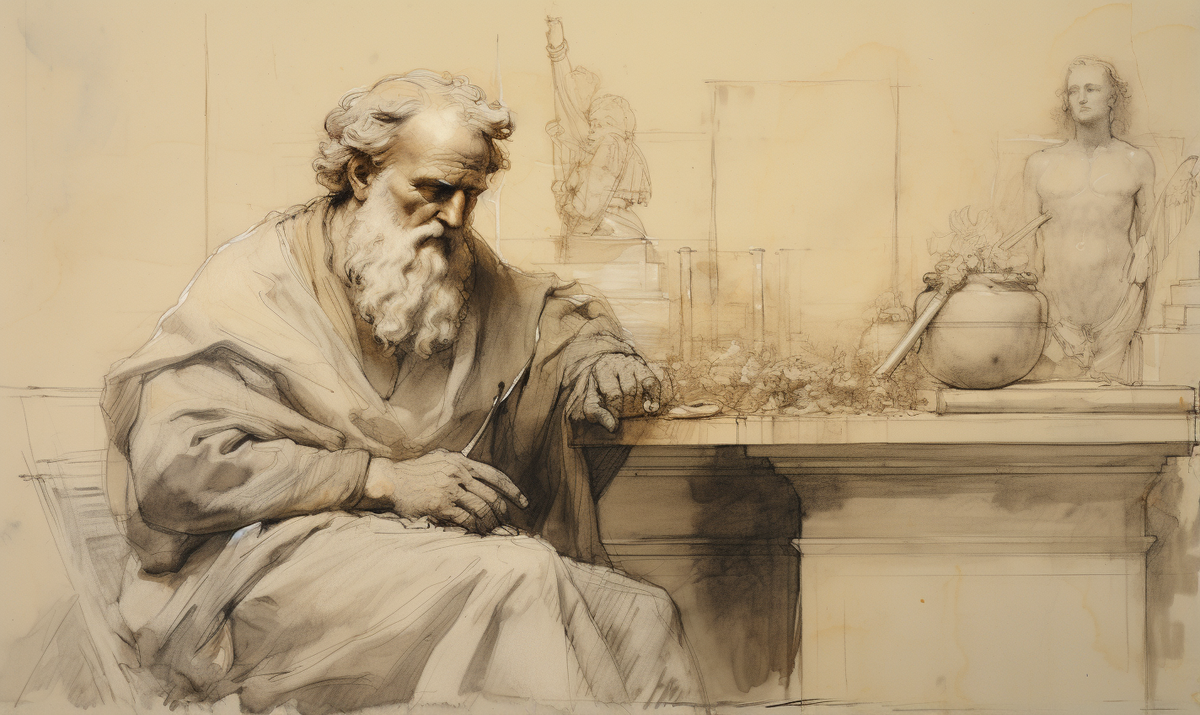
Zosimos of Panopolis was a Greek-Egyptian alchemist who wrote around 300 CE and is the earliest alchemist whose own writings survive in any quantity. He described stills and vapour apparatus, treated the colouring of metals as a spiritual purification, and recorded dream visions of dismemberment and rebirth that Carl Jung later read as a map of psychological transformation.
Key takeaways
- Zosimos of Panopolis wrote around 300 CE in Roman Egypt and is the earliest alchemist whose own writings survive in quantity.
- He treated the colouring and transmutation of metals as inseparable from the purification of the soul, drawing on Hermetic and Gnostic ideas.
- His texts describe the tribikos still and the kerotakis, devices he credited to Maria the Jewess, along with recipes for sulphur water and arsenic whitening.
- His treatise On Excellence records dream visions of a priest dismembered and transformed into spirit, which Carl Jung analysed in Alchemical Studies.
- Depth therapists use his imagery of the vessel, dissolution and refinement as a language for slow psychological change.
Who was Zosimos of Panopolis?
Zosimos came from Panopolis, the modern town of Akhmim on the Nile in Upper Egypt. Almost everything we know about him comes from his own surviving texts and from the Byzantine scholars who copied and commented on them. Lawrence Principe calls him the first alchemist about whom we have reasonably reliable historical details, and notes that most of what he wrote is lost.5
Historical context
Zosimos lived in Roman Egypt at a time when Greek philosophy, Egyptian temple religion, Judaism, early Christianity and the Hermetic and Gnostic movements all shared the same cities and often the same readers. Alexandria, some six hundred kilometres down the Nile, was the great centre of Greek learning, and later tradition places part of Zosimos’ working life there. Garth Fowden’s study of the Hermetic writings shows how this world produced texts that mixed practical craft knowledge with teaching about the soul’s ascent, and Zosimos belongs squarely inside it.7 He quotes Hermes Trismegistus, the Egyptian Thoth in Greek dress, as an authority, and the background to him is covered in the mystical philosophy of Hermes Trismegistus.
Panopolis itself was a lively Greek-speaking town. It was known for its linen weaving and dyeing, and it later produced the epic poet Nonnus. Not far up the river, near Nag Hammadi, a jar of Gnostic and Hermetic books was buried in the fourth century, a reminder of how close these traditions were to Zosimos’ home ground. For an introduction to that movement, see Gnosticism and the pursuit of divine knowledge.
Biographical details
Zosimos addressed most of his surviving work to a woman named Theosebeia, whom he treats as a fellow practitioner and pupil. Olivier Dufault argues that she was also his patron, and that many of his letters are polemics against rival alchemists competing for her support.6 Zosimos was plainly well read. He cites Plato, Hermes, Zoroaster, Jewish scripture and the earlier alchemical books attributed to Democritus and to Maria the Jewess, and he writes as someone trained in Greek philosophy who also worked at a furnace. Scholars still debate whether he was a pagan, a Christian or something in between; Jung and many older writers called him a Gnostic because his picture of the soul trapped in matter and fate is so close to Gnostic teaching.3
What did Zosimos believe alchemy was for?
The spiritual dimension of alchemy
For Zosimos, the art was never only a recipe for making gold. Working on metals went together with working on the person doing it. In the letter known as the Final Count he urges Theosebeia to calm her passions, to stop chasing quick results from priests and spirits, and to seek the “natural” processes that follow the order of things. He ends by telling her to hurry to Poimandres and be baptized in the mixing bowl, a direct reference to a Hermetic treatise in which the mind is offered to souls as a baptism in a divine vessel.7 In other words, the purification of the metal and the purification of the soul belong to one discipline.
In his treatise On the Letter Omega Zosimos sets out the anthropology behind this. Every human being has an outer, bodily Adam, ruled by fate (Greek heimarmene), and an inner man of light, whom he calls Phos. The task of the philosopher is to recognize the inner man and free him, not by magic that tries to force fate, but by self-knowledge.1 Jung quoted this passage at length in Psychology and Alchemy as an ancient image of the self hidden within the ordinary personality.4
The concept of transmutation
Greek alchemy inherited from Aristotle the idea that all bodies share an underlying matter that takes on different qualities. If copper, lead and silver differ only in their qualities, then a skilled worker can strip a metal of one set of qualities and give it another. The early alchemists expressed this unity of matter with the ouroboros, the serpent eating its tail, labelled “the all is one” in the treatise attributed to Cleopatra; H. J. Sheppard traced how the image carried this doctrine.10
Zosimos worked within this framework rather than inventing it. His own vocabulary distinguishes between “bodies” (the fixed metals) and “spirits” (volatile substances such as mercury, sulphur and arsenic compounds that rise in vapour). Transmutation meant driving the spirits into the bodies so that a base metal took on the colour and properties of silver or gold. Sherwood Taylor’s surveys of the Greek texts remain clear accounts of this theory.11,12
The role of the alchemist
Zosimos pictured the alchemist as a mediator between the visible and invisible orders: a philosopher who understands nature and can therefore cooperate with it. He drew on a story from the Book of Enoch, in which fallen angels taught the arts of nature to human women, to explain where alchemical knowledge came from, and Kyle Fraser has shown how Zosimos used this myth to cast alchemy as divine knowledge that had to be handled with moral seriousness.9 This image of the practitioner as a sage-priest, not a mere technician, ran through later Western esotericism, from Byzantine commentators to Renaissance Hermeticists and the Rosicrucian manifestos of 1614 to 1616.
What did Zosimos contribute to practical alchemy?
Alchemical apparatus and techniques
Zosimos is a major source for the laboratory equipment of ancient alchemy, and the Greek manuscripts preserve drawings of it.2 He describes the tribikos, a still with three spouts that carried condensed vapour into separate receivers, and the kerotakis, a closed vessel in which a sheet of metal on a palette was exposed to the vapours of mercury, sulphur or arsenic heated beneath it. He credits both devices to Maria the Jewess, whom he treats as one of the founders of the art; Raphael Patai collected the fragments of her teaching that survive only through Zosimos.8 These descriptions are among the earliest detailed records of distillation and sublimation apparatus anywhere.
Chemical processes and substances
Zosimos’ recipes deal with real materials: copper, lead, tin, mercury, sulphur, the arsenic sulphides orpiment and realgar, natron, alum and vinegar. A central product was the so-called “divine water” or “sulphur water” (the Greek theion means both), a sulphurous liquid used to colour metals. He also describes whitening copper with arsenic vapour to make it look like silver, and subliming mercury.14 The strongest acid available to him was vinegar; the mineral acids such as nitric and sulphuric acid first appear clearly in Latin texts of the thirteenth century.5
The concept of tinctures
The Greek word that became “tincture” is baphe, a dye. Ancient alchemy borrowed much of its language from the dyeing workshops that Panopolis was known for: just as a dye penetrates cloth, a tincture was thought to penetrate a metal and change its colour throughout. In the Final Count Zosimos contrasts “timely” tinctures, which he says local spirits and temple priests hand out to their followers, with natural tinctures that the philosopher reaches by understanding.6 The later idea of a single powerful agent, the philosopher’s stone, which turns any quantity of base metal to gold, grew out of this older concept of the tincture.15
What did Zosimos write?
The corpus of Zosimos
Zosimos wrote a large body of work, perhaps arranged in twenty-eight books, but it survives only in excerpts copied into Byzantine collections, the oldest of which date from the tenth or eleventh century. Marcellin Berthelot and Charles-Émile Ruelle printed the Greek texts in 1887 and 1888, and Michèle Mertens produced the modern critical edition of the thirteen pieces known as the Authentic Memoirs in 1995.2,1 The main titles are:
- On Excellence (Greek Peri aretes, often translated “On Virtue”), the treatise that contains the visions.
- On the Letter Omega, the treatise on the inner and outer man and on fate.
- The Final Count (also rendered “The Final Quittance” or “Final Reckoning”), the letter to Theosebeia on natural and “timely” tinctures.
- On Apparatus and Furnaces and other technical pieces on stills, the kerotakis and the treatment of metals.
- The Book of Pictures (Arabic Mushaf as-suwar), a work that survives only in Arabic, with a series of coloured drawings that Theodor Abt published in facsimile in 2007.13
Translations were made into Syriac and Arabic, and Arabic scholars knew Zosimos as a leading ancient authority. Very little of him passed directly into Latin; his ideas reached medieval Europe mainly through Arabic works that had absorbed them.5
Allegorical and symbolic writing
Zosimos writes in two registers at once. A passage may give a practical instruction about heating and condensing, then shift into dream, myth or prayer. His most famous texts are vivid visions in which the stages of a chemical operation appear as human figures suffering and changing. This blend of laboratory detail and symbolic narrative became a hallmark of alchemical literature for the next fifteen centuries, and it is why later readers, from medieval monks to modern psychologists, found alchemy both baffling and rich.
What are the visions of Zosimos?
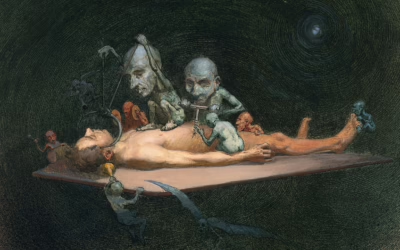
The treatise On Excellence records a series of dreams. In the first, Zosimos falls asleep and sees a priest standing on top of an altar shaped like a shallow bowl, reached by fifteen steps. The priest, who calls himself Ion, says he has undergone unbearable torment: a man came at dawn with a sword, dismembered him, flayed him, and burned his bones and flesh in the fire until his body was changed and he became spirit. Zosimos then sees the priest vomiting and eating his own flesh. He wakes and asks himself whether the dream is about the composition of liquids.1,3
The dreams that follow repeat the pattern. People stand in boiling water on the altar and cry out; a man of brass, an “Agathodaimon” and other figures appear; each time the narrative of torment ends in transformation into spirit. Zosimos himself treats the visions as teaching about the operations of the art, the boiling, separating and sublimating that turn a crude substance into a refined one.
How did Carl Jung interpret Zosimos?
Carl Jung lectured on the visions at the Eranos conference in Ascona in 1937, published the lecture the next year, and expanded it as “The Visions of Zosimos” in 1954. The English version appears in Alchemical Studies, volume 13 of the Collected Works (1967).3 His reading rests on the idea of projection: the alchemists, staring into their vessels for weeks, saw in the changing colours and vapours the contents of their own unconscious, and wrote them down as if they were properties of matter.
On this reading, the priest who is both sacrificer and sacrificed is an image of a psychic process in which the old attitude is broken down so that something new can form. The bowl-shaped altar is the alchemical vessel, the container that holds the process. The dismemberment resembles the initiatory dreams of shamans, in which the novice is cut apart and reassembled, and Jung returned to the same visions in his essay on transformation symbolism in the Mass. For Jung the visions showed, in ancient form, the same movement he called individuation: the painful dissolution and reorganization of the personality around the self.3,4 The question is taken up more fully in what alchemy has to do with psychology.
Jung was not the first psychoanalyst to read alchemy this way. Herbert Silberer had published a psychological study of an alchemical parable in 1914. Jung’s students carried the work on: Marie-Louise von Franz edited and interpreted alchemical texts, and Edward Edinger organized the operations of alchemy into a working vocabulary for psychotherapy. Theodor Abt, who brought out the Book of Pictures, is himself a Jungian analyst. Jung’s own visionary record, described in Jung’s The Red Book, helps explain why the Zosimos dreams struck him so strongly: he recognized his own experience in them.
How did Zosimos influence later alchemy and chemistry?
Impact on medieval alchemy
Byzantine scholars treated Zosimos as the classic author of the art. Olympiodorus in the sixth century and Stephanus of Alexandria in the seventh wrote commentaries that lean on him, and the compilers of the great Greek alchemical collections organized their material around his texts. In the Arabic world his name appears in catalogues of ancient authorities, and works attributed to him circulated in translation.5 Through those Arabic intermediaries his apparatus and his union of practical and spiritual work entered the Latin alchemy of the later Middle Ages, the world of figures such as Arnaldus de Villanova.
Contributions to the development of chemistry
Modern chemistry has left the theory of tinctures behind, but it kept many of the tools. The still, the reflux vessel and the techniques of sublimation and distillation that Zosimos describes passed from late antique workshops through Arabic and Latin laboratories to early modern chemists. Principe uses the term “chymistry” for this long period because, before the eighteenth century, practitioners did not separate the search for transmutation from careful work with substances.5 Zosimos’ habit of recording apparatus, materials and steps belongs to that history of patient observation.
Influence on esoteric and mystical traditions
The other line of descent runs through esotericism. The idea that working on matter is also working on the soul, and that the vessel of the art mirrors an inner vessel, reappears in Renaissance and early modern alchemists such as Gerhard Dorn, who said plainly that the alchemist must transform himself. It also fed the Hermetic revival and the visionary literature that runs from Jakob Boehme to Emanuel Swedenborg. Jung’s whole study of alchemy, summarized in Carl Jung’s major influences, depends on taking that line seriously.
What can a therapist learn from Zosimos?
Depth psychotherapists use alchemy as a language for change that happens slowly and under pressure. Clients often describe periods of life in terms Zosimos would recognize: falling apart, being boiled, being burned down to the bones. The alchemical frame does not treat these states as simple malfunctions to be removed. It asks what is being dissolved, what is being refined, and what is trying to form.
Three features of the visions are especially useful in a therapy room. First, the vessel: Zosimos’ transformation takes place on a closed altar, and therapists speak of the session as a container in which intense material can be heated without spilling out into the rest of life. Second, Zosimos’ response to his dream. He wakes and asks what the images mean, and then returns to sleep and dreams again. That is close to what Jungians do with dreams (see Jungian dream interpretation) and with active imagination, staying with an image and questioning it rather than explaining it away. Third, the body. The priest’s transformation is physical before it is spiritual, and people recovering from trauma often find that change starts in sensation and posture before it reaches words.
At Taproot we bring these ideas into Jungian therapy, where dreams of dismemberment, fire or descent are explored as part of the person’s own process, and into body-based trauma work such as Brainspotting therapy for trauma, where a client stays with a felt sense in the body while images and memories are allowed to change at their own pace. Both share Zosimos’ assumption that the psyche has its own way of refining what is crude.
Why does the Greek alchemical tradition still matter?
Zosimos links the temple and workshop culture of Roman Egypt with the alchemy of Byzantium, the Islamic world and, eventually, medieval and Renaissance Europe. He gave the art its classic apparatus, its vocabulary of bodies, spirits and tinctures, and its habit of writing technical knowledge as vision and myth. Much of his work is lost and what survives is hard to read, partly because alchemists wrote obscurely on purpose. Yet the fragments still show a mind holding together what later centuries split apart: experiment, philosophy and the inner life.
That union is what makes Zosimos worth reading for anyone interested in how people change. His dreams of torment and renewal describe something many clients live through, and they suggest that suffering inside a well-held vessel can become transformation rather than mere damage. If that way of working speaks to you, you can contact Taproot Therapy Collective to talk with one of our therapists.
Frequently asked questions
What is Zosimos of Panopolis known for?
Zosimos of Panopolis is known as the earliest alchemist whose own writings survive in substantial form. Writing around 300 CE in Egypt, he described distillation apparatus, discussed tinctures that colour metals, wrote letters to his pupil Theosebeia, and recorded symbolic dream visions that later fascinated Carl Jung and historians of chemistry.
What happens in the visions of Zosimos?
In the visions of Zosimos, the dreamer sees a priest named Ion on a bowl-shaped altar with fifteen steps. Ion says he was dismembered with a sword, flayed and burned until his body became spirit. Later dreams show people boiling on the altar. Zosimos read them as teaching about alchemical operations on liquids and metals.
Why did Carl Jung write about Zosimos?
Carl Jung saw the visions of Zosimos as an ancient record of the unconscious projected onto matter. He lectured on them at Eranos in 1937 and published the expanded essay in 1954, now in Alchemical Studies. For Jung, the priest’s dismemberment and renewal pictured individuation, the breakdown and reorganization of the personality.
Who was Theosebeia in Zosimos’ writings?
Theosebeia was the woman to whom Zosimos of Panopolis addressed most of his surviving works. He treats her as a fellow practitioner and pupil, and the historian Olivier Dufault argues she was also his patron. In the Final Count, Zosimos warns her against priests and spirits offering quick tinctures.
Did Zosimos invent the alchemical still?
Zosimos did not claim to invent the still. He described the tribikos, a three-spouted still, and the kerotakis, a vapour vessel, and credited both to Maria the Jewess, an earlier alchemist. His descriptions are among the earliest detailed records of distillation and sublimation apparatus.
Related reading
- Charles Eames: Pioneering Designer of the Modern Era
- Ludwig Mies van der Rohe: Architect of the Modern Age
- Max Weber: The Architect of Modern Sociology
- Jean-Paul Sartre: Existentialism, Freedom, and the Human Condition
- Ernst Cassirer: Philosopher of Symbolic Forms and Cultural Theory
- Jacob Burckhardt: A Life of Cultural History and Psychological Insight
References
- Mertens, M. (Ed. & Trans.). (1995). Les alchimistes grecs: Tome IV, 1re partie. Zosime de Panopolis, Mémoires authentiques. Les Belles Lettres.
- Berthelot, M., & Ruelle, C.-É. (Eds.). (1887-1888). Collection des anciens alchimistes grecs (3 vols.). G. Steinheil.
- Jung, C. G. (1967). The visions of Zosimos. In Alchemical studies (R. F. C. Hull, Trans.; Collected Works, Vol. 13, pp. 57-108). Princeton University Press. (Original work published 1938, revised 1954)
- Jung, C. G. (1968). Psychology and alchemy (2nd ed., R. F. C. Hull, Trans.; Collected Works, Vol. 12). Princeton University Press. (Original work published 1944)
- Principe, L. M. (2013). The secrets of alchemy. University of Chicago Press.
- Dufault, O. (2019). Early Greek alchemy, patronage and innovation in late antiquity. California Classical Studies.
- Fowden, G. (1986). The Egyptian Hermes: A historical approach to the late pagan mind. Cambridge University Press.
- Patai, R. (1994). The Jewish alchemists: A history and source book. Princeton University Press.
- Fraser, K. A. (2004). Zosimos of Panopolis and the Book of Enoch: Alchemy as forbidden knowledge. Aries, 4(2), 125-147. https://doi.org/10.1163/1570059042321588
- Sheppard, H. J. (1962). The ouroboros and the unity of matter in alchemy: A study in origins. Ambix, 10(2), 83-96. https://doi.org/10.1179/000269862790222870
- Taylor, F. S. (1937). The origins of Greek alchemy. Ambix, 1(1), 30-47. https://doi.org/10.1179/amb.1937.1.1.30
- Taylor, F. S. (1930). A survey of Greek alchemy. The Journal of Hellenic Studies, 50(1), 109-139. https://doi.org/10.2307/626167
- Abt, T. (Ed.). (2007). The book of pictures: Mushaf as-suwar by Zosimos of Panopolis. Edition of the pictures and introduction. Living Human Heritage Publications.
- Lindsay, J. (1970). The origins of alchemy in Graeco-Roman Egypt. Frederick Muller.
- Holmyard, E. J. (1957). Alchemy. Penguin Books.



0 Comments