
Updated November 2026 · By Joel Blackstock, LICSW-S
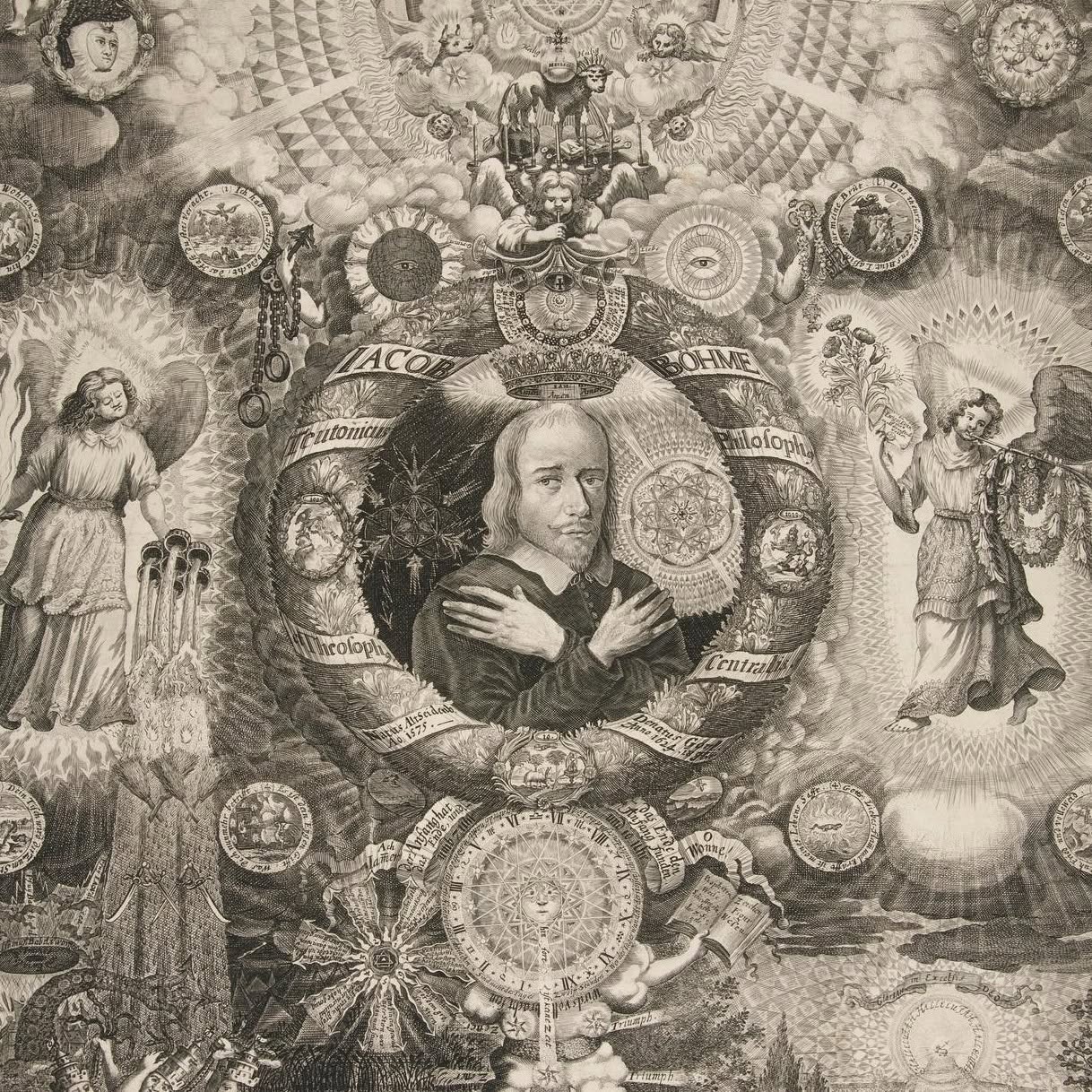
Jakob Boehme (c. 1575–1624) was a shoemaker in Görlitz whose visionary books describe a God who comes to know himself only through the strife between a dark, wrathful fire and the light of love. Carl Jung cited him in Psychology and Alchemy, Aion and Mysterium Coniunctionis, and in Aion named him “above all” as the one whose God-image held good and bad in one divine being.1, 2, 3
One sentence of Boehme’s, which Hegel quoted, carries the whole idea: “No thing can become manifest to itself without opposition.”4 This page argues that the sentence is a theological sketch of what Jung called individuation. A person becomes whole the way Boehme’s God does: by giving the dark ground a place and letting it change, not by cutting it out. Jung took the idea seriously and also kept his distance from the metaphysics behind it. Both halves of his response are useful in a therapy room.
Who Jakob Boehme was
Boehme was born around 1575 in Alt Seidenberg, a village near Görlitz in Upper Lusatia that is now Stary Zawidów in Poland.5, 6 His family were peasants. He worked as a herd boy, was judged not robust enough for farm work, and was apprenticed to a shoemaker. By 1599 he was a master shoemaker in Görlitz, married to a butcher’s daughter.7, 8 He was a Lutheran by birth and still one at his death, worth remembering whenever he is called a heretic.6
In 1600, looking at sunlight reflected in a polished pewter dish, he had the illumination that shaped the rest of his life. He later wrote that “the Gate was opened to me, that in one quarter of an hour I saw and knew more than if I had been many years together at an University.”7 Twelve years later he wrote Aurora (1612), unfinished and not meant for print. A nobleman, Karl von Ender, had copies made, and one reached Gregor Richter, the chief pastor of Görlitz, who attacked the shoemaker from the pulpit. The magistrates forbade him to write, and he kept quiet for about five years.5, 7, 8
When he started writing again, around 1618, the books came quickly, among them The Three Principles of the Divine Essence (1619), Forty Questions on the Soul (1620), The Signature of All Things (1621) and Mysterium Magnum (1623). His first biographer counted thirty works, all in German and passed around in handwritten copies.5, 6 The first to be printed, The Way to Christ, appeared around the turn of 1624 and set off a new attack. Boehme went to the elector’s court at Dresden, where, by the account his editors pass on, the theologians declined to condemn him. He died at home in Görlitz in November 1624, aged forty-nine.5, 7, 8
“Philosophus Teutonicus” was a title others gave him, used in the 1682 Amsterdam collected edition, not a pen name.2 Hegel called him “the German cobbler of Lusatia, of whom we have no reason to be ashamed,” through whom “Philosophy first appeared in Germany with a character peculiar to itself.” Hegel also judged his manner and system “barbarous,” a fair warning for anyone opening Aurora.4
The Ungrund, the seven qualities and the three principles
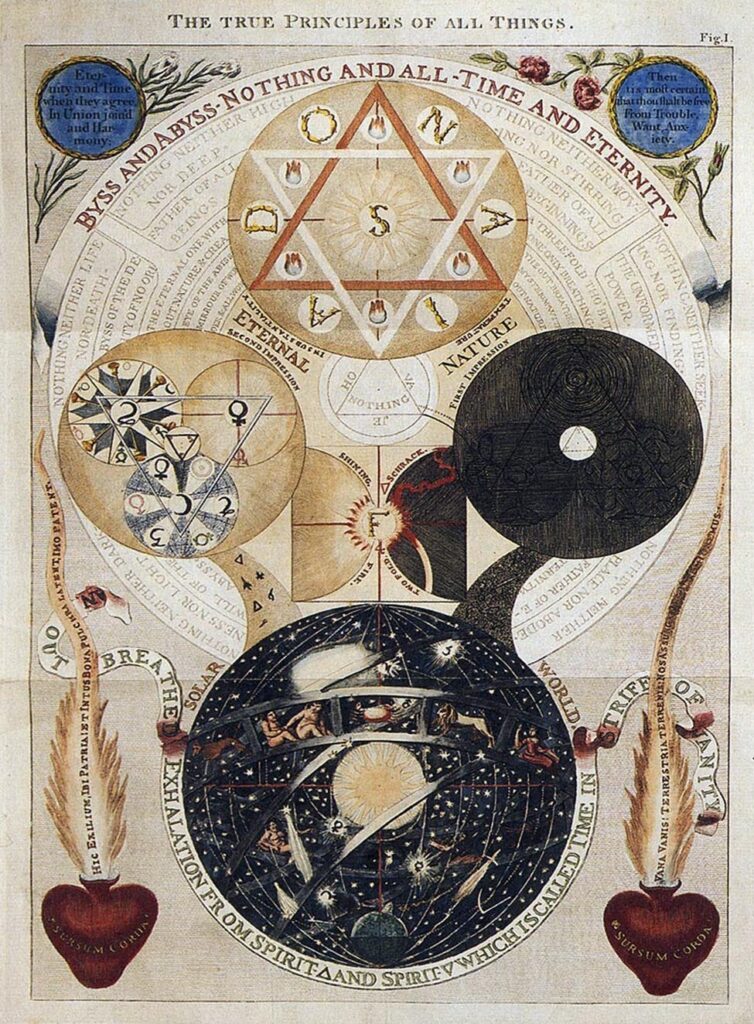
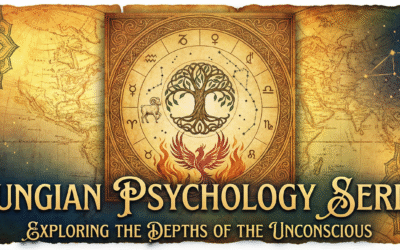
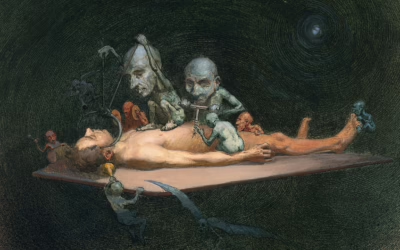
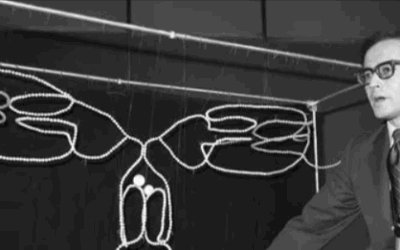
Boehme begins behind God. Before anything is revealed there is what he called the Ungrund, the groundless: a hidden, undivided will with nothing to push against. Schelling took the concept over for his 1809 essay on human freedom.9 The same vocabulary of groundlessness turns up in William Law’s free English paraphrase of one of the dialogues, where whoever finds divine love “findeth a supernatural, supersensual Abyss, which hath no ground or Byss to stand on.”8 The banner across the plate above, “Byss and Abyss,” draws on it too.
How could such a God ever know himself? Boehme’s answer, quoted at length by Hegel: “Without adversity life would have no sensibility nor will nor efficacy, neither understanding nor science.” If the hidden God had not divided his will, and “had this element of separation in life not come into warfare, how was the will of God which is only one to be revealed to Himself?”4 Revelation, for Boehme, is a fight before it is a light.
He worked the fight out as seven qualities: dry, sweet, bitter, fire, love, sound and body.6 The first, dryness, he associated with Saturn and the power of death, and Jung noted that Boehme derived the divine “wrath-fire” partly from it.3, 5 Hegel admired the wordplay that runs Qual, torment, into Quelle, a spring, and Qualität, quality: in Boehme’s German, pain is where qualities come from.4
Summaries of Boehme often get the three principles wrong. They are not contraction, expansion and a reconciling Christ. Boehme’s own wording is: “God is a spirit; three principles are in him, that is, the sources and powers of the darkness, of the light, and of this world.”7 The first principle is the dark, fiery world of wrath; the second is the light world of love; the third is our temporal, visible world, where the two are mixed.3, 6 As the Master puts it in the dialogues, “The visible World hath both in it; and there is no place but Heaven and Hell may be found or revealed in it.”8
The dark fire is not evil in itself. In Boehme’s dialogues, hell is located “in Self-hood and in the False Will,” and is “but the turning in of the Will into the wrath of God.”8 Evil is the fire closed in on itself, cut off from the light. Redemption does not put the fire out. In the dialogue printed as The Way from Darkness to True Illumination, the Son “changeth the Fire of the Father, namely, the first Principle, or Wrathful Property of the Soul, into the Flame of Love, so that out of Fire and Light (viz. Wrath and Love) there cometh to be one Essence.”8 The wrath is changed, not removed.
Where Jung actually cites Boehme
Claims that Jung was “deeply influenced” by Boehme go further than the passages where Jung actually discusses him. Boehme is a recurring witness in Jung’s later books, brought in when Jung needs a European example of opposites held inside the God-image.
In Psychology and Alchemy (1944), Jung quotes Boehme comparing life to “a round spherical wheel that goes on all its sides, as the wheel in Ezekiel shows,” and states that “Böhme’s mysticism is influenced by alchemy in the highest degree.” His historical verdict is blunt: “Paracelsus and Böhme between them split alchemy into natural science and Protestant mysticism.”1 Paracelsus, who died in 1541, was a source for Boehme, not a follower of his.6
In “A Study in the Process of Individuation,” Jung discusses a patient’s painting in which a golden flash of lightning has blasted one of several round forms out of its place among the boulders. He reads the flash as a sudden, unexpected and overpowering change of psychic condition and turns to Boehme’s writing on lightning for parallels; the essay’s first figure is a mandala from Boehme’s Forty Questions concerning the Soul.10, 11 One of the passages Jung quotes comes from Boehme’s account of his own illumination. In the English of The Confessions, the body “attains only a glimpse thereof; just as by a lightning-flash,” and then “the outermost presently closes again, for the wrath of God is stirred up there as fire is struck from the stone.”7
Aion (1951) contains the passage that matters most. Discussing the contradictory God-image of the Book of Job, Jung writes that, through the medium of the Cabala, “it evidently had an influence on Jakob Böhme. In his writings we find a similar ambivalence, namely the love and the ‘wrath-fire’ of God, in which Lucifer burns for ever.” When collective ideas leave gaps, he argues later, the unconscious compensates, and alchemy was one such compensation. “Above all it was Jakob Böhme who, influenced by alchemy and the Cabala equally, envisaged a paradoxical God-image in which the good and the bad aspects appertain to the same divine being.”2 For the Kabbalistic background, see the Kabbalistic concept of Ein Sof. Jung was not uncritical: he judged the alchemist Gerhard Dorn “far more lucid in his formulations than his successor Jakob Böhme.”2
In Mysterium Coniunctionis (1955–1956), Boehme’s heavenly Virgin, Wisdom, “has the character of an anima, for ‘she is given to be a companion to thee in thy soul.'” Jung links the alchemical central fire to “Boehme’s ‘divine wrath-fire,'” and says the poet Angelus Silesius “had drunk with Jacob Boehme at the fount of Mater Alchimia.” When an alchemical treatise speaks of a “fire of divine wrath,” he notes the echo of Boehme in a footnote and adds, “I do not know whether there is direct connection between them.”3
Why Boehme reads like a map of individuation
In Aion Jung calls the shadow “a moral problem that challenges the whole ego-personality,” and adds: “To become conscious of it involves recognizing the dark aspects of the personality as present and real.”2 Set that next to Boehme and three parallels stand out.
First, consciousness needs opposition. Boehme’s God cannot know himself as an undivided will; something has to push back. A person who has never been crossed, and has never crossed anyone, has no edges to know herself by. Second, the dark is one’s own ground, not an invader. Boehme places wrath inside the divine nature and calls it the “first Principle” of the soul; the devil is what that fire becomes when it turns in on itself. The shadow is likewise made of one’s own excluded material. Third, the goal is transformation inside a relationship, not removal. Boehme’s fire becomes a flame of love and stays fire. Jung’s late work on the opposites, which fills Mysterium Coniunctionis, aims at their union rather than the victory of one side.3
The line from Boehme to depth psychology is also historical. Schelling borrowed the Ungrund, and S. J. McGrath has argued that Schelling created the concept of the unconscious; the first chapter after his introduction is titled “Tending the dark fire: the Boehmian notion of drive.”9, 12 In England, William Blake’s The Marriage of Heaven and Hell (composed 1790–1793) declares “Without contraries is no progression,” and uses Boehme against Swedenborg: “any man of mechanical talents may from the writings of Paracelsus or Jacob Behmen produce ten thousand volumes of equal value with Swedenborg’s.”13 This site has longer pieces on William Blake and the visionary imagination and on Swedenborg’s visions and Jung.
Where the parallel breaks
Boehme was making claims about God. Jung insisted he was not: “Since psychology is not metaphysics, no metaphysical dualism can be derived from, or imputed to, its statements concerning the equivalence of opposites.”2 Jung’s subject was the God-image in the psyche. Boehme’s subject was the living God. His major concerns, as Ariel Hessayon summarizes them, were creation, the origin and presence of evil, and salvation through inward regeneration and rebirth.6 Reading him only as an early psychologist flattens him. A 2025 Brill monograph by Glenn J. McCullough argues the psychological reading at book length, with chapters titled “Boehme as Psychotherapist” and “Boehme’s Map of the Soul: the Birth of the Unconscious Mind.”14
The second break matters more clinically. Boehme’s dialogues say the soul must be “tried, refined, and purified.”8 It is easy to slide from there to the idea that suffering is an initiation and trauma a spiritual gift. That is not what trauma treatment requires, and it can add shame to people who did not find meaning in what happened to them. Meaning can come out of suffering, but no one owes it. Related reading: the influence of Christian mystics on Jungian thought and philosophers with implications for post-Jungian thought.
What this looks like in therapy
Many people come to therapy running Boehme in reverse. They try to be all light. Anger, envy, desire and ambition are treated as foreign bodies to be cut out, and the effort is exhausting. Boehme’s scheme suggests another reading: the dark first principle belongs to the ground; it is not a defect in it. Anger, held in relation, can become a boundary, a “no” that gives a “yes” its meaning.
The laboratory evidence points the same way, though modestly. In Daniel Wegner’s 1987 “white bear” experiments, people told not to think of a white bear could not manage it, and when they were later asked to think about it, they thought about it more than people who had been asked to think about it from the start.15 A 2001 meta-analysis of controlled studies found this rebound effect to be small to moderate, varying with the kind of thought and the way it was measured. Clinical samples did not show larger rebounds, though few studies included them.16 That does not prove Boehme right, but it does suggest that banishing a thought is a poor way to be rid of it.
In Internal Family Systems therapy, the angry or critical part is not pushed out; the therapist gets curious about what it is protecting. In Jungian depth therapy, the dark figure in a dream is treated as a part of the dreamer before it is treated as an enemy. Jung’s idea of compensation, the same idea he used to explain Boehme, is a working hypothesis here: what the conscious attitude leaves out tends to come back, in dreams, moods or the people we cannot stand. The evidence base for Jungian therapy is real but limited: a 2013 review found consistent improvement, mostly in naturalistic and retrospective studies from Germany and Switzerland, designs that cannot rule out other explanations as randomized trials can.17
Boehme is also useful with religious clients, and in Alabama many clients bring their faith into the room. Some grew up with a God-image that is all wrath, and some with one so sweet that their own anger feels like apostasy. A meta-analysis of 49 studies found that positive forms of religious coping track better adjustment to stress and negative forms track worse adjustment.18 Another meta-analysis of 97 studies found that therapy adapted to clients’ religious and spiritual beliefs worked about as well as standard therapy for distress in the most rigorous comparisons, and added gains in spiritual well-being.19 A therapist does not have to share Boehme’s theology to tell a client, accurately, that a Lutheran shoemaker wrote four centuries ago about a God of both wrath and love.
Reading Boehme today
Start with Andrew Weeks’s intellectual biography (SUNY Press, 1991) and the Weeks, Bonheim and Spang Aurora, which prints Boehme’s own manuscript opposite the first modern English translation.20, 21 Ariel Hessayon and Sarah Apetrei’s collection covers four centuries of reception; McGrath and McCullough cover the psychological line.12, 14, 22 Bernard Holland’s edition of the Dialogues on the Supersensual Life is free online and easier going than Aurora, though Holland notes that Law’s version is a paraphrase.8
If you are working on the parts of your own story you have tried to banish, or on a picture of God that has only wrath in it, that work can be done carefully and at your own pace. Taproot’s Jungian depth therapy in Hoover is one place to start, and you can reach us through the contact page.
References
- Jung, C. G. (2014). Psychology and alchemy (R. F. C. Hull, Trans.; Collected Works Vol. 12, 2nd ed., paras. 214–215, 514). Princeton University Press. (Original work published 1944) https://doi.org/10.1515/9781400850877
- Jung, C. G. (2014). Aion: Researches into the phenomenology of the self (R. F. C. Hull, Trans.; Collected Works Vol. 9, Part 2, 2nd ed., paras. 14, 111–112, 191, 266). Princeton University Press. (Original work published 1951) https://doi.org/10.1515/9781400851058
- Jung, C. G. (2014). Mysterium coniunctionis (R. F. C. Hull, Trans.; Collected Works Vol. 14, 2nd ed., paras. 124, 580, 632, notes and bibliography). Princeton University Press. (Original work published 1955–1956) https://doi.org/10.1515/9781400850853
- Hegel, G. W. F. (1896). Lectures on the history of philosophy (E. S. Haldane & F. H. Simson, Trans.; Vol. 3, pp. 188–216). Kegan Paul, Trench, Trübner. https://archive.org/details/lectureshistoryp03hegeuoft
- Jakob Böhme. (n.d.). In Wikipedia. Retrieved November 8, 2026, from https://en.wikipedia.org/wiki/Jakob_Böhme
- Hessayon, A. (2025). Jacob Boehme. In Oxford bibliographies in Renaissance and Reformation. Oxford University Press. https://doi.org/10.1093/obo/9780195399301-0557
- Boehme, J. (1920). The confessions of Jacob Boehme (W. S. Palmer, Comp. & Ed.; E. Underhill, Intro.). Alfred A. Knopf. https://archive.org/details/confessionsofjac00bh
- Boehme, J. (n.d.). Dialogues on the supersensual life (W. Law and others, Trans.; B. Holland, Ed.). Frederick Ungar. https://archive.org/details/dialoguesonsuper00be
- Friedrich, H.-J. (2009). Der Ungrund der Freiheit im Denken von Böhme, Schelling und Heidegger. frommann-holzboog. https://doi.org/10.5771/9783772830051
- Jung, C. G. (2014). A study in the process of individuation. In The archetypes and the collective unconscious (R. F. C. Hull, Trans.; Collected Works Vol. 9, Part 1, 2nd ed., pp. 290–354, paras. 531–535 and Fig. 1). Princeton University Press. https://doi.org/10.1515/9781400850969.290
- International Association for Analytical Psychology. (n.d.). Volume 9.1: The archetypes of the collective unconscious (Collected Works abstracts, entry 000271, “A study in the process of individuation. Picture 2”). Retrieved November 8, 2026, from https://iaap.org/resources/academic-resources/collected-works-abstracts/volume-9-1-archetypes-collective-unconscious/
- McGrath, S. J. (2013). The dark ground of spirit: Schelling and the unconscious. Routledge. https://doi.org/10.4324/9780203134399
- Blake, W. (2014). The marriage of heaven and hell (Project Gutenberg eBook No. 45315). Project Gutenberg. (Original work composed 1790–1793) https://www.gutenberg.org/ebooks/45315
- McCullough, G. J. (2025). Jacob Boehme and the spiritual roots of psychotherapy: Dreams, ecstasy, and wisdom. Brill. https://doi.org/10.1163/9789004680296
- Wegner, D. M., Schneider, D. J., Carter, S. R., & White, T. L. (1987). Paradoxical effects of thought suppression. Journal of Personality and Social Psychology, 53(1), 5–13. https://doi.org/10.1037/0022-3514.53.1.5
- Abramowitz, J. S., Tolin, D. F., & Street, G. P. (2001). Paradoxical effects of thought suppression: A meta-analysis of controlled studies. Clinical Psychology Review, 21(5), 683–703. https://doi.org/10.1016/S0272-7358(00)00057-X
- Roesler, C. (2013). Evidence for the effectiveness of Jungian psychotherapy: A review of empirical studies. Behavioral Sciences, 3(4), 562–575. https://doi.org/10.3390/bs3040562
- Ano, G. G., & Vasconcelles, E. B. (2005). Religious coping and psychological adjustment to stress: A meta-analysis. Journal of Clinical Psychology, 61(4), 461–480. https://doi.org/10.1002/jclp.20049
- Captari, L. E., Hook, J. N., Hoyt, W., Davis, D. E., McElroy-Heltzel, S. E., & Worthington, E. L., Jr. (2018). Integrating clients’ religion and spirituality within psychotherapy: A comprehensive meta-analysis. Journal of Clinical Psychology, 74(11), 1938–1951. https://doi.org/10.1002/jclp.22681
- Weeks, A. (1991). Boehme: An intellectual biography of the seventeenth-century philosopher and mystic. State University of New York Press.
- Weeks, A., Bonheim, G., & Spang, M. (2013). Jacob Boehme: Aurora (Morgen Röte im auffgang, 1612) and Fundamental Report (Gründlicher Bericht, Mysterium Pansophicum, 1620). Brill. https://doi.org/10.1163/9789004225688
- Hessayon, A., & Apetrei, S. (Eds.). (2013). An introduction to Jacob Boehme: Four centuries of thought and reception. Routledge. https://doi.org/10.4324/978020375402








0 Comments