

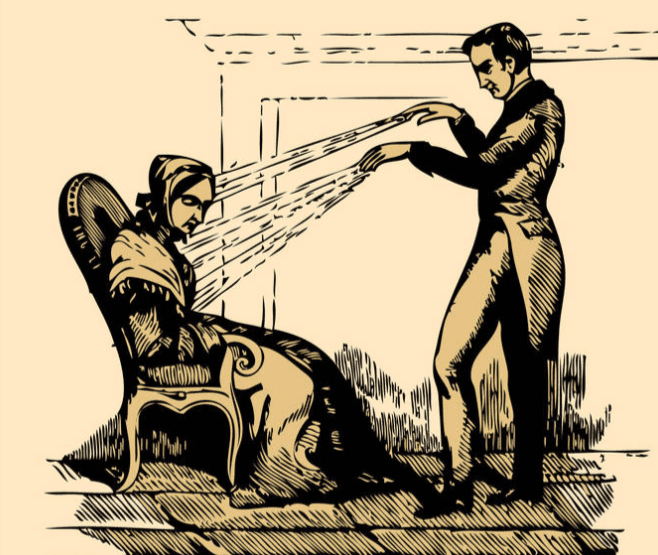
Franz Anton Mesmer (1734 to 1815) was a German-born physician who claimed that an invisible fluid, which he called animal magnetism, flows through all living things and that illness comes from its blocked flow. A French royal commission found no such fluid in 1784, but his healing sessions led directly to hypnosis and to the modern idea that the mind and the relationship can heal.
Key takeaways
- Franz Anton Mesmer (1734 to 1815) claimed an invisible universal fluid, animal magnetism, flows through living bodies and that blocked flow causes illness.
- A 1784 royal commission including Benjamin Franklin, Lavoisier and Bailly used blindfolded tests and found the effects came from imagination, imitation and touch.
- Mesmer’s pupil Puységur discovered the calm magnetic sleep, and James Braid renamed it hypnotism in 1843, starting the line that leads to Freud, Janet and Erickson.
- Mesmer was wrong about the fluid but right that unseen relational forces and mental states change the body, which research on attunement and hypnosis supports.
- His story shows that clinical intuition finds what heals and that honest testing must study the relationship as well as the technique.
Who was Franz Anton Mesmer?
Mesmer was born on 23 May 1734 in Iznang, a village on Lake Constance in Swabia, and died on 5 March 1815 in nearby Meersburg. He studied theology and philosophy before turning to medicine, and took his medical doctorate at the University of Vienna in 1766. His dissertation, De planetarum influxu (On the Influence of the Planets), argued that the planets act on the human body through an invisible tide, an idea he borrowed heavily from the English physician Richard Mead.3
In Vienna he married a wealthy widow, moved in musical circles and knew the young Mozart’s family. Mozart later joked about him: in Così fan tutte (1790) the maid Despina, disguised as a doctor, revives the lovers with a “Mesmer stone”. That joke tells you how famous Mesmer had become within a decade.
His reputation rose and then broke over two patients. In 1774 he treated Franziska Oesterlin, a young woman with recurring convulsions, by placing magnets on her body, using magnets supplied by the Jesuit astronomer Maximilian Hell. She improved, and Mesmer concluded that the magnets were only conductors: the healing force came from his own body. In 1777 he took on Maria Theresia von Paradis, a blind pianist favoured by the Empress. Reports that her sight was returning were followed by a family quarrel, accusations from the Viennese medical faculty and her return home still blind. Mesmer left Vienna for Paris in 1778.3
What is animal magnetism?
Animal magnetism was Mesmer’s name for a fine, universal fluid that he believed fills space and passes through every living body. “Animal” here means belonging to living beings (from the Latin anima, soul or breath), as opposed to the mineral magnetism of an iron magnet. In his Mémoire sur la découverte du magnétisme animal (1779) he set out 27 propositions: that a mutual influence links the heavenly bodies, the earth and living bodies; that the fluid ebbs and flows like a tide; that disease is an obstruction of that flow; and that a trained physician can concentrate and redirect it.1
The treatment followed from the theory. Mesmer sat knee to knee with a patient, gazed into their eyes and made slow passes with his hands along the body, sometimes for an hour. The aim was to provoke a “crisis”, often trembling, weeping or convulsions, after which the obstruction was thought to clear and the patient to recover.
In Paris, demand forced him to treat people in groups. He built the baquet, a covered wooden tub filled with “magnetized” water and iron filings, from which bent iron rods reached out to the patients seated around it. Patients held the rods, linked hands or were tied together with a cord, while music played and Mesmer moved among them in a lilac robe. Crises spread from one person to the next, and a padded “crisis room” stood ready for those who collapsed. By 1783 his followers had founded the Society of Harmony to teach the method for a fee, and mesmerism became a fashionable movement tied to hopes of social reform.4
What did the 1784 Franklin commission find?
In March 1784 Louis XVI appointed a commission drawn from the Academy of Sciences and the Paris Faculty of Medicine. Benjamin Franklin, then the American envoy, was its senior member; the chemist Antoine Lavoisier, the astronomer Jean-Sylvain Bailly, who wrote the report, and the physician Joseph-Ignace Guillotin also served. Mesmer refused to take part, so the commissioners studied the practice of his leading pupil, Charles d’Eslon.2
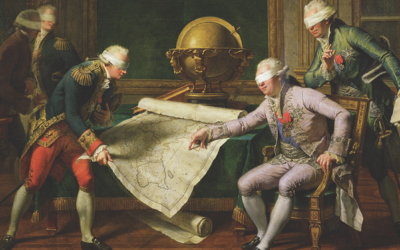
The tests were simple and clever. Blindfolded subjects were told they were being magnetized when they were not, and reacted strongly; others were magnetized without being told, and felt nothing. At Franklin’s house in Passy a young man sensitive to magnetism was led to a row of apricot trees, one of which had been “magnetized”, and he fell into a crisis under the wrong tree. Women drank from cups of plain or magnetized water and responded according to what they believed, not to what was in the cup.2
The commission concluded that there was no evidence of a magnetic fluid and that the effects came from imagination, imitation and touch. A separate commission of the Royal Society of Medicine reached the same verdict, with one member, the botanist Antoine-Laurent de Jussieu, dissenting. A secret report to the king added a warning about the moral risks of male magnetizers working on women in crisis. Historians now treat these experiments as one of the first uses of blinding to separate the effect of expectation from the effect of a treatment.3 Mesmer left Paris soon afterwards and spent his last decades in relative obscurity in Switzerland and on Lake Constance.
How did mesmerism become hypnosis?
Mesmer is often called the father of modern hypnosis, but the trance itself was found by one of his students. In 1784 the Marquis de Puységur, magnetizing a young peasant named Victor Race on his estate at Buzancy, saw no convulsions at all. Instead Race fell into a calm, sleep-like state in which he spoke more fluently than when awake and later remembered nothing. Puységur called it “magnetic sleep” or artificial somnambulism, and his followers shifted the method away from crises toward quiet trance and conversation.7
Through the nineteenth century magnetizers, physicians and showmen kept the practice alive. In 1841 the Manchester surgeon James Braid watched a stage demonstration by the Swiss magnetizer Charles Lafontaine. He concluded that the effects came from the subject’s own fixed attention, not from any fluid, and in Neurypnology (1843) he named the state “neuro-hypnotism”, nervous sleep, from which our word hypnosis comes.8 In France, Jean-Martin Charcot in Paris and Hippolyte Bernheim in Nancy argued over whether hypnosis was a sign of hysteria or an ordinary effect of suggestion, and young Sigmund Freud studied with both before turning hypnosis into the talking cure.6
In the twentieth century Milton H. Erickson moved hypnosis away from commands toward an indirect, metaphorical style built on stories, permissive language and the client’s own resources. Today hypnosis is used in medicine and psychotherapy for pain, anxiety, procedures and stress. A meta-analysis of 18 studies by Montgomery, DuHamel and Redd found a moderate to large pain-relieving effect, and a 2019 review of 85 controlled experimental trials found that hypnotic suggestion reliably reduced pain, most of all in highly suggestible people.10, 11 Researchers still debate how hypnosis works, but they agree that it rests on suggestion, attention and the subject’s active involvement, not on sleep or a loss of control.9
Intuition and discovery in psychotherapy
Many methods in the history of psychotherapy began with the intuition and clinical experience of practitioners rather than with a theory proved in advance. Mesmer saw that something happened between him and a suffering patient, and he built a physics to explain it. Freud noticed that patients improved when they talked freely, and he built psychoanalysis around it. Erickson watched how people actually respond to words, posture and timing, and he built his strategic therapy out of those observations.
The historian Henri Ellenberger argued in The Discovery of the Unconscious (1970) that the whole line of “dynamic psychiatry”, from the magnetizers through Pierre Janet, Freud and Jung, grew out of Mesmer’s sessions.5 The magnetic sleep showed that a second stream of memory and action could run beside ordinary awareness. Janet built his theory of dissociation on that observation, William James wrote about hypnotic states in The Principles of Psychology (1890), and Jung’s medical dissertation of 1902 studied a young medium’s somnambulistic trances. The lineage runs straight into the weird history of depth psychology.
The pattern matters for how the field grows. Clinicians notice what helps long before anyone can explain it. The explanation is often wrong at first, as Mesmer’s fluid was, while the observation underneath it is sound. Good intuition gives research something worth testing.
The unseen forces in hypnosis: what did Mesmer sense?
The commission proved that there was no magnetic fluid. It did not prove that nothing was happening. Its own conclusion, that imagination, imitation and touch produced dramatic bodily effects, points to real forces that act outside conscious awareness. Three of them echo Mesmer’s picture of an invisible, connecting medium.
The therapeutic relationship
Mesmer worked knee to knee, eyes locked, hands moving slowly over the body. Whatever he believed, he was building intense rapport and trust. Hypnosis researchers have found that the relationship between hypnotist and subject, and the subject’s expectations, shape how strongly suggestions take hold.9 In psychotherapy more broadly, Bruce Wampold’s review of the research concluded that the alliance, empathy and expectations account for more of the difference in outcomes than the specific techniques of competing schools.13 That relational dynamic operates largely outside awareness, which is close to what Mesmer meant by a fluid passing between two people.
Unconscious communication
The second force is the body-to-body signalling that passes between people without words. In the early 1990s Giacomo Rizzolatti’s group in Parma found neurons in the macaque brain that fire both when a monkey performs an action and when it watches another perform it. These mirror neurons became a leading model of how we read the actions and feelings of others.14 In hypnosis, the hypnotist’s pace of speech, breathing, tone and calm are picked up and matched by the client, and they carry safety and confidence more powerfully than the words themselves. The interpersonal neurobiology of Allan Schore describes the same right-brain to right-brain attunement between mother and infant, and between therapist and client.
Mind and body
Mesmer treated mental and bodily illness as one problem. Psychoneuroimmunology, a field named by the psychologist Robert Ader in the 1970s, studies the pathways linking the brain, behaviour, hormones and the immune system. In one study by Janice Kiecolt-Glaser and colleagues, medical students who learned hypnotic relaxation before exams showed smaller stress-related changes in some immune measures than students who did not, and those who practised more often did best.12 Hypnosis also changes pain perception, as the trials above show. The mechanisms are more complicated than a tide of fluid, but Mesmer’s sense that mental states reach into bodily processes was sound, and the interconnectedness of mind and body is now a working assumption of experiential and somatic therapy.
Why does empirical testing matter?
Intuition starts discoveries, and testing tells us what in them is true. The 1784 commission is the clearest example in the history of psychology: by hiding from subjects what was being done to them, it showed that the fluid was imaginary while the patients’ reactions were real. The history of psychotherapy holds many methods that looked promising and then failed to withstand scientific scrutiny, and some, such as using hypnosis to “recover” memories as if replaying a recording, did harm.9
Testing has to ask the right question, though. The commissioners asked whether a magnetic fluid existed. They did not ask why so many people got better, and so they discarded the relational and suggestive forces that later became hypnosis. Modern research can make the same mistake when it measures only the technique and ignores the relationship, the clinician and the client. That is one reason we think the field’s narrow reading of evidence-based practice can go wrong: what a manual specifies is often not the thing doing the healing.
Why does Mesmer still matter?
Mesmer’s physics was wrong, but his picture of human beings as connected, responsive to each other and able to change bodily states through the mind has held up. Research on mirror systems and on emotional attunement describes how people unconsciously match one another’s states, and therapists now call the shared calming of two nervous systems co-regulation. In this sense Mesmer was pointing at a real invisible force between people, even though his explanation for it was incorrect.
He also shaped the culture of healing. The magnetizers of the early nineteenth century were among the first to treat “nervous” complaints with sustained one-to-one attention, and the age of nervousness that followed produced the first modern psychotherapies. The verb “to mesmerize”, still common in English, is the trace he left in ordinary speech.
Mesmer’s checkered legacy
Mesmer was part genuine healer, part showman and part businessman. He guarded his method as a secret, charged high fees, staged his treatments as theatre and refused to submit to the commission’s tests. His most famous Viennese case ended in scandal. Yet the people who sat around his tub often did feel better, and his students turned his sessions into the magnetic sleep that became hypnosis, then psychoanalysis, then the wider family of depth therapies.
The lesson of his story has three parts. The human psyche is larger and stranger than any single theory of it. The relationship between healer and sufferer is a strong force for change in its own right. And the road to effective treatment needs both the clinician’s intuition and honest testing of what that intuition finds.
What does Mesmer’s story mean for therapy today?
In a therapy room, Mesmer’s legacy shows up first as attention to the relationship. A therapist working in this tradition pays as much attention to the client’s breathing, posture and shifts in state as to their words, and to their own state, because the two nervous systems influence each other. People with anxiety, panic, chronic pain or trauma often come in with bodies that are braced for danger, and a calm, attuned presence is part of what lets them settle.
Second, many current methods use focused, inward attention that descends from the magnetic sleep. Clinical hypnosis in Erickson’s style uses imagery and indirect suggestion, and psychiatrists such as Herbert and David Spiegel have shown how a person’s capacity for trance can be measured and put to work in treatment.15 At Taproot, Brainspotting uses a fixed eye position and the therapist’s attuned presence to help a client stay with a trauma memory or body sensation long enough for it to process. Braid’s discovery, that fixed attention alone changes the state of the nervous system, is part of the same story.
Third, the body is treated as part of the problem and part of the cure. Somatic therapy tracks sensation, movement and nervous system arousal, working from the same intuition Mesmer had about mind and body as one system, without his fluid.
Let Alan Rickman mesmerize you: the 1994 film
The story of Mesmer’s rise and fall in Vienna was filmed as Mesmer (1994), directed by Roger Spottiswoode from a screenplay by the British television dramatist Dennis Potter. Alan Rickman plays Mesmer as a brilliant, vain and wounded man, and Amanda Ooms plays Maria Theresia von Paradis, the blind pianist whose treatment brought about his downfall in Vienna. The film takes liberties with the facts, but it captures the theatre of his sessions and the hostility of the medical establishment he faced.
Mesmer’s story is a reminder that the forces that heal often work between people and below awareness. At Taproot we draw on that history in Jungian depth therapy, somatic work and Brainspotting, where attention to the relationship, the body and the unconscious is the heart of the work.
Frequently asked questions
What does animal magnetism mean?
Animal magnetism was Franz Anton Mesmer’s term for an invisible fluid he believed filled the universe and passed through every living body. Animal meant belonging to living beings, as opposed to mineral magnetism. Mesmer taught that illness was a blockage of this fluid and that a physician could redirect it with hand passes, touch and his magnetized tub, the baquet.
Is mesmerism the same as hypnosis?
Mesmerism and hypnosis are related but not the same. Mesmer sought convulsive crises caused by a supposed fluid. His pupil the Marquis de Puységur found a calm, sleep-like trance in 1784, and the surgeon James Braid explained it by focused attention and named it hypnotism in 1843. Modern hypnosis keeps the trance and drops the fluid.
Why did Benjamin Franklin investigate Mesmer?
In 1784 King Louis XVI asked a commission of scientists and physicians, with Benjamin Franklin as its senior member, to judge whether Mesmer’s magnetic fluid existed. Working with Mesmer’s pupil Charles d’Eslon, they used blindfolds and fake magnetized objects and found that people reacted to what they believed was happening, so the effects came from imagination rather than any fluid.
Where does the word mesmerize come from?
The English verb mesmerize comes from Franz Anton Mesmer, the eighteenth-century physician whose animal magnetism treatments put patients into crises and trances. At first it meant to treat someone with animal magnetism or put them into a magnetic trance. Today mesmerize simply means to hold someone’s attention so completely that they seem spellbound.
Who played Mesmer in the movie?
Alan Rickman played Franz Anton Mesmer in the 1994 film Mesmer, directed by Roger Spottiswoode from a screenplay by Dennis Potter. Amanda Ooms played Maria Theresia von Paradis, the blind pianist whose treatment led to Mesmer’s departure from Vienna. The film dramatizes his Viennese years and the theatre of his magnetic healing sessions.
Related reading
- The Theories and Ideas of Rollo May
- Ludwig Mies van der Rohe: Architect of the Modern Age
- The Life and Work of Alan Watts: A Transformative Bridge Between East and West
- Jean-Paul Sartre: Existentialism, Freedom, and the Human Condition
- Otto Rank: Pioneer of Birth Trauma Theory and the Will in Psychoanalysis
- Donald Winnicott: Post Freudian Progress
References
- Mesmer, F. A. (1779). Mémoire sur la découverte du magnétisme animal. P. Fr. Didot le jeune.
- Franklin, B., Majault, Le Roy, Sallin, Bailly, J.-S., D’Arcet, de Bory, Guillotin, J.-I., & Lavoisier, A. (2002). Report of the commissioners charged by the king with the examination of animal magnetism. International Journal of Clinical and Experimental Hypnosis, 50(4), 332-363. (Original work published 1784) https://doi.org/10.1080/00207140208410109
- Lanska, D. J., & Lanska, J. T. (2007). Franz Anton Mesmer and the rise and fall of animal magnetism: Dramatic cures, controversy, and ultimately a triumph for the scientific method. In H. Whitaker, C. U. M. Smith, & S. Finger (Eds.), Brain, mind and medicine: Essays in eighteenth-century neuroscience (pp. 301-320). Springer. https://doi.org/10.1007/978-0-387-70967-3_22
- Darnton, R. (1968). Mesmerism and the end of the Enlightenment in France. Harvard University Press.
- Ellenberger, H. F. (1970). The discovery of the unconscious: The history and evolution of dynamic psychiatry. Basic Books.
- Gauld, A. (1992). A history of hypnotism. Cambridge University Press.
- Crabtree, A. (1993). From Mesmer to Freud: Magnetic sleep and the roots of psychological healing. Yale University Press.
- Braid, J. (1843). Neurypnology; or, the rationale of nervous sleep, considered in relation with animal magnetism. John Churchill.
- Lynn, S. J., Kirsch, I., Terhune, D. B., & Green, J. P. (2020). Myths and misconceptions about hypnosis and suggestion: Separating fact and fiction. Applied Cognitive Psychology, 34(6), 1253-1264. https://doi.org/10.1002/acp.3730
- Montgomery, G. H., DuHamel, K. N., & Redd, W. H. (2000). A meta-analysis of hypnotically induced analgesia: How effective is hypnosis? International Journal of Clinical and Experimental Hypnosis, 48(2), 138-153. https://doi.org/10.1080/00207140008410045
- Thompson, T., Terhune, D. B., Oram, C., Sharangparni, J., Rouf, R., Solmi, M., Veronese, N., & Stubbs, B. (2019). The effectiveness of hypnosis for pain relief: A systematic review and meta-analysis of 85 controlled experimental trials. Neuroscience & Biobehavioral Reviews, 99, 298-310. https://doi.org/10.1016/j.neubiorev.2019.02.013
- Kiecolt-Glaser, J. K., Marucha, P. T., Atkinson, C., & Glaser, R. (2001). Hypnosis as a modulator of cellular immune dysregulation during acute stress. Journal of Consulting and Clinical Psychology, 69(4), 674-682. https://doi.org/10.1037/0022-006X.69.4.674
- Wampold, B. E. (2015). How important are the common factors in psychotherapy? An update. World Psychiatry, 14(3), 270-277. https://doi.org/10.1002/wps.20238
- Rizzolatti, G., & Craighero, L. (2004). The mirror-neuron system. Annual Review of Neuroscience, 27, 169-192. https://doi.org/10.1146/annurev.neuro.27.070203.144230
- Spiegel, H., & Spiegel, D. (2004). Trance and treatment: Clinical uses of hypnosis (2nd ed.). American Psychiatric Publishing.














0 Comments