
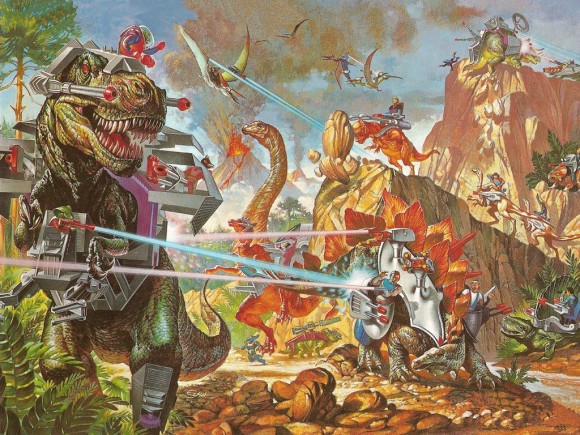
Roughly one in three children between 18 months and six years old develops what developmental psychologists call an Extremely Intense Interest. The child does not simply like dinosaurs. The child knows that Parasaurolophus had a hollow crest, corrects the adults who call a pterodactyl a dinosaur, and sorts plastic figures into plant eaters and meat eaters before learning to read. Trains, trucks, dragons, unicorns and the inner workings of the vacuum cleaner follow the same pattern.
Hollywood understood this long before psychology gave it a name. Jurassic Park became the highest grossing film in history when it opened in 1993. Cars, Transformers, How to Train Your Dragon, Pokémon and seventy years of Godzilla are built on the same three or four categories that dominate the research on early childhood fascination. The blockbuster is, in large part, an industrial answer to a developmental question.
That overlap says something about how the brain is built, about the culture that sells to it, and about what therapists can do with the part of the mind that is wired to seek the new inside the familiar.
What an Extremely Intense Interest Actually Is
An Extremely Intense Interest, or EII, is a passionate and long lasting attraction to a single category of objects or knowledge. It often appears between 18 and 24 months, sometimes before the child has a dozen words, and the words tied to the interest are frequently among the first ones spoken. It lasts months or years. It also travels across contexts. A toddler absorbed in wheels will find them in ceiling fans, rug patterns and the gears on a bicycle.
The content is remarkably consistent across cultures. Judy DeLoache and her colleagues found that vehicles, dinosaurs and other conceptual domains dominated the interests of young boys, while girls more often fixed on pretend play, dolls and art. Mythical creatures, mechanical motion, and later letters, numbers and shapes round out the list.
The cognitive payoff is large. In a 1983 study, Michelene Chi and Randi Koeske tested a four and a half year old boy whose parents had read to him from nine dinosaur books for about three hours a week. He recalled twice as many names from a list of dinosaurs he knew well as from a list he knew less well. He also reasoned about unfamiliar species from their anatomy, inferring diet and habitat from teeth and bills. Chi and Koeske described his knowledge as a dense semantic network, where every new fact had something to attach to. Expertise in one domain let a preschooler outperform the limits assumed for his age.
Learning scientist Kevin Crowley and his coauthor Jacobs called these pockets of knowledge islands of expertise. They grow out of ordinary family life: the library book, the documentary, the museum trip. In Crowley’s museum observations, parents link a new fossil to what the child already knows, and over time the roles flip. The child becomes the guide and the parent becomes the audience.
The islands are fragile. Joyce Alexander, Kathy Johnson and colleagues followed children from age four to six and found that about half showed a conceptual interest at some point, but only about a fifth kept it. The steepest drop came with the start of formal school, where fixed curricula leave little room for one child’s obsession and friendships depend on shared ground with peers.
Novelty Inside a Safe Frame
The human brain is built to find new information rewarding, but only up to a point. In the 1960s the psychologist Daniel Berlyne described curiosity as an inverted U. Too little novelty is boring. Too much is threatening. The pleasure sits in the middle, where something is new enough to register and familiar enough to be understood.
An intense interest is a near perfect machine for staying in that middle zone. The domain itself is closed and predictable. Dinosaurs have rules: they are extinct, they eat plants or meat, they belong to periods and families. Inside that closed system there is an almost endless supply of new members. Every unfamiliar species, every new locomotive, every new dragon is a small surprise that lands in a structure the child already owns.
Neuroscience gives that pattern a biological shape. Dopamine neurons in the midbrain respond most strongly to prediction errors, the gap between what was expected and what arrived. George Loewenstein described curiosity as the felt pull of an information gap. In 2014, Matthias Gruber, Bernard Gelman and Charan Ranganath showed that states of high curiosity engage the dopaminergic midbrain and the hippocampus together, and that people in those states remember even incidental information better. The dinosaur expert in the Chi and Koeske study was doing exactly this. Curiosity was writing facts into memory faster than ordinary learning would.
Evolution helps explain why predators and powerful machines so often fill the frame. Researchers including H. Clark Barrett and Richard Coss have argued that predator detection shaped primate cognition, and studies of visual attention find that people spot animals in a scene faster than they spot objects. A child who learns everything about the speed, teeth and habits of a Velociraptor is running ancient threat mapping software on a target that can never bite. Vehicles share some of that appeal. They are large, fast, loud and self propelled, which is to say they move like animals while obeying rules like machines.
The Blockbuster as an Engineered Intense Interest
The major franchises of the last forty years map onto the developmental literature almost category for category. Dinosaurs have Jurassic Park and Godzilla. Vehicles have Thomas the Tank Engine, Cars and Fast and Furious. Mythical creatures have How to Train Your Dragon, Harry Potter’s bestiaries and the unicorn and dragon economy of the toy aisle. Transformers, which began as a Hasbro toy line in 1984, fused the two biggest boyhood categories into one product: a vehicle that becomes a creature.
The Jurassic films even dramatize the novelty curve. In Jurassic World (2015), the park’s real dinosaurs no longer draw crowds, so the scientists engineer a bigger, stranger hybrid to restore the thrill. The plot is a franchise describing its own business model. Audiences habituate, and the studio answers with a new species inside the same closed system. That is the same structure that keeps a four year old turning pages.
Pokémon may be the clearest case of a culture building directly for the semantic network. The original games in 1996 offered 151 creatures sorted by type, strength, weakness and evolution. The roster now passes a thousand. The Pokédex is, functionally, the Chi and Koeske dinosaur study turned into a device and sold to children worldwide. Collecting cards is not incidental to the franchise. Categorization is the product.
Thomas the Tank Engine shows a quieter version of the same logic. Surveys of parents by the UK’s National Autistic Society found the series unusually beloved among autistic children, and parents pointed to its predictable stories and the engines’ clear, exaggerated faces. The show joins two things a young mind wants at once: a rule bound mechanical system and a readable social signal.
The adult version is the cinematic universe. Marvel, Star Wars and their fan wikis give grown viewers the same experience Crowley found in museum families: lore to master, timelines to keep straight, and the social reward of being the one who explains it. In the tradition of cultural critics like Adam Curtis, a harder reading is available. A consumer economy discovered that the preschool need for mastery could be sold back in collectible units, with a new installment always arriving just as the last one becomes familiar. The franchise does not invent the hunger. It learns its shape and keeps feeding it.
Serge Tisseron and the Psychoanalysis of Images
Cognitive science explains how a child learns forty dinosaur names. It does not explain why the child chose dinosaurs. The most useful answer comes from Serge Tisseron, a French psychiatrist, psychoanalyst and research psychologist at Université Paris Cité who has spent five decades studying how people use images to digest experience. He came to psychoanalysis by an unusual road. His medical thesis was drawn as a comic book, and comics, cartoons, film and later video games and robots became his clinical material.
Tisseron’s central idea is that words are not the only way the mind makes sense of what happens to it. Classical psychoanalysis privileged speech. Tisseron argues that experience is symbolized in three registers: through the body, in gesture, posture and movement; through images, both seen and imagined; and finally through language. A young child cannot yet put fear or rage into sentences, but can draw it, act it out with toys, or attach it to a picture of a monster. Those are not lesser forms of thinking. They are the first forms.
Images, in this view, do more than represent things. They hold feelings that have not yet found words, and they help transform those feelings into something bearable. That is why Tisseron has never treated children’s media as simply good or bad. His widely cited 3-6-9-12 guidelines for screen use, published in France in 2008, are less a list of prohibitions than a developmental map: no screens before three, no personal game console before six, accompanied internet use after nine, independent use after twelve. The question for Tisseron is always what a child is doing with an image, and whether an adult is present to help make meaning of it.
The Dinosaur on the Couch
Between two and six, children are small, dependent and regularly overwhelmed by their own anger, fear of abandonment and frustration with adult rules. Tisseron’s reading of the dinosaur begins there. The child needs a container for feelings too large to say, and the dinosaur is close to ideal. It is enormous, destructive and terrifying, and it is safely extinct. Its distance in time makes it a perfect virtual object: charged with real emotion, yet incapable of real harm.
The interest works on at least three levels. The first is omnipotence. A child who identifies with Tyrannosaurus rex borrows a feeling of total power in a world where they decide almost nothing, not bedtime, not dinner, not when the family leaves the park. The second is aggression. Smashing toy dinosaurs into a cardboard city stages destructive impulses in a symbolic arena, where the tension can discharge without anyone being hurt. The third, and the one most often missed, is mastery. Memorizing Latin names, diets, geological periods and theories of extinction turns a creature that could devour you into an object you command. Fear becomes taxonomy.
That third level is where Tisseron’s work meets the cognitive research. The semantic network Chi and Koeske documented is not only a memory structure. In psychoanalytic terms it is a defense, a way of binding anxiety through knowledge. The child who can explain exactly why a Velociraptor hunted in packs has placed the predator inside a system they control. Adults do the same thing when they read everything about a diagnosis, a disaster or a war. Knowledge is one of the oldest ways human beings make terror sit still.
Gender, Systemizing and the Toy Aisle
The gender gap in intense interests is large. In DeLoache’s research, the great majority of four year olds with a conceptual interest such as dinosaurs or vehicles were boys. Simon Baron-Cohen’s empathizing and systemizing theory reads this as biology: male brains, shaped in part by prenatal testosterone, lean toward rule based systems.
Cordelia Fine and other critics call that conclusion premature. Children’s environments are gendered from birth. Boys are handed blocks and trucks, girls are handed dolls, and the marketing aisle is color coded long before a child can state a preference. Observers may also miss girls’ intense interests because they look like expected behavior. A girl who builds elaborate social worlds for her dolls, or tracks the relationships of every character in a fantasy series, is doing deep systemizing work that rarely gets labeled as such.
One finding complicates both camps. In a large study of toddlers at elevated likelihood for autism, sex differences in interest intensity appeared among typically developing children but disappeared among children who went on to an autism diagnosis. Whatever drives the gap in the general population, it is not a fixed law of the brain. The entertainment industry, for its part, treats the gap as something to maintain. Franchises are routinely split into separate boy and girl product lines drawn from the same source material.
Intensity, Peculiarity and the Autistic Mind
Intense, focused interests are also part of the diagnostic picture for autism, listed under restricted and repetitive behaviors and interests. That overlap worries many parents of dinosaur obsessed toddlers. Research suggests intensity alone is not the signal.
A 2021 study by Catherine Burrows and colleagues followed 352 toddlers, many of them younger siblings of autistic children. It separated how intense an interest was from how unusual it was. Intensity tracked family history: toddlers with an autistic sibling showed strong interests whether or not they were later diagnosed. Peculiarity was what predicted diagnosis at 24 months. A typically developing child loves trains. An autistic child might fix on spinning a single wheel at eye level, or on traffic lights, ceiling fans or the mechanism of a toilet.
The neurodiversity movement offers a more useful frame than restriction. Dinah Murray and Mike Lesser’s theory of monotropism describes attention as a spectrum. Polytropic minds spread attention across many inputs. Monotropic minds pour it into a narrow, deep tunnel. In that model, an autistic interest is an attention system doing what it does best, locking onto meaningful and predictable input. The cost is the effort required to leave the tunnel. A child pulled out of a deep interest without warning is not being defiant. Their attention has to be rebuilt from scratch, and the strain often shows as a meltdown.
Clinicians also need to separate intense interests from obsessive compulsive disorder. An intense interest is ego syntonic. It brings joy and the child goes looking for it. An OCD obsession is ego dystonic. It is unwanted, intrusive and driven by fear. A child who lines up trains because they love trains needs a different response than a child who lines them up because something terrible will happen if they don’t. Treating the first as the second can strip away a child’s main source of joy and learning.
Built to Seek Novelty: What Personality Research Adds
Personality science has long treated the appetite for the new as a core trait. Robert Cloninger’s temperament model names novelty seeking as one of four basic dimensions, alongside harm avoidance, reward dependence and persistence. In the Big Five, openness to experience captures a similar drive, and Colin DeYoung has linked its intellectual side to dopamine’s role in exploration.
Intense interests reveal something those trait scales can miss. Novelty seeking and harm avoidance are often described as opposites, but the dinosaur expert holds both at once. The child wants new information constantly and wants it delivered inside a system that never surprises them in a frightening way. The closed domain resolves the conflict. It offers exploration without exposure. Many adults run on the same arrangement. The birder adding to a life list, the record collector, the historian of one war and the fan who can recite every film in a franchise are all seeking novelty inside a frame they control.
Jung’s typology offers a complementary lens. His introverted sensing function describes a mind that stores concrete detail and returns to it with deep familiarity, the archivist’s temperament. Extraverted intuition describes a mind pulled toward the next possibility and the unexplored connection. The young collector of dinosaur facts often looks like the first. The blockbuster economy speaks directly to the second, with the next sequel, the next species and the next card always on the horizon. Most people carry both pulls, and how a person balances the familiar and the new is one of the more revealing things about their character.
Attention differences sharpen the picture. Many adults with ADHD describe their focus as interest driven rather than importance driven: effortless when the subject is captivating, nearly impossible when it is not. That fits what is known about dopamine and novelty. For these clients, an intense interest is not a distraction from functioning. It is often the only reliable on switch they have.
What This Means for Modern Therapy
For most of the twentieth century, behavioral programs and schools tried to redirect or extinguish intense interests, treating them as barriers to social life and broader learning. Contemporary practice has largely reversed course. Studies of word learning in autistic children found that new vocabulary taught through a child’s focused interest was learned as well as neurotypical peers learned it, while the same words taught through neutral material were learned far less well. The interest is the doorway.
In child therapy, that means the dinosaurs come into the room. A sandtray full of predators, a story about a dragon who is afraid of the dark, or a game where the child plays the monster, the victim and the rescuer in turn can reach feelings that direct questions never will. Parents can use the same principles at home. Explaining causes (“its teeth are sharp because it eats meat”), linking new facts to old ones, and letting the child teach are the three moves that most reliably deepen an island of expertise.
The frame applies to adults as well. One of the more revealing questions a therapist can ask is what a client was obsessed with at five. The answer often points to where curiosity first lived and where it went underground, sometimes under the pressure of school, peers or a family that had no room for it. Recovering that lost interest is frequently part of recovering a sense of self. Adult fandoms deserve the same respect. A client who explains their grief through a Star Wars arc or their anger through a Marvel villain is using the shared mythology of their generation, and a skilled clinician can work inside that language.
Trauma treatment draws on the same machinery. Approaches such as Brainspotting, EMDR and Somatic Experiencing rely on resource states, places in the body and mind where a person feels capable and safe. An intense interest is often one of the strongest resources a client has, because it is where their nervous system already knows how to settle and focus. For neurodivergent children, qEEG brain mapping can add another layer, showing how attention and arousal are organized so that treatment works with a child’s wiring rather than against it.
The practical line for parents and clinicians is simple. Joy, mastery and a willingness to share suggest a healthy intense interest, whatever its intensity. Distress, fear and compulsion suggest something else, and so does an interest that is not just strong but strikingly unusual for the child’s age. Those patterns are worth a professional evaluation. The passion itself is not.
The Dinosaur We Keep
The four year olds who learned to pronounce Pachycephalosaurus in 1993 are now in their late thirties, and many of them have taken their own children to Jurassic World. The franchise endures because the need it answers endures. Human beings are built to seek the new inside the familiar, to turn fear into knowledge and to borrow power from creatures larger than themselves. Children do this with plastic figures and library books. Adults do it with box office weekends, fan wikis and collections that quietly fill a spare room.
The real question is whether the interest remains a person’s own or becomes a loop someone else profits from. A child’s island of expertise is a place of agency, built with a parent and eventually led by the child. A franchise can feed that island or replace it. Therapy, at its best, helps people find their way back to the first kind: the curiosity that was theirs before anyone sold it to them.















0 Comments