

Updated November 2026 · By Joel Blackstock, LICSW-S
Plotinus (c. 204/205–270 CE) wrote the treatises collected as the Enneads, the founding texts of what scholars now call Neoplatonism: everything flows from an indescribable One, and the soul can turn inward and make its way back toward it.1 Carl Jung quoted him in Aion (1951) as an ancient picture of the Self: a soul circling the center it came from.2
This page argues that turning inward heals when it reorients the ego toward a center that was never lost, and becomes avoidance when it uses that center to escape the body and the shadow. Plotinus supplies the first half: part of the soul, he held, never descends into the body’s troubles, so we lose sight of it without losing it. Jung supplies the second. Plotinus called matter “the Primal Evil,” and Jung argued at length in Aion that evil cannot be explained away as a mere absence of good.2, 3 Therapy needs both halves.
Who Plotinus was
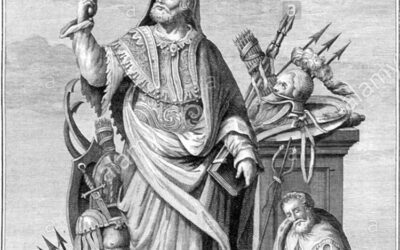
Almost everything known about his life comes from Porphyry, the student who lived in his circle in Rome for about five years and wrote On the Life of Plotinus and the Arrangement of His Work.1, 5 Its first sentence is one any therapist would underline: Plotinus “seemed ashamed of being in the body.” He would not name his parents or his birthplace, and he refused to sit for a portrait, which would only leave posterity “an image of the image.”5
In his late twenties he found his teacher, Ammonius Saccas in Alexandria (“This was the man I was looking for”), and stayed eleven years. At 38 he joined Emperor Gordian III’s campaign against Persia, hoping to study the philosophy of the Persians and Indians, and when Gordian was killed in Mesopotamia he got away to Antioch only with great difficulty. At forty he settled in Rome, where he taught for more than twenty-five years and began writing only at about fifty; Porphyry later sorted the treatises into six sets of nine, the “nines” or Enneads.1, 5 Ill at the end and avoided by friends, he withdrew to an estate in Campania and died there in 270. His last words appear in MacKenna’s translation as “I am striving to give back the Divine in myself to the Divine in the All”; Henry, introducing the same volume, reads them instead as advice to the living: “Strive to bring back the god in yourselves to the Divine in the universe.”5, 6
The same man took in other people’s orphans and checked their accounts so that their fortunes would be “kept intact for them,” and Porphyry insists that none of this interrupted his “intention towards the Supreme.”5 Inwardness and practical care lived together in him.
Two correctiPlotinus never called himself a Neoplatonist; Paul Henry, introducing the standard English translation, wrote that he “would have been surprised at being thought of as the founder of a new school.”6 Nor did he blend Plato with Christianity, Judaism and Egyptian religion. He wrote a treatise against the Gnostics, and Henry notes that he scorned them, and by implication the Christians, for making humanity the subject of a redemption.6
The One, Intellect and Soul
Plotinus describes three levels of reality. The One is first and simplest. No predicate fits it, because predicates name beings and the One is not a being, yet it is “the (productive) power of all things.” Intellect (nous) is second and is identical with the Forms it thinks. Soul is third and reaches from Intellect down to bodies, which is why Plotinus calls it “amphibious.” Matter is not a fourth level. It is the outer limit, a “complete privation” of form.1
The old page turned his psychology into a ladder of vegetative, sensitive and rational souls to climb. Plotinus does distinguish those powers, but his more useful idea is where he locates the self. The “we,” the everyday center of experience, sits in the representational faculty, phantasia, and can face upward toward Intellect or downward toward the body; the Stanford Encyclopedia of Philosophy calls this a “reorientation of its attention.”1 Ascent is a change in where attention rests, not a climb away from the lower rungs. He even had a theory of compulsive busyness: people “weak on the side of contemplation, find in action their trace of vision and of reason” (III.8), hurried into doing because they cannot yet see.3
The part of the soul that never comes down
Plotinus rarely writes about himself, which makes the opening of his treatise on the soul’s descent into the body (IV.8) stand out: “Many times it has happened: lifted out of the body into myself; becoming external to all other things and self-encentred; beholding a marvellous beauty.” What troubles him is the return: “I ask myself how it happens that I can now be descending.”3, 6
His answer is the doctrine scholars call the undescended soul. “Even our human Soul has not sunk entire,” he writes; “something of it is continuously in the Intellectual Realm.” The problem is visibility, not loss: when the embodied part is “mastered here and troubled, it keeps us blind to what the upper phase holds in contemplation.” Nor is everything in the soul known to us. A “desire locked up within the desiring faculty remains unknown” until we make it fully our own.3
In the treatise on happiness (I.4.10) awareness works like a mirror. When “the mirror within is shattered through some disturbance of the harmony of the body,” thinking goes on but is no longer pictured. Much of our best activity runs below awareness anyway: “A reader will often be quite unconscious when he is most intent.”3 As the Stanford Encyclopedia summarizes him, unconscious apprehensions “also play an important role in psychic life.”1 It is a strikingly modern picture: a body in turmoil blocks reflection without destroying what reflection would show.
Where Jung found Plotinus
Jung read Plotinus the way he read most philosophers, as evidence of how the psyche pictures itself; our essay on Jung’s kinship with other philosophers follows that habit further. Early on, in Psychology of the Unconscious, he cited Plotinus’s world-soul, “wholly energy,” while widening libido into “a conception of the will in general.”7
The use that matters came decades later. In Aion Jung quotes Ennead VI.9.8 as “a parallel conception” of the self: the soul’s natural movement “is not in a straight line”; “it circles around something interior, around a centre,” and “anyone who withdraws from it is a man who has remained un-unified.” Jung’s gloss: “Here the point is the centre of a circle that is created, so to speak, by the circumambulation of the soul. But this point is the ‘centre of all things,’ a God-image. This is an idea that still underlies the mandala-symbols in modern dreams.”2 In the next paragraph he turns to the Gnostic image of the spark and its echo, the “little spark of the soul” in Meister Eckhart.
The statue passage the old page quoted is genuine, from Ennead I.6.9 in Stephen MacKenna’s translation: “Withdraw into yourself and look. And if you do not find yourself beautiful yet, act as does the creator of a statue that is to be made beautiful: he cuts away here, he smoothes there … until a lovely face has grown upon his work.”3 It is usually read as self-improvement. Read closely, it is subtraction: nothing is added, and the face is already in the stone. That sits close to Psychological Types (1921), where individuality “is already given” and individuation is its development “as a differentiated being from the general, collective psychology.”8 The parallel is my reading, not Jung’s.
The same book defines introversion as “a turning inwards of the libido,” and splits it in two. It is “active, when the subject wills a certain seclusion in face of the object,” and “passive when the subject is unable to restore again to the object the libido which is streaming back from it.”8 Plotinus could tell the two apart. When Porphyry shut himself away and resolved to end his life, Plotinus came to his house unannounced, told him the decision “sprang not from reason but from mere melancholy,” and advised him to leave Rome. Porphyry went to Sicily.5 The philosopher of the inward turn prescribed a change of scene, not more contemplation.
Where they split: matter, evil and the shadow
The old page said Plotinus saw evil as a simple absence of good that appears when the soul gets too attached to matter. He was harsher than that. In the treatise on evil (I.8) matter is “the Primal Evil, Evil Absolute,” “the bodily Kind, in that it partakes of Matter, is an evil thing,” and the soul’s vice comes second, because “the cause, at once, of the weakness of Soul and of all its evil is Matter.”3 Matter is evil precisely as privation, the lack of every trace of form.1
He was not a simple world-hater. Against the Gnostics (II.9) defends the beauty of the visible cosmos against teachers who called it the work of a foolish or malevolent creator.1 Jung was warmer toward Plotinus’s opponents than Plotinus was: in Aion he wrote that the Gnostics “tackled the problem of evil on a broader basis than the Church Fathers.”2 Our essay on Gnosticism and depth psychology covers that quarrel. Plotinus even granted the descent a use: “the experience of evil brings the clearer perception of Good.”3
Augustine carried the idea of evil as absence into Christian theology. In the Confessions he describes reading “certain books of the Platonists, translated from Greek into Latin,” and concluding that the evil he had been hunting “is not any substance.”9 Henry wrote that the Middle Ages, which never had the Enneads, stayed “closely dependent upon his thought” through Augustine and the pseudo-Dionysius, one channel to the Christian mystics Jung later read.6
Jung attacked that inheritance directly. In Aion he blamed the privatio boni, which he says Origen first propounded, for making evil “a mere diminution of good and thus deprived of substance,” and answered as a clinician: “One must, however, take evil rather more substantially when one meets it on the plane of empirical psychology. There it is simply the opposite of good.”2 His target was church doctrine, not Plotinus by name, but the family resemblance is plain. Henry saw the gap from the other side: Plotinian mysticism “acknowledges neither disquiet nor anguish nor ‘the darkness’ nor the ‘night of the spirit.'”6 Jung’s individuation goes through that night. The shadow is not an absence to rise above. It belongs inside the circle around the center.
What this looks like in therapy
Psychology has studied a version of the fork Plotinus and Jung describe. Trapnell and Campbell found evidence that the “private self-consciousness” scale mixed two motivationally distinct dispositions, rumination and reflection, which may account for a “self-absorption paradox”: high scorers show more accurate self-knowledge and more distress.10 Watkins’s review found that repetitive thought can aid recovery from upsetting and traumatic events and from depression, or can feed depression and anxiety, and proposed that the difference turns on its content, its context, and whether it is abstract or concrete.11
Formal practices show both sides too. A meta-analysis of 142 samples (12,005 participants) found mindfulness-based interventions for psychiatric disorders outperformed no treatment and did not differ significantly from established evidence-based treatments.12 A systematic review of meditation adverse events found a pooled prevalence of 8.3%, much higher in observational studies than in experiments, most often anxiety, depression and cognitive anomalies, sometimes in people with no prior mental health problems.13 Counselors also name the inward turn that skips the work: spiritual bypass, when people “use their spiritual beliefs, practices, and experiences to avoid genuine contact with their psychological ‘unfinished business.'”14 That is a clinical concept, not a measured effect, but therapists recognize it: serenity that cannot say what it is angry about.
In the room, the Plotinian half usually comes first. Many people arrive sure that nothing in them is intact, and early work means finding what is: the capacity to notice, to be curious, to feel steady for a minute. Parts-based approaches such as Internal Family Systems therapy build on this, aiming to help people reach what the model calls an “undamaged, compassionate Self.”15 That is a model’s premise rather than a laboratory finding, but it is Plotinus’s claim that the center is hidden, not gone. His mirror is a fair picture of the order of work: when the body is in alarm, reflection tends not to land, which is one reason many therapists, including those offering somatic therapy, work on settling the nervous system before pressing for insight.
The Jungian half keeps the circle honest. A center helps only if what circles it includes grief, anger, envy, sexuality and the body a person may want to leave behind. So the therapist keeps asking a Plotinian question with a Jungian edge: is this inward turn moving toward something, or away from something? After prayer, meditation or solitude, can the person feel their body and name their anger, or only report peace? Plotinus’s hardest question was how to come back down, and it is a fair test of any inward turn: what can the person carry back into a marriage, a job, a body? If withdrawal has turned into thoughts of ending your life, do not wait it out alone. Call or text 988, or use the local options on our crisis resources page.
The evidence for Jungian psychotherapy itself is modest but real: a 2013 review of naturalistic and retrospective studies, mainly from Germany and Switzerland, reported improvements in symptoms, interpersonal problems and personality structure lasting up to six years; naturalistic designs like these are weaker evidence than randomized trials.16 For a contemporary analyst’s view of individuation, see our piece on Murray Stein.
If the inward turn has started to feel more like hiding than healing, that is a question Jungian depth therapy takes seriously. Taproot Therapy Collective sees people in Hoover, and you can reach us here to ask whether it fits what you are carrying.
References
- Kalligas, P. (2024). Plotinus. In E. N. Zalta & U. Nodelman (Eds.), The Stanford encyclopedia of philosophy. Metaphysics Research Lab, Stanford University. https://plato.stanford.edu/entries/plotinus/
- Jung, C. G. (1968). Aion: Researches into the phenomenology of the self (R. F. C. Hull, Trans.; 2nd ed., Collected Works Vol. 9, Part 2). Princeton University Press.
- Plotinus. (1956). The Enneads (S. MacKenna, Trans.; 2nd ed., rev. B. S. Page). Faber and Faber. https://archive.org/details/plotinustheennea033190mbp
- The School of Athens. (2026). In Wikipedia. Retrieved November 8, 2026, from https://en.wikipedia.org/wiki/The_School_of_Athens
- Porphyry. (1956). On the life of Plotinus and the arrangement of his work. In Plotinus, The Enneads (S. MacKenna, Trans.; 2nd ed., rev. B. S. Page, pp. 1–20). Faber and Faber.
- Henry, P. (1956). Introduction: Plotinus’ place in the history of thought. In Plotinus, The Enneads (S. MacKenna, Trans.; 2nd ed., rev. B. S. Page). Faber and Faber.
- Jung, C. G. (1916). Psychology of the unconscious: A study of the transformations and symbolisms of the libido (B. M. Hinkle, Trans.). Moffat, Yard and Company. https://archive.org/details/psychologyofunco00jung
- Jung, C. G. (1923). Psychological types; or, The psychology of individuation (H. G. Baynes, Trans.). Kegan Paul, Trench, Trubner; Harcourt, Brace. https://archive.org/details/psychological_types
- Augustine. (1887). The confessions (J. G. Pilkington, Trans.). In P. Schaff (Ed.), Nicene and post-Nicene fathers, first series (Vol. 1). Christian Literature Publishing. https://www.newadvent.org/fathers/110107.htm
- Trapnell, P. D., & Campbell, J. D. (1999). Private self-consciousness and the five-factor model of personality: Distinguishing rumination from reflection. Journal of Personality and Social Psychology, 76(2), 284–304. https://doi.org/10.1037/0022-3514.76.2.284
- Watkins, E. R. (2008). Constructive and unconstructive repetitive thought. Psychological Bulletin, 134(2), 163–206. https://doi.org/10.1037/0033-2909.134.2.163
- Goldberg, S. B., Tucker, R. P., Greene, P. A., Davidson, R. J., Wampold, B. E., Kearney, D. J., & Simpson, T. L. (2018). Mindfulness-based interventions for psychiatric disorders: A systematic review and meta-analysis. Clinical Psychology Review, 59, 52–60. https://doi.org/10.1016/j.cpr.2017.10.011
- Farias, M., Maraldi, E. de O., Wallenkampf, K. C., & Lucchetti, G. (2020). Adverse events in meditation practices and meditation-based therapies: A systematic review. Acta Psychiatrica Scandinavica, 142(5), 374–393. https://doi.org/10.1111/acps.13225
- Cashwell, C. S., Bentley, P. B., & Yarborough, J. P. (2007). The only way out is through: The peril of spiritual bypass. Counseling and Values, 51(2), 139–148. https://doi.org/10.1002/j.2161-007x.2007.tb00071.x
- IFS Institute. (n.d.). What is Internal Family Systems? Retrieved November 8, 2026, from https://ifs-institute.com/
- Roesler, C. (2013). Evidence for the effectiveness of Jungian psychotherapy: A review of empirical studies. Behavioral Sciences, 3(4), 562–575. https://doi.org/10.3390/bs3040562









0 Comments