
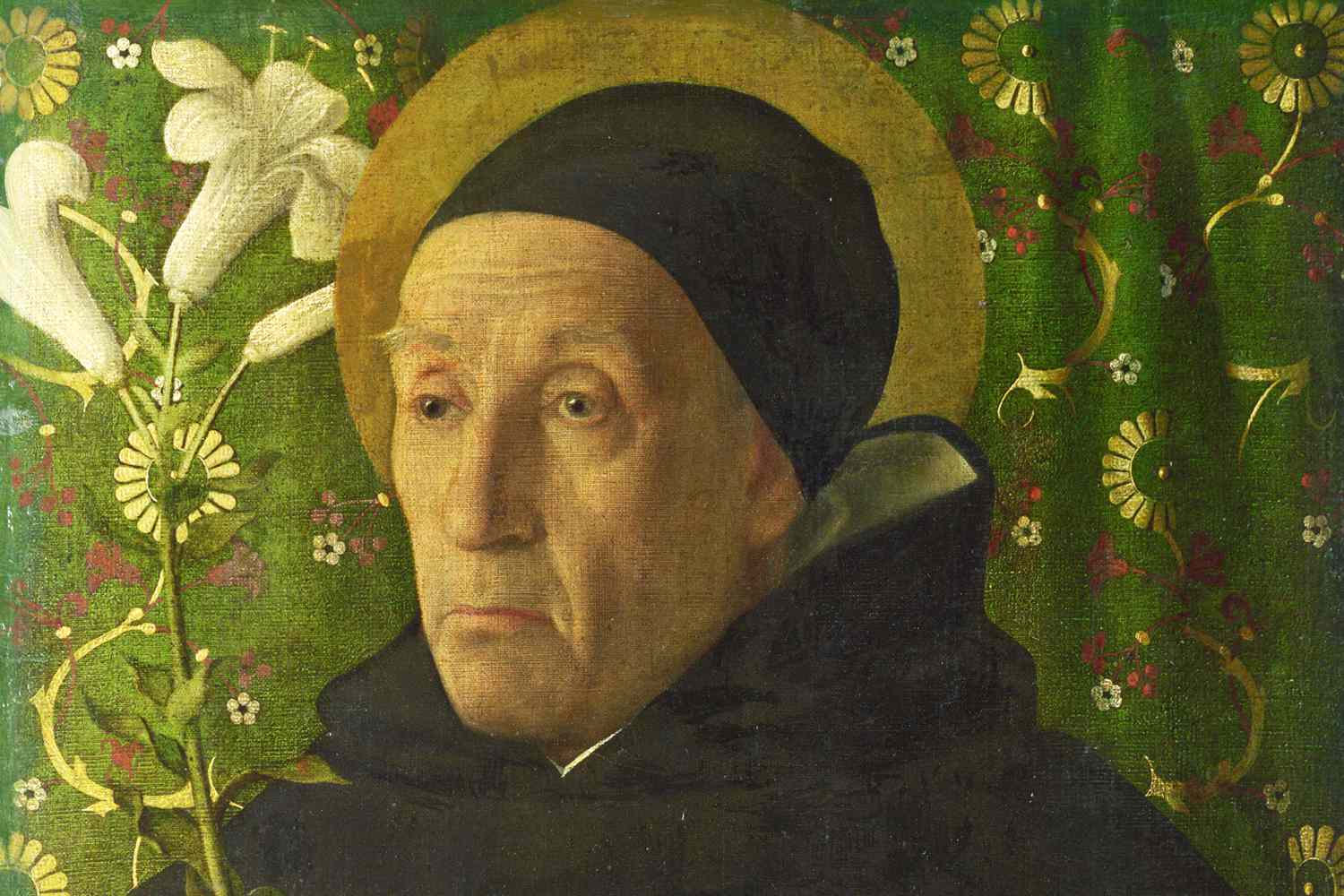
Carl Jung read Meister Eckhart (c. 1260–1328), the German Dominican whose sentences Pope John XXII condemned in 1329, as a medieval forerunner of a psychological understanding of religion. In Psychological Types (1921) he gave a full section to what he called Eckhart’s “relativity” of God, and in Aion (1951) he read Eckhart’s nameless Godhead as a picture of the unconscious itself.1, 2
An earlier version of this page told the familiar story: a free mystic, a rigid Church, a late vindication. The record is more useful than that. The papal bull condemned 28 sentences, not the man, and it said why it mattered: he had preached them to “the simple.” What the institution policed was translation, meaning who got access to the depths and in what language. The ego handles the unconscious the same way. It seldom denies outright what rises from below. It quarantines it, admits it as theory, and convicts its sentences out of context. Integration takes something Eckhart had a word for, gelâzenheit, letting be: neither prosecuting what arises nor obeying it, while staying present to it.
Who Meister Eckhart was
Eckhart was born around 1260, most likely at Tambach near Gotha in Thuringia, and probably entered the Dominican house at Erfurt in his late teens. After lecturing in Paris in 1293–94 he served as prior of Erfurt, and in 1302 he returned to Paris as master of theology. From 1303 to 1311 he ran the new Dominican province of Saxony, at least 47 houses across northern and eastern Germany and the Low Countries, founding three convents for women and serving as vicar-general for Bohemia. In 1311 Paris called him back for a second term as master, an honor previously given only to Thomas Aquinas. From 1313 he spent about a decade in Strasbourg, close to Dominican nuns and the beguines, lay women’s communities, and more and more of his preaching was in German. Around 1323 or 1324 he moved to Cologne.4 This page’s old timeline got several of these dates and offices wrong.
His vocabulary matters more than his résumé. Eckhart distinguished God, named and known as Father, Son and Spirit, from the Godhead, a ground beyond every name. In one sermon the spark of the soul is not content even with the three Persons; it wants “its simple ground,” the “silent desert” where no distinct thing has ever entered.5 In the soul’s own ground the Word is born. The conditions are abgescheidenheit, detachment, and gelâzenheit, releasement or letting be, and the life that follows is lived “without why.”4 The old page called this a “process of holding”; Eckhart used no such term, and his words point the other way.
Two of his images are routinely flattened. In the treatise on detachment he writes that “to be empty of creatures is to be full of God and to be full of creatures is to be empty of God.”5 And in his sermon on Luke 10:38, which he renders as Jesus being “received by a certain virgin who was a wife,” the virgin is “a person void of alien images.” Then he turns: “the ever virgin is never fruitful. To be fruitful the soul must be wife.”5 Emptiness is not the goal. Receptivity has to give birth to something lived. The line most people know, “The eye wherein I see God is the same eye wherein God sees me,” comes from his sermon on the text Qui audit me.5
What the Church actually did
The trouble began inside his own order. In 1325 a Dominican general chapter in Venice warned against friars in Germany whose sermons could lead “simple and uneducated people into error.”6 In 1326 two Dominicans who had themselves been accused of corruption gave Archbishop Henry of Virneburg of Cologne a list of 74 suspect propositions. Before the archbishop’s commission that September, Eckhart argued that he might have erred in understanding, but heresy is a matter of the will, and he would retract any error found.4 On February 13, 1327, he had a public protest of his orthodoxy read out in the Dominican church at Cologne, in a German translation he made himself so the lay audience could follow.6 That spring he appealed to the pope at Avignon.
The papal commission cut the lists down to 28 articles and judged them “heretical as the words sound,” reading them literally and out of context. Eckhart died before a verdict, most likely on January 28, 1328. On March 27, 1329, John XXII issued the bull In agro dominico, condemning 17 articles as heretical and 11 as ill-sounding, rash and suspect of heresy. The bull recorded that Eckhart had submitted himself and his writings to the Holy See before he died, and it was sent to Cologne to be published so that the hearts of the simple, to whom he had preached, would not be filled with its errors. Nowhere did it declare Eckhart a heretic.4, 6, 7
So there was one bull, not two, and it came after his death. Nor did Pope John Paul II rehabilitate Eckhart in 2010, as this page once said; he died in 2005. Dominican requests for rehabilitation in the late twentieth century produced no public act.6 When the Congregation for the Doctrine of the Faith, under Cardinal Joseph Ratzinger, warned in 1989 against prayer that seeks immersion “in the indeterminate abyss of the divinity,” its footnote named Eckhart as the source of the phrase.8 Nearly seven centuries on, the official position remains unsettled.
The setting explains a good deal. On June 1, 1310, the beguine Marguerite Porete was burned in Paris after refusing to withdraw The Mirror of Simple Souls, a book she had written in French rather than Latin. A year later Eckhart was living in the same Paris house as her inquisitor, William of Paris.4 The Council of Vienne (1311–12) then condemned the supposed errors of beguines and beghards, a list historians later used to define the “Free Spirit” heresy, though many doubt any organized Free Spirit sect existed.9 John XXII, meanwhile, was at war with the Franciscans over property, and in 1323 he declared it heretical to hold that Christ and the apostles owned nothing.10 Eckhart preached poverty of spirit, an inner poverty rather than a property claim, to nuns, beguines and lay audiences in their own language, during the same years in which unsupervised lay piety and the word “poverty” had become political. Read materially, the trial looks less like a dispute about metaphysics than a dispute about who controls access to the sacred, and in which language.
The suppression did not work. Henry Suso and Johannes Tauler carried his teaching into the lay Friends of God, and Nicholas of Cusa later collected and annotated his Latin works.6 In 1957 D. T. Suzuki opened Mysticism: Christian and Buddhist with a chapter titled “Meister Eckhart and Buddhism.”11 A sentence like “Why I pray God to rid me of God,” from his sermon on “Blessed are the poor in spirit,” works on a reader a little like a Zen koan: it cannot be obeyed literally, only lived with.5
What Jung took from Eckhart
Jung’s main treatment is in chapter 5 of Psychological Types, in a section titled “The Relativity of the Idea of God in Meister Eckehart.” He calls Eckhart “the most brilliant representative of that critical movement in the Church at the close of the thirteenth century,” and he names the core discovery: “the relativity of God to man and his soul” was, in his view, “one of the most important steps upon the way to a psychological understanding of the religious phenomenon.” His summary is blunt: “Eckehart clearly understands God as a psychological value.”1
Three moves in that section still matter clinically. The first concerns projection. Jung quotes Eckhart, “Who fetcheth God from without, troubled is he by objects,” and reads it this way: when the highest value is placed outside, in a person, a role or a possession, the object “gains a supreme influence over the subject, holding him in a certain slavish dependence.” In a footnote he adds that intellectual insight dissolves a projection “only when it is already ripe for dissolution,” and that an unripe projection cannot be withdrawn “by means of intellectual judgment and will.” Second, he defines the soul as “the relation to the unconscious.” Third, he reads Eckhart’s “breaking-through” into the Godhead as the ego sinking back into “the flood and source” of unconscious energy, a “religiously organized regression.” He does not treat that flood as the goal. When the soul is “entirely flooded,” Jung writes, “it is by no means a happy state.” The good state comes when the soul “comprehends the unconscious and takes on the imaged form or symbol of it.” His conclusion: “the happy state is a creative state.”1 In the same pages he quotes William Blake, “Energy is eternal delight,” which ties this reading to Blake’s visionary imagination.
Thirty years later, in the chapter of Aion on Gnostic symbols of the self, Jung returned to the Godhead “of which no qualities, except unity and being, can be predicated,” and argued that “as the Godhead is essentially unconscious, so too is the man who lives in God.” He quoted the poverty sermon at length and drew the two-way conclusion that runs through his psychology of religion: “The unconscious God-image can therefore alter the state of consciousness, just as the latter can modify the God-image once it has become conscious.”2
This is a reading, not a neutral report. Jung read Eckhart in pre-critical texts: Franz Pfeiffer’s 1857 edition, H. Büttner’s modern German translation and C. de B. Evans’s English one. His history could be loose. The English text of Aion places the Free Spirit movement “at the beginning of the eleventh century,” some three centuries before the heresy trials of around 1300, and gives Eckhart’s death as 1327, the date usual in Jung’s day; scholars now place it in early 1328.1, 2, 4, 7 The Jungian scholar John Dourley has traced how Jung took Eckhart’s ground of the soul and of the Godhead as the ground of the psyche. Dourley, who is sympathetic, says plainly that this implies a relativization of God and moves beyond conventional monotheism; the 1989 Vatican letter suggests how such language sounds from the other side.12, 13 Eckhart scholars also warn that he is quoted out of context more than almost any medieval thinker, and that the label “mystic” hides how much of a scholastic philosopher he was.4 Dourley reads Jung’s Eckhart alongside Jung’s reading of Jakob Boehme; see also Christian mystics in Jungian thought. The claim that all mystics describe one experience is the thesis of the perennial philosophy, and Eckhart is a good test of how much it flattens.
The trial as a map of the ego’s defenses
The useful parallel is not “Church bad, mystic good.” It lies in the procedure, which a frightened ego repeats with material from below.
It judges sentences, not the speaker. The commission lifted 28 sentences out of his sermons and treatises and judged them “heretical as the words sound.” A harsh inner critic does the same. A grieving person thinks, for one second, that they wish the long illness were over, and the critic convicts the whole self on that sentence, read literally and stripped of the love around it.
It polices the language, not the idea. The bull singled out the simple people who had heard him preach, mostly in German, as the ones to protect. Many people can say “I know this is about my father” in the Latin of insight while never letting the feeling arrive in the vernacular of the body. Jung’s footnote applies here: understanding does not release a projection until the projection is ripe.
Suppression has a cost, though a modest one. The old page claimed that pushing the unconscious away “gives it more power.” The evidence supports a smaller version. A meta-analysis of controlled studies found a small-to-moderate rebound effect: thoughts people tried to suppress came back more often afterward.14 A later meta-analysis of 31 studies in Daniel Wegner’s paradigm found the rebound regardless of mental load, while the immediate surge during suppression appeared only under load.15 These studies measure the frequency of a target thought, not the Jungian unconscious, but as an image they fit Eckhart’s case: the condemnation of 1329 did not stop Tauler, Suso or Cusa from reading him.
The opposite error is flooding. The inverse of the tribunal treats every image from below as revelation. Jung’s reading rules that out, since being flooded is not the happy state, and so does Eckhart’s virgin who must also be a wife: openness that never bears fruit in an ordinary life has gone nowhere.
Letting be is a capacity, not a mood. Between prosecution and surrender sits the ability to tolerate not knowing for a while, a narrow slice of which psychology measures as intolerance of uncertainty. A meta-analysis of 181 studies with more than 52,000 participants found a moderate association (r = 0.51) between intolerance of uncertainty and symptoms of anxiety disorders, obsessive-compulsive disorder, depression and eating disorders.16 The data are correlational, so they do not show that intolerance of uncertainty causes these problems. They do suggest that a measurable sliver of what Eckhart called gelâzenheit matters clinically.
What this looks like in therapy
People rarely come to therapy saying “my ego is defending against the unconscious.” They come with a dream that will not leave them alone, an image from an old trauma, a grief that arrives at the wrong moments, a sudden religious experience, or an impulse that frightens them. Usually a trial has already started inside them: what does this mean about me, and is it allowed?
Much of the early work is slowing that trial down. Before deciding whether something is pathology or revelation, we ask what it is saying in its own language. A dream gets told in the present tense, with attention to where the body reacts. A frightening thought gets treated as a sentence that has a context, not as a verdict. Where value has been projected outward, onto a job, a partner, a parent’s approval or a spiritual teacher, we track it without arguing it away, because projections tend to loosen when they are ready, not when they are refuted. In parts-based therapy the inner prosecutor is usually treated as a protector doing a job it was given long ago, and the work is to understand that job before asking it to stand down.
The other half of the work is containment. Experiences of boundlessness, oneness or revelation are not all mystical. Sleep loss, mania, psychosis and trauma-related dissociation can produce them, so a careful clinician assesses first and keeps the person’s ordinary life, sleep and relationships in view. For clients from religious backgrounds Eckhart is often a relief, because he shows that the tradition itself contains a language for unknowing; therapy does not ask anyone to give up their faith or to adopt Jung’s.
On evidence, honesty matters. Jungian therapy has some empirical support, mostly from naturalistic outcome studies in Germany and Switzerland, and its own researchers say randomized controlled trials are still needed.17, 18 We use depth work alongside approaches with stronger trial evidence, and we do not present it as a proven treatment for any specific disorder.
Common questions about Eckhart and Jung
Was Meister Eckhart condemned as a heretic?
No. The 1329 bull In agro dominico condemned 28 propositions drawn from his works, 17 as heretical and 11 as suspect, but it never declared Eckhart himself a heretic. He had died the year before, after submitting his writings to the pope’s judgment.
Has the Catholic Church rehabilitated Meister Eckhart?
No formal rehabilitation has been issued. A claim that John Paul II rehabilitated him in 2010 cannot be right, since that pope died in 2005, and a 1989 Vatican letter on prayer still cited Eckhart as the source of language it warned against.
Where does Jung write about Meister Eckhart?
The longest discussion is the section on the relativity of God in chapter 5 of Psychological Types (1921). He returns to Eckhart’s Godhead in Aion (1951), in the chapter on Gnostic symbols of the self, and mentions him at several other points in that book.
If something from below has been pressing on you, a dream, a grief or a question about faith, and you want help listening to it without being swept away, our Jungian depth therapy in Hoover is one place to start. You can also contact us to talk through whether it fits.
References
- Jung, C. G. (1923). Psychological types; or, The psychology of individuation (H. G. Baynes, Trans.). Kegan Paul, Trench, Trubner; Harcourt, Brace. (Original work published 1921). https://archive.org/details/psychological_types
- Jung, C. G. (1968). Aion: Researches into the phenomenology of the self (R. F. C. Hull, Trans.; 2nd ed.; Collected Works, Vol. 9, Part 2). Princeton University Press. (Original work published 1951)
- National Gallery, London. (n.d.). Giovanni Bellini, Portrait of Fra Teodoro of Urbino as Saint Dominic (L1115). https://www.nationalgallery.org.uk/paintings/giovanni-bellini-portrait-of-fra-teodoro-of-urbino-as-saint-dominic
- Griffioen, A. L. (2023). Meister Eckhart. In E. N. Zalta & U. Nodelman (Eds.), The Stanford encyclopedia of philosophy. Metaphysics Research Lab, Stanford University. https://plato.stanford.edu/entries/meister-eckhart/
- Meister Eckhart. (1924). Meister Eckhart (F. Pfeiffer, Ed.; C. de B. Evans, Trans.; Vol. 1). John M. Watkins. https://archive.org/details/in.ernet.dli.2015.31707
- Meister Eckhart. (2026). In Wikipedia. Retrieved November 8, 2026, from https://en.wikipedia.org/wiki/Meister_Eckhart
- McMahon, A. (1909). Meister Johann Eckhart. In The Catholic encyclopedia (Vol. 5). Robert Appleton Company. https://www.newadvent.org/cathen/05274a.htm
- Congregation for the Doctrine of the Faith. (1989). Letter to the bishops of the Catholic Church on some aspects of Christian meditation (Orationis formas). https://www.vatican.va/roman_curia/congregations/cfaith/documents/rc_con_cfaith_doc_19891015_meditazione-cristiana_en.html
- Lerner, R. E. (1972). The heresy of the Free Spirit in the later Middle Ages. University of California Press.
- Pope John XXII. (2026). In Wikipedia. Retrieved November 8, 2026, from https://en.wikipedia.org/wiki/Pope_John_XXII
- Suzuki, D. T. (1957). Mysticism: Christian and Buddhist. Harper & Brothers.
- Dourley, J. P. (2001). Jung, mysticism and a myth in the making. Studies in Religion/Sciences Religieuses, 30(1), 65–78. https://doi.org/10.1177/000842980103000106
- Dourley, J. P. (2011). Jung’s equation of the ground of being with the ground of psyche. Journal of Analytical Psychology, 56(4), 514–531. https://doi.org/10.1111/j.1468-5922.2011.01926.x
- Abramowitz, J. S., Tolin, D. F., & Street, G. P. (2001). Paradoxical effects of thought suppression: A meta-analysis of controlled studies. Clinical Psychology Review, 21(5), 683–703. https://doi.org/10.1016/s0272-7358(00)00057-x
- Wang, D., Hagger, M. S., & Chatzisarantis, N. L. D. (2020). Ironic effects of thought suppression: A meta-analysis. Perspectives on Psychological Science, 15(3), 778–793. https://doi.org/10.1177/1745691619898795
- McEvoy, P. M., Hyett, M. P., Shihata, S., Price, J. E., & Strachan, L. (2019). The impact of methodological and measurement factors on transdiagnostic associations with intolerance of uncertainty: A meta-analysis. Clinical Psychology Review, 73, 101778. https://doi.org/10.1016/j.cpr.2019.101778
- Roesler, C. (2013). Evidence for the effectiveness of Jungian psychotherapy: A review of empirical studies. Behavioral Sciences, 3(4), 562–575. https://doi.org/10.3390/bs3040562
- Roesler, C., & Reefschläger, G. I. (2022). Jungian psychotherapy, spirituality, and synchronicity: Theory, applications, and evidence base. Psychotherapy, 59(3), 339–350. https://doi.org/10.1037/pst0000402












0 Comments