
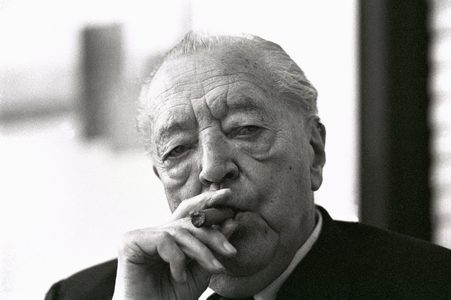
Ludwig Binswanger (1881-1966) was a Swiss psychiatrist who founded existential analysis, or Daseinsanalyse, by applying the phenomenology of Edmund Husserl and Martin Heidegger to psychiatric patients. He asked how a person experiences space, time, other people and themselves, rather than only which symptoms they show. That shift made him a founding figure for existential and humanistic psychotherapy.
Key takeaways
- Ludwig Binswanger (1881-1966) ran the Bellevue Sanatorium in Kreuzlingen from 1911 to 1956 and founded existential analysis, or Daseinsanalyse.
- He trained under Eugen Bleuler and Carl Jung and kept a close friendship with Sigmund Freud from 1907 until Freud’s death, despite disagreeing with his theory.
- Binswanger used Husserl’s phenomenology and Heidegger’s Being and Time to describe each patient’s world design: how they live space, time, other people and themselves.
- His case of Ellen West is a detailed record of life inside an eating disorder and remains debated for its diagnosis and its reading of her death.
- Through the 1958 book Existence and Rollo May, his ideas shaped existential-humanistic therapy and phenomenological psychiatry.
Who was Ludwig Binswanger?
Binswanger was born on 13 April 1881 in Kreuzlingen, on the Swiss shore of Lake Constance, into a family of psychiatrists. His grandfather, also named Ludwig Binswanger, founded the Bellevue Sanatorium there in 1857, and his father Robert ran it after him. His uncle Otto Binswanger was professor of psychiatry at Jena, where he treated Friedrich Nietzsche after Nietzsche’s collapse in 1889. Psychiatry was the family business, and so was an interest in the inner life of patients from educated, often artistic, families.
He studied medicine at Lausanne, Heidelberg and Zurich, and in Zurich he trained at the Burghölzli hospital under Eugen Bleuler, the psychiatrist who coined the word schizophrenia. His doctoral dissertation, on the psychogalvanic response in the word association experiment, was supervised by Carl Jung and published in 1907 as part of Jung’s association studies. After a year working under his uncle in Jena, he joined Bellevue, and when his father died at the end of 1910 he became its medical director. He ran the sanatorium from 1911 until 1956, forty-five years, and died in Kreuzlingen on 5 February 1966.9
Bellevue was an open, residential clinic where patients could stay for months and where the director lived among them. Its patients included the art historian Aby Warburg, who stayed from 1921 to 1924 and gave his lecture on the serpent ritual of the Pueblo peoples there. Long stays and close daily contact gave Binswanger something most psychiatrists of his era lacked: the chance to watch how a person’s whole way of living changed over time, not just how their symptoms looked on admission.
During those early years at Bellevue he grew dissatisfied with the psychiatry he had learned. Bleuler’s and Emil Kraepelin’s diagnostic systems sorted patients well, and Freud’s psychoanalysis explained them through drives and mechanisms, but neither, in his view, described the patient’s actual world. His answer took about twenty years to build and drew on two sources: his long friendship with Freud and his reading of the phenomenologists.
What was Binswanger’s friendship with Freud?
Binswanger first met Sigmund Freud in March 1907, when he travelled to Vienna with Jung. The two men liked each other at once, and their letters ran from 1908 until 1938, the year Freud left Vienna for London.6 Binswanger was one of the first Swiss psychiatrists to use psychoanalysis in a hospital, and he stayed loyal to Freud as a person long after he had moved away from Freud’s theory.
In 1912 Binswanger underwent surgery for a tumour that he feared might be fatal, and Freud travelled to Kreuzlingen at Whitsun to see him. Freud did not stop in Zurich on the way, and Jung took the omission as a deliberate snub. This “Kreuzlingen gesture” became one of the grievances in the break between Freud and Jung, a story told among the great feuds in psychotherapy. Binswanger, unusually, stayed on good terms with both men.
The friendship survived real disagreement. In May 1936, for Freud’s eightieth birthday, Binswanger lectured in Vienna on Freud’s conception of the human being in the light of anthropology, arguing that psychoanalysis described “homo natura”, the person as a piece of nature driven by instinct, and left out the person as a historical, loving, self-interpreting being. Freud replied warmly but held his ground: he had always worked, he wrote, on the ground floor and in the basement of the human building, and left the upper floors to others. Binswanger later published his memoir of the relationship, translated in 1957 as Sigmund Freud: Reminiscences of a Friendship.5 The letters were published in German in 1992 and in English in 2003.6
How did Husserl and Heidegger shape existential analysis?
Binswanger read Edmund Husserl early. Phenomenology, in Husserl’s sense, means describing experience as it is actually given, before theory explains it away. Binswanger’s 1922 book Einführung in die Probleme der allgemeinen Psychologie (Introduction to the Problems of General Psychology) already argued that psychiatry needed this kind of description to understand a patient as a person rather than as an organism or a set of mechanisms.9
The decisive book was Martin Heidegger‘s Being and Time (1927). Heidegger called the human being Dasein, literally “being there”, and his “existential analytic” (Daseinsanalytik) set out the basic structures of that kind of being: that we are always already “in the world”, among things and other people, caring about what happens, stretched between past and future, and aware that we will die. Binswanger named his own method Daseinsanalyse, the analysis of Dasein, after Heidegger’s analytic. It was not a blend of the word Dasein with psychoanalysis, although it did keep psychoanalysis’s interest in the life history.3
For Binswanger, being-in-the-world became the unit of psychiatric study. Psychological suffering, he argued, is not only a conflict inside the mind or a faulty thought. It is a change in a person’s whole relation to themselves, to others and to their surroundings. Mental illness often shows up as a narrowing of that relation: possibilities close, the world shrinks, and the person can no longer move freely within it.110
Binswanger also departed from Heidegger. In Grundformen und Erkenntnis menschlichen Daseins (Basic Forms and Knowledge of Human Existence, 1942) he argued that Heidegger’s account of care left out love, the “we” of two people who belong together. Heidegger himself, in seminars he later gave for Medard Boss’s circle in Zurich, said Binswanger had misread Being and Time by treating its ontological structures as psychological ones.8 Binswanger came to accept part of the charge and called his reading a productive misunderstanding: wrong as Heidegger scholarship, fertile as psychiatry.11
What are Umwelt, Mitwelt and Eigenwelt?
Binswanger described a person’s world as having three interwoven regions, each named with a German compound on the word Welt (world). The terms were later made famous in English by Rollo May’s introduction to Existence (1958).2
- Umwelt, the “around world”: the physical and biological world of the body, needs, drives, weather, place and the natural environment.
- Mitwelt, the “with world”: the world of other people, relationships, community and shared language.
- Eigenwelt, the “own world”: a person’s relation to themselves, their self-awareness, values and sense of who they are.
These are not three separate places. A person lives in all three at once, and health means being able to move among them with some freedom. Distress often shows up as one region swallowing the others or falling away. Someone gripped by panic may live almost entirely in the Umwelt, in heartbeat, breath and the threat of the room. Someone in a psychotic withdrawal may lose the shared Mitwelt, so that other people stop being companions and become strangers or persecutors. Someone deeply depressed may feel the Eigenwelt go hollow, with no felt sense of what they want or value. These examples are illustrations of the framework, not diagnoses Binswanger assigned to the three regions, but they show how a clinician can use it to ask where a person’s world has narrowed.
What is the existential a priori and the world design?
Binswanger’s most distinctive idea is the world design (Weltentwurf). Every person, he argued, lives inside a basic pattern of meaning that shapes everything they can perceive and do. He also called this the existential a priori: a frame that comes before any particular experience and decides in advance how experience will show up. It includes how a person lives space (wide or cramped, open or blocked), time (flowing, stopped or rushing), other people and their own body.3
He found these designs in the language of patients and in dreams. His 1930 essay “Dream and Existence” (Traum und Existenz) began from the common experience of falling, of having the ground pulled out from under us, and showed how vertical images of rising and falling carry a person’s whole relation to hope and despair.7 When the French translation appeared in 1954, the young Michel Foucault wrote an introduction longer than the essay itself, one of his first substantial publications.7
In Über Ideenflucht (On the Flight of Ideas, 1933) he applied the same method to mania, describing a world that has become flat, all surface and leap, with no ground to stand on. In severe illness, he argued, the world design becomes rigid and narrow. A patient may live in a world organised around a single theme, such as threat, contamination or emptiness, so that everything that happens is read through it. The task of existential analysis is to describe that design carefully, to understand what the suffering means inside it, and to look for where it might open again.1
What happened in the case of Ellen West?
Binswanger’s most famous and most debated case is that of “Ellen West”, the pseudonym he gave a young woman who came to Bellevue in January 1921. From her teens she had been tormented by a dread of becoming fat and a craving to eat; today she would be recognised as having anorexia nervosa with bulimic episodes. Before Kreuzlingen she had already been through psychoanalytic treatment, several clinics and consultations with leading psychiatrists. Her diaries and poems record a woman of real intelligence and longing who felt her life reduced to the single question of eating.4
After about two and a half months, Binswanger consulted Eugen Bleuler and the German psychiatrist Alfred Hoche. All three agreed that she had a progressive schizophrenic illness and that no treatment offered real hope. Ellen West asked to leave, and she was discharged with her husband at the end of March. Three days later, at home, she took a lethal dose of poison. Her husband reported that on her last day she seemed calm and even happy, eating freely for the first time in years.4
Binswanger published the case in 1944 and 1945 as “an anthropological-clinical study”. He read her life as a world split between an ethereal world of airy, weightless spirit and a tomb world of the earthbound, decaying body, with the space between them shrinking until no livable ground was left. He saw her death as, in a sense, the completion of her existence. That reading is where admiration and criticism meet. Carl Rogers, writing in 1961, argued that what Ellen West lacked was a relationship in which she could be fully accepted, and that her doctors talked about her rather than with her. Later readers, especially in the eating disorders field, have asked whether the diagnosis of schizophrenia was right and whether treating her death as fulfilment came too close to accepting it. Even critics agree that Binswanger’s account, built from her own words, is one of the most detailed records of what it is like to live inside an eating disorder, which is why it is still taught.
What other cases and works did Binswanger write?
Ellen West was one of a series of long case studies. “Ilse” (1945) concerned a woman who, hoping to change her father’s harsh treatment of her mother, held her hand in a burning stove, and whose later delusions Binswanger traced to that act of sacrifice; it appears in English in Existence.2 The cases of Jürg Zünd, Lola Voss and Suzanne Urban followed and were collected in Schizophrenie (1957). Late in life he returned to Husserl, publishing Melancholie und Manie (Melancholy and Mania, 1960) and Wahn (Delusion, 1965), which analysed how the basic structures of experience, especially time, come apart in mood disorders and psychosis.910
For English readers the two key collections are Existence: A New Dimension in Psychiatry and Psychology (1958), edited by Rollo May, Ernest Angel and Henri Ellenberger, which includes “The Existential Analysis School of Thought”, the Ellen West and Ilse cases, and essays by Eugène Minkowski and Erwin Straus,2 and Being-in-the-World: Selected Papers of Ludwig Binswanger (1963), translated with a long introduction by the philosopher Jacob Needleman, which includes “Dream and Existence”, the 1936 Freud lecture and his key methodological essays.1
How did Binswanger approach psychotherapy?
Binswanger did not leave a technique or protocol. He left an attitude and a set of questions. Three themes run through his clinical writing.
Phenomenological exploration and understanding
The existential analyst tries to enter the patient’s world and grasp it from the inside, rather than fitting the patient to a category first. That means close attention to how the person describes space, time, the body, other people and the future, and to the images they use. The therapist sets aside, as far as possible, their own assumptions and theories so that the patient’s experience can show itself. At the same time the therapist knows the basic givens of human life, finitude, uncertainty, choice and responsibility, and helps the patient face them rather than flee them.3
Encounter and being-with
Binswanger insisted that therapy is a meeting between two people, not a procedure done by one to the other. His idea of love as a basic form of existence shaped this: the therapist and patient form a “we”, and it is inside that shared space that the patient’s world can widen. The therapist has to be willing to be moved by the patient, while staying grounded in their own way of being in the world. He respected Freud’s work on transference but treated the relationship as more than a screen for the past: it is a real present encounter with its own healing force.1
Freedom and responsibility
The aim of existential analysis is not just symptom relief but a freer way of being-in-the-world. This is not a return to some prior normality. It is a gradual move from a narrowed, self-estranged existence towards one in which the person can take up their own possibilities and choices within the limits of their facts, their history, body and circumstances. That usually involves grief and anxiety: accepting finitude, mourning paths not taken, tolerating what cannot be fixed. It also opens room for creativity and for saying yes to a life that includes pain.10
How did Binswanger differ from Medard Boss?
The Zurich psychiatrist Medard Boss took up the name Daseinsanalysis after Binswanger, and the two are often confused. Boss worked directly with Heidegger from 1959 onward, hosting the seminars later published as Zollikon Seminars, and he built a therapy that tried to follow Heidegger’s ontology faithfully.8 Boss kept much of the outer form of psychoanalysis, such as the couch and free association, while dropping its theory of drives and mechanisms.
Binswanger, by contrast, used Heidegger as one source among several, added his own account of love, and stayed mainly a psychiatric researcher describing world designs in severe illness. Boss’s school became the Daseinsanalysis practised today in Zurich and elsewhere, while Binswanger’s work fed more directly into phenomenological psychiatry and the American existential movement. Both influence what is now called existential analysis therapy. The term should not be confused with the “existential analysis” of Viktor Frankl‘s logotherapy, which grew up separately in Vienna.
What was Binswanger’s influence on existential and humanistic psychology?
Binswanger’s ideas reached the English-speaking world mainly through Existence in 1958. Rollo May‘s two introductory chapters presented existential analysis to American psychologists, and the book helped start the existential-humanistic movement of the 1960s.2 Carl Rogers engaged with Binswanger directly through the Ellen West case, and James Bugental built an existential-humanistic therapy on similar ground.
Later existential therapists drew on that tradition. Irvin Yalom discusses Binswanger and the Ellen West case in Existential Psychotherapy (1980), and Emmy van Deurzen expanded the three worlds into four by adding a spiritual dimension. In Britain, R. D. Laing drew on Binswanger’s case studies when he argued in The Divided Self (1960) that psychotic experience could be understood if one entered the patient’s world.
His influence went beyond therapy. His careful descriptions of how time and space are lived in mania, melancholy and delusion helped found phenomenological psychiatry, a field that still produces research on the experience of schizophrenia and depression.10 His insistence on describing experience before explaining it also helped legitimise the qualitative and hermeneutic methods now used across the human sciences.9
Why does Binswanger still matter today?
Psychiatry today relies on symptom checklists, standardised diagnoses and treatments matched to them. Binswanger’s work is a reminder of what this leaves out: the person’s own world, the meaning that suffering has inside it, and the relationship in which change happens. Two people with the same diagnosis can live in very different worlds, and those worlds matter for treatment. The psychiatrist Nassir Ghaemi has argued that Binswanger’s methods remain useful in ordinary psychiatric practice for exactly this reason.10
His idea of the world design also fits with how many clinicians now think about trauma. A traumatic experience does not just leave a bad memory. It can reorganise how a person lives space (no place feels safe), time (the past keeps happening now), other people (everyone is a potential threat) and the body (a source of alarm rather than a home). Binswanger did not write about trauma in these terms, but his framework gives clinicians language for it.
Finally, Binswanger’s picture of the person is one in which human beings are always already in a world of meanings, relationships and possibilities, and are called to take responsibility for their existence within limits they did not choose. Even where his specific clinical judgments, as in the Ellen West case, are open to question, that picture keeps the existential side of suffering in view in a field that easily forgets it.
How do we use Binswanger’s ideas in therapy at Taproot?
At Taproot, existential analysis is less a technique than a way of listening. We pay attention to how a client describes the shape of their world: whether time has stopped or is racing, whether rooms feel cramped or open, whether other people feel near or far, whether the body feels like home. These descriptions often tell us more about where someone is stuck than a diagnosis does, and they help us track change as the world opens again.
This kind of listening is useful with depression that feels like emptiness, with anxiety that has shrunk a person’s life to a few safe routines, with grief, with the loss of meaning after a major life change, and with trauma that has changed a person’s sense of space, time and safety. In Brainspotting, the client’s attention to where they look and what they feel in the body is itself a form of phenomenological exploration, a point developed in the phenomenology of Brainspotting. Somatic and parts-based work likewise start from lived experience rather than from theory.
Binswanger’s emphasis on encounter also shapes how we hold the relationship. Therapy here is a meeting between two people, and the safety and honesty of that meeting is part of what helps a narrowed world open. If the questions Binswanger asked, about meaning, freedom, finitude and how you live in your world, are the ones you are carrying, our existential therapy in Birmingham is built around them.
Frequently asked questions
What is Daseinsanalyse?
Daseinsanalyse, or existential analysis, is the psychiatric method Ludwig Binswanger developed from the 1920s onward. Named after Heidegger’s analysis of Dasein, the human way of being, it describes how a patient lives space, time, the body, other people and themselves, and treats mental illness as a narrowing of that whole world rather than only a set of symptoms.
Was Ludwig Binswanger a student of Freud?
Ludwig Binswanger was not formally Freud’s student. He trained under Eugen Bleuler and Carl Jung in Zurich, met Freud in Vienna in 1907 and became a lifelong friend. He used psychoanalysis at Bellevue but later argued that Freud described the person only as a creature of nature, leaving out love, history and meaning. Their letters ran from 1908 to 1938.
What was the Ellen West case?
Ellen West was the pseudonym Ludwig Binswanger gave a woman treated at Bellevue in 1921 for what would now be called anorexia nervosa with bulimia. With Bleuler and Alfred Hoche he diagnosed schizophrenia, and she died by suicide three days after discharge. His 1944-45 study of her diaries is still taught and still argued over.
What is the difference between Binswanger and Medard Boss?
Both Ludwig Binswanger and Medard Boss called their work Daseinsanalysis. Binswanger used Heidegger freely, added his own theory of love and focused on describing world designs in severe illness. Boss worked with Heidegger directly from 1959, followed his ontology more closely and built a therapy school in Zurich that kept the outer form of psychoanalysis.
What books should I read by Ludwig Binswanger in English?
The best starting points for Ludwig Binswanger in English are Existence (1958), edited by Rollo May, Ernest Angel and Henri Ellenberger, which contains the Ellen West and Ilse cases, and Being-in-the-World (1963), translated by Jacob Needleman. Dream and Existence (1993) pairs his 1930 essay with Michel Foucault’s introduction.
Related reading
- Diane Poole Heller: From Trauma Survivor to Pioneer of Attachment Healing
- Joseph Wolpe: The Pioneer Who Taught Us How to Unlearn Fear
- Otto Rank: Pioneer of Birth Trauma Theory and the Will in Psychoanalysis
- Pierre Janet: Pioneer of Dissociation Theory and Psychological Analysis
- David Grand: From EMDR Trainer to Brainspotting Pioneer Through a Champion Skater’s Frozen Gaze
- Wilhelm Reich’s Analysis of Fascism: Enduring Wisdom and Controversial Reception
References
- Binswanger, L. (1963). Being-in-the-world: Selected papers of Ludwig Binswanger (J. Needleman, Trans.). Basic Books.
- May, R., Angel, E., & Ellenberger, H. F. (Eds.). (1958). Existence: A new dimension in psychiatry and psychology. Basic Books. https://doi.org/10.1037/11321-000
- Binswanger, L. (1958). The existential analysis school of thought. In R. May, E. Angel, & H. F. Ellenberger (Eds.), Existence: A new dimension in psychiatry and psychology (pp. 191-213). Basic Books. https://doi.org/10.1037/11321-007
- Binswanger, L. (1958). The case of Ellen West: An anthropological-clinical study. In R. May, E. Angel, & H. F. Ellenberger (Eds.), Existence: A new dimension in psychiatry and psychology (pp. 237-364). Basic Books. https://doi.org/10.1037/11321-009
- Binswanger, L. (1957). Sigmund Freud: Reminiscences of a friendship (N. Guterman, Trans.). Grune & Stratton.
- Fichtner, G. (Ed.). (2003). The Freud-Binswanger correspondence 1908-1938 (A. J. Pomerans, Trans.). Open Gate Press.
- Foucault, M., & Binswanger, L. (1993). Dream and existence (K. Hoeller, Ed.). Humanities Press.
- Heidegger, M. (2001). Zollikon seminars: Protocols, conversations, letters (M. Boss, Ed.; F. Mayr & R. Askay, Trans.). Northwestern University Press.
- Spiegelberg, H. (1972). Phenomenology in psychology and psychiatry: A historical introduction. Northwestern University Press.
- Ghaemi, S. N. (2001). Rediscovering existential psychotherapy: The contribution of Ludwig Binswanger. American Journal of Psychotherapy, 55(1), 51-64. https://doi.org/10.1176/appi.psychotherapy.2001.55.1.51
- Frie, R. (1999). Interpreting a misinterpretation: Ludwig Binswanger and Martin Heidegger. Journal of the British Society for Phenomenology, 30(3), 244-257. https://doi.org/10.1080/00071773.1999.11007259






















0 Comments