
J. L. Moreno (1889–1974) was a Romanian-born psychiatrist, trained in Vienna, who invented psychodrama: a group method in which one person acts out scenes from their own life while a director guides the action and other group members play the people in it. He also introduced the term “group psychotherapy” in 1932 and founded sociometry, the study of who chooses whom in a group.1
Moreno’s phrase for what he saw in his first groups was that one person could become “a therapeutic agent of the other.”1 That is the real content of the mutual-healing idea attached to his name, and it is the argument of this piece. Moreno held that people are hurt in relationships and in action, so they have to be helped in relationships and in action, often by other people who are changed in the same process.1 Psychodrama’s stage, roles and techniques are machinery for making that reciprocity happen on purpose. Group therapy, the empty chair and some of today’s parts work inherited the machinery, often without his name on it.
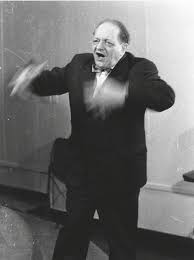
Vienna: refugees, encounters and a theater of spontaneity
Moreno was born Iacob Levy in Bucharest on May 18, 1889, into a Sephardi Jewish family that moved to Vienna in 1895.2 He studied medicine at the University of Vienna and qualified as a physician in 1917. Many famous stories about his early life come only from his own writing, and he was a showman, so read them as his telling.
He was working with groups before he had a medical degree. Around 1913 he helped organize a group of sex workers in Vienna, and later wrote that this was where “one individual could become a therapeutic agent of the other.”1 From 1915 to 1918 he worked at the Mitterndorf refugee camp, where he proposed restructuring the camp “by means of sociometric analysis.” Earlier, as a university student, he and friends had opened a House of the Encounter for refugees and migrants, whose evening meetings he later called the first encounter groups.1
His early religious writing, published anonymously and including The Words of the Father, held that every person can awaken the Godhead within, and that creativity is the divine quality people share.1 His later clinical idea of spontaneity reads as that conviction made practical.
By his own account the first psychodrama took place on April 1, 1921. Dressed as a jester, he invited members of a Vienna audience onto the stage to play the “King of the New World Order” and say how they would stabilize postwar Austria. His Theater of Spontaneity, the Stegreiftheater, followed: actors improvised scenes from the day’s newspapers and from audience suggestions. He meant it as social theater and found it therapeutic for players and audience alike.1
He set himself against Freud early. In Moreno’s version of a meeting after one of Freud’s lectures, he told him: “You meet people in the artificial setting of your office. I meet them on the street and in their homes, in their natural surroundings. You analyzed their dreams; I try to give them courage to dream again.”1 The difference he named was real. Freud treated acting out as resistance. For Moreno, acting it out, in front of witnesses and with other people in the roles, was the treatment.1 The best-known break with Freud, the split between Jung and Freud over the unconscious, was about theory. Moreno’s quarrel was about method.
New York: sociometry, Beacon and group psychotherapy
Moreno emigrated to New York in 1925. He opened an Impromptu Theater at Carnegie Hall in 1929, studied relationships among Sing Sing inmates, and in 1932, at the American Psychiatric Association meeting in Philadelphia, presented that work and introduced the terms “group therapy” and “group psychotherapy.”1 His claim to have founded group therapy is disputed: many date the first therapy group to Joseph Pratt’s 1905 classes for tuberculosis patients in Boston. Fairly put, Moreno named the field and was among its main pioneers.
He spent a year as director of research at the New York State Training School for Girls in Hudson, and the work became Who Shall Survive? (1934).1,3 The book contains some of the earliest drawn maps of social networks, which is why Moreno is also counted among the founders of social network analysis. Its opening ambition is pure Moreno: “A truly therapeutic procedure cannot have less an objective than the whole of mankind.”1
In 1936 he opened the Beacon Hill Sanitarium in Beacon, New York, with a purpose-built stage, and began using psychodrama systematically with seriously ill patients. He launched the journal Sociometry in 1937 and founded what became the American Society of Group Psychotherapy and Psychodrama in 1942. Zerka Toeman arrived at Beacon in 1941 seeking help for her mentally ill sister, became his collaborator, and married him in 1949. His writing was dense, and she did much to make the method teachable. Moreno died at Beacon in 1974.1
What “mutual healing” meant, and what it did not
An earlier version of this article said that Moreno asked his patients to help him gain insight when he had made a mistake, and that he believed therapy was meant to heal the therapist as well. There is no source for that. The best-documented experiment in a patient analyzing the analyst belongs to Sándor Ferenczi, whose 1932 Clinical Diary records his “mutual analysis” with Elizabeth Severn.4,5 That episode became a reference point for the later relational turn in psychoanalysis, and it is a different idea from Moreno’s.
Moreno’s mutuality was structural, not confessional. He built situations in which patients treated each other:
- The group is the patient. “In individual psychotherapy the patient is a single individual. In group psychotherapy the patient is a group of individuals.”1
- Auxiliary egos. Group members who play roles in someone else’s drama act, in Moreno’s description, as actors, therapeutic agents and social investigators. Playing a role can stir something of their own.1
- Tele. Moreno’s word for an accurate, two-way knowing between people, which he set against transference, the one-way projection of an old relationship onto a new one.1
- Interpersonal catharsis. In Psychodrama, Volume 1, he argued that one member’s catharsis depends on the others’: “the catharsis has to be interpersonal.”1,6
- Sharing, not advice. After an enactment, group members say what in the scene touched their own lives. They do not give feedback or advice, and the director may share too, within professional limits.1
This version of mutual healing does not make the therapist a co-patient. It makes everyone in the room a possible source of help, and makes the leader responsible for keeping that help safe.
How a psychodrama works
A classical psychodrama has five elements: the stage, the protagonist whose story is enacted, the director, the auxiliary egos who play the other roles, and the audience, which is the rest of the group. It runs in three phases: a warm-up that builds enough trust for someone to step forward, the enactment, and a sharing that brings the protagonist back into the group.1
Moreno’s theory of change rested on spontaneity, which he defined as the capacity to “respond with some degree of adequacy to a new situation or with some degree of novelty to an old situation.”1 Its opposite is the “cultural conserve,” the finished product of an earlier creative act, such as a script, that gets repeated rather than lived. A 2018 systematic review distilled dozens of techniques into 11 core ones, among them the soliloquy, double, mirror, role reversal, sculpture and role training.7 Four do most of the work:
- Doubling. Someone beside the protagonist voices what they may be feeling but not saying; the protagonist keeps what fits.
- Mirroring. The protagonist steps out and watches someone else play them, to see the scene from outside.
- Role reversal. The protagonist becomes the other person, a mother or a boss, and answers from that position.
- Concretization and surplus reality. Inner states become objects or people on stage, and scenes that never happened can be played: a conversation with someone who has died, or with a parent as they needed that parent to be. Moreno called this freedom from ordinary rules “surplus reality.”1,8
Moreno tied the first three techniques to child development: an infant needs a parent who doubles, voicing its experience; then a mirror; and only later can the child reverse roles and take another person’s view.1 The point he took from this is that the self is built out of roles learned in relationships. Some of those roles fit, and some were assigned. Alice Miller’s gifted child, who learns to play the attentive role a parent needs and loses track of their own feelings, is a case of an assigned role hardening into a self. Psychodrama gives that role a body and a stage where it can be played differently, in a group or one to one, with empty chairs standing in for the other people.1 Psychodramatists call what results “action insight,” which Peter Felix Kellermann defined as the “integration of emotional, cognitive, imaginary, behavioral, and interpersonal learning experiences.”1,9
Where Moreno’s methods went
Fritz Perls attended psychodrama sessions in New York and acknowledged Moreno’s influence in his memoir, and psychodramatists have a reasonable claim that the empty chair, Gestalt therapy’s signature, came from Moreno’s stage.1 The journalist Walter Truett Anderson recalled a 1969 convention panel, quoted in Jonathan Moreno’s biography of his father, at which Moreno told Perls, “I don’t mind you stealing my stuff, but you should have stolen all of it.”1,10 Eric Berne, the founder of transactional analysis, named “the Moreno problem”: nearly every active technique had been tried first by Moreno in psychodrama. In 1968 Abraham Maslow wrote to Life magazine that many techniques in its article on Esalen and the human potential movement “were originally invented by Dr. Jacob Moreno.”1
The line continues into family therapy and parts work. Virginia Satir brought Moreno’s methods into family therapy, and Richard Schwartz, developing Internal Family Systems, was influenced by Perls’s empty chair work and by his work with Satir. Many drama therapists regard Moreno as the first drama therapist.1 John Nolte’s study of Moreno makes the uncomfortable point that his methods were widely adopted and his theory was not, so much group therapy and psychodrama now runs on non-Morenean theory.11
The earlier version of this article also said that Irvin Yalom acknowledged Moreno’s impact on his work. I have not found a statement in which Yalom credits Moreno as an influence on his own work. The traditions grew up apart: Samuel Slavson’s psychoanalytic American Group Psychotherapy Association was founded within a year of Moreno’s 1942 society, and the two societies’ journals have rarely cited each other.1 Yalom’s therapeutic factors, widely adopted in group therapy, are rarely mentioned in psychodrama circles.1 The overlap is in ideas. Yalom’s emphasis on the here-and-now, his view of the group as a social microcosm, and his factor of altruism, in which members are helped by helping each other, sit close to Moreno’s therapeutic agent.1,12 One documented point of contact runs through the encounter groups of the 1960s, which Moreno said had cannibalized his work: Yalom co-authored a study of who gets hurt in such groups.13
What the research shows
The evidence for psychodrama is real but thin. Kellermann’s 1987 review of 23 outcome studies from 1952 to 1985 judged psychodrama a valid alternative to other approaches, especially for behavior change in adjustment and antisocial problems, while noting the studies’ limits.14 Kipper and Ritchie’s 2003 meta-analysis of 25 experimentally designed studies found a large overall improvement effect, similar to or better than that usually reported for group psychotherapy, with role reversal and doubling the most effective techniques.15 Plain role-playing showed barely any effect.1,15 Twenty-five studies is a small base, and it mixed student and clinical samples.
A 2019 integrative systematic review found 31 psychodrama intervention publications from 2007 to 2017, measuring more than 20 different outcomes. The authors called the results promising and asked for better methods and reporting.16 It is an accredited psychotherapy in Austria and Hungary but has apparently never been submitted for evidence-based review in the United States.1
The strongest support for Moreno’s core intuition comes from group therapy research generally. A meta-analysis of 55 studies found that group cohesion, the quality of members’ bonds with each other and the group, correlated with outcome at r = .26, a moderate effect.17 The relationships among members are part of what helps.
The research also says when it hurts. In Yalom and Lieberman’s study of 18 university encounter groups, 16 of the 170 students who finished were judged casualties: lasting harm caused by the group. The riskiest leaders were aggressive, charismatic, intrusive and focused on individuals rather than the group, and the most vulnerable participants had low self-regard and unrealistic hopes. Other group members spotted the casualties more reliably than the leaders did.13 Powerful action methods led by a charismatic director are the kind of setup that study warns about.
What this looks like in therapy
Psychodrama itself has been marginal in American mental health for decades, so most people meet Moreno’s ideas in pieces. A therapist might invite someone to speak to an empty chair that holds a parent, then to switch chairs and answer as that parent. The answer shows what the person assumes the parent thinks. A therapist might offer a sentence in the client’s own voice, such as “part of me is still waiting for an apology,” and ask whether it fits, which is doubling in miniature. Objects or chairs can stand for parts of a person, a cousin of the way Internal Family Systems therapy names protective and wounded parts and works with them directly. A hard conversation can be rehearsed, and a goodbye never said can be said.
Moreno’s lessons about safety matter as much as his techniques. Role-play without a warm-up often falls flat. The aim is what psychodramatists call a catharsis of integration, where something reorganizes after it is expressed, not release for its own sake. Trauma-focused versions of psychodrama, which appeared from the 1990s on, were developed partly because the older emphasis on dramatic release could re-traumatize people.1 A good director follows the person, not the drama.
The mutual part shows up in the relationship. A therapist working this way is affected by the work and can be honest about what is happening in the room, the here-and-now focus shared with existential therapy. The client is not handed the job of treating the therapist. What Moreno asked for was a room arranged so that people could become therapeutic agents for each other.
If role play or parts work sounds like a useful way into a pattern that keeps repeating, our Hoover therapists use parts-based and experiential methods alongside talk therapy. Read more about our IFS therapy or reach us through the contact page.
References
- Giacomucci, S. (2021). Social work, sociometry, and psychodrama (Psychodrama in counselling, coaching and education, Vol. 1). Springer. https://doi.org/10.1007/978-981-33-6342-7
- Marineau, R. F. (1989). Jacob Levy Moreno, 1889–1974: Father of psychodrama, sociometry, and group psychotherapy. Tavistock/Routledge.
- Moreno, J. L. (1934). Who shall survive? A new approach to the problem of human interrelations. Nervous and Mental Disease Publishing.
- Ferenczi, S. (1988). The clinical diary of Sándor Ferenczi (J. Dupont, Ed.; M. Balint & N. Z. Jackson, Trans.). Harvard University Press.
- Rudnytsky, P. L. (2021). Mutual analysis: Ferenczi, Severn, and the origins of trauma theory. Routledge. https://doi.org/10.4324/9781315280134
- Moreno, J. L. (1946). Psychodrama, first volume. Beacon House. https://doi.org/10.1037/11506-000
- Cruz, A., Sales, C. M. D., Alves, P., & Moita, G. (2018). The core techniques of Morenian psychodrama: A systematic review of literature. Frontiers in Psychology, 9, 1263. https://doi.org/10.3389/fpsyg.2018.01263
- Moreno, Z. T., Blomkvist, L. D., & Rützel, T. (2013). Psychodrama, surplus reality and the art of healing. Routledge. https://doi.org/10.4324/9780203770047
- Kellermann, P. F. (1992). Focus on psychodrama: The therapeutic aspects of psychodrama. Jessica Kingsley.
- Moreno, J. D. (2014). Impromptu man: J. L. Moreno and the origins of psychodrama, encounter culture, and the social network. Bellevue Literary Press.
- Nolte, J. (2014). The philosophy, theory and methods of J. L. Moreno: The man who tried to become God. Routledge. https://doi.org/10.4324/9780203795170
- Yalom, I. D., & Leszcz, M. (2005). The theory and practice of group psychotherapy (5th ed.). Basic Books.
- Yalom, I. D., & Lieberman, M. A. (1971). A study of encounter group casualties. Archives of General Psychiatry, 25(1), 16–30. https://doi.org/10.1001/archpsyc.1971.01750130018002
- Kellermann, P. F. (1987). Outcome research in classical psychodrama. Small Group Behavior, 18(4), 459–469. https://doi.org/10.1177/104649648701800402
- Kipper, D. A., & Ritchie, T. D. (2003). The effectiveness of psychodramatic techniques: A meta-analysis. Group Dynamics: Theory, Research, and Practice, 7(1), 13–25. https://doi.org/10.1037/1089-2699.7.1.13
- Orkibi, H., & Feniger-Schaal, R. (2019). Integrative systematic review of psychodrama psychotherapy research: Trends and methodological implications. PLOS ONE, 14(2), e0212575. https://doi.org/10.1371/journal.pone.0212575
- Burlingame, G. M., McClendon, D. T., & Yang, C. (2018). Cohesion in group therapy: A meta-analysis. Psychotherapy, 55(4), 384–398. https://doi.org/10.1037/pst0000173













0 Comments