
Transactional analysis (TA) is the theory of personality and communication that the Canadian-born psychiatrist Eric Berne built in California in the late 1950s. It describes people as moving between Parent, Adult and Child ego states and acting out repetitive “games” and unconscious “life scripts.” It rose to mass fame with Games People Play in 1964, faded from American academic psychology by the 1980s, and still shapes how therapists think about relationships.
Key takeaways
- Eric Berne, a Montreal-born psychiatrist trained by Paul Federn and Erik Erikson, launched transactional analysis in a 1958 paper in the American Journal of Psychotherapy.
- Transactional analysis describes Parent, Adult and Child ego states and analyses each exchange by which ego state speaks and which one answers.
- Berne defined a game as a series of complementary ulterior transactions leading to a predictable payoff; the Persecutor, Rescuer and Victim roles come from Stephen Karpman’s 1968 Drama Triangle.
- TA declined after Berne’s death in 1970 as the movement split and pop versions spread, but it remains a recognised therapy in Europe and beyond.
- Ego states, games and life scripts still help therapists name relationship patterns and connect them to early decisions that parts-based and depth work can change.
Berne’s story is a rise and a fall. He took psychoanalytic ideas, stripped them of jargon, and handed the public a vocabulary that millions used to talk about their marriages and workplaces. Then the movement splintered, the popular books outran the theory, and newer models took its place in training programs. Yet the concepts survived. I still find that clients respond to insights from transactional analysis at my therapy practice in Hoover, Alabama.
Who was Eric Berne?
Eric Berne was born Eric Lennard Bernstein in Montreal on 10 May 1910. His father, David Hillel Bernstein, was a general practitioner who often took his son on house calls; his mother, Sarah Gordon Bernstein, was a professional writer and editor. His father died of tuberculosis when Eric was about eleven, and his mother raised him and his sister alone.5
Berne earned a BA from McGill University in 1931 and his MD and CM (Master of Surgery) from McGill’s medical school in 1935. He then moved to the United States, completed a psychiatric residency at Yale, became an American citizen, and shortened his name to Berne. During the Second World War he served as a psychiatrist in the US Army Medical Corps, an experience that put him in front of large numbers of men he could assess only briefly, and sharpened his interest in fast, intuitive judgments about people.5
His psychoanalytic training was long and orthodox. From 1941 he trained at the New York Psychoanalytic Institute and was analysed by Paul Federn, one of Freud’s early Viennese circle and the analyst who had done most to develop the idea of “ego states.” After the war Berne settled in Carmel, California, and continued his training in San Francisco, where he was analysed by Erik Erikson from 1947 to 1949. He was also reading Harry Stack Sullivan and the other interpersonal theorists who placed the self inside relationships rather than inside a closed system of drives.5
In 1956, after some fifteen years of preparation, the San Francisco Psychoanalytic Institute declined to admit him as a full member. Berne’s biographers treat this as the turning point. He had already been publishing papers on intuition and on what he called “ego images,” and the rejection freed him to develop those ideas as a separate system rather than as a footnote to psychoanalytic thought.5
How did transactional analysis begin?
From around 1950 Berne ran a Tuesday-evening seminar in San Francisco where clinicians met to discuss cases. Through the 1950s the group became the laboratory for his new terms. He presented “Transactional Analysis: A New and Effective Method of Group Therapy” at a regional meeting of the American Group Psychotherapy Association in 1957, and the paper appeared in the American Journal of Psychotherapy in 1958. That article is the formal debut of the theory: it introduced Parent, Adult and Child, the analysis of single transactions, and the first sketch of games and scripts.1
In 1958 the seminar was incorporated as the San Francisco Social Psychiatry Seminars. Its members included Claude Steiner, a young psychologist who became Berne’s closest collaborator on script theory, Stephen Karpman, Franklin Ernst, Jack Dusay and Thomas A. Harris, a Sacramento psychiatrist who trained with Berne. The Transactional Analysis Bulletin began in 1962, and in 1964 the group became the International Transactional Analysis Association (ITAA).5
Berne laid out the full system for professionals in Transactional Analysis in Psychotherapy: A Systematic Individual and Social Psychiatry (Grove Press, 1961). It sold modestly. The book that made him famous was Games People Play: The Psychology of Human Relationships (Grove Press, 1964), which he wrote for a general readership. It stayed on the New York Times bestseller list for about two years and has sold more than five million copies.2, 3
Several things explain the appeal. Berne wrote in plain words and gave each pattern a name that stuck, such as “Kick Me” or “Ain’t It Awful.” His ideas fitted the 1960s appetite for self-understanding and personal change, the same current that runs through the genealogy of the American psyche. He also borrowed the prestige of the era’s sciences of systems: cybernetics, communication theory and the language of game theory, though his “games” owe more to psychoanalysis than to mathematics.
What are the Parent, Adult and Child ego states?
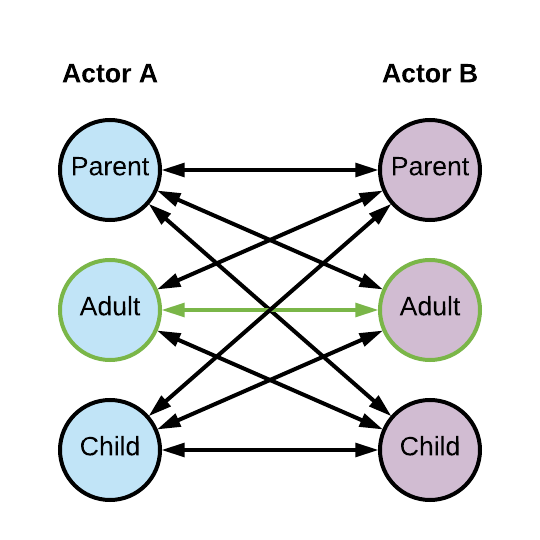
Berne defined an ego state as a consistent pattern of feeling and experience directly related to a corresponding consistent pattern of behaviour. He took the term from Federn, and he supported it with the neurosurgeon Wilder Penfield’s reports that stimulating the brain could make a patient relive an old scene with its original feelings. The point was observable: a person’s posture, voice, vocabulary and gestures shift when they move from one state to another.2
Parent
The Parent ego state holds attitudes, values and behaviours copied from parents and other authority figures. Berne’s technical name for it was the exteropsyche, because its contents came from outside. When someone scolds a colleague in the very words and tone their father used, they are in Parent. Later TA writers divided it by function into the Nurturing Parent, which protects and cares, and the Critical or Controlling Parent, which sets rules and judges.10
Adult
The Adult, or neopsyche, gathers information and tests it against present reality. Berne compared it to a computer that estimates probabilities. It does not mediate between the other two in the sense of a referee, but it can notice what Parent and Child are doing and decide what fits the situation in front of it.
Child
The Child, or archaeopsyche, is the person’s own childhood carried forward: the feelings, impulses and early decisions of the child they were. Berne distinguished the Natural Child, spontaneous and curious, from the Adapted Child, which complies or rebels in response to parental pressure. He also named the “Little Professor,” the intuitive, inventive part of the Child that figures out how the family works.
Berne’s structural analysis looked at how these states are arranged. “Contamination” means that Parent prejudice or Child fear has leaked into the Adult, so that an old belief feels like a fact. “Exclusion” means that one state is shut out, as in a person who can never play, or one who cannot think when frightened. Jack Dusay later drew “egograms,” bar charts of how much energy a person puts into each functional state, and argued that when one state rises another falls.10
What are transactions and strokes?
A transaction is the basic unit of social exchange: a stimulus from one person and a response from another. Transactional analysis proper, in Berne’s narrow sense, means diagramming which ego state sends each message and which ego state answers. Berne set out three kinds of transaction and three rules of communication.2, 3
Complementary transactions
In a complementary transaction the response comes from the ego state that was addressed, and goes back to the one that sent the message. Adult asks Adult the time and gets the time; a frightened Child appeals to a protective Parent and is comforted. Berne’s first rule is that as long as transactions stay complementary, communication can continue indefinitely.
Crossed transactions
In a crossed transaction the response comes from an unexpected ego state. A husband asks, from Adult, “Do you know where my keys are?” and his wife answers from Parent, “Why can’t you ever keep track of your things?” Berne’s second rule is that when a transaction is crossed, communication breaks off, at least until someone shifts ego state.
Ulterior transactions
An ulterior transaction carries two messages at once: an overt social message and a covert psychological one. The salesman who says “This one is probably too expensive for you” is talking Adult to Adult on the surface while hooking the customer’s Child. Berne’s third rule is that the behavioural outcome is decided at the psychological level, not the social one.
Strokes and stimulus hunger
Berne called a unit of recognition a “stroke.” He drew the idea from René Spitz’s studies of infants raised in institutions, who were fed and kept clean but rarely held, and who often failed to thrive or died. Spitz described this as hospitalism; Berne generalised it into “stimulus hunger” and “recognition hunger,” which adults satisfy with words, nods and attention rather than touch.11, 3 The same research tradition fed attachment theory.
Strokes can be verbal or nonverbal, positive or negative, conditional (for what you do) or unconditional (for who you are). The idea that drew most attention is that negative strokes are better than none: a child who cannot get praise will settle for being shouted at. Claude Steiner later described the “stroke economy,” a set of family rules (do not give strokes freely, do not ask for them, do not accept them, do not reject them, do not stroke yourself) that keep people starved of recognition.8
Berne also asked how people fill their time. He listed six ways of structuring time, from least to most risky: withdrawal, rituals, pastimes, activities, games and intimacy. Games sit just below intimacy. They deliver strokes and a predictable outcome without the exposure that real closeness requires.3
What did Berne mean by “games people play”?
In Games People Play Berne defined a game as an ongoing series of complementary ulterior transactions progressing to a well-defined, predictable outcome. Each game has a “gimmick,” the hook that catches the other player, and a “payoff,” the feeling or confirmation the player was after all along. The surface looks like an honest exchange; underneath, both players are following a pattern neither has chosen in Adult.3
Berne gave a formula for any game: Con plus Gimmick equals Response, then Switch, then Crossup, then Payoff. The Switch is the moment a player changes stance, and the Crossup is the brief confusion the other player feels when it happens. The transactions run complementary on the surface until the Switch, which is why games feel so smooth right up to the moment they go wrong.4
The roles of Persecutor, Rescuer and Victim are usually linked with games, but they come from Stephen Karpman rather than Berne. In a 1968 paper on fairy tales, Karpman drew the Karpman Drama Triangle and showed that the drama of a game lies in the switch between these roles: the Rescuer becomes a Persecutor, the Victim turns on the Rescuer. Berne welcomed the triangle, and Karpman received the Eric Berne Memorial Scientific Award for it in 1972.7
Berne sorted his games into families: life games, marital games, party games, sexual games, underworld games, consulting-room games and a short list of “good games.” He gave each one a thesis, an aim, the roles, the moves, the payoff and an “antithesis,” the move that stops the game. The games below are among the best known, described as Berne and later TA writers did.
“Why Don’t You, Yes But”
Berne called this the game that first led him to the concept. The player presents a problem; the others offer solutions that begin “Why don’t you…”; the player answers each with “Yes, but…” until everyone falls silent. The aim is not a solution. It is to show that no one can tell the player anything, which reassures the Child that its old position was right. Berne’s antithesis was to stop offering advice.3
“If It Weren’t For You”
Berne’s example is a woman who complains that her domineering husband keeps her from dancing and going out. When the restriction lifts, she finds she is afraid to do those things. She chose a restrictive partner to protect herself from her own fears, and the complaint lets her avoid them while blaming him. It is a marital game, and the payoff is avoidance dressed as grievance.3
“See What You Made Me Do”
A person absorbed in some task is interrupted, makes a slip, and turns on the interrupter: “See what you made me do.” Repeated often enough, the game wins solitude, because others learn to keep away. A related form, “You Got Me Into This,” lets one partner hand decisions to the other and then blame them when things go badly.3
“Now I’ve Got You, You Son of a Bitch”
Here the player waits for someone to make a small mistake and then uses it to justify a full release of stored-up anger. Berne’s example was a man who found a plumber had overcharged him by a few dollars and treated the error as permission for fury. The real payoff is the license to be enraged, not the money.3
“Let’s You and Him Fight”
In Berne’s version, one person maneuvers two others into competing or fighting over them, then stands back. It can be a ritual or a manipulation, and the instigator may end up with neither rival. In everyday terms it covers anyone who stirs up a conflict between two people and then watches from the side.3
“Wooden Leg”
The thesis is “What do you expect of someone with a wooden leg?” The player pleads diminished responsibility because of a real or claimed handicap: a hard childhood, a neurosis, a diagnosis. Berne listed it among consulting-room games, since therapy can easily supply the excuse. The antithesis is to accept the limitation and still expect what the person can do.3
“Schlemiel”
The schlemiel spills a drink on the host’s carpet, breaks a glass, burns a hole in the sofa, and apologises each time. The host must hide irritation and forgive, and the forgiveness is the payoff. Berne’s antithesis was the “anti-Schlemiel”: the host declines to grant forgiveness, which removes the reward.3
“Poor Me”
“Poor Me” is the name TA writers give to the core victim game: the player recites misfortunes, draws sympathy and advice, and turns the advice aside, so that the sympathy keeps flowing and nothing has to change. It overlaps with “Why Don’t You, Yes But” and with Berne’s consulting-room game “Indigence.” Helpers often burn out and withdraw, which confirms the player’s view that no one stays.
“Ain’t It Awful”
Berne treated this first as a pastime, the shared complaint about how bad things are, which can be a harmless way to pass time. It becomes a game when a person gathers misfortunes for the strokes they bring. The covert aim is to gain from misfortune rather than to change it.3
“Kick Me”
The player behaves in ways that invite rejection or punishment, then asks, “Why does this always happen to me?” Berne described it as wearing a sign that says “Please don’t kick me” in a way that attracts kicks. The payoff confirms the script belief that the world is against the player.3
“Blemish”
The player cannot feel at ease with a new person until a flaw is found: bad grammar, a cheap suit, a political view. Berne located it in a depressive Child position. Finding the blemish lets the player say, in effect, “I am not OK, but neither are you,” which protects against feeling inferior.3
“Harried”
Berne’s example, very much of its time, was a homemaker who accepts every demand and every criticism, takes on more and more, and runs herself ragged until she collapses. The collapse is the payoff: it proves how much she has carried and excuses her from carrying anything further. Today the same pattern shows up in overextended professionals of every kind.3
“Stupid”
Berne listed “Stupid” among the consulting-room games. The player keeps making simple mistakes and invites others to call them stupid, which confirms a script decision made in childhood. The way out is to refuse to treat the player as stupid.3
“Do Me Something”
“Do Me Something” appears in the TA catalogue as the demand that someone else fix the player’s problem, paired with a quiet refusal to let any fix work. It is a close relative of “Why Don’t You, Yes But,” with the difference that the player asks for action rather than advice. The helper ends up exhausted and the player keeps the problem.
“Courtroom”
A marital game played with a third party, often the therapist. One spouse lays out the case against the other, the other defends, and both wait for the “judge” to rule. Berne’s antithesis was for the therapist to refuse the judge’s chair and address the pattern instead of the verdict.3
Across all of these, the players receive strokes and confirm old beliefs, but the indirect communication blocks real problem-solving and intimacy. Berne did not think games were simply bad. They structure time and keep people in contact. The aim of therapy was to make them conscious, so that a person could choose, from Adult, to say plainly what they want.
What is a life script in transactional analysis?
Berne’s script theory, worked out with Claude Steiner and set out most fully in What Do You Say After You Say Hello? (published in 1972, two years after his death), holds that each person writes a life plan in early childhood. The child makes decisions under the pressure of parental messages, and the adult then lives out those decisions without remembering making them. Scripts determine which games a person plays and what ending they expect.4, 9 The same idea shows up in family scripts that control your life, where a household hands one role down through generations.
Berne took his models from myth and fairy tale. He wrote of Tantalus, always reaching for what he cannot have (“Never” scripts), of Sisyphus pushing the same stone (“Over and Over”), of Damocles living under a sword (“After”), and of Little Red Riding Hood. Stories, for Berne, were how a child learned what kind of life was possible, which is one reason mythology in therapy fits so naturally with his work.4
Winners, losers and non-winners
Berne sorted scripts by outcome. A winner, in his definition, is someone who accomplishes what they set out to do. A loser repeatedly fails to reach their declared goals, sometimes in disaster. A non-winner gets by: works hard, avoids big losses and big wins, and settles for less than they wanted. Berne’s point was that these outcomes are often decided early and then played out with remarkable consistency.4
Later writers added the script’s building blocks. Steiner described “banal scripts” of ordinary joylessness alongside tragic ones. Robert and Mary Goulding listed “injunctions,” the prohibitions a child absorbs (“Don’t be close,” “Don’t feel,” “Don’t exist”), and developed redecision therapy to help clients reverse them.9, 13 William Cornell and other later TA writers questioned whether scripts are fixed as early as Berne thought, and reframed them as patterns that keep being revised through life.12
The four life positions
Berne described four basic positions, the stance a person takes toward self and others: “I’m OK, You’re OK”; “I’m OK, You’re not OK”; “I’m not OK, You’re OK”; and “I’m not OK, You’re not OK.” The first is the healthy position of mutual respect. The second underlies blaming and contempt. The third underlies depression and self-sacrifice. The fourth underlies futility. Thomas Harris made the first position famous with I’m OK, You’re OK (1969), and Franklin Ernst mapped the four positions onto a grid he called the “OK Corral.”6
For Berne the goal was autonomy, which he defined as the release or recovery of three capacities: awareness, spontaneity and intimacy. A script-free person sees what is in front of them, responds freely, and can be close without games. TA therapists worked toward this through “deconfusion” of the Child, game analysis and script analysis.3
Why did transactional analysis decline?
The fall began with success. Harris’s I’m OK, You’re OK became an even bigger bestseller than Games People Play and turned TA into a fixture of 1970s self-help, management training and church groups. The popular version kept the catchphrases and lost much of the clinical depth, and many academics came to see TA as pop psychology rather than a serious theory.6
Berne died of a heart attack in Carmel on 15 July 1970, aged sixty. Without him the movement split into schools. The classical school stayed close to his methods. The Gouldings’ redecision school combined TA with Gestalt work. Jacqui Schiff’s Cathexis school used deep regression and “reparenting,” which drew serious controversy and was eventually rejected by the ITAA. The ITAA lost much of its early momentum in the United States.13
The wider field also moved. University psychology turned toward cognitive and behavioural models built for controlled trials, insurance began paying for diagnosis-based treatment after DSM-III in 1980, and a theory spread mainly through seminars and paperbacks lost its place in American graduate programs. The same pressures squeezed other depth and humanistic approaches, a story told in the shift from CBT toward somatic therapies.
TA did not disappear. The European Association for Transactional Analysis was founded in 1974, and TA has remained a recognised psychotherapy training in Britain, much of Europe, India and Latin America. The Transactional Analysis Journal is still published, and Ian Stewart and Vann Joines’s TA Today (1987) remains a standard introduction.13
What influenced Berne, and what did TA influence?
Berne joined psychoanalysis, interpersonal psychiatry, humanistic ideas of choice and autonomy, communication theory and cybernetics into a single readable framework. His ideas run parallel to those of many contemporaries. Alfred Adler‘s “life style,” a plan formed in childhood, anticipates the script. Carl Jung‘s complexes and his use of myth anticipate Berne’s mythic script types. Erikson’s life stages, Carl Rogers‘s focus on the present relationship, Gregory Bateson’s work on double messages, and the communication research of the Palo Alto group all share ground with Berne’s ulterior transactions.
Many of Berne’s core ideas, ego states, transactions, strokes, games and scripts, live on in other approaches, sometimes under new names.
Cognitive therapies
Albert Ellis and Aaron Beck developed their methods independently of Berne, but the overlap is real. TA’s focus on present behaviour, on beliefs formed in childhood and on the decisions a person keeps making shows up in Albert Ellis‘s irrational beliefs and in the “core beliefs” of cognitive therapy. Berne’s “contamination” of the Adult is close to what cognitive therapists call a distorted belief.
Schema therapy
Jeffrey Young’s early maladaptive schemas resemble Berne’s scripts, and Young’s “schema modes,” such as the Vulnerable Child, the Punitive Parent and the Healthy Adult, closely resemble Berne’s ego states.
Family systems therapy
Family therapists analyse repeating communication patterns and the roles people take in them. Games, the Drama Triangle and family scripts translated easily into family work, and Karpman’s triangle is still taught widely in that field.
Psychodrama and Gestalt
J. L. Moreno‘s psychodrama, older than TA, already had people act out roles to change them. Fritz Perls‘s Gestalt therapy, developed at the same time and in the same California milieu, met TA in the Gouldings’ redecision work and in Muriel James and Dorothy Jongeward’s Born to Win (1971), which paired TA ideas with Gestalt experiments.
Integrative psychotherapy
Richard Erskine’s integrative psychotherapy grew directly out of TA, and the later relational school of TA brought it back into dialogue with contemporary psychoanalysis. Parts-based models such as Internal Family Systems share TA’s basic insight that a person is a family of states rather than a single voice.
Organizational psychology
TA spread widely in management training and customer service in the 1970s. Ego states and strokes gave trainers a simple way to discuss leadership, feedback and conflict, and organizational TA remains a recognised field within the ITAA.
Everyday language
Phrases like “games people play” and “life script” entered ordinary speech through Berne. His Child ego state also helped prepare the ground for the later popular language of the inner child.
Some of TA’s jargon now sounds dated, but Berne’s gift for naming patterns has lasted. His work says that beneath social masks people hunger for recognition, wrestle with roles they did not choose, and repeat patterns that keep real intimacy at a distance. He made the hidden side of ordinary social life visible.
How do therapists use ego states and games today?
Berne’s model still gives a therapist a practical map. It turns vague complaints (“we always fight,” “I can’t say no”) into patterns that can be seen, named and changed. Classical TA work has four parts.
Structural analysis
The therapist looks at which ego states dominate a client’s life and where the Adult is contaminated by Parent rules or Child fears. Someone who “knows” they are unlovable is treating a Child conclusion as an Adult fact. Separating the two gives the Adult room to look at the evidence.
Transactional analysis proper
Therapist and client examine particular exchanges, often the argument from last week, to see which ego states were talking. Many conflicts turn out to be crossed transactions, with one person speaking from Adult and the other answering from Parent or Child. The aim is not constant Adult-to-Adult talk but more choice about which state is in charge.
Game analysis
Here the client learns to spot the gimmick, the switch and the payoff in their own repeating dramas. Once a person can see that every helpful friendship ends with them feeling used, they can ask what they were after, and find a direct way to ask for it. Breaking a game often means refusing the expected move, which Berne called crossing the transaction from Adult.
Script analysis
Script work traces present patterns back to the messages and decisions of childhood, and helps the client make a new decision in the present. Redecision therapists often have the client return, in imagination, to the original scene and decide differently, which is close to the experiential work used in parts-based and somatic approaches today.
At Taproot we find that Berne’s ideas fit well alongside depth and body-based therapy. Ego states map naturally onto the parts we meet in parts-based therapy, and scripts look a great deal like the unconscious life patterns Jungian and existential therapists work with. We use TA’s vocabulary when it helps clients name a pattern in their relationships, and we work on the feeling and the body memory underneath it with approaches such as Brainspotting and IFS.
Berne wanted people to recover awareness, spontaneity and intimacy, and to stop living out decisions they made as frightened children. That is still the work. If repeating relationship patterns or an old life script are shaping your life, you can contact Taproot Therapy Collective to talk with one of our therapists in Hoover.
Frequently asked questions
What is transactional analysis in simple terms?
Transactional analysis is Eric Berne’s theory that personality is made of three ego states, Parent, Adult and Child, and that every exchange between people can be mapped by which state speaks and which answers. It also describes games, the repetitive hidden-agenda patterns people fall into, and life scripts, the unconscious life plans formed in childhood.
What are the three ego states in TA?
In transactional analysis the Parent holds attitudes copied from parents and authority figures, the Adult processes present reality and makes decisions, and the Child carries the feelings, impulses and early decisions of childhood. Eric Berne said a person’s posture, voice and words change visibly when they shift from one ego state to another.
Who created the Drama Triangle, Berne or Karpman?
Stephen Karpman, a student of Eric Berne, created the Drama Triangle in a 1968 paper on fairy tales and script drama. Its three roles, Persecutor, Rescuer and Victim, describe how players switch positions in a game. Berne adopted the idea, and Karpman received the Eric Berne Memorial Scientific Award for it in 1972.
Why did transactional analysis become less popular?
Transactional analysis lost ground in the United States after Eric Berne died in 1970. The movement split into rival schools, bestsellers such as I’m OK, You’re OK made it look like pop psychology, and universities and insurers moved toward diagnosis-based, trial-oriented models. TA remained an established psychotherapy training in Britain, Europe, India and Latin America.
Is transactional analysis still used in therapy?
Yes. Transactional analysis is still taught and practised worldwide through the ITAA and the European Association for Transactional Analysis, and its ideas appear in schema therapy, integrative psychotherapy and parts-based work. Many therapists use ego states, games and scripts to help clients see and change repeating relationship patterns.
Related reading
- The Tech-Enhanced Therapy Room: A Clinician’s Guide to AI, Neuro-Tech, and Vagal Nerve Stimulators
- Rise and Fall of the Empire and The Ego: Ancient Rome as a Therapy Case Study
- Your Nervous System is a Storyteller: Understanding Polyvagal Theory Through Myth
- Myth, Meaning, and the Self: The Role of Archetypes Across Cultures
- What Happens When We Can’t Feel Emotion?
- Adam Curtis’s Documentary Films: Emotional Truth Telling Through the Language of Conspiracy Theory
References
- Berne, E. (1958). Transactional analysis: A new and effective method of group therapy. American Journal of Psychotherapy, 12(4), 735-743. https://doi.org/10.1176/appi.psychotherapy.1958.12.4.735
- Berne, E. (1961). Transactional analysis in psychotherapy: A systematic individual and social psychiatry. Grove Press.
- Berne, E. (1964). Games people play: The psychology of human relationships. Grove Press.
- Berne, E. (1972). What do you say after you say hello? The psychology of human destiny. Grove Press.
- Cheney, W. D. (1971). Eric Berne: Biographical sketch. Transactional Analysis Journal, 1(1), 14-22. https://doi.org/10.1177/036215377100100104
- Harris, T. A. (1969). I’m OK, you’re OK: A practical guide to transactional analysis. Harper & Row.
- Karpman, S. B. (1968). Fairy tales and script drama analysis. Transactional Analysis Bulletin, 7(26), 39-43.
- Steiner, C. M. (1971). The stroke economy. Transactional Analysis Journal, 1(3), 9-15. https://doi.org/10.1177/036215377100100305
- Steiner, C. M. (1974). Scripts people live: Transactional analysis of life scripts. Grove Press.
- Dusay, J. M. (1972). Egograms and the “constancy hypothesis.” Transactional Analysis Journal, 2(3), 37-41. https://doi.org/10.1177/036215377200200313
- Spitz, R. A. (1945). Hospitalism: An inquiry into the genesis of psychiatric conditions in early childhood. The Psychoanalytic Study of the Child, 1(1), 53-74. https://doi.org/10.1080/00797308.1945.11823126
- Cornell, W. F. (1988). Life script theory: A critical review from a developmental perspective. Transactional Analysis Journal, 18(4), 270-282. https://doi.org/10.1177/036215378801800402
- Stewart, I., & Joines, V. (1987). TA today: A new introduction to transactional analysis. Lifespace Publishing.













0 Comments