
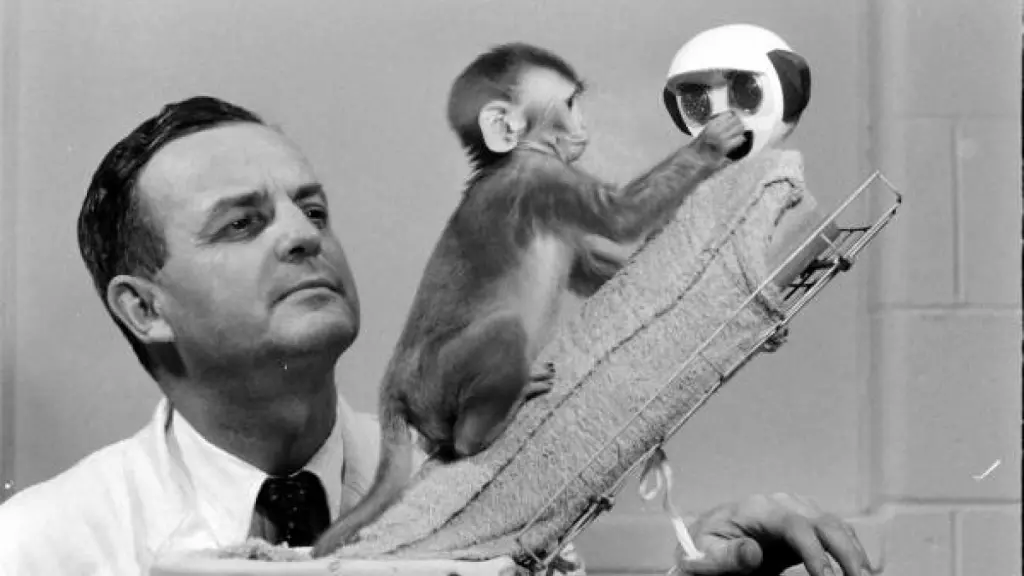
Harry Harlow’s monkey experiment, run at the University of Wisconsin in the late 1950s, gave infant rhesus monkeys raised apart from their mothers two artificial mothers: a bare wire figure that held a bottle of milk and a soft cloth figure that gave none. The infants spent most of their time clinging to the cloth mother. Comfort, not food, was what they attached to.1,2
Most accounts stop there, which leaves out half the story. The thesis here is that Harlow’s work makes a two-part case: attachment starts with felt safety in the body, and repair comes through responsive contact with a living other, paced so a frightened animal can bear it. His cloth-reared monkeys still grew up socially damaged. What later brought isolated monkeys back was a younger monkey who kept approaching and clinging, session after session. Safety first, then relationship at a tolerable pace, is close to how trauma-focused therapy works. The monkeys paid for the lesson, and that cost belongs in the story.
What Harlow’s monkey experiment found
The experiment began as a husbandry problem. Imported monkeys were expensive and often arrived sick. After tuberculosis wiped out almost all of Harlow’s rhesus colony in 1955, he set out to breed his own disease-free animals and began separating infants from their mothers within hours of birth.3,4 The babies were healthy but behaviorally strange. They clung to the cloth pads that covered their cage floors and, in Harlow’s words, “engaged in violent temper tantrums when the pads were removed and replaced for sanitary reasons.”1
So Harlow and his colleague R. R. Zimmermann built substitutes. One surrogate was bare wire mesh; the other was covered in terry cloth and warmed by a light bulb. The decisive comparison was small: eight infants, four fed by the cloth mother and four by the wire one. The result was lopsided. The infants who could get milk only from the wire figure still spent most of their time on the cloth one, and their pull toward her grew with age.1,3 Harlow wrote that he expected contact comfort to matter, “but we did not expect it to overshadow so completely the variable of nursing.”1
The fear tests made the point sharper. When a moving mechanical toy bear was put in the cage with both surrogates present, the infants fled to the cloth mother, whichever figure fed them. In a strange room full of objects, they first clutched the cloth mother and then used her as what Harlow called “a base of operations,” exploring and coming back. When she was absent, they froze in a crouch or ran from object to object, screaming and crying.1,5 Harlow presented these results on August 31, 1958, in his presidential address to the American Psychological Association, and published them that December as “The Nature of Love.”1 A puppy replication found the same preference, though feeding still shifted how the pups divided their time:6 contact comfort outweighed food without making it irrelevant.
Who Harry Harlow was
Harlow was born Harry Israel on October 31, 1905, and later took the surname Harlow.3,7 He finished his PhD at Stanford in 1930 and went straight to the University of Wisconsin as an assistant professor. He had planned to study rats, but the rat laboratory had been dismantled, so he started watching primates at Madison’s Vilas Park Zoo. In 1932 he moved into a campus building that became his primate laboratory, which he directed until he retired in 1974.3,4 Deborah Blum’s Love at Goon Park is the full-length biography.8
His first reputation was in learning, a field whose founding texts include Edward Thorndike’s 1898 experiments on associative learning in animals.9 Harlow designed the Wisconsin General Test Apparatus, which became a standard tool for testing primate intelligence, and in 1949 showed that monkeys could learn how to learn, which he called forming “learning sets.”3,10 He also found that his monkeys worked at mechanical puzzles with no food reward at all,11 which did not fit Clark Hull’s drive-reduction theory, in which animals act to relieve hunger and other bodily needs.3 Curiosity was the first motive the hunger models could not explain. Contact would be the second.
He was elected to the National Academy of Sciences in 1951 and received the National Medal of Science in 1967. His private life was harder. He had bouts of depression throughout adulthood and a worsening drinking problem, and in 1968 he spent 59 days at the Mayo Clinic for major depression, where he was treated with electroconvulsive therapy. His second wife, Margaret, who also worked in the primate lab, was diagnosed with breast cancer in 1967 and died in 1971. In 1972 he remarried his first wife, Clara Mears.3 He died on December 6, 1981.7
Against “cupboard love”
In the 1950s, two schools that agreed on little agreed on why babies love their mothers. Learning theory in Hull’s tradition treated love as a secondary drive: the mother matters because she is associated with relief from hunger, thirst and pain. Psychoanalysis tied the infant’s bond to feeding at the breast. The shared assumption was nicknamed cupboard love: the infant loves whoever stocks the cupboard. Harlow’s surrogate results cut against both.1,3 He pointed out an irony in his 1958 address. John Watson, who launched behaviorism in 1913,12 had been one of the few psychologists to hold that love was an innate emotion, set off by stimulation of the skin, and later experimenters had brushed the idea aside.1
Clinicians had already been describing “hospitalism,” the decline of infants in hospitals and foundling homes who were fed and kept clean but had no steady caregiver. Harry Bakwin, William Goldfarb and René Spitz were among the observers.13 Spitz’s work helped prompt Harlow’s cloth-and-wire studies, and the two later became friends.14 Read in material terms, the discovery came out of a production decision: a lab that needed reliable animals took infants from their mothers to protect its breeding colony, much as the institutions Spitz studied organized infant care around feeding and hygiene. The surrogates exposed what that efficiency left out.
The closest ally was British. John Bowlby, the founder of attachment theory, had already warned in a World Health Organization monograph that “the prolonged deprivation of the young child of maternal care may have grave and far-reaching effects on his character and so on the whole of his future life.”4,15 The two were in close contact from 1957 into the mid-1970s; they first met on April 26, 1958, and Bowlby spent two days at the Wisconsin lab that June. Bowlby drew on the monkey data, and Harlow modeled separation experiments on the “protest” and “despair” phases Bowlby and James Robertson had described in hospitalized children.4,16 After touring the lab’s singly caged monkeys, which rocked and sucked their fingers and toes, Bowlby told Harlow he had “more crazy monkeys here than probably exist in any other place on the face of the earth.”4,17
Mary Ainsworth folded William Blatz’s security theory into Bowlby’s framework,18 and her Strange Situation studies measured how toddlers use a parent as a base for exploring an unfamiliar room, the pattern Harlow’s infants showed with the cloth mother.19 From inside psychoanalysis, Margaret Mahler’s work on separation and individuation traced how toddlers move away from the mother and come back.20
Isolation, evil mothers and the pit of despair
The surrogate studies had a sequel that textbooks often skip. When the cloth-reared monkeys grew up, they did not mate normally, and females who were made pregnant were abusive to their young.3,21 The cloth mother had soothed them, but she could not respond, play or teach. Harlow came to suspect that the missing ingredient was contact with other monkeys, and his work turned toward what he called affectional systems: separate bonds with mother, peers, mates and, eventually, offspring.3,22
Total isolation did the worst damage. Macaques kept alone for at least the first six months of life showed “severe deficits in virtually every aspect of social behavior.”23 The lab also built “evil” surrogates that shook, catapulted, blasted compressed air at or pushed spikes toward the infants clinging to them. The infants were disturbed, but the disturbance did not last.3
Then came the device Harlow is now remembered for. With Stephen Suomi, then his research assistant, he built a stainless-steel vertical chamber whose sides sloped inward so that a young monkey could not climb out. About 30 days alone in it was enough to produce depressive behavior.3,24 Suomi and Harlow wrote in 1969 that they had “euphemistically called it the pit, or the vertical chamber for those who find the term ‘pit’ psychologically unacceptable.”25 It has been known since as the pit of despair. The work intensified after his own hospitalization; handwritten notes published in 2022 show him vowing to find a treatment for an illness he described in a poem as “a life within a wall of steel.”3
None of this makes the experiments easier to defend. The animals’ suffering was the method. John Gluck has called Harlow a paradox: his work fostered a view of monkeys as having rich subjective lives full of intention and emotion, yet he has been criticized for research that seemed to ignore the ethical implications of his own discoveries.26 Responding to the controversy, Harlow was quoted in a Madison newspaper in 1978: “Some of the work is in a sense cruel, but remember for every mistreated monkey there exist a million mistreated children. If my work will point this out and save only one million human children, I can’t get overly concerned about 10 monkeys.” The animal-rights movement found its public voice only later in the 1970s, and Suomi and Gluck both later distanced themselves from this kind of research.3
The monkey therapists
The most clinically useful part of Harlow’s career came last, and it began with him being wrong. In a 1969 letter he wrote that deprivation for the first six months of life “completely destroys the monkey as a social animal—and destroys it forever.” By 1974 his lab had rehabilitated both six-month and twelve-month isolates, and he wrote that he was “both chastened and educated.”3
What worked was specific. Isolates housed with normal monkeys of the same age made only limited gains, and same-age peers could be aggressive toward them.3,23 Six-month isolates paired instead with normal three-month-olds, younger animals who posed no threat and who tended to approach and cling, achieved what Harlow and Suomi called “essentially complete social recovery for all situations tested.”23,27
The sequence matters. At first the isolate huddled in a corner while the young “therapist” approached and clung to it. Over sessions of a few hours, most days of the week, the isolate began to cling back, then to join in play, and finally to start play itself.3 Harlow and Suomi’s explanation was that recovery needed two things: contact had to become acceptable, and there had to be a medium of interaction in which more complex social behavior could develop gradually.23 Melinda Novak later extended the approach to monkeys isolated for their entire first year.28
Harlow drew the clinical moral himself in an unpublished manuscript: “The psychotherapeutic principles of avoidance of social fears and the inculcation of gradual stepwise social interaction will doubtless eventually be discovered by the psychiatrists.” In print he and his co-authors were blunter: “In our study of psychopathology, we began as sadists trying to produce abnormality. Today we are psychiatrists trying to achieve normality and equanimity.”3 The historian of science Marga Vicedo argues that this peer research pulled Harlow away from Bowlby: his findings did not support Bowlby’s belief in an innate need for mother love, or the thesis that the mother is the child’s psychic organizer.22
What the monkeys can and cannot tell us about people
Rhesus monkeys are not children, the samples were small, and the conditions were deliberately extreme. Still, the best human evidence points the same way. The Bucharest Early Intervention Project randomly assigned young children in Romanian institutions to stay in institutional care or move into foster families. Children who stayed fell markedly behind in cognitive development; those placed in families did better, and the youngest at placement gained most.29 At 42 months, children placed in foster care before age two were more likely to have secure attachments.30 Timing matters, and late is not the same as hopeless. For a clinician’s view of early neglect, see our profile of Bruce Perry and his work with maltreated children.
Touch itself has measurable effects. A 2024 meta-analysis of 137 studies found that touch interventions reduced pain, depression and anxiety in adults, with moderate effects, and helped regulate cortisol and weight gain in newborns, where a parent’s touch helped more than a health care worker’s. Touch from objects or robots gave similar physical benefits but smaller mental-health benefits than touch from people (Hedges’ g = 0.34 versus 0.58), and the authors note small-study bias and the impossibility of blinding.31 It is a modern echo of the cloth mother: contact from an object helps the body, but more of the psychological benefit comes from a person.
The monkeys have also been misread. Touring the lab in 1958, Bruno Bettelheim saw the rocking, self-clasping animals as confirmation that cold “refrigerator mothers” caused autism. Harlow was scathing, and in an unpublished review called Bettelheim’s The Empty Fortress “relatively empty from cover to cover.” Neither Harlow nor Bowlby claimed that unresponsive mothering causes autism, and Bettelheim’s theory has been discarded.4 Attachment research describes what helps children; it is not a tool for blaming parents.
What this looks like in therapy
People with early neglect, relational trauma or long stretches of isolation often know in their heads that the therapy room is safe while their bodies stay braced. Harlow’s isolates were not argued out of their fear. They recovered when contact became tolerable and then, slowly, rewarding. That gives therapy an order of operations.
Safety comes first, built from ordinary things: the same time each week, a therapist who stays steady when the client pulls back, no demand for disclosure before the client is ready. The younger monkeys did not push; they approached, clung and kept showing up, while the rougher same-age peers produced little change. The clinical parallel is pacing. Moving too fast into traumatic memory, or into closeness, can overwhelm a nervous system that learned early that people are dangerous, so good work proceeds in steps the client can tolerate.
Contact in therapy rarely means touch. Most psychotherapy involves none, and it does not need to. What carries contact comfort in a session is voice, facial expression, timing and a steady presence, along with the client’s own attention to what the body does as connection comes close: bracing, going numb, reaching, settling. That is the focus of somatic therapy for nervous system regulation, which works with those bodily responses directly instead of relying on insight alone.
The relationship is one of psychotherapy’s best-studied ingredients. A meta-analysis of 295 studies covering more than 30,000 patients found a consistent association between the strength of the therapeutic alliance and outcome (r = .28) across treatment approaches, while cautioning that correlation does not settle causation.32 Harlow, writing about his own stay at the Mayo Clinic, called the harm of social isolation a historical blind spot for physicians.3 When withdrawal has become the pattern, depression treatment often has to rebuild contact in small, safe pieces before anything else can move.
If something here sounds familiar, whether a habit of bracing against closeness, a long practice of going it alone, or a depression that feels like a wall, it can help to talk with someone trained in attachment and trauma work. You can read more about our somatic approach or reach us through the contact page.
References
- Harlow, H. F. (1958). The nature of love. American Psychologist, 13(12), 673–685. https://doi.org/10.1037/h0047884
- Harlow, H. F., & Zimmermann, R. R. (1959). Affectional responses in the infant monkey. Science, 130(3373), 421–432. https://doi.org/10.1126/science.130.3373.421
- van Rosmalen, L., Luijk, M. P. C. M., & van der Horst, F. C. P. (2022). Harry Harlow’s pit of despair: Depression in monkeys and men. Journal of the History of the Behavioral Sciences, 58(2), 204–222. https://doi.org/10.1002/jhbs.22180
- van Rosmalen, L., van der Veer, R., & van der Horst, F. C. P. (2020). The nature of love: Harlow, Bowlby and Bettelheim on affectionless mothers. History of Psychiatry, 31(2), 227–231. https://doi.org/10.1177/0957154X19898997
- Yoshida, S., & Funato, H. (2021). Physical contact in parent-infant relationship and its effect on fostering a feeling of safety. iScience, 24(7), 102721. https://doi.org/10.1016/j.isci.2021.102721
- Igel, G. J., & Calvin, A. D. (1960). The development of affectional responses in infant dogs. Journal of Comparative and Physiological Psychology, 53(3), 302–305. https://doi.org/10.1037/h0049308
- Sidowski, J. B., & Lindsley, D. B. (1989). Harry Frederick Harlow: October 31, 1905–December 6, 1981. Biographical Memoirs of the National Academy of Sciences, 58, 219–257.
- Blum, D. (2002). Love at Goon Park: Harry Harlow and the science of affection. Perseus Publishing.
- Thorndike, E. L. (1898). Animal intelligence: An experimental study of the associative processes in animals. The Psychological Review: Monograph Supplements, 2(4), i–109. https://doi.org/10.1037/h0092987
- Harlow, H. F. (1949). The formation of learning sets. Psychological Review, 56(1), 51–65. https://doi.org/10.1037/h0062474
- Harlow, H. F. (1950). Learning and satiation of response in intrinsically motivated complex puzzle performance by monkeys. Journal of Comparative and Physiological Psychology, 43(4), 289–294. https://doi.org/10.1037/h0058114
- Watson, J. B. (1913). Psychology as the behaviorist views it. Psychological Review, 20(2), 158–177. https://doi.org/10.1037/h0074428
- van der Horst, F. C. P., & van der Veer, R. (2008). Loneliness in infancy: Harry Harlow, John Bowlby and issues of separation. Integrative Psychological and Behavioral Science, 42(4), 325–335. https://doi.org/10.1007/s12124-008-9071-x
- van Rosmalen, L., van der Horst, F. C. P., & van der Veer, R. (2012). Of monkeys and men: Spitz and Harlow on the consequences of maternal deprivation. Attachment & Human Development, 14(4), 425–437. https://doi.org/10.1080/14616734.2012.691658
- Bowlby, J. (1952). Maternal care and mental health. World Health Organization.
- van der Horst, F. C. P., LeRoy, H. A., & van der Veer, R. (2008). “When strangers meet”: John Bowlby and Harry Harlow on attachment behavior. Integrative Psychological and Behavioral Science, 42(4), 370–388. https://doi.org/10.1007/s12124-008-9079-2
- Suomi, S. J., van der Horst, F. C. P., & van der Veer, R. (2008). Rigorous experiments on monkey love: An account of Harry F. Harlow’s role in the history of attachment theory. Integrative Psychological and Behavioral Science, 42(4), 354–369. https://doi.org/10.1007/s12124-008-9072-9
- van Rosmalen, L., van der Horst, F. C. P., & van der Veer, R. (2016). From secure dependency to attachment: Mary Ainsworth’s integration of Blatz’s security theory into Bowlby’s attachment theory. History of Psychology, 19(1), 22–39. https://doi.org/10.1037/hop0000015
- Ainsworth, M. D. S., Blehar, M. C., Waters, E., & Wall, S. (1978). Patterns of attachment: A psychological study of the strange situation. Lawrence Erlbaum.
- Mahler, M. S., Pine, F., & Bergman, A. (1975). The psychological birth of the human infant. Basic Books.
- Seay, B., Alexander, B. K., & Harlow, H. F. (1964). Maternal behavior of socially deprived rhesus monkeys. Journal of Abnormal and Social Psychology, 69(4), 345–354. https://doi.org/10.1037/h0040539
- Vicedo, M. (2010). The evolution of Harry Harlow: From the nature to the nurture of love. History of Psychiatry, 21(2), 190–205. https://doi.org/10.1177/0957154X10370909
- Harlow, H. F., & Suomi, S. J. (1971b). Social recovery by isolation-reared monkeys. Proceedings of the National Academy of Sciences, 68(7), 1534–1538. https://doi.org/10.1073/pnas.68.7.1534
- Harlow, H. F., & Suomi, S. J. (1971a). Production of depressive behaviors in young monkeys. Journal of Autism and Childhood Schizophrenia, 1(3), 246–255. https://doi.org/10.1007/BF01557346
- Suomi, S. J., & Harlow, H. F. (1969). Apparatus conceptualization for psychopathological research in monkeys. Behavior Research Methods & Instrumentation, 1(7), 247–250. https://doi.org/10.3758/BF03209902
- Gluck, J. P. (1997). Harry F. Harlow and animal research: Reflection on the ethical paradox. Ethics & Behavior, 7(2), 149–161. https://doi.org/10.1207/s15327019eb0702_6
- Suomi, S. J., & Harlow, H. F. (1972). Social rehabilitation of isolate-reared monkeys. Developmental Psychology, 6(3), 487–496. https://doi.org/10.1037/h0032545
- Novak, M. A., & Harlow, H. F. (1975). Social recovery of monkeys isolated for the first year of life: I. Rehabilitation and therapy. Developmental Psychology, 11(4), 453–465. https://doi.org/10.1037/h0076661
- Nelson, C. A., Zeanah, C. H., Fox, N. A., Marshall, P. J., Smyke, A. T., & Guthrie, D. (2007). Cognitive recovery in socially deprived young children: The Bucharest Early Intervention Project. Science, 318(5858), 1937–1940. https://doi.org/10.1126/science.1143921
- Smyke, A. T., Zeanah, C. H., Fox, N. A., Nelson, C. A., & Guthrie, D. (2010). Placement in foster care enhances quality of attachment among young institutionalized children. Child Development, 81(1), 212–223. https://doi.org/10.1111/j.1467-8624.2009.01390.x
- Packheiser, J., Hartmann, H., Fredriksen, K., Gazzola, V., Keysers, C., & Michon, F. (2024). A systematic review and multivariate meta-analysis of the physical and mental health benefits of touch interventions. Nature Human Behaviour, 8(6), 1088–1107. https://doi.org/10.1038/s41562-024-01841-8
- Flückiger, C., Del Re, A. C., Wampold, B. E., & Horvath, A. O. (2018). The alliance in adult psychotherapy: A meta-analytic synthesis. Psychotherapy, 55(4), 316–340. https://doi.org/10.1037/pst0000172


















0 Comments