
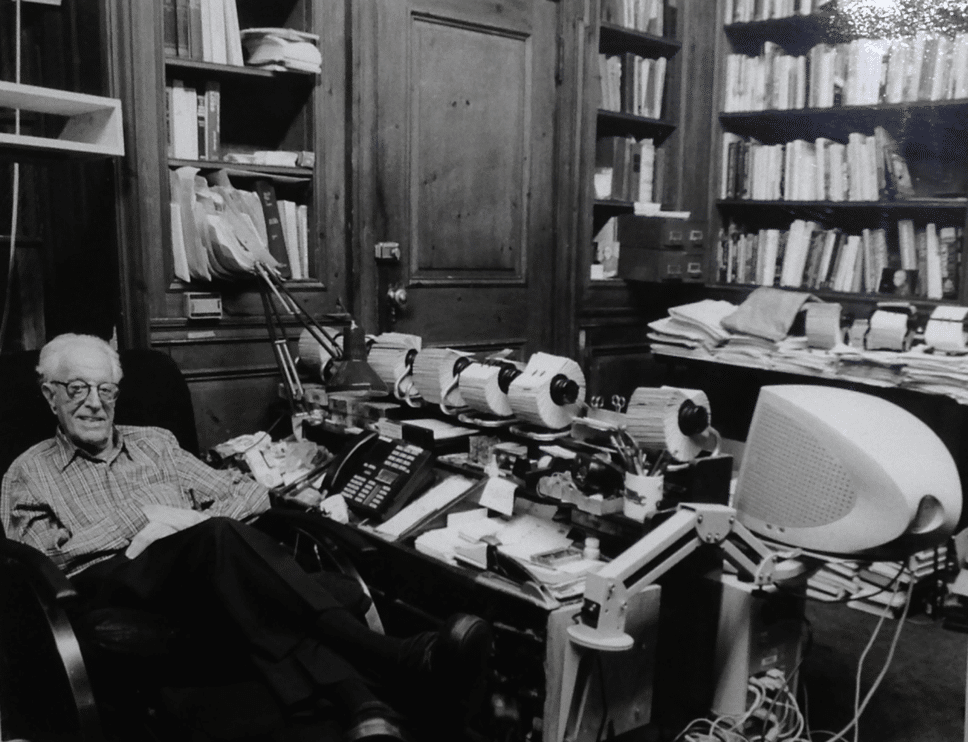
Ellis is remembered for his style. He was loud, profane, impatient and funny, and in his last years he was at war with his own institute. The style is the least useful thing he left behind. His real claim was that a therapist can attack a belief as hard as he likes while fully accepting the person who holds it, and that the answer to self-condemnation is not higher self-esteem but refusing to rate yourself at all. That pairing of a blunt, directive method with an unconditional stance toward the person is what makes REBT humane. Where Ellis himself fell short of it, the method is the better guide.

Who Albert Ellis was
Ellis was born in Pittsburgh on September 27, 1913, and raised in the Bronx. He was a sickly child, hospitalized repeatedly for a series of ailments, most notably nephritis, which once kept him in the hospital for ten months. A 2005 New York magazine profile traced his later emphasis on acceptance back to those stretches in a hospital bed.2 He took a business degree from the City College of New York in 1934, tried business and fiction writing during the Depression, and turned to nonfiction about sex and relationships, which led him toward psychology. He earned an MA in clinical psychology at Teachers College, Columbia University, in 1943 and a PhD there in 1947.
Teachers College trained clinicians mainly in psychoanalysis, and Ellis came out a believer. He sought further analytic training and practiced psychoanalysis for about six years before rejecting it outright.2 His widow, the psychologist Debbie Joffe Ellis, has described what he saw in his consulting room: “some people were feeling better but they were not getting better.”3
What Ellis was reacting against
Ellis’s quarrel with psychoanalysis was about where change happens. In the 1965 training film Three Approaches to Psychotherapy, he introduced his method by saying its most important hypothesis is that the past is not crucial. The past affects a person, he said, but the person affects himself much more, by continuing to indoctrinate himself with ideas drawn from it.4 Psychoanalysis looked backward for causes. Ellis looked at what the person was telling himself this week. He mostly stepped around the long argument over the unconscious that split Freud and Jung, betting that the beliefs doing the damage could be found in the present.
His sources were older than Freud. Ellis read philosophy as a teenager and credited Epictetus with his central principle,2 which comes from the Enchiridion: “Men are disturbed not by things, but by the views which they take of things.”5 He also wrote that Alfred Adler’s individual psychology strongly influenced the way he designed REBT.6 And Karen Horney’s “tyranny of the should”, from Neurosis and Human Growth (1950), is a close cousin of the musts Ellis would spend his career attacking.7
By the mid-1950s Ellis had stopped practicing analysis and was calling his approach rational therapy. He set it out in a 1958 paper titled “Rational Psychotherapy,”8 and in 1959 he founded a nonprofit institute in New York to teach it, soon buying a mansion on East 65th Street in Manhattan with royalties from his book The Art and Science of Love.2 Rational therapy became rational-emotive therapy, and in the 1990s Ellis renamed it rational emotive behavior therapy to make plain that behavioral work had always been part of it.1,9 Two early books set it out: A Guide to Rational Living (1961), written with Robert A. Harper, and Reason and Emotion in Psychotherapy (1962), his first major book on the method.10,11
The ABC model and the trouble with must
REBT’s teaching device is the ABC model, usually taught in its extended ABCDE form. A is the activating event or adversity: a rejection, a mistake, a diagnosis. C is the emotional and behavioral consequence: anxiety, rage, depression, avoidance. Most people assume A causes C. Ellis argued that B, the beliefs a person holds about A, does most of the work. D is disputing those beliefs, and E is the more effective outlook built to replace them.12
The key distinction is between a preference and a demand. “I very much want this job” is a preference, and losing the job will hurt. “I must get this job” is a demand, and losing it produces something worse than disappointment. REBT theory treats demandingness as the primary irrational belief and names three others that grow out of it: awfulizing (this is the worst thing that could happen), low frustration tolerance (I can’t stand it) and depreciation, the global judgment that I, or you, or the world, are no good.12 Ellis had his own word for the habit of turning wants into musts: “musturbation.”2
Part of this has been tested. A meta-analysis of 100 samples found irrational beliefs moderately associated with distress, including anxiety, depression, anger and guilt (r = 0.38).13 That is a correlation, not proof that the beliefs cause the distress. In a randomized trial for major depression, change in implicit demandingness appeared to be the shift most strongly tied to lower depression and relapse prevention at follow-up. The same trial found that REBT, Beck’s cognitive therapy and medication all changed these beliefs, with no clear difference between them.14 The musts look important. They are not something only REBT can reach.
Depreciation is where Ellis was most original. He did not think the answer to “I am worthless” was “I am worthy.” Any global rating of a whole person, good or bad, ties worth to a performance that will vary. His alternative was a trio: unconditional self-acceptance, unconditional acceptance of others and unconditional acceptance of life.2 He made the argument at book length in a late title that states it outright, The Myth of Self-Esteem (2005).15 This puts him at an angle to later strengths-based approaches such as positive psychotherapy. Ellis did not want clients to tally their strengths. He wanted them to stop keeping score. Our longer guide covers how rational emotive behavior therapy creates change, including disputing and homework.
The style: Gloria, Friday nights and four-letter words
In 1964 the psychologist Everett Shostrom filmed a 31-year-old woman, Gloria Szymanski, in first sessions with Carl Rogers, Fritz Perls and Ellis. The films came out in 1965 as Three Approaches to Psychotherapy.4 Gloria said she was shy with the kind of men she wanted to meet and kept feeling she had “missed my chance again.” Ellis kept supplying the conclusion she had left unsaid, that it would be awful, and asked whether ending up an ordinary “Jane Doe” would really be so terrible. He told her she was overgeneralizing, catastrophizing and blaming herself. Afterward he said he had been attacking her philosophies, not her, and that he did not think she experienced it as a personal attack. Gloria said she “couldn’t keep up” with him and felt unfinished because his ideas could not “sink in enough.”4 Set beside Carl Rogers’s person-centered session, the film shows both the strength and the cost of the approach. The logic is clear, and the client is a step behind it.
For about forty years, from the mid-1960s until his board stopped them in 2005, Ellis ran Friday Night Workshops in which he treated volunteers in front of an audience that paid about $10 a session. He wrote comic “rational” lyrics to familiar tunes and led audiences in singing them. He swore freely, and in 2005 he told a reporter, with evident pride, that he had been the first psychologist to use four-letter words at an American Psychological Association conference. The same reporter noted that volunteers picked for his onstage demonstrations occasionally felt more like victims than patients.2
His reach was real all the same. In a 1982 survey of clinical and counseling psychologists, published in American Psychologist, Ellis was ranked the second most influential psychotherapist, behind Carl Rogers and ahead of Freud.16
Controversies, including the fight over his own institute
Ellis began as a sexologist, and his early fame came from books such as Sex Without Guilt (1958). His record there is mixed. He argued for sexual freedom when that was unpopular, but his 1965 book Homosexuality: Its Causes and Cure treated homosexuality partly as a condition to be cured.17 He softened that position in Sex and the Liberated Man (1976), three years after the American Psychiatric Association removed homosexuality from its list of mental disorders. A 2005 New York magazine profile also reported that he had admitted to having sex with patients, though only after their treatment had ended.2
The ugliest episode came at the end. After a run of serious illness that began in late 2002, the institute’s leadership began to contemplate an institute without him. His medical bills in 2004 came to about $300,000. Relations worsened after the institute dismissed his assistant, Debbie Joffe, in October 2004. In July 2005 the executive director, Michael Broder, suspended Ellis from professional activities. In September the board removed him from power and shut down the Friday workshops. The board said it feared that paying his medical costs could be treated as excess benefits and threaten the institute’s nonprofit status. Ellis argued that the removal broke the bylaws because it happened at a regular meeting rather than the special meeting they required, and he sued Broder and three other trustees.2 In January 2006 a New York court restored him to the board, in a case reported as Ellis v. Broder. He died on July 24, 2007, at 93, in his apartment on the institute’s top floor.
The fight was a fair test of his own theory, and he failed it in public. At a 2005 seminar he told one questioner, “You damn the things people do, you don’t damn them.” Answering the next question, he called Broder “a power freak” and said it would be better if he were dead.2 It was a joke in his usual provocateur register. It was also exactly the global damnation of a person that his philosophy rules out. In this case the theory was better than the man, which is a reasonable thing to want from a theory.
What the research shows about REBT
REBT’s evidence is real, but thinner than its fame. In 1993 David Haaga and Gerald Davison wrote that its “professional impact thus far exceeds its scientific status.” They pointed to disagreement over how to define and measure irrational beliefs and to a lack of studies on how the therapy actually produces change.18 A 1993 analysis of 28 controlled studies found REBT better than placebo and no treatment and about as effective as other treatments, while warning that the studies were few and varied.19
A 2018 systematic review and meta-analysis pooled five decades of studies. REBT produced a medium overall effect compared with control conditions (d = 0.58). Against other psychological treatments the advantage shrank to a small d = 0.26, and in clinical samples it was smaller still and not statistically significant. Higher-quality studies tended to report smaller effects, and the authors called for more rigorous trials.1 The outcome report from the 2008 depression trial mentioned above randomized 170 outpatients to 14 weeks of REBT, cognitive therapy or the antidepressant fluoxetine, and all three did equally well by the end of treatment. At six months REBT held a significant edge over medication on one of the two depression measures.20 One trial is no basis for choosing between therapy and medication; that decision belongs in a conversation with a prescriber.
The wider cognitive-behavioral field grew up around Aaron Beck as much as around Ellis. Beck, a psychiatrist, came to cognitive therapy by his own route, through research on how depressed patients think, including a 1963 paper on their “idiosyncratic content and cognitive distortions,”21 and his school went on to build the larger and more rigorous research base. Ellis himself wrote a 2001 paper on why REBT was “relatively neglected” in the professional and scientific literature.22 REBT shaped CBT, but CBT is not REBT renamed. And newer therapies did not simply adopt his disputing. The developers of acceptance and commitment therapy describe it as working through different processes from traditional CBT.23 Dialectical behavior therapy and offshoots such as radically open DBT for overcontrol are separate developments with their own theories.
What this looks like in therapy
Most therapists who use Ellis’s ideas today do not sound like Ellis. The useful part travels without the shouting. It usually starts with listening for the word must and its disguises: should, have to, can’t stand, always, never. A client who says “I can’t stand it when my boss criticizes me” can, in fact, stand it, and has been standing it for years. What the sentence carries is a demand that the criticism should not happen, and that demand is where the work is. The question is less “is this thought accurate?” than “where is the must, and what would the preference sound like?”
The second part is the separation Ellis tried to show with Gloria: the belief is fair game, and the person is not. A client can be told plainly that “I’m worthless because the marriage ended” is a bad argument, and in the same conversation be treated as someone whose worth was never up for a vote. Done well, that is warmer than it sounds. Done badly, as Gloria’s “couldn’t keep up” suggests, it outruns the client, who then experiences the therapist as one more person who knows better.
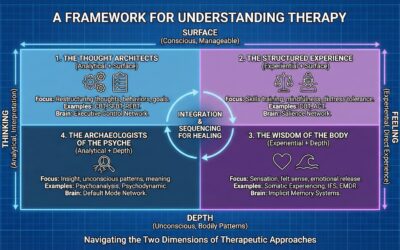
Disputing has limits. It works on beliefs a person can put into words. Some distress, especially after trauma, shows up first as the body’s alarm, before it becomes a sentence, and arguing with the sentence may not reach the alarm. That is one reason we often pair cognitive work with somatic therapy for nervous system regulation and with the slower relational work of depth therapy. A must is often a child’s solution still running in an adult’s life. “I must never make anyone angry” made sense in a volatile house. Ellis would have disputed it on the spot. A depth-oriented therapist also wants to know where it came from and what it protected, because a belief that once kept someone safe rarely gives way to logic alone.
If you recognize your own musts here and want help loosening them, our page on rational emotive behavior therapy at Taproot explains how we use these methods alongside other approaches. You can also contact us with questions about whether it fits what you are dealing with.
References
- David, D., Cotet, C., Matu, S., Mogoase, C., & Stefan, S. (2018). 50 years of rational-emotive and cognitive-behavioral therapy: A systematic review and meta-analysis. Journal of Clinical Psychology, 74(3), 304–318. https://doi.org/10.1002/jclp.22514
- Dobkin, M. (2005, October 28). Behaviorists behaving badly: Why Albert Ellis isn’t allowed at the Albert Ellis Institute. New York. https://nymag.com/nymetro/news/people/features/14947/
- Ellis, D. J., & Rovira, M. (2015). Rational emotive behavioural therapy: The evolution of a revolution. Interview with Dr. Debbie Joffe Ellis, work partner and wife of Dr. Albert Ellis, the creator of REBT. Europe’s Journal of Psychology, 11(1), 7–15. https://doi.org/10.5964/ejop.v11i1.911
- Martin, J. (2026). The 1965 “Gloria films,” then and now. Journal of the History of the Behavioral Sciences, 62(3), e70062. https://doi.org/10.1002/jhbs.70062
- Epictetus. (2014). The Enchiridion (T. W. Higginson, Trans.). Project Gutenberg. (Original work written ca. 125 CE) https://www.gutenberg.org/ebooks/45109
- Ellis, D. J. (2017). Rational emotive behavior therapy and individual psychology. The Journal of Individual Psychology, 73(4), 272–282. https://doi.org/10.1353/jip.2017.0023
- Horney, K. (1950). Neurosis and human growth: The struggle toward self-realization. W. W. Norton.
- Ellis, A. (1958). Rational psychotherapy. The Journal of General Psychology, 59(1), 35–49. https://doi.org/10.1080/00221309.1958.9710170
- Ellis, A. (1995). Changing rational-emotive therapy (RET) to rational emotive behavior therapy (REBT). Journal of Rational-Emotive & Cognitive-Behavior Therapy, 13(2), 85–89. https://doi.org/10.1007/BF02354453
- Ellis, A., & Harper, R. A. (1961). A guide to rational living. Prentice-Hall.
- Ellis, A. (1962). Reason and emotion in psychotherapy. Lyle Stuart.
- Michel-Kröhler, A., Wong, M., & Turner, M. J. (2025). Irrational beliefs in Bahasa Malaysia and Mandarin speaking populations: The cross-cultural validation of the irrational performance beliefs inventory. BMC Psychology, 13, Article 1349. https://doi.org/10.1186/s40359-025-03579-y
- Vîslă, A., Flückiger, C., grosse Holtforth, M., & David, D. (2016). Irrational beliefs and psychological distress: A meta-analysis. Psychotherapy and Psychosomatics, 85(1), 8–15. https://doi.org/10.1159/000441231
- Szentagotai, A., David, D., Lupu, V., & Cosman, D. (2008). Rational emotive behavior therapy versus cognitive therapy versus pharmacotherapy in the treatment of major depressive disorder: Mechanisms of change analysis. Psychotherapy: Theory, Research, Practice, Training, 45(4), 523–538. https://doi.org/10.1037/a0014332
- Ellis, A. (2005). The myth of self-esteem: How rational emotive behavior therapy can change your life forever. Prometheus Books.
- Smith, D. (1982). Trends in counseling and psychotherapy. American Psychologist, 37(7), 802–809. https://doi.org/10.1037/0003-066X.37.7.802
- Ellis, A. (1965). Homosexuality: Its causes and cure. Lyle Stuart.
- Haaga, D. A. F., & Davison, G. C. (1993). An appraisal of rational-emotive therapy. Journal of Consulting and Clinical Psychology, 61(2), 215–220. https://doi.org/10.1037/0022-006X.61.2.215
- Engels, G. I., Garnefski, N., & Diekstra, R. F. W. (1993). Efficacy of rational-emotive therapy: A quantitative analysis. Journal of Consulting and Clinical Psychology, 61(6), 1083–1090. https://doi.org/10.1037/0022-006X.61.6.1083
- David, D., Szentagotai, A., Lupu, V., & Cosman, D. (2008). Rational emotive behavior therapy, cognitive therapy, and medication in the treatment of major depressive disorder: A randomized clinical trial, posttreatment outcomes, and six-month follow-up. Journal of Clinical Psychology, 64(6), 728–746. https://doi.org/10.1002/jclp.20487
- Beck, A. T. (1963). Thinking and depression: I. Idiosyncratic content and cognitive distortions. Archives of General Psychiatry, 9(4), 324–333. https://doi.org/10.1001/archpsyc.1963.01720160014002
- Ellis, A. (2001). Reasons why rational emotive behavior therapy is relatively neglected in the professional and scientific literature. Journal of Rational-Emotive & Cognitive-Behavior Therapy, 19(1), 67–74. https://doi.org/10.1023/A:1007899317618
- Hayes, S. C., Luoma, J. B., Bond, F. W., Masuda, A., & Lillis, J. (2006). Acceptance and commitment therapy: Model, processes and outcomes. Behaviour Research and Therapy, 44(1), 1–25. https://doi.org/10.1016/j.brat.2005.06.006




















0 Comments