
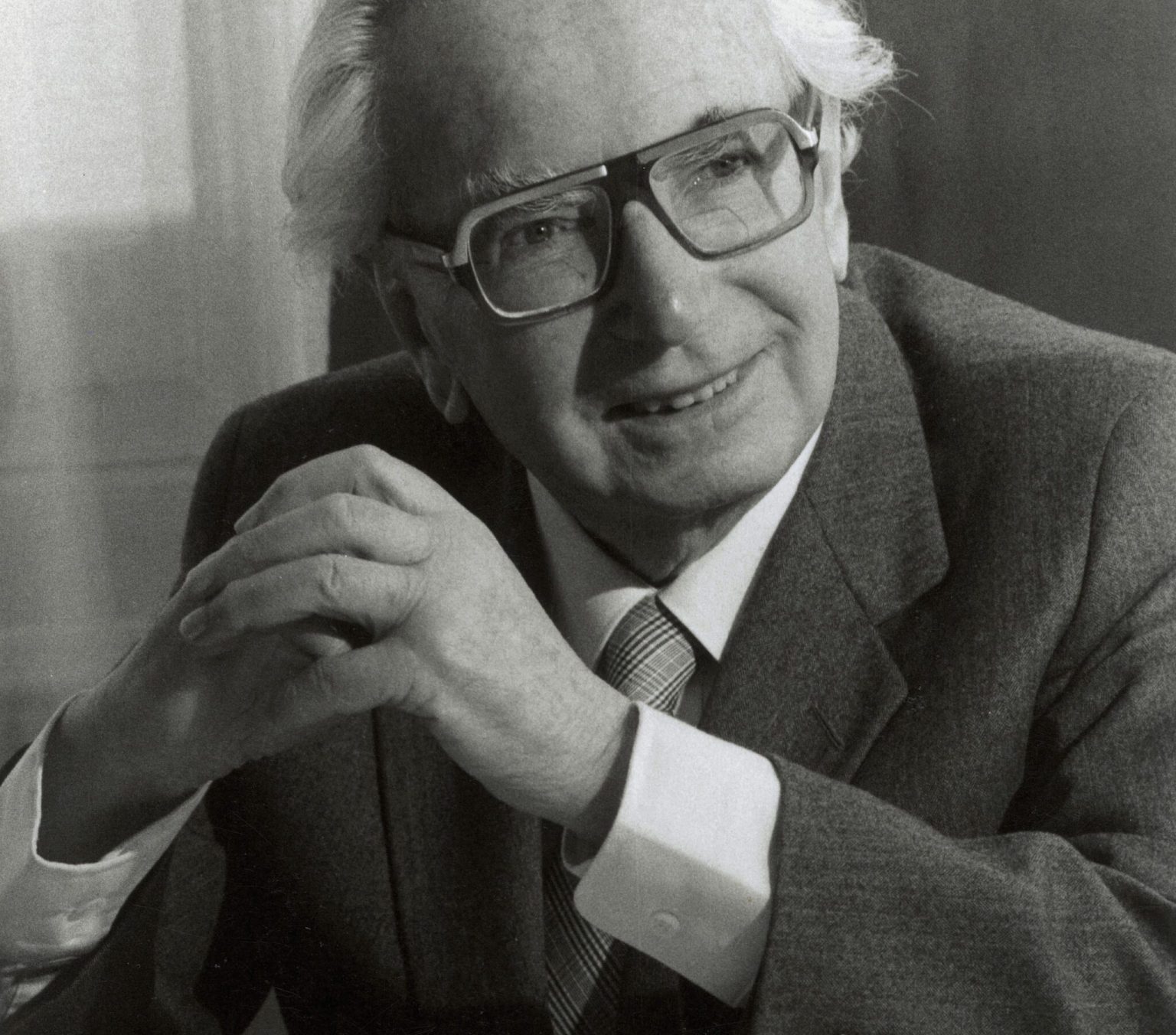
Viktor Frankl (1905-1997) was a Viennese psychiatrist and neurologist who survived Theresienstadt, Auschwitz and two Dachau subcamps and founded logotherapy, a psychotherapy built on the claim that the deepest human motive is the will to meaning. In Man’s Search for Meaning (1946) he argued that people can find meaning even in suffering they cannot avoid, through what they create, what they love and the attitude they take.
Key takeaways
- Viktor Frankl was a Viennese psychiatrist who survived Theresienstadt, Auschwitz and two Dachau subcamps and founded logotherapy, the Third Viennese School of Psychotherapy.
- Frankl held that the will to meaning, not pleasure or power, is the primary human motive, and that meaning is discovered in each situation rather than invented.
- He described three paths to meaning: what we create, what we experience and love, and the attitude we take toward suffering we cannot change.
- Logotherapy’s techniques include paradoxical intention for anticipatory anxiety, dereflection, Socratic dialogue and modification of attitudes toward unchangeable fate.
- Research on purpose in life and trials of meaning-centred therapies support Frankl’s view that meaning matters for mental and physical health.
Who was Viktor Frankl?
Viktor Emil Frankl was born in Vienna on 26 March 1905, the middle of three children in a Jewish family. His father, Gabriel, was a civil servant in the social ministry; his mother, Elsa, came from an old Prague family. In his autobiography Frankl remembers asking himself as a small boy whether the inevitability of death made life meaningless, a question that stayed with him for the rest of his career.5
He was drawn into psychoanalysis while still a schoolboy. He corresponded with Sigmund Freud, and in 1924 Freud passed one of the teenager’s papers to the Internationale Zeitschrift für Psychoanalyse, which published it. Frankl soon moved toward Alfred Adler’s individual psychology, published in Adler’s journal in 1925, and was expelled from the Adlerian circle in 1927 for arguing that psychology should not reduce human values to drives or social striving. His path through the two schools that dominated Viennese therapy is part of the story of Adler’s unfinished legacy as much as his own.57
As a medical student in the late 1920s Frankl organised free youth counselling centres in Vienna, timed to the end of the school term, when student suicides peaked. After qualifying as a physician in 1930 he trained in neurology and psychiatry, and from 1933 to 1937 he ran the ward for suicidal women at the Steinhof psychiatric hospital. He opened a private practice in 1937, and after the 1938 annexation of Austria, when Jewish doctors could treat only Jewish patients, he became head of neurology at the Rothschild Hospital, where he used his diagnoses to shield patients from the Nazi programme that killed psychiatric patients.57
In 1941 Frankl received a visa to emigrate to the United States. He let it lapse because his elderly parents could not leave with him. That December he married Tilly Grosser, a nurse at the hospital. By then he had written most of a book on what he called logotherapy, from the Greek logos, meaning. That manuscript would become Ärztliche Seelsorge, published in 1946 and in English as The Doctor and the Soul.25
Deportation and the camps
On 25 September 1942 Frankl, Tilly and his parents were deported to the Theresienstadt ghetto in occupied Czechoslovakia. His father died there of starvation and pneumonia in early 1943. In October 1944 Frankl and Tilly were sent to Auschwitz. His mother was deported to Auschwitz soon after and murdered in the gas chambers. Within days Frankl was moved to Kaufering III, one of the Dachau subcamps in Bavaria, where prisoners did slave labour building underground armaments works, and in March 1945 he went to Türkheim, another Dachau subcamp, where he fell ill with typhus. American troops liberated Türkheim on 27 April 1945.57
All told he spent about two and a half years in four camps. Back in Vienna he learned that Tilly had died at Bergen-Belsen, and that his brother Walter had died in Auschwitz. Only his sister Stella, who had emigrated to Australia, survived from his family of origin. The Nazi authorities had earlier forced Tilly to end a pregnancy, so the couple had no child.7
After the war
Frankl dictated Ein Psychologe erlebt das Konzentrationslager (A psychologist experiences the concentration camp) over nine days and published it in 1946. It appeared in English in 1959 as From Death-Camp to Existentialism and from 1962 as Man’s Search for Meaning, with an added outline of logotherapy. The book has sold millions of copies in dozens of languages, and a 1991 reader survey for the Library of Congress and the Book-of-the-Month Club listed it among the ten most influential books in the United States.1
From 1946 to 1971 he headed the Vienna Neurological Policlinic. In 1947 he married Eleonore Schwindt, a nurse, and their daughter Gabriele was born the following year. He became a professor of neurology and psychiatry at the University of Vienna, taught as a visiting professor at Harvard, Southern Methodist University and the United States International University in San Diego, and wrote more than thirty books. He died in Vienna on 2 September 1997. Logotherapy came to be called the “Third Viennese School of Psychotherapy,” after Freud’s psychoanalysis and Adler’s individual psychology, a lineage traced in the history of psychotherapy from Freud onward.57
What are Frankl’s main ideas?
Frankl’s thought can be stated in a handful of claims. Each gets its own section further on, but together they form one picture of the person: a being driven less by pleasure or power than by the need for something worth living for.13
- Logotherapy is a meaning-centred psychotherapy. It helps people find purpose in their lives, including in illness, loss and adversity.
- The will to meaning is, for Frankl, the primary human motive, more basic than the pursuit of pleasure (which he attributed to Freud) or of power (which he attributed to Adler).
- Three pathways to meaning: what we give to the world through work and creation, what we receive through experience and love, and the stand we take toward suffering we cannot change.
- Meaning and endurance: in the camps Frankl saw that prisoners who held on to a future task, a person or a faith were better able to bear conditions designed to break them.
- Tragic optimism is the capacity to say yes to life in the face of the “tragic triad” of pain, guilt and death.
- Freedom of will: people are conditioned by biology, psychology and society, but they keep the freedom to take a stand toward those conditions.
- Paradoxical intention asks an anxious patient to wish for the very thing they fear, which breaks the loop of anticipatory anxiety.
- The existential vacuum is a state of inner emptiness and boredom which, Frankl argued, feeds depression, addiction and aggression.
- Self-transcendence: people become most fully themselves when they reach beyond themselves toward a cause to serve or a person to love.
- The noetic dimension: Frankl added a “spiritual” dimension, not necessarily religious, to the body and the psyche, and treated it as the seat of conscience, values and freedom.
Read together, these ideas offer a response to nihilism and spiritual emptiness that does not depend on any one creed. They tie psychology to philosophy, ethics and spirituality, and they respect the fact that every person discovers meaning in their own way.
What is the will to meaning?
The will to meaning is Frankl’s name for what he took to be the primary motivational force in human beings: the striving to find and fulfil meaning and purpose. He set it against Freud’s pleasure principle, which he called the “will to pleasure,” and against Adler’s striving for superiority, which he called the “will to power.” In his view the search for meaning is not a secondary rationalisation of instinct. It is a basic need in its own right.13
When this need is frustrated, Frankl argued, people do not simply feel bad. They develop what he called existential frustration, and in some cases a “noogenic neurosis,” a neurosis that grows out of a conflict of values or a loss of meaning rather than out of a drive conflict or a trauma. He thought that a share of the patients who came to psychiatrists were suffering from this kind of problem and that treating it as a purely psychological or biochemical symptom missed the point.1
A key part of his argument is that meaning is found, not invented. Here he parted from the atheist existentialism of Jean-Paul Sartre, for whom human beings create their values from nothing. For Frankl, each situation holds a meaning that is there to be discovered, much as a question holds the possibility of a right answer. The person’s task is to perceive it and respond.13
He also stressed that meaning is concrete and personal. He compared asking about “the meaning of life” in general to asking a chess champion for the best move in the world: there is no such move, only the best move in a particular position against a particular opponent. Meaning differs from person to person and from hour to hour, so no one can prescribe it for someone else. That is why logotherapy treats each client as the authority on their own life while still insisting that meaning is real.1
The camps gave him evidence for the drive’s strength. He saw prisoners sustained by hope of reunion with someone they loved, by commitment to unfinished work, or by faith. This orientation toward meaning acted as an anchor amid chaos, and to Frankl it showed that human beings remain meaning-seeking creatures even under extreme deprivation.1
What are Frankl’s three ways to find meaning?
Frankl proposed that meaning can be discovered in three main ways, which he called creative, experiential and attitudinal values. He first set them out in The Doctor and the Soul and summarised them in Man’s Search for Meaning as creating a work or doing a deed, experiencing something or encountering someone, and the attitude we take toward unavoidable suffering.12
Creative values
Creative values are the meanings found in what we give to the world: our work, our craft, our service, our achievements. Frankl did not think the work had to be grand or publicly admired. A teacher, a craftsperson and a parent all bring something into the world that would not exist without them.
What mattered to him was not the job but the way it is done. In The Doctor and the Soul he argued that the size of a person’s field of activity is beside the point; what counts is whether they fill the circle of their tasks with responsibility. A work becomes a source of meaning when it is taken up as an answer to something being asked of us, a kind of calling, rather than as a way to fill time or earn status. The same theme runs through the psychology of mastery through craft.2
Experiential values
Experiential values are the meanings we receive rather than give: the encounter with nature, art, truth, beauty and above all another person. Frankl illustrated this with a thought experiment: a music lover in a concert hall, moved by a passage of a symphony, might feel that it would be worth having lived just for that moment. A life can be meaningful because of what it takes in, not only because of what it produces.2
He gave love special weight. Love, he wrote, is the only way to grasp another human being in the innermost core of their personality, to see not only who they are but who they could become. In the camps, on a march to a work site in the freezing dark, he found himself holding a conversation with the image of his wife, and he describes understanding in that moment how a person who has nothing left can still know bliss in the contemplation of the beloved.1
Attitudinal values
Attitudinal values are the meanings available when nothing can be created and nothing enjoyed: when a person faces a fate that cannot be changed, such as an incurable illness, an irreversible loss or imprisonment. Frankl argued that even then the person keeps the freedom to choose their attitude, and that bearing suffering with courage and dignity is a human achievement in its own right.12
This is the most demanding of the three and, for Frankl, the one that makes meaning unconditional. If meaning depended only on work and pleasure, a person who could neither work nor enjoy would have no meaning left. Because a stance toward suffering is always possible, life keeps its meaning to the last breath. In the camps he saw people who chose compassion over cruelty and hope over despair, and he regarded that freedom of attitude as the clearest expression of the human spirit.1
How did meaning help prisoners endure the camps?
The first part of Man’s Search for Meaning is not a treatise but a psychological account of camp life in three phases: the shock of admission, the long period of apathy and emotional numbing, and the strange aftermath of liberation, when many survivors found that they had “lost the ability to feel pleased.” Frankl wrote it as a psychiatrist observing himself and others, and he was careful to say that he was not describing the most notorious atrocities but the daily grind of the ordinary prisoner.1
What he noticed was that physical strength did not predict who held out. Prisoners who kept a sense of a future, a person waiting for them, a task only they could finish, a faith, endured better than those who lost it. He quotes Friedrich Nietzsche on this point: “He who has a why to live for can bear with almost any how.”1
He also describes the opposite. A prisoner who lost faith in the future was, he wrote, doomed: such a man would one morning refuse to get up, lie in his own excrement and smoke his last cigarettes, and soon die. Frankl reports the camp doctor’s observation that the death rate in the week between Christmas 1944 and New Year 1945 rose beyond anything seen before, which the doctor put down to the collapse of the naive hope that prisoners would be home by Christmas.1
Frankl’s own anchor was the lost manuscript. He had sewn the draft of Ärztliche Seelsorge into the lining of his coat, and it was taken from him on arrival at Auschwitz along with everything else. In Türkheim, sick with typhus, he began reconstructing it in shorthand on scraps of paper, and he describes imagining himself after the war in a warm lecture hall, speaking about the psychology of the camp. Holding that future in mind gave him a reason to stay alive and a way to keep his identity as a physician. His account sits within a wider history of how therapists have conceptualised war and atrocity.15
Finding meaning in suffering
From these observations came Frankl’s distinctive view of suffering. Many therapies aim only to relieve pain. Logotherapy accepts that some suffering is part of existence and holds that it can be meaningful. “If there is a meaning in life at all,” he wrote, “then there must be a meaning in suffering.”1
The practical shift is in the question being asked. The person stops asking only “Why is this happening to me?” and begins to ask “What does this situation ask of me?” That turns the sufferer from a passive victim into someone who responds. Courage in the face of fear, dignity under humiliation and compassion amid cruelty become achievements that no one else can perform in that person’s place.
Frankl was emphatic that this does not glorify suffering. To suffer unnecessarily, he wrote, is masochistic rather than heroic: if the cause of suffering can be removed, the meaningful thing is to remove it, whether it is psychological, biological or political. Meaning is found in suffering only when the suffering cannot be avoided, and it is found despite the suffering, not because of it.1
Frankl gives a well-known example from his own practice. An elderly general practitioner came to him unable to overcome his grief two years after his wife’s death. Frankl asked what would have happened if he had died first and she had survived him. The man said she would have suffered terribly. Frankl pointed out that he had spared her that suffering, at the price of now bearing it himself. The man’s loss did not change, but his suffering now had a meaning, the meaning of a sacrifice made for her.1
What did Frankl mean by freedom and responsibility?
Freedom of will
Frankl described the human being as conditioned but not determined. Biology, psychological history and social circumstances shape a person heavily, but they do not have the last word, because the person can always take a stand toward them. He insisted that this freedom is not freedom from conditions but freedom to respond to them.13
The camps confirmed the idea for him. He remembered men who walked through the huts comforting others and giving away their last piece of bread. They may have been few, he wrote, but they showed that everything can be taken from a person except “the last of the human freedoms,” the freedom to choose one’s attitude in any given set of circumstances, to choose one’s own way.1
For therapy this has a direct consequence. If people were only the products of drives and conditioning, change would mean adjusting the mechanism. Frankl wanted the therapist to address the person who has the drives, the one who can relate to their symptoms, take a distance from them, even laugh at them. He called this capacity self-distancing, and he treated it, together with self-transcendence, as one of the two specifically human abilities that logotherapy works with.3
Responsibility as the essence of existence
Freedom without responsibility, Frankl thought, slides into arbitrariness. Logotherapy, he wrote, sees responsibleness as the very essence of human existence, and he once proposed that the Statue of Liberty on America’s East Coast be matched by a Statue of Responsibility on the West Coast.1
In logotherapy responsibility means the ability to respond: to answer the questions that life puts to us in each situation. Frankl described a “Copernican” turn in the camps: it did not really matter what we expected from life, but what life expected from us. People stop demanding that life deliver something to them and start asking what they are being called to deliver.1
This responsibility reaches past the self toward other people and the wider community. Frankl distrusted happiness as a target. In the 1984 preface to Man’s Search for Meaning he wrote that “success, like happiness, cannot be pursued; it must ensue,” as the side effect of dedication to a cause greater than oneself or of surrender to another person.1
How does logotherapy work in practice?
The existential vacuum
Frankl described a condition he believed was spreading through modern societies: the existential vacuum, an inner emptiness marked by boredom, apathy and the sense that nothing matters. He explained it as a double loss. Unlike animals, humans are not told by instinct what they must do, and unlike earlier generations, they are no longer told by tradition what they should do. Left with neither, many people end up doing what others do (conformism) or what others want (totalitarianism).1
The vacuum often hides behind other problems. Frankl saw it in depression, aggression and addiction, and in the compulsive pursuit of money, power or pleasure, which he regarded as substitutes that give temporary distraction but deepen the emptiness. He thought it most visible in affluent societies, where survival is secure but the question “what for?” goes unanswered.14
One small sign of it was what he called “Sunday neurosis,” the depression that sets in when the busy week ends and people meet the emptiness that work had been covering. He also noted that the vacuum shows up in retirement and in old age, when external structure falls away.1
Logotherapy’s techniques
Logotherapy is not a fixed protocol. Frankl and his students developed several characteristic interventions, each tied to his picture of the person.
Paradoxical intention is the best known. Frankl began using it in the late 1930s and described it in English in a 1960 paper. He observed that anticipatory anxiety tends to produce the very thing it fears: the person afraid of blushing blushes, the person afraid of not sleeping lies awake. He asked patients to wish for or deliberately try to produce the feared symptom, often with humour. A young doctor terrified of sweating in front of others was told to resolve to show people just how much he could sweat, and the sweating stopped. With insomnia the patient is asked to try to stay awake rather than force sleep. The effect depends on self-distancing: once the person can laugh at the fear, it loses its grip.81
Dereflection addresses what Frankl called hyper-reflection, excessive attention to oneself, and hyper-intention, trying too hard to make something happen. He saw these behind many sexual difficulties, where the more a person monitors performance and pleasure, the less either arrives. Dereflection turns attention outward, toward the partner, a task or a value, so that well-being can arrive indirectly as a by-product of engagement.13
Socratic dialogue is the main conversational method. Through careful questions the therapist helps the person uncover meanings already present but unnoticed in their life: what they care about, what they would not give up, what has moved them, what still waits for them. The therapist does not supply answers. The aim is to draw out what the person already knows, in the sense of the midwifery of Socrates.3
Modification of attitudes, as later logotherapists such as Elisabeth Lukas named it, helps a person find a new stance toward an unchangeable situation: a terminal diagnosis, a permanent disability, a death. The case of the grieving physician is the classic example. The facts stay the same; the person’s relation to them changes.19
Applications beyond psychotherapy
Frankl never saw logotherapy only as a treatment for pathology. He presented it as a philosophy of life for anyone, and logotherapists have carried it into education, workplaces, pastoral care, medicine and social work.39
In schools the emphasis falls on helping students connect learning to values and purposes beyond grades. In organisations it means asking what work is for, not only how productive it is, and leaders who link a team’s tasks to larger values tend to find people more committed. In community work and social services logotherapy offers a way of treating people as responsible agents who can make meaning of their lives, rather than as passive recipients of help.
What is tragic optimism?
The concept of tragic optimism
Tragic optimism is the stance Frankl described in “The Case for a Tragic Optimism,” a postscript added to Man’s Search for Meaning in 1984 and based on a lecture he gave in 1983. It means remaining optimistic in spite of the “tragic triad” that touches every life: pain, guilt and death. Frankl argued that each part of the triad can be turned into something human: suffering into an achievement, guilt into an opportunity to change for the better, and life’s transitoriness into an incentive to act responsibly.1
This is different from forced positivity that waves suffering away. Frankl warned that happiness cannot be ordered up and that telling people to be cheerful only makes them more miserable. Tragic optimism takes the full weight of loss seriously and still affirms that a meaningful response is possible. Meaning, in this view, is unconditional: circumstances may be terrible, yet the possibility of responding well remains.1
Frankl’s answer to the transience of life is one of his most quoted images. The pessimist, he wrote, resembles a man who watches with fear and sadness as his wall calendar grows thinner each day. The person who lives fully resembles someone who removes each sheet, files it carefully with its predecessors after jotting a few diary notes on the back, and can reflect with pride on all that those sheets contain. What has been lived, he argued, is safely stored in the past and can never be taken away.1
In clinical life the idea takes familiar shapes: a bereaved parent who comes to help other grieving families, a person with a terminal illness who spends the remaining time deepening relationships, someone who has done harm and turns that history into work with people at risk. None of these cancels the tragedy. Each makes something of it.
The defiant power of the human spirit
Underneath tragic optimism lies what Frankl called the “defiant power of the human spirit” (Trotzmacht des Geistes): the capacity to stand against psychological, biological and social determinism and to keep one’s humanity. The German title of his later lectures, …trotzdem Ja zum Leben sagen (“saying yes to life in spite of everything”), names the same idea.13
Frankl saw this defiance at work in several ways:
- rising above biological limits, as when a seriously ill person keeps their sense of self and dignity;
- opposing psychological determinism, as when someone acts against their own temperament out of commitment to a value;
- resisting social pressure, as when a person holds to a principle at the cost of rejection;
- keeping humour and perspective in dire circumstances. Frankl and a friend in the camp agreed to invent one funny story every day about life after liberation, and he called humour “another of the soul’s weapons in the fight for self-preservation.”
For Frankl the defiant spirit is what dignity rests on: the value a person keeps when every outward marker of worth has been stripped away. He saw it in prisoners who shared their bread and spoke encouragement to others when survival instinct alone would have counselled the opposite.1
What is self-transcendence?
Beyond self-actualisation
Self-transcendence is Frankl’s term for the fact that human existence always points beyond itself, toward a meaning to fulfil or another person to meet. He argued that the more a person forgets themselves, by giving themselves to a cause or to someone they love, the more human they become and the more they actualise themselves. Self-actualisation, in other words, is a side effect, not a goal.13
This put him at odds with Freud’s pleasure principle and Adler’s striving for power, and also with readings of Abraham Maslow’s hierarchy that place self-actualisation at the summit. Frankl and Maslow corresponded and respected each other, and in his late writing Maslow himself added self-transcendence above self-actualisation. Frankl’s image for the point was the eye. The eye sees the world precisely because it does not see itself; when it starts to see something of itself, a cloud or a halo, it is because something is wrong with it. In the same way, people who aim directly at self-fulfilment tend to miss it.3
Clinicians influenced by Frankl sometimes map self-transcendence in three directions:
- upward, toward ultimate concerns, whether conceived as God, the cosmos or values that hold beyond the self, which Frankl called the “supra-meaning”;
- outward, toward other people, through love, service and community;
- across time, toward meanings that outlast one’s own life through what is passed on.
These directions overlap. A parent’s care for a child, for example, is at once love for a person, service to a future beyond one’s own life and, for many, an expression of faith.
Love as the ultimate meaning
Among the forms of self-transcendence, Frankl gave love the most attention. Love, he wrote, lets us grasp another person in their uniqueness and see the potential in them that is not yet realised, and by making the beloved aware of it, the lover helps bring it about. Love in this sense affirms the other’s unconditional worth.1
His own experience gave the idea its force. On the forced marches he talked with the image of his wife without knowing whether she was alive, and he came to see that it no longer mattered: love reaches beyond the physical presence of the beloved, and even beyond death. He recalled the verse from the Song of Songs that love is as strong as death. Only after liberation did he learn that Tilly had died.17
Frankl did not limit this to romance. The therapist who sees a client’s potential beneath their symptoms, the teacher who sees capacities a student has not yet shown, the friend who stays with someone through suffering are all practising the same meaning-giving love. The French philosopher Simone Weil, writing out of a very different suffering in the same years, made attention to another person the centre of her ethics in a similar way.
How did Frankl think education and culture could respond to meaninglessness?
Educating for meaning and responsibility
Frankl believed education should do more than pass on knowledge and skills. In an age when inherited traditions and values are losing their hold, he argued, its main task is to refine conscience, the faculty that perceives the unique meaning hidden in each situation. He put it as a contrast: as the Ten Commandments lose their unconditional authority for many people, they need to learn to hear the ten thousand commandments arising from the ten thousand unique situations of their lives.43
A meaning-centred education, in this spirit, would involve:
- helping students discover what they in particular are called to contribute;
- developing the ability to perceive values and to make ethical judgements;
- fostering responsibility toward oneself, others and the community;
- cultivating the freedom of attitude in the face of limits;
- preparing young people to meet an uncertain future with resilience.
In this model teachers are not only instructors but examples. They show what it looks like to live in response to meaning, and they make room for students to struggle with existential questions and reach their own answers rather than receiving set ones.
Cultural healing in an age of meaninglessness
Frankl also wrote as a diagnostician of culture. In The Unheard Cry for Meaning (1978) he described a “mass neurotic triad” of depression, aggression and addiction, and argued that all three are fed in large part by the existential vacuum. He pointed to rising suicide among young people in affluent countries, to drug use and to violence as signs that material security had not answered the question of purpose.4
Read as a programme, his writings point toward several remedies:
- education that attends to values and meaning as well as technical training;
- communities that offer real connection and shared purpose;
- cultural stories that affirm human dignity and responsibility;
- encouragement for each person to find their own contribution;
- room for spiritual questions and transcendent values in public life.
He did not want a single meaning system imposed on everyone. The goal was conditions in which people can discover varied but authentic meanings, held together by a few shared values: dignity, responsibility and the capacity for meaningful choice.4
What is the noetic dimension?
Body, psyche and spirit
Frankl described the human being as existing in three dimensions: the somatic (the body), the psychic (emotions, drives, conditioning) and the noetic, or noological, which he called the spiritual dimension. The word comes from the Greek nous, mind or spirit. The noetic is where the specifically human capacities live: conscience, the perception of values, self-transcendence and self-distancing.23
He was clear that “spiritual” here does not mean religious. The noetic dimension includes ethical discernment, aesthetic appreciation, humour, creativity, love and conscience, which belong to atheists as much as to believers. A person who commits to a value beyond themselves is acting from the noetic dimension whatever their beliefs.
Frankl called his model “dimensional ontology” and explained it with a geometric picture. A cylinder projected onto a floor casts a circle; projected onto a wall it casts a rectangle. The two shadows contradict each other, yet both come from one object. In the same way biology and psychology each capture a true projection of the person, but neither captures the whole, and the contradictions between them do not refute the unity of the human being. He used the image to argue against reducing people to any single level.3
For therapy this means illness in one dimension affects the others. A depression may have biological roots and still raise noetic questions; an existential crisis may show up in sleep and the body. Somatic therapists observe the same interdependence from the other end, which is why somatic therapy pays as much attention to the body as Frankl paid to the spirit.
Spirituality and religion in logotherapy
Frankl was a believing Jew who kept his faith private in his clinical writing. He saw that religion provides many people with a ready framework of meaning and ethical guidance that can carry them through suffering, and in The Unconscious God (1948, later expanded in English as Man’s Search for Ultimate Meaning) he argued that many people carry an unconscious religiousness, a latent relation to transcendence, that may surface in crisis.6 Questions about why faith is so persistent in human cultures are taken up in our piece on the evolutionary origins of religion.
Clinically, though, he kept logotherapy open to every worldview. He described the logotherapist as an eye specialist rather than a painter. A painter shows us the world as the painter sees it; an ophthalmologist helps us see the world as it is. Logotherapy does not prescribe meanings, religious or otherwise. It helps people see the meanings already present in their lives, which for many include a religious dimension that therapy neither imposes nor excludes.1
This allows religious meanings into the therapy room without requiring therapist and client to share beliefs. What matters is whether a person’s meaning is authentic and whether it moves them toward responsible living. In this respect Frankl stands close to the theologian Paul Tillich, who described faith as a state of ultimate concern rather than assent to doctrine.
How has logotherapy spread around the world?
Cross-cultural applications
Logotherapy institutes and training programmes now exist across Europe, the Americas, Asia, Africa and Australia, and the Viktor Frankl Institute in Vienna, founded in 1992, coordinates training and research. Its spread reflects how widely the meaning question is shared, even though it takes different forms in different settings.
In more collectivist cultures, logotherapy’s stress on self-transcendence and responsibility to others fits traditional values of community and harmony. In individualist societies it works as a corrective to excessive self-focus, linking personal fulfilment back to contribution. Purpose-centred worldviews outside the European tradition offer their own parallels, explored in our piece on existentialism and indigenous worldviews of purpose.
In secular Western settings, logotherapy gives therapists a way to talk about existential and spiritual questions without assuming any religion. In more traditionally religious societies it offers a bridge between psychological health and spiritual values, working alongside faith rather than against it.
Meaning and collective challenges
The meaning question becomes sharper when problems feel too large for any individual. Applied to the present, Frankl’s framework speaks to several of them:
- climate change and environmental damage, which call for ways of linking personal choices to the wider world;
- technological disruption, which raises the question of what innovation is for;
- political polarisation, which needs dialogue that respects difference while looking for common ground;
- economic inequality, which raises the question of work and wealth in relation to human dignity.
In each case logotherapy’s pairing of freedom and responsibility points away from both passive resignation and the expectation that someone else will fix things, toward the question of what each person can do in their own position.
What is Frankl’s influence on psychology today?
Influence on psychotherapy
Frankl is one of the founding figures of existential psychotherapy, alongside the Swiss existential analysts Ludwig Binswanger and Medard Boss and, in the United States, Rollo May. Irvin Yalom‘s Existential Psychotherapy (1980) gives meaninglessness a place among its four ultimate concerns and draws repeatedly on Frankl, and our piece on Yalom’s lessons on acceptance follows that thread.
His emphasis on meaning anticipated themes in positive psychology, narrative therapy and research on posttraumatic growth. Richard Tedeschi and Lawrence Calhoun, who coined “posttraumatic growth” in the 1990s, describe how people who struggle with trauma can report a greater appreciation of life, closer relationships, new possibilities, a sense of personal strength and spiritual change, an outcome Frankl had described from the inside.14 Martin Seligman’s work on learned helplessness, and the resilience research that followed, explored from the laboratory side the question Frankl had posed about what keeps people going.
Several current approaches carry logotherapy’s ideas forward:
- meaning-centred counselling and therapy, such as Paul Wong’s meaning-centred approach, which applies logotherapeutic concepts across clinical settings;
- Meaning-Centered Psychotherapy, developed by William Breitbart for people with advanced cancer;
- Acceptance and Commitment Therapy, which shares logotherapy’s emphasis on values-based living;
- narrative therapy, which parallels its interest in the stories people tell about their lives;
- posttraumatic growth models, which build on the idea that people can find meaning through suffering.
What the research shows
A substantial body of research supports Frankl’s central claim that meaning matters for health. In 1964 James Crumbaugh and Leonard Maholick published the Purpose in Life Test, built directly on Frankl’s concept of noogenic neurosis, and it opened decades of empirical work. Reviewing that literature, Michael Thir and Alexander Batthyány found consistent links between a sense of meaning and mental health and between the lack of it and psychological distress.9
Large studies of physical health point the same way. A 2016 meta-analysis by Randy Cohen, Chirag Bavishi and Alan Rozanski, pooling ten prospective studies with more than 136,000 participants, found that a higher sense of purpose in life was associated with lower all-cause mortality and fewer cardiovascular events.12 Patrick Hill and Nicholas Turiano, following more than 6,000 American adults for 14 years, found that purpose predicted longer life at every age, not only in later life.13
Meaning-centred therapies have been tested directly. In a randomised trial, William Breitbart and colleagues found that Meaning-Centered Group Psychotherapy improved spiritual well-being and the sense of meaning in people with advanced cancer, and reduced their depression, hopelessness and desire for hastened death, more than a supportive group did.11 A meta-analysis of existential therapies by Joel Vos, Meg Craig and Mick Cooper found that meaning-centred therapies in particular produced large improvements in meaning in life and moderate reductions in psychopathology.10
Philosophical and spiritual impact
Beyond psychology, Frankl has been read by philosophers, theologians, educators and business writers. His work joins existential philosophy, from Søren Kierkegaard to Max Scheler, whose value philosophy shaped his thinking, to the practical question of how to live. Theologians of many traditions have found in logotherapy a framework that respects faith while remaining open to secular readers.
The Canadian philosopher Charles Taylor, in The Malaise of Modernity (1991), described modern discontents that include a loss of meaning and moral horizons under a narrow individualism, and the dominance of instrumental reason.15 Frankl’s emphasis on meaning answers the same worries. It is neither nostalgic nor dismissive of modern life; it keeps hold of older wisdom about responsibility and transcendence while speaking to people who no longer share a single tradition.
Frankl for the 21st century
Frankl’s distinction between what is specifically human and what can be mechanised has only become sharper with automation and artificial intelligence. Perceiving meaning, making ethical choices and loving a particular person are not things a system can do on our behalf.
Amid constant stimulation, logotherapy keeps returning to a few plain questions: What is mine to contribute? Whom and what do I love? How will I meet the suffering I cannot avoid? These questions cut through noise to what lasts.
For people facing uncertainty, loneliness or existential anxiety, Frankl offers both a challenge and a hope. He replaces victimhood with responsibility and despair with tragic optimism, a stance that is neither naive positivity nor cynical resignation.
How do therapists use Frankl’s ideas?
Logotherapy is a distinct school with its own training, but Frankl’s questions run through much of existential and depth-oriented work. In practice they show up in several ways.
Depression and emptiness. When a client describes flatness, boredom or the sense that nothing matters, a Frankl-informed therapist listens for the existential vacuum as well as for symptoms. Questions such as “What used to matter to you?” or “Who still needs something from you?” are not pep talks. They are Socratic questions meant to locate meanings that are still present but out of view.
Grief and irreversible loss. Frankl’s attitudinal values give grief a direction without hurrying it. The goal is not to make the loss acceptable but to help the person find what their love for the one they lost now asks of them. Our writing on existential therapy and meaning after loss goes further into this.
Anticipatory anxiety. Paradoxical intention and dereflection remain useful for fears that feed on themselves: fear of panic, fear of insomnia, performance anxiety. Humour and self-distancing loosen the loop in which the effort to control a symptom keeps it going.
Illness and disability. With chronic pain, serious illness or disability, the question becomes what kind of life is possible within the limits, and what stance the person wants to take toward them.
Trauma. Frankl wrote as a trauma survivor, and his work insists that what happened to a person does not have the final word on who they become. At Taproot we hold that alongside what trauma therapy has learned since: meaning is hard to reach while the nervous system is still braced for danger. Approaches such as Brainspotting for trauma work with the way traumatic experience is held in the brain and body, and once that activation settles, clients often find Frankl’s questions about meaning, responsibility and love opening up on their own rather than being imposed.
Throughout, the therapist’s role is the one Frankl described: not to paint the world for the client but to help them see more clearly. That fits our existential and Jungian outlook, which treats symptoms as carrying a question about how a life is being lived.
The unconditional meaning of life
Frankl’s most radical claim is that life has meaning under any conditions. He did not reach it from a desk. He had lost his parents, his brother and his wife, and he had watched men die of hopelessness, and he still concluded that the last freedom, the freedom to choose one’s stance, could not be taken from a person.
That leaves each person with a choice: to live as a passive product of circumstance or as someone who answers life’s questions. Even where outer freedom is almost gone, Frankl insisted, a person can still decide who they will become in relation to what is happening to them.
He also dissolves a false choice between personal fulfilment and responsibility to others. Through self-transcendence, a person’s own meaning is found in connection with others, commitment to values and contribution to something beyond the self. The search for meaning leads not into isolation but into deeper involvement with the world.
Frankl offered a maxim that turns all of this into a daily exercise: “Live as if you were living already for the second time and as if you had acted the first time as wrongly as you are about to act now!” Imagining the present as a past that could be changed puts the full weight of responsibility on the choice in front of us, with sobriety and with hope.1
At Taproot Therapy Collective we see Frankl’s questions come alive in the room every week, in grief, in depression, in the aftermath of trauma and in the quieter emptiness of lives that look fine from the outside. If you want to explore them with someone, our existential therapy in Birmingham is built for that work, and our longer study of the existential psychology of Viktor Frankl continues the conversation.
Frequently asked questions
What is logotherapy in simple terms?
Logotherapy is the psychotherapy Viktor Frankl developed in Vienna from the 1920s onward. Its name comes from the Greek logos, meaning. It assumes that people are driven above all by a will to meaning, and it helps clients find purpose through their work, their relationships and love, and the stance they take toward suffering they cannot avoid.
Which concentration camps was Viktor Frankl in?
Viktor Frankl was deported with his wife and parents to Theresienstadt in September 1942. In October 1944 he was sent to Auschwitz, then within days to Kaufering III, a Dachau subcamp, and in March 1945 to Türkheim, another Dachau subcamp, where American troops liberated him on 27 April 1945. His parents, brother and wife Tilly all died.
What does Frankl mean by the last of the human freedoms?
In Man’s Search for Meaning, Viktor Frankl wrote that everything can be taken from a person except the last of the human freedoms: the freedom to choose one’s attitude in any given set of circumstances. He drew this from prisoners in the camps who comforted others and gave away their bread, showing that inner freedom survived extreme conditions.
What is paradoxical intention?
Paradoxical intention is a technique Viktor Frankl introduced in the late 1930s. The anxious person is asked to wish for or deliberately produce the symptom they fear, such as trying to stay awake with insomnia or trying to sweat more. Done with humour, this breaks the cycle of anticipatory anxiety that keeps the symptom going.
How long did it take Frankl to write Man’s Search for Meaning?
Viktor Frankl dictated the account of his camp experiences in about nine days after returning to Vienna, and it was published in German in 1946. The English translation appeared in 1959 as From Death-Camp to Existentialism and from 1962 as Man’s Search for Meaning, with a section on logotherapy added.
Related reading
- The Interpersonal Theory of Psychiatry: Harry Stack Sullivan’s Vision of the Social Self
- The Terminal Station Demolition: The Psychology of Destroying What We Love Most
- African American Resilience and Creative Expression: Combating Generational Trauma and Reconnecting with Cultural Roots
- The Labyrinth in Jungian Psychology: Traversing the Winding Path of Individuation
- How to Understand Jung Part 2: Applying Jungian Archetypes
- Myth, Meaning, and the Self: The Role of Archetypes Across Cultures
References
- Frankl, V. E. (2006). Man’s search for meaning (I. Lasch, Trans.). Beacon Press. (Original work published 1946)
- Frankl, V. E. (1955). The doctor and the soul: An introduction to logotherapy (R. Winston & C. Winston, Trans.). Alfred A. Knopf. (Original work published 1946)
- Frankl, V. E. (1969). The will to meaning: Foundations and applications of logotherapy. World Publishing.
- Frankl, V. E. (1978). The unheard cry for meaning: Psychotherapy and humanism. Simon & Schuster.
- Frankl, V. E. (1997). Recollections: An autobiography (J. Fabry & J. Fabry, Trans.). Insight Books.
- Frankl, V. E. (1997). Man’s search for ultimate meaning. Insight Books. (Original work published 1948)
- Klingberg, H., Jr. (2001). When life calls out to us: The love and lifework of Viktor and Elly Frankl. Doubleday.
- Frankl, V. E. (1960). Paradoxical intention: A logotherapeutic technique. American Journal of Psychotherapy, 14(3), 520-535. https://doi.org/10.1176/appi.psychotherapy.1960.14.3.520
- Thir, M., & Batthyány, A. (2016). The state of empirical research on logotherapy and existential analysis. In A. Batthyány (Ed.), Logotherapy and existential analysis: Proceedings of the Viktor Frankl Institute Vienna (Vol. 1, pp. 53-74). Springer. https://doi.org/10.1007/978-3-319-29424-7_7
- Vos, J., Craig, M., & Cooper, M. (2015). Existential therapies: A meta-analysis of their effects on psychological outcomes. Journal of Consulting and Clinical Psychology, 83(1), 115-128. https://doi.org/10.1037/a0037167
- Breitbart, W., Rosenfeld, B., Pessin, H., Applebaum, A., Kulikowski, J., & Lichtenthal, W. G. (2015). Meaning-centered group psychotherapy: An effective intervention for improving psychological well-being in patients with advanced cancer. Journal of Clinical Oncology, 33(7), 749-754. https://doi.org/10.1200/JCO.2014.57.2198
- Cohen, R., Bavishi, C., & Rozanski, A. (2016). Purpose in life and its relationship to all-cause mortality and cardiovascular events: A meta-analysis. Psychosomatic Medicine, 78(2), 122-133. https://doi.org/10.1097/PSY.0000000000000274
- Hill, P. L., & Turiano, N. A. (2014). Purpose in life as a predictor of mortality across adulthood. Psychological Science, 25(7), 1482-1486. https://doi.org/10.1177/0956797614531799
- Tedeschi, R. G., & Calhoun, L. G. (2004). Posttraumatic growth: Conceptual foundations and empirical evidence. Psychological Inquiry, 15(1), 1-18. https://doi.org/10.1207/s15327965pli1501_01
- Taylor, C. (1991). The malaise of modernity. House of Anansi Press.








0 Comments