
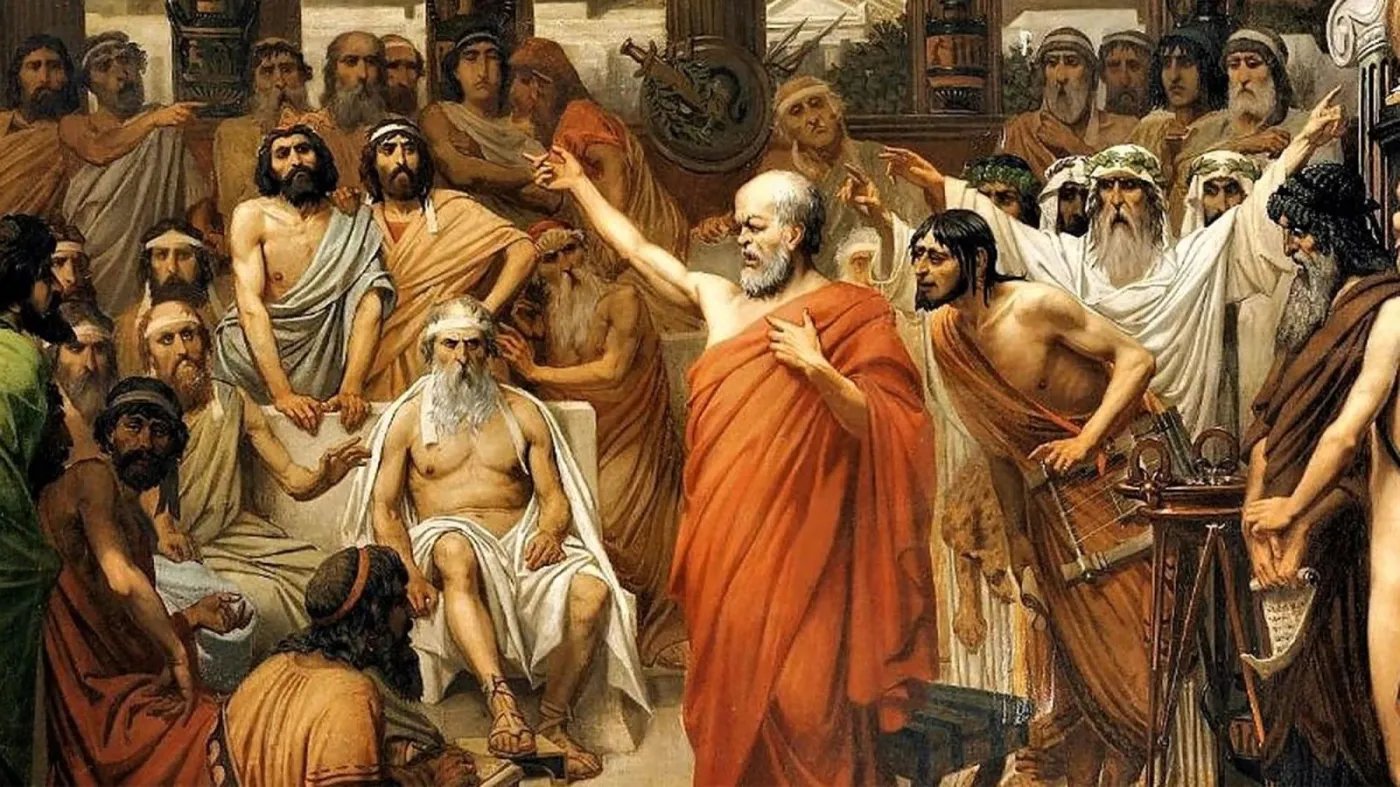
Socrates (c. 470/469 to 399 BCE) was an Athenian philosopher who wrote nothing, taught by questioning, and was executed for impiety. His influence on philosophy is the turn from studying the cosmos to examining how we should live. His influence on depth psychology is the conviction that a person must question their own story, and listen to an inner voice, to know themselves.
Key takeaways
- Socrates (c. 470/469 to 399 BCE) wrote nothing and is known through Plato, Xenophon and Aristophanes, and he was executed in Athens for impiety and corrupting the young.
- His method of cross-examination, the elenchus, exposes contradictions in a person’s beliefs so that false certainty gives way to honest inquiry.
- Socrates turned Greek philosophy from the study of the cosmos toward ethics and self-knowledge, shaping Plato, Aristotle, the Stoics, Kierkegaard, Nietzsche and Foucault.
- His daimonion, an inner voice that only ever held him back, parallels the autonomous inner figures such as Philemon that Carl Jung described.
- In therapy, a Socratic stance of honest questions and not-knowing helps people take apart the rigid narratives that trauma leaves behind.
Who was Socrates?
Socrates was born in Athens around 470 or 469 BCE and died there in 399 BCE, when a jury of citizens sentenced him to drink hemlock. He lived through the high point of Athenian power in the age of Pericles, the building of the Parthenon, the flowering of tragedy, and then the long, ruinous Peloponnesian War with Sparta (431 to 404 BCE). His questions about justice, courage, piety and knowledge set the agenda for ethics, epistemology and much of metaphysics in the West.
Socrates’ ability to deconstruct narratives was always compelling to me when I was in college. It was what let me see the power that deconstruction has to take apart traumatic narratives.
What do we actually know about Socrates’ life?
Because Socrates left no writings, everything we know comes through other people. The main sources are the dialogues of his student Plato, the Socratic works of the soldier and historian Xenophon, and the comedy Clouds by Aristophanes, staged in 423 BCE, which mocks Socrates as a sophist running a “thinkery.” Later Aristotle adds a few precise remarks. These portraits do not always agree, and scholars call the task of separating the historical Socrates from Plato’s literary character “the Socratic problem.”3
Plato’s Theaetetus names his father as Sophroniscus, traditionally described as a stonemason or sculptor, and his mother as Phaenarete, a midwife. Socrates makes much of that second fact: he calls himself a midwife of ideas who has no wisdom of his own to give birth to, but who can help others deliver what they are carrying and test whether it is sound.1
He served as a hoplite, a heavy infantryman, in the Peloponnesian War. In Plato’s Apology he reminds the jury that he held his post at Potidaea, Amphipolis and Delium, and in the Symposium Alcibiades describes him walking barefoot over ice during the winter campaign at Potidaea and keeping his head during the retreat from Delium.1
His appearance was famous. Plato has characters remark on his snub nose and bulging eyes, Alcibiades compares him to the statues of Silenus, ugly on the outside and full of images of gods within, and in Xenophon’s Symposium Socrates jokes about dancing to slim down his belly. He went barefoot, wore the same cloak year round, took no fees, and spent his days in the marketplace and the gymnasia, talking with anyone who would answer him.
What did Socrates teach?
Socrates did not hand down a doctrine. He practised an activity, and the activity carried a set of convictions about knowledge, virtue and the soul.
The examined life
At his trial, offered the chance to save himself by going quiet, Socrates told the jury that the unexamined life is not worth living for a human being.1 The line sums up his philosophy. The most important knowledge is knowledge of oneself, echoing the Delphic inscription “know thyself,” and the path to wisdom and virtue runs through questioning one’s own beliefs and assumptions rather than collecting information.
The elenchus, or Socratic method
The Greek word elenchus means testing or cross-examination. A typical conversation runs in steps. Socrates asks for a definition (“What is courage?”). The other person offers one (“Standing firm in battle”). Socrates draws out further beliefs the person also holds (“Is a strategic retreat ever courageous?”). Then he shows that the new admissions contradict the first answer. The person is left in aporia, a state of puzzlement, but with a false certainty removed and a sharper question in its place.3 The aim was never to win. It was to help the other person recognise the limits of what they knew, and to turn them toward truth and goodness.
Epistemic humility
Socrates is often credited with saying “I know that I know nothing,” but that tidy line does not appear in Plato. What the Apology describes is more careful. His friend Chaerephon asked the oracle at Delphi whether anyone was wiser than Socrates, and the priestess answered that no one was. Puzzled, Socrates questioned politicians, poets and craftsmen, and concluded that he was wiser only in this: he did not think he knew what he did not know.1 Wisdom, on this view, begins with an honest account of one’s ignorance and a willingness to keep examining.
Ethical rationalism and the Sophists
Socrates believed that moral truths can be found through reason and argument. That put him at odds with the Sophists, paid teachers of rhetoric such as Protagoras, whose saying that “man is the measure of all things” was taken to mean that truth and value are relative to each person or city. Socrates held instead that there are real standards of justice and goodness, that we can come to know them by inquiry, and that no one does wrong knowingly: wrongdoing comes from ignorance of what is truly good.3
Care of the soul
Socrates’ ethics rest on his idea of the soul, the psyche. In the Apology he says his whole mission is to persuade Athenians to care less for money, reputation and the body and more for the state of their souls.1 In the Phaedo, set on the day of his death, Plato’s Socrates goes further and presents the body as a source of appetites and distractions that pull the soul away from reason. Scholars debate how much of that dualism belongs to Socrates himself and how much to Plato, but both agree that happiness, eudaimonia, depends on the cultivation of wisdom and virtue rather than pleasure or wealth.
How did Socrates shape Plato and Aristotle?
Plato and Xenophon both wrote extensively about their teacher. Plato’s dialogues are our richest source: in the early ones, such as the Euthyphro, Laches and Charmides, Socrates tests definitions of piety, courage and self-control and usually ends in puzzlement. In the Symposium, Phaedrus and Republic the conversations widen to love, beauty, justice and the nature of knowledge.1
Plato’s own philosophy grew out of Socratic questions. If Socrates kept asking “What is justice itself?”, Plato answered that there must be a Form of Justice: an eternal, unchanging reality that just acts imperfectly reflect, known by reason rather than the senses. The allegory of the cave in the Republic pictures ordinary experience as shadows on a wall. The same work proposes the philosopher-king, a ruler whose love of wisdom fits them to govern for the common good.1 Vlastos argued that the earlier, questioning Socrates and the later, system-building Socrates of the middle dialogues are two different philosophers sharing one name.3
Aristotle never met Socrates; he studied under Plato at the Academy for about twenty years. He rejected the separate Forms, grounded his philosophy in the study of nature and of human behaviour, and built the first formal logic. Yet he gave Socrates a precise place in that history. In the Metaphysics he says two things can fairly be credited to Socrates: inductive arguments and universal definition.2 The habit of moving from particular cases to a general account, and of insisting on clear definitions, is the Socratic inheritance inside Aristotle’s empirical method.
How did Socrates change Western philosophy?
Before Socrates, Greek philosophy was mostly about the cosmos. The Presocratics, Thales, Anaximander, Heraclitus and others, asked what the world is made of and what principle governs change. Thales proposed water, Anaximander the boundless, Heraclitus the ever-living fire and the unity of opposites. Their speculations laid groundwork for later science, but they pointed outward. Cicero, writing in the 40s BCE, said that Socrates was the first to call philosophy down from the heavens, set it in cities and homes, and make it ask about life, morals, good and evil.
That inward turn shaped everything after it. The Academy, which Plato founded around 387 BCE, and Aristotle’s Lyceum, founded in 335 BCE, are the ancestors of the university. Socrates’ insistence on clear definitions, logical consistency and testing ideas with examples and analogies became the model for philosophical argument. Teachers still use “Socratic” questioning to have students reason their way to conclusions rather than memorise them, and law schools have long taught cases this way.
His influence runs through later thinkers too. The Stoics treated Socrates as their model sage, and the self-examination in Marcus Aurelius’ Meditations descends from him. Pierre Hadot showed that for ancient schools philosophy was a set of spiritual exercises, a way of life, rather than a body of theory, with Socrates as its founding figure.6 Søren Kierkegaard wrote his 1841 dissertation, The Concept of Irony, with Continual Reference to Socrates, on Socratic irony as a way of freeing the individual from received opinion.7 Friedrich Nietzsche attacked him in The Birth of Tragedy (1872) and “The Problem of Socrates” in Twilight of the Idols (1889) for trusting reason over instinct, which is itself a measure of how central he remained. Late in his life Michel Foucault returned to the Socratic “care of the self” as a practice of truth-telling and self-formation.
Would Socrates approve of the modern university?
Socrates might not have endorsed the academic system that grew from his example. Modern universities reward specialisation, professional credentials and research for its own sake. Socrates took no fees, held no post, published nothing, and cared about knowledge only insofar as it made a person better. For him the goal of education was virtue and a good life, not technical expertise or abstract information.
He saw philosophy as a way of life: the daily, sometimes uncomfortable examination of oneself and one’s beliefs in the pursuit of wisdom. A scholar can know a great deal about ethics and live badly. Socrates would have counted that as a failure of philosophy, not a separate matter.
Was Socrates an atheist?
His accusers said so, in effect. In 399 BCE Meletus, backed by Anytus and Lycon, charged Socrates with not recognising the gods the city recognised, introducing new divine beings, and corrupting the young. Historians also point to the political background: several of his associates, including Alcibiades and Critias, had been linked with treachery or with the brutal oligarchy of the Thirty Tyrants.4
In the Apology Socrates flatly denies being an atheist and describes his whole questioning mission as service to Apollo, the god of the Delphic oracle.1 He was critical of the traditional myths, especially stories of gods lying, quarrelling and behaving badly, and in the Euthyphro he asks whether the pious is loved by the gods because it is pious, or pious because the gods love it. But he prayed, followed dreams and oracles, and in the Phaedo his last words ask his friend Crito to make an offering of a cockerel to Asclepius, the god of healing.1
Most scholars now read Socrates as deeply religious in an unusual, reforming way. McPherran argues that his philosophy and his piety form one whole: he insisted the gods are wholly good and wise, and he moved Greek religion toward the more rational theology Plato developed.5 His idea of the divine was more ethical and more abstract than the gods of Homer, but it was not unbelief.
What was Socrates’ daimonion?
The “new divine beings” in the charge almost certainly referred to Socrates’ daimonion, his “divine sign.” In the Apology he says it is a kind of voice that has come to him since childhood, and that it only ever turns him away from something he is about to do; it never urges him forward. It held him back from entering politics, and, he notes, it did not oppose him going to court on the day of his trial, which he took as a sign that what was happening was not bad for him.1
The daimonion is one of the oldest descriptions in Western literature of an inner authority that is not the same as conscious reasoning. Socrates was the most argumentative man in Athens, yet he obeyed a signal he could not argue his way to. The word daimon later took on a long life of its own, traced in the daimon in the history of psychotherapy, from the Greek sense of a guiding spirit to the modern idea of a calling or an authentic self.
How did Socrates influence Carl Jung and depth psychology?
The connection between Socrates and Carl Jung is less a matter of direct borrowing than of a shared shape of experience. Jung, the Swiss psychiatrist who founded analytical psychology, held that the psyche contains autonomous figures and voices that speak with an authority the ego did not create. Socrates’ daimonion is the classical example of exactly that, and Jung used the language of the daimon freely. In his memoir he described his own creative drive as a daimon that ruled his life.8
Philemon and the inner teacher
Jung’s best-known inner figure is Philemon. Jung recounts in Memories, Dreams, Reflections that during his confrontation with the unconscious, after his break with Freud in 1913, a winged old man with the horns of a bull appeared to him in a dream and then in waking fantasies. Jung held conversations with him while walking in the garden, said Philemon represented insight superior to his own, and called him a guru.8 Philemon fills many pages of the Red Book, the illustrated record of these experiments that Jung worked on from 1913 until about 1930 and that was finally published in 2009.9
Jung took the name from the old man Philemon of Ovid’s tale of Philemon and Baucis, whom Goethe’s Faust destroys, and he carved “Philemon’s shrine, Faust’s repentance” over the door at his Bollingen tower. Jung did not say Philemon came from Socrates. The resemblance is still real: both are inner presences that teach by unsettling the ego, and both made their hearers more humble about what conscious reason knows. Jungians read Philemon as an image of the archetype of the wise old man, the figure of guidance that appears in dreams and myths as the hermit, the magician or the old teacher.
Self-knowledge, shadow and individuation
The deeper link is method. Socrates taught that wisdom begins when we see that we do not know what we thought we knew. Jung taught that individuation, becoming the whole person one actually is, begins when the ego stops identifying with its persona and meets the shadow, the disowned qualities we project onto others. Both require a willingness to confront one’s own ignorance, and both proceed through dialogue: Socrates with a partner in the marketplace, Jung with dream figures in active imagination.
James Hillman carried the Socratic thread further. In The Soul’s Code (1996) he proposed an “acorn theory” in which each life is shaped by a daimon or calling that the person must learn to hear, an idea with roots in Plato’s myth of Er and in the daimonion of the Apology. Two other thinkers in this inward and dialogical line are Hans-Georg Gadamer, whose hermeneutics treats understanding as a conversation modelled on Plato’s dialogues, and Plotinus, whose Neoplatonism turned Socratic self-knowledge into a path of inner ascent.
How is the Socratic method used in therapy?
Socrates’ ideas run through modern psychotherapy. Aaron Beck’s cognitive therapy adopted “Socratic questioning” as a core technique, Viktor Frankl‘s logotherapy uses “Socratic dialogue” to help people find meaning, and the psychologist James Overholser has written a series of papers and a book showing how the method’s elements work across many forms of therapy: systematic questioning, inductive reasoning, the search for universal definitions, a disavowal of knowledge by the therapist, and a commitment to self-improvement.101113 A review by Carey and Mullan found that therapists call the method fundamental while describing it in quite different ways.12 That is not surprising: Socrates himself never wrote a manual.
We use his ideas often at Taproot Therapy Collective in Hoover, Alabama. What we take from Socrates is less a questioning technique than a stance.
Taking apart a traumatic narrative
Trauma leaves people with stories that feel like plain fact: “It was my fault,” “I should have stopped it,” “I am the kind of person this happens to.” These beliefs are rarely reached by reasoning, so they are rarely loosened by being argued with. A Socratic therapist asks honest questions instead. What would you say to a friend who had been in that position at that age? What did you actually know then? Where in your body do you feel the word “fault”? The aim, as in the elenchus, is not to replace one story with a nicer one but to let the person discover that the old account does not hold together, and to make room for something truer.
The therapist who does not know
Socrates’ disavowal of knowledge is a model for the therapeutic relationship. Overholser describes the therapist’s honest uncertainty as what invites the client to do their own thinking.11 Like the midwife, the therapist helps the client deliver what is already in them, and meaning is made between the two of them in conversation rather than handed over. That takes active listening and real empathy, which is why the Socratic stance fits depth work as well as it fits a classroom. That matters in existential therapy, where the questions of freedom, death and meaning belong to the client, and in Jungian therapy, where the analyst follows the client’s dreams rather than imposing an interpretation.
Listening for the daimonion
The daimonion said only “no.” Many clients know that kind of signal: a tightening in the chest before agreeing to something, a dream that keeps returning, a refusal in the body that the mind cannot yet explain. Depth and somatic therapists treat such signals as information rather than symptoms to suppress. In Brainspotting and other brain-based trauma work, attention to where the eyes rest and what the body feels lets that inner “no” be heard, processed and understood, so that a person’s choices come from the whole self rather than from the ego alone.
Why does Socrates still matter?
Socrates’ commitment to truth, his willingness to question authority and convention, and his faith that honest dialogue can change a person are as useful now as in fifth-century Athens. Philosophy owes him its turn toward ethics and self-knowledge and its method of clear definition and argument. Depth psychology owes him a model of the inner voice and the conviction that we have to examine the stories we live by. Both traditions keep returning to his trial-day sentence about the examined life, because it states the work they share.
At Taproot, that work happens one conversation at a time: questioning the narratives trauma leaves behind, listening for the voice that says “not this,” and helping people know themselves well enough to live by what they find. To talk with a therapist about this kind of work, you can contact Taproot Therapy Collective.
Frequently asked questions
What is the Socratic method in simple terms?
The Socratic method is a way of reaching understanding by asking questions. Socrates asked someone to define a value such as courage, drew out other beliefs they held, and showed where those beliefs contradicted the definition. The person ended up puzzled but freer of false certainty, and better placed to look for a truer answer through further dialogue.
Did Socrates really say he knew nothing?
Not in those words. In Plato’s Apology, Socrates says the Delphic oracle called him the wisest of men, and after questioning politicians, poets and craftsmen he decided his only advantage was that he did not think he knew what he did not know. The slogan “I know that I know nothing” is a later simplification of that more careful claim.
What was the daimonion of Socrates?
The daimonion was Socrates’ divine sign, an inner voice he said had come to him since childhood. According to Plato’s Apology it only ever warned him away from an action and never told him what to do. His accusers probably had it in mind when they charged him with introducing new divine beings in 399 BCE.
Why was Socrates sentenced to death?
In 399 BCE an Athenian jury convicted Socrates of impiety, meaning not recognising the city’s gods and introducing new divinities, and of corrupting the young. Historians add that Athens had just lived through defeat by Sparta and the rule of the Thirty Tyrants, and several of Socrates’ former associates were tied to that regime. He was executed by drinking hemlock.
How is Socrates connected to Carl Jung?
Socrates and Carl Jung both described an inner voice with an authority the conscious mind did not create. Socrates obeyed his daimonion, while Jung held long dialogues with an inner teacher he called Philemon, recorded in Memories, Dreams, Reflections and the Red Book. Both also held that self-knowledge begins by confronting what we do not know about ourselves.
Is Socratic questioning used in psychotherapy?
Yes. Socratic questioning appears in Aaron Beck’s cognitive therapy, Viktor Frankl’s logotherapy and many depth and existential approaches. Psychologist James Overholser describes its elements as systematic questioning, inductive reasoning, universal definitions, the therapist’s disavowal of knowledge and self-improvement, which together help clients examine their own beliefs and stories.
Related reading
- Emanuel Swedenborg’s Mystical Visions and Their Influence on Carl Jung’s Psychology
- St. Augustine and the Foundations of Depth Psychology: How a Fourth-Century Bishop Became a Forefather of Modern Psychotherapy
- Paul Tillich and the Soul’s Depth: The Enduring Relevance of an Existentialist Theologian for Depth Psychology and Psychotherapy
- Martin Heidegger and the Quest for Being: Implications for Psychotherapy and Depth Psychology
- Gerhard Dorn: Alchemist, Philosopher, Visionary
- Jacob Burckhardt: A Life of Cultural History and Psychological Insight
References
- Plato. (1997). Complete works (J. M. Cooper & D. S. Hutchinson, Eds.). Hackett.
- Aristotle. (1984). The complete works of Aristotle: The revised Oxford translation (J. Barnes, Ed.; Vols. 1-2). Princeton University Press.
- Vlastos, G. (1991). Socrates, ironist and moral philosopher. Cornell University Press.
- Waterfield, R. (2009). Why Socrates died: Dispelling the myths. W. W. Norton.
- McPherran, M. L. (1996). The religion of Socrates. Pennsylvania State University Press.
- Hadot, P. (1995). Philosophy as a way of life: Spiritual exercises from Socrates to Foucault (A. I. Davidson, Ed.; M. Chase, Trans.). Blackwell.
- Kierkegaard, S. (1989). The concept of irony, with continual reference to Socrates (H. V. Hong & E. H. Hong, Eds. & Trans.). Princeton University Press. (Original work published 1841)
- Jung, C. G. (1963). Memories, dreams, reflections (A. Jaffé, Ed.; R. Winston & C. Winston, Trans.). Pantheon Books.
- Jung, C. G. (2009). The red book: Liber novus (S. Shamdasani, Ed.; M. Kyburz, J. Peck, & S. Shamdasani, Trans.). W. W. Norton.
- Overholser, J. C. (1993). Elements of the Socratic method: I. Systematic questioning. Psychotherapy: Theory, Research, Practice, Training, 30(1), 67-74. https://doi.org/10.1037/0033-3204.30.1.67
- Overholser, J. C. (1995). Elements of the Socratic method: IV. Disavowal of knowledge. Psychotherapy: Theory, Research, Practice, Training, 32(2), 283-292. https://doi.org/10.1037/0033-3204.32.2.283
- Carey, T. A., & Mullan, R. J. (2004). What is Socratic questioning? Psychotherapy: Theory, Research, Practice, Training, 41(3), 217-226. https://doi.org/10.1037/0033-3204.41.3.217
- Overholser, J. C. (2018). The Socratic method of psychotherapy. Columbia University Press. https://doi.org/10.7312/over18328













0 Comments