

The Sage archetype is the pattern in the psyche that seeks truth, understanding and perspective. Carl Jung described it as the Wise Old Man, an image of spirit and insight that appears in dreams, myths and mentors. Psychologically it matters because it is the part of us that steps back to make meaning, and because, cut off from feeling and the body, it turns into cold intellectualization.
Key takeaways
- The Sage archetype is the pattern in the psyche that seeks truth and perspective; Jung called it the Wise Old Man, an image of spirit and reflection.
- The twelve-archetype list that includes the Sage comes from Carol S. Pearson and Margaret Mark, not from Jung himself.
- In Campbell’s monomyth the Sage appears at the stage of Supernatural Aid; Christopher Vogler later renamed it Meeting with the Mentor.
- The Sage’s shadow is arrogance, dogmatism and intellectualization, using understanding as a wall against grief, need and the body.
- Therapy aims for a Sage that thinks with the whole person, linking insight to feeling and bodily sensation through Jungian, parts-based and somatic work.
Where does the Sage archetype come from?
The word “Sage” belongs to a modern vocabulary, but the figure is old. Jung’s own term was the Wise Old Man, sometimes called the senex. In his essay “The Phenomenology of the Spirit in Fairytales,” first given in 1945 and revised in 1948, Jung argued that the archetype of spirit tends to show up in dreams and folk tales as an old man who appears at the moment the hero is stuck, asks the right question, and supplies the insight or the magical help the hero cannot find alone.1 The old man stands for reflection itself: the capacity to pause, gather what is known and see the situation from above.
Jung did not treat this as theory only. In 1913 and 1914, during the period he later recorded in The Red Book, an inner figure he called Philemon appeared to him in fantasies: an old man with the horns of a bull and the wings of a kingfisher. In Memories, Dreams, Reflections Jung described Philemon as a figure who taught him that thoughts and images in the psyche have a life of their own, and he treated Philemon as an inner teacher.3 For Jung the Wise Old Man was something you could meet, talk with and learn from.
He also saw the danger. In Two Essays on Analytical Psychology Jung described the “mana personality,” the inflation that happens when the ego, having made contact with this kind of inner authority, decides that it is the wise one.2 The person begins to speak as an oracle. Much of what later writers call the shadow of the Sage is already present in that warning.
The twelve archetypes and the Sage
The list of twelve archetypes used across this site, Innocent, Everyman, Hero, Caregiver, Explorer, Rebel, Lover, Creator, Jester, Sage, Wizard and Ruler, does not come from Jung. It was built by Carol S. Pearson, who began mapping archetypes of personal development in the 1980s, and it took its best-known form in The Hero and the Outlaw (2001), which she wrote with Margaret Mark, where some of the names differ slightly (the Wizard is the Magician, the Rebel is the Outlaw).6 In that system the Sage’s motto is that the truth will set you free, its core desire is to understand the world, and its fear is being deceived or ignorant. You can read the whole set in our overview of the 12 major archetypes.
The Sage sits closest to two neighbours. The Wizard archetype also knows things, but the Wizard wants to use knowledge to change reality, while the Sage wants to understand reality as it is. The Jester archetype is the Sage’s mirror: where the Sage seeks the truth by careful thought, the Jester exposes it by mockery, and the wise fool, one of the Sage’s forms in fiction, combines the two.
An evolutionary reading
The Jungian psychiatrist Anthony Stevens, in Archetype: A Natural History of the Self (1982), argued that archetypes are evolved predispositions, readiness to perceive and respond to the recurring figures of human life, much as ethologists describe inborn releasing patterns in animals.7 From that angle the Sage is the elder of the band: the person who remembered where water was found in the last drought, who knew which plants healed, and whose memory kept the group alive. A child is born ready to look for such a person, and an adult is ready to become one.
How does the Sage appear in parts-based therapy?
Parts-based therapies, among them Internal Family Systems (IFS), Schema Therapy and Voice Dialogue, describe the mind as a system of subpersonalities, each with its own motives, memories and ways of coping. These models were built independently of the archetype literature, but they give therapists a practical language for how an archetype lives inside a single person.
Internal Family Systems (IFS)
Richard Schwartz developed IFS in the 1980s and 1990s, after noticing that his clients spoke naturally about “parts” of themselves.9 IFS distinguishes parts from the Self, a core of calm, curiosity, clarity and compassion that every person has underneath their parts. In IFS language the healthy Sage is close to Self: clear, curious and compassionate at once. You can read more about Richard Schwartz and the origins of IFS.
A Sage-like part is something else. It may be a protector, a “manager” in IFS terms, that learned early that understanding things was the safest way to feel in control. When that part is burdened it can sound wise while working as a critic or perfectionist, holding the person to impossible standards, explaining away their feelings, or lecturing other parts. The IFS therapist does not argue with this part. They help the person get curious about it, learn what it is protecting, and, once the part trusts that Self can lead, help it set down the burden it took on. What remains is usually a part that still loves thinking but no longer has to run the whole system.
Schema Therapy
Schema Therapy, developed by Jeffrey Young and colleagues, describes “modes,” moment-to-moment states, and early maladaptive schemas, long-standing patterns formed when childhood needs went unmet.10 The Healthy Adult mode, the part that can meet needs, set limits and hold perspective, carries many of the Sage’s best qualities. Two of Young’s eighteen schemas, Unrelenting Standards and Emotional Inhibition, describe the Sage gone wrong: a person who learned that only correct answers earned love, or that showing feeling was dangerous, and so retreated into rigour and restraint. Schema work aims to weaken those schemas and strengthen the Healthy Adult so that wisdom includes warmth.
Voice Dialogue
Voice Dialogue was developed by Hal Stone and Sidra Stone, and set out in Embracing Our Selves.11 The facilitator asks to speak directly with a particular self, “the one who always needs to understand,” for example, and the client physically moves to a different seat to let that voice talk. The Stones distinguished primary selves, the ones we identify with, from disowned selves, the ones we push away. A Sage voice can be a primary self in an academic or professional who has disowned the emotional, playful or vulnerable voices. The goal is not to remove the Sage but to build an “aware ego” that can hear all the voices and choose. See our post on Hal and Sidra Stone’s psychology of selves.
What a parts-based view lets a therapist do
- Help a person find and strengthen their inner Sage, the part that can step back and see the larger pattern when decisions are hard.
- Recognise when a Sage-like part has become critical, perfectionistic or contemptuous, and work with it rather than against it.
- Bring the Sage into relationship with other parts, especially the emotional, playful and bodily ones it tends to override.
- Heal the old wounds behind an overgrown or a banished Sage, such as being shamed for not knowing or shamed for knowing too much, so that the person’s wisdom becomes their own.
What role does the Sage play in the hero’s journey?
In The Hero with a Thousand Faces (1949), Joseph Campbell described the monomyth: departure, initiation and return.4 Early in the departure, just after the hero answers the call, comes a stage Campbell named Supernatural Aid. A protective figure, he wrote, often an old crone or an old man, appears and gives the hero an amulet or advice against the dangers ahead. That is the Sage’s place in the story. You can read more about Joseph Campbell’s monomyth and how it is used in therapy.
The word “mentor” in most modern accounts comes from Christopher Vogler, a Hollywood story analyst who adapted Campbell for screenwriters. In The Writer’s Journey Vogler renamed the stage “Meeting with the Mentor” and made the Mentor one of his core character archetypes, with the job of teaching, gift-giving and preparing the hero.5 The name itself is borrowed from Homer: in the Odyssey, Athena takes the form of Mentor, an old friend of Odysseus, to guide his son Telemachus.
Symbolically, the Sage in the hero’s journey stands for the hero’s own growing capacity for insight. The mentor usually leaves or dies before the final ordeal, and the hero has to face it alone. That departure is the point. Wisdom that stays outside the hero, in a teacher or a book, has not yet been integrated; the journey is complete only when the hero carries the mentor’s perspective inside.
The Sage also brings a particular emotional tone to the story: steadiness. The mentor is the one who is not panicking. By taking in that steadiness, the hero learns to hold fear without being run by it, and to think clearly in danger. In therapy, the therapist often plays this role for a time, and the work is complete when the client no longer needs to borrow the calm.
The Sage in prehistory, myth and world religions
The shaman as the first Sage
In small-scale societies, the person who held healing, ritual and memory was often the shaman. Mircea Eliade’s Shamanism: Archaic Techniques of Ecstasy (French edition 1951, English 1964) described the shaman as a specialist of the soul who travels in trance to the spirit world and returns with knowledge for the community.12 Before writing, this person also kept the oral traditions: genealogies, songs, the stories of where the people came from. Read more in our post on Mircea Eliade and the sacred.
Mythology and early philosophy
- Greece. Athena was the goddess of wisdom and strategic skill. In Hesiod’s Theogony she is the daughter of Metis, whose name means cunning intelligence, and whom Zeus swallowed. Socrates (c. 470 to 399 BCE) was not a myth but a historical Athenian philosopher. In Plato’s Apology, Socrates explains that he is wise only in knowing that he does not know, which may be the best one-line definition of the healthy Sage. See our post on Socrates and depth psychology.
- Egypt. Thoth, often shown with the head of an ibis, was the god of writing, wisdom and measurement, the scribe who recorded the verdict when the heart of the dead was weighed. The Greeks identified him with Hermes, and from that pairing came the figure of Hermes Trismegistus, the legendary author of the Hermetic texts Jung read closely.
- China. Confucius (551 to 479 BCE) was also historical, a teacher whose sayings were collected by his students in the Analects. In Chinese tradition he became the model of the sage (shengren), the person whose wisdom shows up as moral cultivation and right relationship rather than abstract knowledge.
The Sage in world religions
Most religious traditions have a founder who embodies wisdom and a line of scholars who interpret it. The two roles are different expressions of the same archetype: the one who sees, and the ones who explain.
Christianity. The Hebrew Bible personifies Wisdom as a woman in Proverbs 8, present with God at creation. Paul, writing in the 50s CE, calls Christ “the power of God and the wisdom of God” (1 Corinthians 1:24). Paul himself, the most influential interpreter in the early church, plays the second role: the Sage as theologian, working out what the new faith means.
Buddhism. Siddhartha Gautama, the Buddha, lived around the fifth century BCE and taught that suffering could be ended through insight into its causes. Later philosophers carried that insight further: Nagarjuna (c. 150 to 250 CE), founder of the Madhyamaka school, argued that all things are empty of fixed essence, and Vasubandhu (fourth to fifth century CE) systematised the Yogacara analysis of mind.
Islam. Muslims understand Muhammad (c. 570 to 632 CE) as the final prophet, to whom the Quran was revealed. In the classical period, al-Ghazali (1058 to 1111) and Averroes, Ibn Rushd (1126 to 1198), argued over the place of philosophy in faith. Al-Ghazali’s story speaks to the Sage’s shadow: at the height of his fame as a scholar in Baghdad he fell into a crisis in 1095, lost the ability to lecture, and left his post to live as a Sufi, later writing in Deliverance from Error that learning without lived experience had not given him certainty.
The Sage in literature and art
Western literature keeps returning to the old teacher. Merlin first enters the Arthurian story in Geoffrey of Monmouth’s History of the Kings of Britain (c. 1136), as the prophet and magician who arranges Arthur’s birth. Gandalf, in J.R.R. Tolkien’s The Lord of the Rings (1954 to 1955), is a wizard who rarely casts spells and mostly gives counsel; he dies and returns as Gandalf the White, a death-and-rebirth of the Sage himself. Albus Dumbledore, in J.K. Rowling’s Harry Potter books (1997 to 2007), guides Harry, but the later books reveal his secrecy and early ambitions, a reminder that the mentor has a shadow too.
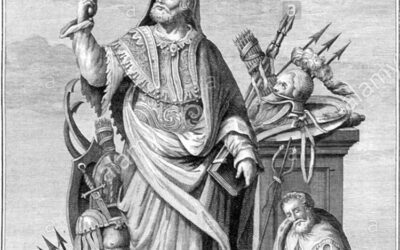
Visual artists gave the Sage recognisable attributes: a long beard, a book or scroll, a lamp, an hourglass, a skull on the desk. The art historian Erwin Panofsky made the reading of such attributes a discipline in Studies in Iconology. Raphael’s School of Athens (1509 to 1511) places Plato and Aristotle at the centre of a crowd of philosophers, while Albrecht Dürer’s engraving Melencolia I (1514) shows the darker side, a winged figure surrounded by instruments of measurement and sunk in brooding thought.
What is the shadow side of the Sage?
Jung used “shadow” for the parts of the personality the conscious self does not want to see. Every archetype casts one. The Sage’s shadow shows up as intellectual arrogance, dogmatism, contempt for people who know less, and a detachment from practical life and from feeling. It is the professor who cannot be wrong, the guru who cannot be questioned, the critic who knows everything about love and has never risked it. Read more about the Jungian shadow.
Intellectualization: the Sage as a defence
Psychoanalysis has a name for the Sage’s most common shadow move: intellectualization. Anna Freud described it in The Ego and the Mechanisms of Defence (1936), noting how adolescents flooded by new drives turn to abstract debate about love, freedom and philosophy, managing feelings by thinking about them instead of feeling them.13
In practice it looks like this. Someone comes to therapy after a divorce. They can explain the whole marriage in the language of attachment styles: who was anxious, who was avoidant, how the pattern repeated their parents’ marriage. All of it is accurate. Their voice is even, their hands are still, and when the therapist asks what they feel as they say it, they answer with another explanation. The insight is real, but it is doing the job of a wall. The work is not to take the understanding away; it is to slow down until the grief the understanding was protecting has room to arrive.
Integrating the Sage
Psychological research on wisdom points in the same direction as the depth tradition. Paul Baltes and Ursula Staudinger at the Max Planck Institute described wisdom as expert knowledge about the “fundamental pragmatics of life,” including tolerance for uncertainty and the ability to see a problem from several value positions.14 Monika Ardelt’s three-dimensional model treats wisdom as cognitive, reflective and affective at once: understanding, the willingness to look at oneself from many angles, and compassion.15 In her model, a person who scores high on knowledge but low on compassion is clever, not wise.
That gives a practical recipe for a balanced Sage. Cultivate humility, the Socratic habit of knowing what you do not know. Question your own assumptions as hard as other people’s. Apply what you know to actual problems in actual relationships. A balanced Sage is open-minded and kind, keeps learning for life, and can explain what they know in a way that leaves the listener stronger rather than smaller. The gains are concrete: a clearer sense of purpose, relationships where people feel understood rather than corrected, and work that puts knowledge to use for others.
The Sage in relationships, careers, politics and religion
Relationships
In a relationship, the Sage tends to become the one who explains, advises and interprets. That can be a gift: a partner who helps you see the pattern you are caught in. It becomes a problem when every conflict turns into a lecture, when the partner’s feelings are answered with analysis, or when being right matters more than being close. The useful question for a Sage-identified partner is whether they want to understand their partner or to win. Our post on how archetypes show up in relationships looks at these pairings in more depth.
Careers
People with a strong Sage pattern are often drawn to teaching, research, writing, law, medicine, consulting, the ministry and, not least, therapy. They do well where curiosity is rewarded and where they can pass knowledge on. They struggle in settings that reward speed over accuracy or loyalty over truth, and they are prone to a particular kind of burnout in which they keep reading and preparing long after the meaning has drained out of the work.
Politics
In politics the Sage appears as the leader or adviser who governs by understanding: the statesman who reads history, the policy expert, the elder who counsels restraint. Its shadow is the technocrat who is certain he knows better than the people he serves, or the ideologue who uses superior knowledge to manipulate. Plato‘s philosopher-king in the Republic is the classic statement of both the hope and the danger.
Religion
In religious life the Sage takes the form of the teacher, the guru, the rabbi, the spiritual director or the scholar of scripture: someone who helps others understand texts and practices and find their way to meaning. Healthy religious Sages make the tradition more alive for the people they serve. The shadow version is the leader who becomes rigid, dismisses every other perspective, or uses spiritual authority to control and exploit followers, which is the mana personality Jung warned about, played out in a community.
How does the Sage show up in the body and emotions?
Emotionally, a well-functioning Sage feels like curiosity, absorption in a problem, and the quiet pleasure of passing something useful to someone else. Out of balance, it feels like impatience with people who are slow, a private sense of superiority, and loneliness: the isolation of living mostly in the head. When the Sage is suppressed instead, people describe feeling mentally stagnant, cut off from their own judgment, or tired in a way rest does not fix.
Interpersonal neurobiology and the embodied mind
Daniel Siegel’s interpersonal neurobiology defines the mind as an embodied and relational process that regulates the flow of energy and information, and treats mental health as integration: the linking of differentiated parts of a system, including the brain’s hemispheres, the body and other people.8 From that perspective, an overgrown Sage is a failure of integration: thinking has been split off from sensation and emotion. See our post on Daniel Siegel and integration.
This explains a pattern clinicians see often. A Sage-identified person tends to over-identify with feelings that keep them in control, such as calm, competence and quiet superiority, and to avoid feelings that threaten their sense of knowing, such as confusion, helplessness, need and shame. The avoided feelings do not disappear. They show up in the body.
Posture and somatic patterns
A healthy Sage often carries itself upright and still, with a settled, grounded quality: the stillness of someone who does not need to rush. An unbalanced Sage carries a different signature. Somatic therapists often notice a body organised around the head: the neck pushed forward, the shoulders lifted, the breath high and shallow, and very little sensation reported below the collarbones. Long hours of sitting and study add to the strain, and tension headaches and neck, shoulder and back pain are common companions.
Where curiosity was shamed or punished early, the body may carry that history too. Somatic and trauma therapists observe that chronic fatigue, digestive trouble and diffuse pain sometimes travel with feelings that have no other outlet. Body-based practices such as yoga, tai chi and mindful movement help by giving the head a body to come home to, and so do simple things: regular exercise, posture breaks and a workspace that does not punish the neck.
Trauma and the Sage archetype
Trauma tends to push a person’s relationship with the Sage in one of two directions: enmeshment or avoidance.
Enmeshment means the person becomes the Sage and nothing else. This is common in gifted children who discovered that being clever kept them safe in a chaotic home, or that understanding the adults’ moods let them predict danger. Thinking becomes a survival strategy. As adults they may be very successful and very isolated, burning out on work, neglecting their bodies, and finding it hard to let anyone close enough to see them not know something.
Avoidance is the opposite. A child who was mocked for asking questions, humiliated in front of a class, or told that they were stupid may learn to keep away from learning altogether. As adults they may avoid courses, freeze when asked their opinion, or dismiss their own judgment before anyone else can. Under the avoidance there is usually a real Sage waiting, curious and capable, and kept in exile by shame.
The Sage in the modern world
The modern Sage faces problems no shaman faced: too much information rather than too little, the need to judge which sources can be trusted, and new technologies whose ethics no one has worked out yet. Wisdom now has less to do with having knowledge and more to do with filtering it.
The digital age
- Teachers, lecturers and writers now reach audiences of millions through online courses, podcasts and video, which makes the Sage role more available and also easier to fake.
- Wikipedia, launched in January 2001, is a collective version of the Sage: an attempt to gather and share what is known, open to anyone and built by volunteers.
Artificial intelligence
- Large language models can now produce fluent explanations of almost anything, which puts the Sage’s outer form, confident, well-organised knowledge, within reach of a machine.
- That raises the question the Sage has always faced: is knowledge the same as wisdom? Ethical questions about bias, dependence and who controls these tools are questions about the Sage’s shadow at scale. We look at what this means for therapy in a therapist’s guide to AI.
How has the Sage archetype changed through history?
The Sage has taken a new form in each era, shaped by what that era needed to know:
- Prehistory: shamans and elders who held healing, ritual and memory for the band.
- Ancient civilizations: wisdom gods such as Thoth and Athena, scribes and priests, and the first philosophers in Greece, India and China.
- The world religions: prophets, enlightened teachers and the scholars who interpreted them.
- The Middle Ages: monastic scholars who copied and preserved texts, and the translators of Baghdad and Toledo who carried Greek learning into Arabic and Latin.
- The Renaissance: humanist scholars and artists who recovered classical texts.
- The Enlightenment: philosophers and scientists who made doubt and experiment the method of knowing.
- The modern era: researchers, teachers, therapists and public thinkers working amid information overload.
The Sage’s part in the growth of culture and consciousness
In every period, Sages have helped societies face the unknown. In prehistory, as Eliade describes, the shaman crossed the boundary into “the other,” the spirit world, and came back with new knowledge and practices, bringing outside perspectives into the community. In modern societies the same function belongs to people who question established norms, propose new solutions and teach others to think critically. The healthy Sage helps a culture hold the balance between preserving what is worth keeping and changing what has to change.
How does the Sage relate to the Enneagram and MBTI?
The Sage overlaps with several types in popular personality systems. These correspondences are loose, and anyone of any type can carry the Sage, but they help people recognise the pattern in themselves.
Enneagram. Type 5, often called the Investigator, shares the Sage’s hunger to understand and to master a subject, and its tendency to withdraw into the mind when the world asks too much. Type 9, the Peacemaker, shares the Sage’s capacity to hold several perspectives and offer calm counsel, though from a wish for harmony rather than for truth.
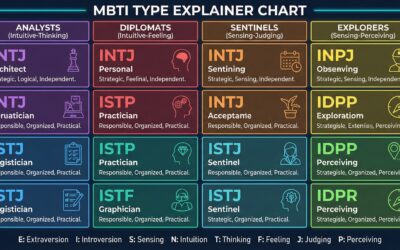
MBTI. The Myers-Briggs Type Indicator grew out of Jung’s Psychological Types (1921). INTP (introverted, intuitive, thinking, perceiving) shares the Sage’s love of ideas, logic and theory. INTJ (introverted, intuitive, thinking, judging) shares its long-range vision and pattern recognition, and its wish to master a field. For a more detailed Jungian map of type, see our post on the Beebe model of type.
The Sage in screenwriting and fiction
In plotting, the Sage’s job is to give the protagonist knowledge, guidance and perspective at the moment they cannot find it alone. Writers use the archetype in several recognisable forms:
- The Mentor. The Sage trains and supports the hero. Obi-Wan Kenobi in Star Wars (1977), Gandalf in The Lord of the Rings, Mr. Miyagi in The Karate Kid (1984), and Melchizedek, the king of Salem who tells the shepherd Santiago about his Personal Legend in Paulo Coelho’s The Alchemist (1988).
- The Oracle. The Sage offers insight or prophecy that shapes the hero’s choices. The Oracle in The Matrix (1999), who bakes cookies and tells Neo what he needs to hear rather than what is literally true; and Grandmother Willow in Pocahontas (1995).
- The Wise Fool. The Sage teaches through humour, riddles and odd behaviour. Yoda in The Empire Strikes Back (1980), who first appears as a comic little creature; Rafiki in The Lion King (1994), who mocks Simba into remembering who he is; and the Cheshire Cat in Lewis Carroll’s Alice’s Adventures in Wonderland (1865).
- The Fallen Mentor. The Sage fails their own wisdom. In Ovid’s Metamorphoses, the inventor Daedalus grows so jealous of his gifted pupil and nephew Perdix that he throws the boy from the Acropolis, and Athena turns Perdix into a partridge. The teacher who cannot bear to be surpassed is the Sage’s shadow in its plainest form.
- The Inner Sage. The protagonist meets their own wisdom through dreams, visions or reflection, often as the turning point of the story. Pocahontas’s conversations with Grandmother Willow, who keeps telling her to listen to her own heart, and Neo learning to trust his own knowing in The Matrix, are both stories in which the outer Sage hands the authority back to the hero.
Working with the Sage in therapy
At Taproot we see the Sage in therapy in two main shapes. The first is the over-identified Sage: the client who has read every book about their problem, can explain it better than most clinicians, and is still stuck. Their understanding is real, but it lives above the neck. The second is the exiled Sage: the client who has stopped trusting their own judgment, often after being shamed for curiosity or overruled for years.
With the over-identified Sage, we try not to compete in explanation. In Jungian therapy, we may work with dreams in which the dreamer meets an old man or woman, or a library, school or exam, and ask what the psyche is saying about the dreamer’s relationship to knowing. In parts work, we get curious about the thinking part itself: when it started, what it protects, what it fears would happen if it stopped. In body-based work such as Brainspotting, the client stays with a body sensation linked to an eye position, and the processing moves at a level below the narrative the Sage has been telling.
With the exiled Sage, the work runs the other way. We help the client notice moments when they already know what they think, give that knowing a voice, and work through the memories of humiliation that taught them to hide it. In both cases the aim is the same: a Sage that thinks with the whole person, mind, body and heart together.
The Sage is the part of the psyche that keeps asking what is true. When it is joined to feeling and to the body, it gives perspective, steadiness and the ability to help others see. When it is split off, it becomes a fortress. Much of depth therapy is the slow work of turning the fortress back into a home. To work with your own Sage, contact Taproot Therapy Collective.
Frequently asked questions
What is the Sage archetype in Jungian psychology?
In Jungian psychology the Sage corresponds to the Wise Old Man, or senex, which Jung described as an image of the archetype of spirit. It appears in dreams and fairy tales as an old figure who arrives when the hero is stuck, asks the right question and offers insight. Psychologically it stands for the capacity to reflect, step back and make meaning.
Did Carl Jung create the 12 archetypes?
No. Jung wrote about many archetypal images, including the Wise Old Man, the shadow, the anima and the self, but he never proposed a fixed list of twelve. The twelve-archetype system that includes the Sage was developed by Carol S. Pearson and published with Margaret Mark in The Hero and the Outlaw in 2001, drawing on Jungian ideas.
What are examples of the Sage archetype in movies and books?
Familiar Sage figures include Merlin in Arthurian legend, Gandalf in The Lord of the Rings, Dumbledore in the Harry Potter books, Obi-Wan Kenobi and Yoda in Star Wars, Mr. Miyagi in The Karate Kid, the Oracle in The Matrix, Rafiki in The Lion King, and Melchizedek in Paulo Coelho’s The Alchemist. Each gives the hero knowledge or perspective at a turning point.
What is the shadow side of the Sage archetype?
The shadow Sage shows up as intellectual arrogance, dogmatism, contempt for people who know less and detachment from feeling and practical life. Its most common defence is intellectualization, which Anna Freud described in 1936: explaining an experience so thoroughly that the feelings underneath never have to be felt. Jung warned of a related inflation he called the mana personality.
What Enneagram and MBTI types match the Sage archetype?
The Sage archetype overlaps most with Enneagram Type 5, the Investigator, and to a lesser degree Type 9, the Peacemaker. In the Myers-Briggs system it resembles INTP and INTJ, types driven by ideas, logic and pattern recognition. These links are loose: a person of any type can carry a strong Sage.
Related reading
- The Archetype’s in Brand Psychology: Building Authentic Identity Through Jung’s Timeless Wisdom
- Manly P. Hall and the Psychological Resurrection of Ancient Wisdom
- Helena Blavatsky and the Theosophical Legacy: Charlatanry, Wisdom, and the Unconscious Mind
- The Caregiver Archetype: Exploring the Nurturing side
- The Lover Archetype: Exploring Conection and Control
- The Everyman Archetype: Exploring the most relatable parts of self
References
- Jung, C. G. (1969). The archetypes and the collective unconscious (2nd ed., R. F. C. Hull, Trans.; Collected Works of C. G. Jung, Vol. 9, Part 1). Princeton University Press.
- Jung, C. G. (1966). Two essays on analytical psychology (2nd ed., R. F. C. Hull, Trans.; Collected Works of C. G. Jung, Vol. 7). Princeton University Press.
- Jung, C. G. (1963). Memories, dreams, reflections (A. Jaffé, Ed.; R. Winston & C. Winston, Trans.). Pantheon Books.
- Campbell, J. (1949). The hero with a thousand faces. Pantheon Books.
- Vogler, C. (2007). The writer’s journey: Mythic structure for writers (3rd ed.). Michael Wiese Productions.
- Mark, M., & Pearson, C. S. (2001). The hero and the outlaw: Building extraordinary brands through the power of archetypes. McGraw-Hill.
- Stevens, A. (1982). Archetype: A natural history of the self. Routledge & Kegan Paul.
- Siegel, D. J. (2006). An interpersonal neurobiology approach to psychotherapy: Awareness, mirror neurons, and neural plasticity in the development of well-being. Psychiatric Annals, 36(4), 248-256. https://doi.org/10.3928/00485713-20060401-06
- Schwartz, R. C., & Sweezy, M. (2020). Internal family systems therapy (2nd ed.). Guilford Press.
- Young, J. E., Klosko, J. S., & Weishaar, M. E. (2003). Schema therapy: A practitioner’s guide. Guilford Press.
- Stone, H., & Stone, S. (1989). Embracing our selves: The voice dialogue manual. Nataraj Publishing.
- Eliade, M. (1964). Shamanism: Archaic techniques of ecstasy (W. R. Trask, Trans.). Princeton University Press.
- Freud, A. (1937). The ego and the mechanisms of defence (C. Baines, Trans.). Hogarth Press.
- Baltes, P. B., & Staudinger, U. M. (2000). Wisdom: A metaheuristic (pragmatic) to orchestrate mind and virtue toward excellence. American Psychologist, 55(1), 122-136. https://doi.org/10.1037/0003-066X.55.1.122
- Ardelt, M. (2003). Empirical assessment of a three-dimensional wisdom scale. Research on Aging, 25(3), 275-324. https://doi.org/10.1177/0164027503025003004










0 Comments