
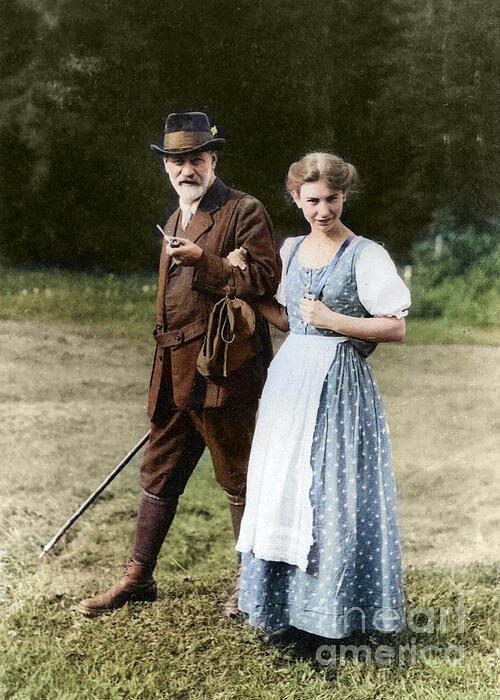
Anna Freud’s 1936 book The Ego and the Mechanisms of Defence turned defense into a working clinical catalogue. She gathered ten mechanisms already described in psychoanalytic writing, most of them by her father (regression, repression, reaction formation, isolation, undoing, projection, introjection, turning against the self, reversal and sublimation) and described others in detail: denial in fantasy, identification with the aggressor, altruistic surrender, and the asceticism and intellectualization of adolescence.
Her real change was one of attention. Many analysts of her time treated defenses as rubble to dig past on the way to buried wishes. She argued that the defenses are the evidence: how a person keeps something out of awareness shows what the danger was and how they learned to survive it. She brought the same protective instinct to her father’s papers. And the idea most tied to her name shows what her framing left out. Identification with the aggressor, which she made famous in 1936, had been put forward four years earlier by Sándor Ferenczi as something darker: not a defense, but what happens to a child when defense fails.
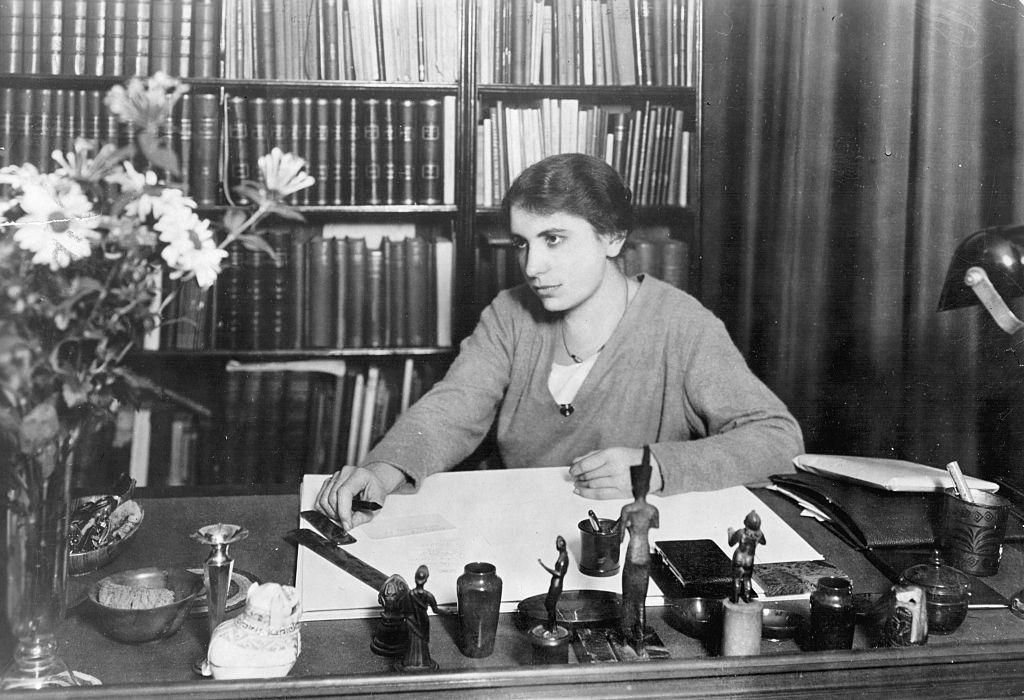
The 1936 book and what it actually claimed
She wrote Das Ich und die Abwehrmechanismen in Vienna, where she had become director of the psychoanalytic training institute in 1935; it appeared in German in 1936 and in Cecil Baines’s English translation from the Hogarth Press in 1937.1 Against analysts who saw a turn “from the id to the ego” as a kind of apostasy, she argued that the ego is “the medium through which we try to get a picture of the other two institutions,” so the analyst “takes his stand at a point equidistant from the id, the ego and the super-ego.”1
She did not invent the defenses on her list, and she said so. She traced the word “defence” to her father’s 1894 paper on the defence neuro-psychoses, named nine mechanisms “very familiar in the practice,” and added a tenth, “sublimation, or displacement of instinctual aims,” which belonged “rather to the study of the normal.”1 The old claim that projection, repression and displacement were her concepts is wrong: she organized mechanisms that Sigmund Freud and other analysts had already described.
What she added was method. In children she noticed that a feeling often arrives transformed: indifference where you would expect disappointment, high spirits in place of mortification, excessive tenderness instead of jealousy. Tracing the transformation shows how a particular ego defends itself: “His affects betray themselves against his will.” She then described defenses against outside danger (denial in fantasy, denial in word and act, restriction of the ego), identification with the aggressor, altruistic surrender (a term she credited to Edward Bibring), and the asceticism and intellectualization of puberty.1
She, Heinz Hartmann and David Rapaport are usually named as the analysts most responsible for turning these ideas into the school of ego psychology. Jacques Lacan rejected the project of shoring up the ego, as our overview of Lacanian psychoanalysis and its quarrel with the ego explains. Heinz Kohut, closer to ego psychology, developed self psychology in the late 1960s and put the self, rather than its defenses, at the center.
Identification with the aggressor: Ferenczi got there first
Ferenczi read the paper later published as “Confusion of Tongues between Adults and the Child” to the International Psychoanalytical Congress in Wiesbaden in September 1932. The German text appeared in 1933, the year he died; an English translation waited until 1949.2 His subject was the sexual abuse of children. The child, he wrote, is too weak even to protest in thought; at the peak of fear it submits automatically, guesses and follows the aggressor’s wishes, forgets itself and identifies with him completely. The attacker becomes an inner reality instead of an outer one, and the child takes in the adult’s guilt too, coming away split, innocent and guilty at once. The weak personality, he concluded, answers sudden unpleasure “instead of with defence, with anxious identification and introjection of the menacing or attacking person” (our translation from the 1933 German).2
Anna Freud’s chapter does not cite Ferenczi, and her examples are everyday. August Aichhorn’s schoolboy pulls faces whenever his teacher scolds him, and the faces turn out to caricature the teacher’s anger. A little girl afraid of ghosts in a dark hall tells her brother, “you just have to pretend that you’re the ghost who might meet you.” Her summary: “By impersonating the aggressor, assuming his attributes or imitating his aggression, the child transforms himself from the person threatened into the person who makes the threat.” She called this “a by no means uncommon stage in the normal development of the super-ego,” one that turns pathological when carried into love relationships.1
So the two ideas share a name and point at different problems. Hers is an ego mastering a threat; his is an ego overrun, closer to dissociation, and recent trauma research builds mostly on Ferenczi’s theory of trauma. Jay Frankel argued that under inescapable threat we “become” what the attacker expects of us, and that the habit can harden into masochism and chronic hypervigilance.3 Elizabeth Howell described a process that starts automatically and becomes defensive with repetition, organized as linked victim and aggressor self-states, and used it to explain dissociative structure and dissociative identity disorder.4 On Yael Lahav and colleagues’ Identification With the Aggressor Scale, students who had been abused as children scored higher, as did those whose abuse was more severe or recurrent or came from a parent figure, and scores tracked dissociation, PTSD symptoms and posttraumatic guilt.5 Among women students abused as children, one subscale (replacing one’s own agency with the perpetrator’s) went with more revictimization and another (hypersensitivity to the perpetrator) with less.6 These cross-sectional self-report studies show the idea can be measured, not that it causes anything.
From a Vienna classroom to the Hampstead nurseries
Anna Freud was born in Vienna on 3 December 1895, the youngest of Sigmund and Martha Freud’s six children and the only one to become a psychoanalyst.7 She had no medical degree; she qualified as a teacher in 1914 and taught until illness ended it in 1920. Her father began analyzing her in October 1918, something no training program would allow today. In 1922 she presented “Beating Fantasies and Daydreams” to the Vienna Psychoanalytic Society and became a member; historians read its fifteen-year-old “case” as largely herself.7
The teacher shaped the clinician. Her 1927 book on child analysis argued that work with young children needed an educational element until the child’s ego was ready for interpretation alone. Dorothy Burlingham, a Tiffany heiress, brought her four children to Vienna for analysis in 1925 and became Anna Freud’s lifelong partner; with Eva Rosenfeld they opened a small school in Hietzing where Erik Erikson taught, and Erikson did his training analysis with Anna Freud.7
After her father’s jaw cancer was diagnosed in 1923 she became his nurse, secretary and spokesperson. After the Anschluss in 1938 the Gestapo questioned her about the International Psychoanalytical Association; she was released, the family reached London that June, and her father died there in September 1939.7
In January 1941 she and Burlingham opened the Hampstead War Nurseries for children whose family lives the war had broken up. They were not orphanages; mothers were encouraged to visit. Their reports, including Infants Without Families, followed how young children react to separation and seek substitute affection, including from other children.8 James Robertson worked there, later joined John Bowlby at the Tavistock Clinic and in 1952 filmed A Two-Year-Old Goes to Hospital. That, not Harry Harlow or Mary Ainsworth as the old page claimed, is the line from Hampstead to attachment research. After the war she and Sophie Dann described young concentration-camp survivors raised together in England,9 and Suzanne Stewart-Steinberg reads her work with such wartime orphans as showing children who built a self through lateral ties to one another rather than vertical ties to a father.10
Klein, the Controversial Discussions and Hampstead
The quarrel with Melanie Klein went back to the 1920s. Klein interpreted a child’s play as the equivalent of free association; Anna Freud wanted an educational approach until the ego matured, which Klein saw as collusion.7 In London the Controversial Discussions of October 1942 to February 1944 kept the British Psychoanalytical Society from splitting, and an agreement formalized in 1946 set up parallel training courses and gave seats on the Society’s key committees to three groups: Kleinians, Anna Freudians and a non-aligned Middle Group, where Donald Winnicott sat.11 The old page claimed she ran the International Psychoanalytical Association and boxed Winnicott in; she was its secretary until 1934 and honorary president from 1973, and the British settlement shared power among all three groups. The Kleinian side is in our piece on Melanie Klein’s theories of the infant mind.
Her developmental model took shape at the Hampstead Child Therapy Course (1947) and Clinic (1952), now the London charity Anna Freud.7 In Normality and Pathology in Childhood (1965) she proposed developmental lines, such as the line from dependency to emotional self-reliance, for judging a child’s growth area by area rather than by symptoms.12 Seminars at Yale Law School led to Beyond the Best Interests of the Child (1973), written with Joseph Goldstein and Albert Solnit.13 She died in London on 9 October 1982.
Guarding her father’s papers: the Fliess letters, the archives and Masson
The charge that she curated her father’s history has a basis. Freud’s letters to Wilhelm Fliess survived because Marie Bonaparte bought them and refused Freud’s request to destroy them. The 1954 English edition, The Origins of Psycho-Analysis, edited by Bonaparte, Anna Freud and Ernst Kris, was incomplete;14 the full letters appeared only in 1985, in Jeffrey Masson’s edition, after Masson persuaded Anna Freud to release them.15
The Sigmund Freud Archives was founded in 1951 by New York analysts including Kurt Eissler, Heinz Hartmann and Ernst Kris, and gave its collection to the Library of Congress from 1952. Anna Freud transferred many of her father’s papers in 1970 and left the rest to the Archives at her death.16 Eissler, its director for decades, kept many documents closed over the objections of historians such as Peter Gay and Peter Swales. The old page’s claim that Anna Freud sealed papers “until 2113” finds no support in the Library’s account, which does not attribute the restrictions to her: most expired in 2000, the collection was digitized in 2016 and 2017, and only interviews with five people remain closed.16 Our post on the sealed Freud archives at the Library of Congress has the details.
Masson, a Sanskrit scholar turned analyst, was hired as projects director of the Archives in 1980 by Eissler and Anna Freud herself. In a 1981 lecture in New Haven he argued that Freud dropped the seduction theory to protect psychoanalysis; the New York Times reported his views, and the Archives’ board fired him.17 The Assault on Truth (1984) made the case.18 Janet Malcolm’s reporting became In the Freud Archives.19 Masson sued her and The New Yorker for libel over her quotations; the Supreme Court revived the suit in 1991,17 and he lost at trial in 1994.
Masson did not discover that Freud changed his mind; Freud said so publicly from 1906, and Masson’s argument was about motive. We found no source for the old page’s claim that he called psychoanalysis a “sterile cult.” His thesis has problems of its own: Allen Esterson argues that Freud’s later accounts of the episode, the foundation of Masson’s case, are false.20
Did she put the myth of her father ahead of the truth of his patients? She guarded the legacy hard and also let it be opened: she co-edited the incomplete Fliess edition and backed an archive that kept scholars waiting, then transferred many of the papers to the Library of Congress, helped hire Masson and agreed to the complete Fliess edition that armed her father’s harshest critic. Stewart-Steinberg’s study offers an Anna Freud who “betrays” her father even as she protects his legacy.10 For the case that concealment ran deeper, see the documentary evidence of cover-ups in the Freud legacy.
What research says about defense mechanisms now
Academic psychology set defense aside for years; Phebe Cramer’s 2000 review traced its return as researchers confirmed unconscious processing and found defensive processes in their own data.21 The support is uneven. Roy Baumeister and colleagues found good evidence for reaction formation, isolation and denial as protections of self-esteem; undoing appeared but did not seem to defend against anything; projection appeared, perhaps as a by-product; displacement was poorly supported; and they found no evidence of sublimation.22 The tenth item on her list, the one she tied to normal life, is the one that review found no evidence for at all.
Clinicians ranked defenses by how adaptive they are. George Vaillant argued that, despite problems with reliability, defensive style is a valid diagnostic axis, especially for personality disorders.23 J. Christopher Perry turned Vaillant’s hierarchy into the Defense Mechanism Rating Scales, which sort 30 defenses into seven levels; research with the scales, Perry and a colleague write, helped persuade the American Psychiatric Association to put a provisional defense axis in DSM-IV.24 In Perry and Michael Bond’s study of 21 adults in long-term dynamic psychotherapy, defensive functioning improved, and change by two and a half years went with better functioning and fewer symptoms at five years.25 In a randomized trial of 47 outpatients in cognitive-behavioral therapy, defensive functioning also improved.26 Both studies are small, and neither shows that interpreting defenses produces the change. They show that defenses can be rated and that they shift in more than one kind of therapy.
What this looks like in therapy
Her working rule still fits an ordinary therapy hour: look at the defense before the content. A client who narrates a painful history in a calm lecturing voice is showing you intellectualization first. A shrug at a betrayal may be the expected feeling turned into its opposite. A life lived through other people’s ambitions may be altruistic surrender. Naming these patterns gently, and wondering with the client what they protect against, is the starting point; arguing with them is not.
She also knew when not to push. When a defense exists because a person fears being overwhelmed from inside, stripping it away can “weaken the ego still further,” she warned; a child’s capacity to tolerate “pain” has to be built, a job she gave more to education than to analysis.1 Trauma treatment now sequences work in a similar spirit: in a 2011 survey of 50 traumatic-stress experts, 84 percent endorsed a phase-based or sequenced approach to complex PTSD. That is expert consensus, not trial evidence.27
Both versions of identification with the aggressor turn up in trauma work. Anna Freud’s looks like the inner critic that speaks in a parent’s exact words, or the person who turns harsh the moment they feel small. Ferenczi’s looks like someone who reads what an angry partner wants before it is said and loses their own view in the process. In dissociation-informed therapy, Howell’s map of victim and aggressor self-states is practical: the part that sounds like the abuser began as a way to survive, so therapists in this tradition treat it as a part with a history to understand, not an enemy to remove.4 With children, the game played the week after a frightening event, when the frightened child becomes the doctor or the ghost, can say more than the child’s account; that kind of play is part of our child and teen therapy.
If you recognize an inner critic that sounds like someone who hurt you, or a habit of disappearing into what other people need, it can help to look at it with someone who treats defenses as protection rather than failure. You can read how we approach parts-based therapy in Alabama, or contact Taproot Therapy Collective with a question.
References
- Freud, A. (1937). The ego and the mechanisms of defence (C. Baines, Trans.). Hogarth Press and the Institute of Psycho-Analysis. (Original work published 1936)
- Ferenczi, S. (1933). Sprachverwirrung zwischen den Erwachsenen und dem Kind: Die Sprache der Zärtlichkeit und der Leidenschaft. Internationale Zeitschrift für Psychoanalyse, 19(1/2), 5–15. English translation reprinted as Ferenczi, S. (1988). Confusion of tongues between adults and the child. Contemporary Psychoanalysis, 24(2), 196–206. https://doi.org/10.1080/00107530.1988.10746234
- Frankel, J. (2002). Exploring Ferenczi’s concept of identification with the aggressor: Its role in trauma, everyday life, and the therapeutic relationship. Psychoanalytic Dialogues, 12(1), 101–139. https://doi.org/10.1080/10481881209348657
- Howell, E. F. (2014). Ferenczi’s concept of identification with the aggressor: Understanding dissociative structure with interacting victim and abuser self-states. The American Journal of Psychoanalysis, 74(1), 48–59. https://doi.org/10.1057/ajp.2013.40
- Lahav, Y., Talmon, A., & Ginzburg, K. (2021). Knowing the abuser inside and out: The development and psychometric evaluation of the Identification With the Aggressor Scale. Journal of Interpersonal Violence, 36(19–20), 9725–9748. https://doi.org/10.1177/0886260519872306
- Lahav, Y., Talmon, A., Ginzburg, K., & Spiegel, D. (2019). Reenacting past abuse: Identification with the aggressor and sexual revictimization. Journal of Trauma & Dissociation, 20(4), 378–391. https://doi.org/10.1080/15299732.2019.1572046
- Young-Bruehl, E. (1988). Anna Freud: A biography. Summit Books.
- Freud, A., & Burlingham, D. T. (1944). Infants without families. International Universities Press.
- Freud, A., & Dann, S. (1951). An experiment in group upbringing. The Psychoanalytic Study of the Child, 6(1), 127–168. https://doi.org/10.1080/00797308.1952.11822909
- Stewart-Steinberg, S. (2012). Impious fidelity: Anna Freud, psychoanalysis, politics. Cornell University Press. https://doi.org/10.7591/9780801463334
- King, P., & Steiner, R. (Eds.). (1991). The Freud-Klein controversies, 1941–45. Tavistock/Routledge.
- Freud, A. (1965). Normality and pathology in childhood: Assessments of development. International Universities Press.
- Goldstein, J., Freud, A., & Solnit, A. J. (1973). Beyond the best interests of the child. Free Press.
- Freud, S. (1954). The origins of psycho-analysis: Letters to Wilhelm Fliess, drafts and notes, 1887–1902 (M. Bonaparte, A. Freud, & E. Kris, Eds.; E. Mosbacher & J. Strachey, Trans.). Basic Books. (Original work published 1950)
- Freud, S. (1985). The complete letters of Sigmund Freud to Wilhelm Fliess, 1887–1904 (J. M. Masson, Ed. & Trans.). Belknap Press of Harvard University Press.
- Library of Congress. (n.d.). Brief history of the collection. Sigmund Freud Papers, Manuscript Division. Retrieved November 8, 2026, from https://www.loc.gov/collections/sigmund-freud-papers/articles-and-essays/brief-history-of-the-collection/
- Masson v. New Yorker Magazine, Inc., 501 U.S. 496 (1991). https://www.law.cornell.edu/supremecourt/text/501/496
- Masson, J. M. (1984). The assault on truth: Freud’s suppression of the seduction theory. Farrar, Straus and Giroux.
- Malcolm, J. (1984). In the Freud archives. Knopf.
- Esterson, A. (1998). Jeffrey Masson and Freud’s seduction theory: A new fable based on old myths. History of the Human Sciences, 11(1), 1–21. https://doi.org/10.1177/095269519801100101
- Cramer, P. (2000). Defense mechanisms in psychology today: Further processes for adaptation. American Psychologist, 55(6), 637–646. https://doi.org/10.1037/0003-066X.55.6.637
- Baumeister, R. F., Dale, K., & Sommer, K. L. (1998). Freudian defense mechanisms and empirical findings in modern social psychology: Reaction formation, projection, displacement, undoing, isolation, sublimation, and denial. Journal of Personality, 66(6), 1081–1124. https://doi.org/10.1111/1467-6494.00043
- Vaillant, G. E. (1994). Ego mechanisms of defense and personality psychopathology. Journal of Abnormal Psychology, 103(1), 44–50. https://doi.org/10.1037/0021-843X.103.1.44
- Di Giuseppe, M., & Perry, J. C. (2021). The hierarchy of defense mechanisms: Assessing defensive functioning with the Defense Mechanisms Rating Scales Q-Sort. Frontiers in Psychology, 12, Article 718440. https://doi.org/10.3389/fpsyg.2021.718440
- Perry, J. C., & Bond, M. (2012). Change in defense mechanisms during long-term dynamic psychotherapy and five-year outcome. American Journal of Psychiatry, 169(9), 916–925. https://doi.org/10.1176/appi.ajp.2012.11091403
- Babl, A., Grosse Holtforth, M., Perry, J. C., Schneider, N., Dommann, E., Heer, S., Stähli, A., Aeschbacher, N., Eggel, M., Eggenberg, J., Sonntag, M., Berger, T., & Caspar, F. (2019). Comparison and change of defense mechanisms over the course of psychotherapy in patients with depression or anxiety disorder: Evidence from a randomized controlled trial. Journal of Affective Disorders, 252, 212–220. https://doi.org/10.1016/j.jad.2019.04.021
- Cloitre, M., Courtois, C. A., Charuvastra, A., Carapezza, R., Stolbach, B. C., & Green, B. L. (2011). Treatment of complex PTSD: Results of the ISTSS expert clinician survey on best practices. Journal of Traumatic Stress, 24(6), 615–627. https://doi.org/10.1002/jts.20697












0 Comments