

Carl Jung never named twelve archetypes. He wrote that there are as many archetypes as there are typical situations in life. The popular list of twelve, from the Innocent and the Sage to the Jester and the Ruler, comes from Margaret Mark and Carol S. Pearson’s 2001 branding book The Hero and the Outlaw, which reworked a set of twelve Pearson published in 1991.
That history matters more than it looks. Pearson built her archetypes as stages of development, roles a person grows into over a lifetime. Mark and Pearson then sorted them into a grid of consumer motives. Used as roles, the twelve are a handy way to ask what a person leans on too hard and what they have never been allowed to try. Used as personality types (“I am a Sage”), they turn Jung’s idea upside down. For Jung, an archetype is not who you are. It is a pattern that can take hold of you, and the trouble starts when you mistake it for yourself.
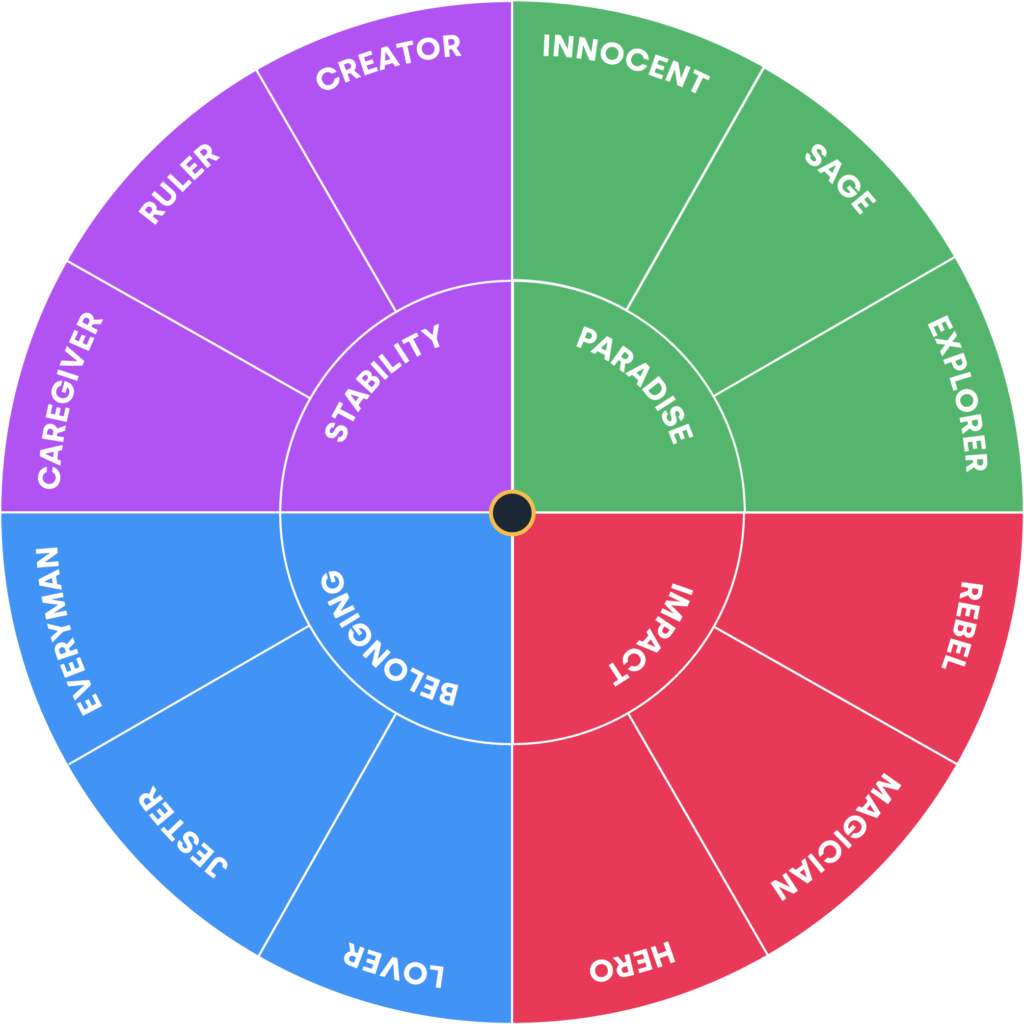
Did Jung identify twelve archetypes?
No. In “The Concept of the Collective Unconscious,” a 1936 lecture at St. Bartholomew’s Hospital in London that was printed in the hospital’s journal, Jung put it flatly: “There are as many archetypes as there are typical situations in life.” Repeated human experience, he argued, had left its mark on the psyche “not in the form of images filled with content, but at first only as forms without content, representing merely the possibility of a certain type of perception and action.”1 The list stays open because typical situations are open-ended.
He was just as firm that an archetype has no fixed content. In his essay on the mother archetype he wrote that “archetypes are not determined as regards their content, but only as regards their form and then only to a very limited degree,” and compared the archetype to the axial system of a crystal. The axis sets the geometry, but every actual crystal comes out differently. The archetype in itself, he said, is “empty and purely formal,” a possibility of representation.2 In a footnote to another essay in the same volume he drew the line more sharply: “The archetype as such is a hypothetical and irrepresentable model, something like the ‘pattern of behaviour’ in biology.” And the archetype itself, he wrote, “is altered by becoming conscious and by being perceived, and it takes its colour from the individual consciousness in which it happens to appear.”3
Jung did write about particular figures: the volume of his Collected Works on archetypes has essays on the mother, rebirth, the child, the Kore or maiden, the spirit as it shows up in fairytales, the trickster and the anima. But he treated these as recurring images worth studying, never as a complete set, and he did not use them to sort people into personality types. When a site, a quiz or a course says “Jung identified twelve archetypes,” it is passing off a later system under his name.
Where the twelve came from
The twelve start with Carol S. Pearson, who worked in the Women’s Studies Program at the University of Maryland and wrote The Hero Within: Six Archetypes We Live By (1986; expanded edition 1989) on a sabbatical from the university. Her six were the Innocent, the Orphan, the Wanderer, the Warrior, the Martyr and the Magician. She said the book “could not have been written without the insights of post-Jungian theorists James Hillman and Joseph Campbell,” and she also credited developmental psychologists such as William Perry, Lawrence Kohlberg and Carol Gilligan. That second debt is the key: Pearson’s archetypes were developmental stages, which she called “additive and not strictly linear.”4
She was also candid about what she was doing. “Archetypes are numerous,” she wrote. She picked six as the ones with the most influence on development in Western culture; a book about heroism in African or Japanese culture, she said, “would be quite different.” In her acknowledgments she described her standard of truth as “not an external measure but my own practical knowledge.”4 That is an honest account of a practitioner’s synthesis, not a research finding.
In Awakening the Heroes Within (1991) Pearson expanded the set to twelve and arranged them as three movements of a hero’s journey. Preparation holds the Innocent, Orphan, Warrior and Caregiver. The Journey holds the Seeker, Destroyer, Lover and Creator. The Return holds the Ruler, Magician, Sage and Fool. The book ends with an appendix titled the Heroic Myth Index.5 Here the Warrior is one early stage, not a destination.
The list that usually circulates as “the twelve Jungian archetypes” is the 2001 revision. Margaret Mark, a former executive vice president of the advertising agency Young & Rubicam, where she worked for sixteen years, co-wrote The Hero and the Outlaw: Building Extraordinary Brands Through the Power of Archetypes with Pearson. They regrouped twelve figures on a grid of two tensions, belonging against independence and stability against risk and mastery, and filed real brands under each: Nike as the Hero, Harley-Davidson as the Outlaw, Ivory as the Innocent, Hallmark as the Lover, Oprah’s Book Club as the Sage.6
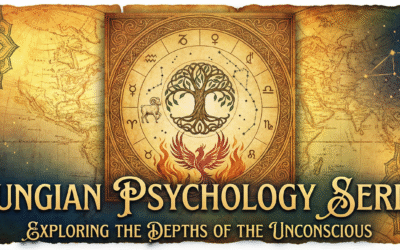
The renaming tells you what kind of document this is. The Seeker became the Explorer, which the book says “also may be known as the seeker.” The Fool became the Jester. The Orphan survives only as the first “level” of the Regular Guy/Gal, the figure the wheel above calls the Everyman. The Destroyer gave way to the Outlaw, whose stated goal is “to destroy what is not working.” Most telling of all, the Warrior was renamed the Hero. A footnote explains that Pearson’s earlier books had argued that the hero’s journey runs through all twelve archetypes and had criticized “the popular confusion of the Hero with the Warrior only.” For branding, the authors went with the popular usage, because “the term ‘Hero’ helps people identify with the more positive aspects of this archetype.”6 That is a sound marketing decision. It is not a discovery about the psyche.
Pearson was not the only author to pick a number. Robert Moore and Douglas Gillette built a psychology of men around four figures in King, Warrior, Magician, Lover (1990), a model our post on finding your inner warrior when you are scared draws on.7 Jean Shinoda Bolen organized hers around Greek goddesses in 1984 and Greek gods in 1989, work we come back to in our piece on the shadow side of the feminine archetypes.8,9 Each count is an author’s design choice. None is Jung’s, because Jung did not keep a list.
The twelve archetypes at a glance
Here is the 2001 set as it usually circulates, grouped by the motives Mark and Pearson assigned, with what they said each archetype helps people do, lightly paraphrased.6 The third column gives the nearest figure from Pearson’s 1991 twelve.5 The last column is a clinical reading of the role when it is overused. It is my reading, not a quotation from either book. Each name links to our longer post on that archetype.
| Archetype | Helps people | 1991 relative | When the role takes over |
|---|---|---|---|
| Independence and fulfillment (the “Paradise” quadrant) | |||
| Innocent | Retain or renew faith | Innocent | Denial; insisting nothing is wrong |
| Explorer | Maintain independence | Seeker | Leaving before anything can hold you |
| Sage | Understand their world | Sage | Analysis as a hiding place from feeling |
| Risk and mastery (the “Impact” quadrant) | |||
| Hero | Act courageously | Warrior | Every problem becomes a fight |
| Outlaw or Rebel | Break the rules | Destroyer (loosely) | Opposition as an identity |
| Magician or Wizard | Bring about transformation | Magician | Control dressed up as insight |
| Belonging and enjoyment | |||
| Everyman (Regular Guy/Gal) | Be OK just as they are | Orphan | Disappearing into the group |
| Lover | Find and give love | Lover | Losing yourself in another person |
| Jester | Have a good time | Fool | Joking so that nothing lands |
| Stability and control | |||
| Caregiver | Care for others | Caregiver | Self-erasure, resentment, burnout |
| Creator | Craft something new | Creator | Perfectionism; nothing gets finished |
| Ruler | Exert control | Ruler | Control that cannot tolerate disorder |
Five of the twelve were renamed or replaced between 1991 and 2001, so even within Pearson’s own work the set was never fixed. And the grouping is about what a customer wants, which is why it sits so easily on brands; our post on archetypes in brand psychology looks at that use.
What the research says
Two questions often get blurred here. One is whether archetypes exist in Jung’s strong sense, as inherited forms shared by every human mind. The other is whether the twelve describe how people actually differ.
On the first question the debate has run for decades without settling. Andrew Neher, writing in the Journal of Humanistic Psychology, found Jung’s claims that archetypes reach beyond the individual “seriously flawed,” while granting that the idea of a genetic basis for some unconscious content “holds some promise.”10 Christian Roesler reviewed the debate in light of genetics and neuroscience and concluded that “there is still no firm scientific foundation” for the claim that complex symbolic patterns such as the hero myth are passed on in a way that gives every person access to them. His title asks whether archetypes are transmitted more by culture than by biology.11 Two years earlier, in the same journal, Erik Goodwyn had questioned what he described as a growing consensus that the inborn archetype should be abandoned for more developmental and “emergent” theories.12 Our longer piece on whether Jungian archetypes can be evidence-based follows that argument further.
On the second question the evidence is thin. Mark and Pearson’s quantitative case rested on Young & Rubicam’s BrandAsset Valuator, the agency’s own large survey of consumer attitudes toward brands, analyzed with an algorithm Mark developed there with two colleagues.6 It measures how people see brands, not how people are built. Pearson also designed, with Hugh Marr, a questionnaire meant to identify the archetypes most active in a person, the Pearson-Marr Archetype Indicator, published in 2000 by the Center for Applications of Psychological Type.6
A study from personality psychology points away from a neat twelve. Michael Faber and John Mayer, writing in the Journal of Research in Personality, built a scale from archetypal characters in popular music, film and classic art and measured how strongly people responded to them. People’s responses fell into five clusters, and that resonance did predict their life themes and media tastes.13 People do respond to archetypal characters in ways that say something about them, but the responses did not sort into twelve. A 2016 marketing study had 102 executive MBA students watch two hotel commercials, take an archetype test and rate the brands’ personalities, and it reported “common ground” between the archetypes and Aaker’s brand-personality framework.14 That is useful for advertisers. It says little about the structure of a person.
The fair summary is this: the twelve are a reasonable vocabulary for characters, stories and brands. We found no good evidence that human personality divides into these twelve types.
Roles, not types
The deeper problem with “which archetype are you?” is that it runs against Jung’s clinical thinking. For Jung, an archetype becomes active when a situation calls it up, and then “a compulsiveness appears, which, like an instinctual drive, gains its way against all reason and will.”1 The danger he named was identification. “The characteristic feature of a pathological reaction is, above all, identification with the archetype,” he wrote, and it “produces a sort of inflation and possession.” He added that “you do not ‘make’ an identification”; you are “possessed by it” without knowing it, and in more difficult cases it is “far more necessary to strengthen and consolidate the ego than to understand and assimilate the products of the unconscious.”15 A quiz that hands you an archetype as an identity is a mild, playful version of the same move. It points attention the wrong way, toward becoming the pattern rather than noticing it.
Those quizzes also feel more accurate than they are. In a classroom demonstration published in 1949, the psychologist Bertram Forer gave his students what they believed were individual personality sketches. Every student got the same generic text, and the class rated it as a good description of themselves.16 An archetype profile written in warm, general language can work the same way.
An earlier version of this page paired archetypes with Myers-Briggs types, crediting the pairings to Isabel Myers’s 1962 manual, and with Enneagram numbers. That manual appeared more than twenty years before The Hero Within, so it could not have mapped Pearson’s archetypes, and we found no source for the Enneagram pairings either. The Myers-Briggs indicator has its own well-documented psychometric limits, which call for caution about any four-letter type.17 The earlier version also tied archetypes to back pain, skin problems and immune function. We found no research behind those links, and they have been removed.
What this looks like in therapy
In depth-oriented therapy the question is rarely “what type am I?” It is closer to “what role has become compulsory, and what did it once protect?” The caregiver who cannot accept help, the hero who cannot stop fighting, the jester whose humor ends every hard conversation, the sage who explains a feeling instead of having it: each is a capacity that worked once and now runs without permission. The work is in seeing when it switches on, what it costs, and which roles never got room at all. In couples, these roles can end up divided between partners; our post on how archetypes show up in relationships covers love and projection.
Images usually tell a therapist more than labels do. Because an archetypal image takes its color from the person in whom it appears,3 the particular figure in a dream, a recurring fantasy or a guided imaginal exercise carries details no category can supply. Our post on archetype meditation covers one way of working with such images. Parts-based approaches such as Internal Family Systems therapy work in a related way: a pattern that dominates someone’s life is approached as a part with a protective job, not as who the person is.
Jung’s caution about ego strength matters here too. For someone with a trauma history or a fragile sense of self, powerful archetypal material is approached slowly, and stability comes first. Nothing about the twelve replaces ordinary clinical judgment. At their best they give client and therapist a shared, nonclinical language for patterns that are otherwise hard to name.
If one of these roles has quietly taken over your life, it can help to look at it with someone trained to work with dreams, images and parts. Our Jungian depth therapy in Hoover page explains how we approach that work, and you can reach us through our contact page with questions.
References
- Jung, C. G. (2014). The concept of the collective unconscious (R. F. C. Hull, Trans.). In H. Read, M. Fordham, G. Adler, & W. McGuire (Eds.), The collected works of C. G. Jung: Vol. 9, Part 1. The archetypes and the collective unconscious (2nd ed., pp. 42–53). Princeton University Press. https://doi.org/10.1515/9781400850969.42 (Original work published 1936). Quotations from paragraph 99.
- Jung, C. G. (2014). Psychological aspects of the mother archetype (R. F. C. Hull, Trans.). In H. Read, M. Fordham, G. Adler, & W. McGuire (Eds.), The collected works of C. G. Jung: Vol. 9, Part 1. The archetypes and the collective unconscious (2nd ed., pp. 75–110). Princeton University Press. https://doi.org/10.1515/9781400850969.75 (Original work published 1938). Quotations from paragraph 155.
- Jung, C. G. (2014). Archetypes of the collective unconscious (R. F. C. Hull, Trans.). In H. Read, M. Fordham, G. Adler, & W. McGuire (Eds.), The collected works of C. G. Jung: Vol. 9, Part 1. The archetypes and the collective unconscious (2nd ed., pp. 3–41). Princeton University Press. https://doi.org/10.1515/9781400850969.3 (Original work published 1934). Quotations from paragraph 6 and its note 9.
- Pearson, C. S. (1989). The hero within: Six archetypes we live by (Expanded ed.). Harper & Row. (Original work published 1986)
- Pearson, C. S. (1991). Awakening the heroes within: Twelve archetypes to help us find ourselves and transform our world. HarperSanFrancisco.
- Mark, M., & Pearson, C. S. (2001). The hero and the outlaw: Building extraordinary brands through the power of archetypes. McGraw-Hill.
- Moore, R., & Gillette, D. (1990). King, warrior, magician, lover: Rediscovering the archetypes of the mature masculine. HarperSanFrancisco.
- Bolen, J. S. (1984). Goddesses in everywoman: A new psychology of women. Harper & Row.
- Bolen, J. S. (1989). Gods in everyman: A new psychology of men’s lives and loves. Harper & Row.
- Neher, A. (1996). Jung’s theory of archetypes: A critique. Journal of Humanistic Psychology, 36(2), 61–91. https://doi.org/10.1177/00221678960362008
- Roesler, C. (2012). Are archetypes transmitted more by culture than biology? Questions arising from conceptualizations of the archetype. Journal of Analytical Psychology, 57(2), 223–246. https://doi.org/10.1111/j.1468-5922.2011.01963.x
- Goodwyn, E. (2010). Approaching archetypes: Reconsidering innateness. Journal of Analytical Psychology, 55(4), 502–521. https://doi.org/10.1111/j.1468-5922.2010.01862.x
- Faber, M. A., & Mayer, J. D. (2009). Resonance to archetypes in media: There’s some accounting for taste. Journal of Research in Personality, 43(3), 307–322. https://doi.org/10.1016/j.jrp.2008.11.003
- Bechter, C., Farinelli, G., Daniel, R.-D., & Frey, M. (2016). Advertising between archetype and brand personality. Administrative Sciences, 6(2), Article 5. https://doi.org/10.3390/admsci6020005
- Jung, C. G. (2014). A study in the process of individuation (R. F. C. Hull, Trans.). In H. Read, M. Fordham, G. Adler, & W. McGuire (Eds.), The collected works of C. G. Jung: Vol. 9, Part 1. The archetypes and the collective unconscious (2nd ed., pp. 290–354). Princeton University Press. https://doi.org/10.1515/9781400850969.290 (Original work published 1934). Quotations from paragraph 621.
- Forer, B. R. (1949). The fallacy of personal validation: A classroom demonstration of gullibility. Journal of Abnormal and Social Psychology, 44(1), 118–123. https://doi.org/10.1037/h0059240
- Pittenger, D. J. (2005). Cautionary comments regarding the Myers-Briggs Type Indicator. Consulting Psychology Journal: Practice and Research, 57(3), 210–221. https://doi.org/10.1037/1065-9293.57.3.210







0 Comments