
Somatic therapy and CBT differ mainly in where change starts. Cognitive behavioral therapy works from the top down: it targets the thoughts and habits that keep distress going, using structured conversation, worksheets and practice between sessions. Somatic and experiential therapies work from the bottom up, with what the body and emotions are doing in the room right now. For PTSD, trauma-focused CBT has the larger research base.
Trauma often persists less as a belief than as a learned body state: a pulse that jumps, a throat that closes, a fog that arrives before any thought does. You can know you are safe and still feel the alarm. One influential account of how therapy works holds that lasting change needs the old state active in the room while something new happens to it.1 Experiential and somatic methods are built to evoke that state directly. Cognitive methods mostly approach it through words and planned exposure. That is why we pair experiential work with EMDR and brainspotting at Taproot, and why the honest answer to “which is better?” depends on where a person is stuck.

I have written quite a bit about how experiential and somatic therapies are the pathway to the subcortical brain and, in my view, the best way to release trauma. Several people have asked what kinds of modalities we use at Taproot other than EMDR and brainspotting. There are several modalities we use as inspiration and borrow techniques from. We don’t hold formal certifications in all of these techniques, where certification is even available, but we are knowledgeable about their history and literature. Eclectic and integrative therapists take inspiration from many writers and psychologists to develop their own unique style.
This is the longer answer to that question: what actually separates these therapies from CBT, what each one does, and what the research does and does not show.
Top-down and bottom-up: the real difference
Cognitive therapy grew out of Aaron Beck’s work on depression. In 1963 he described the “idiosyncratic content” and “cognitive distortions” in depressed patients’ thinking, and the treatment he built from that work teaches people to catch those thoughts and test them against the evidence.2 Merged with behavior therapy’s emphasis on exposure and practice, it became CBT: structured, time-limited, focused on the present, with homework between sessions. The logic runs downward. Change the appraisal and the behavior, and the feeling follows.
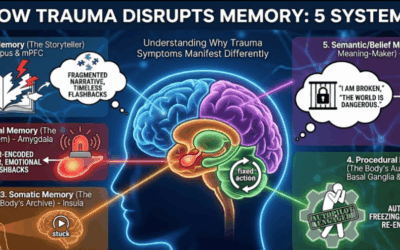
Somatic and experiential therapies run the other way. They start with sensation, posture, impulse and emotion as these happen in the session, on the working assumption that much of what keeps trauma alive is stored in forms that words reach poorly. Chris Brewin’s dual representation theory gives a cognitive-science version of that idea. It separates flexible, contextualized memories, which carry a sense of when and where, from inflexible, sensory-bound ones. In Brewin’s account, a flashback is a sensory-bound memory firing without enough connection to its context, which is why it feels like now rather than then.3 Our guide to how trauma is stored in different kinds of memory goes further into this.
Stress pushes in the same direction. Amy Arnsten’s review of the neuroscience found that even quite mild acute stress, when it feels uncontrollable, can cause a rapid and dramatic loss of the prefrontal abilities we use to plan and reason.4 The popular phrase for this, “amygdala hijack,” comes from Daniel Goleman’s 1995 book Emotional Intelligence.5 It is a metaphor. The prefrontal cortex is not switched off. It works worse, and a coping thought that is easy to reach on a calm afternoon can be hard to find in the middle of a panic attack. That is the practical case for body-based “brakes” that work without much reasoning, the kind described in our grounding guide to the biology of panic.
The line between the two camps is blurrier than the marketing suggests. Prolonged exposure, a core CBT protocol, asks people to feel the memory, not just discuss it. Good somatic work uses words. Richard Lane and colleagues argue that therapies as different as behavior therapy, CBT, emotion-focused therapy and psychodynamic therapy may share one mechanism. An old emotional memory is reactivated, a new emotional experience is folded into it while it is open to updating, and the updated version is then practiced in daily life.1 The modalities differ in how directly they evoke the old state and what they offer it once it arrives.
What the research says about CBT for trauma
Start with the strongest evidence, because it does not favor the bottom-up camp. A 2020 systematic review by Catrin Lewis and colleagues pooled 114 randomized trials with 8,171 participants. It found robust, clinically important effects for trauma-focused CBT and for EMDR, and it named cognitive processing therapy, cognitive therapy for PTSD and prolonged exposure as the CBT protocols with the strongest support.6
The same literature shows the limits. Steenkamp and colleagues reviewed randomized trials of cognitive processing therapy and prolonged exposure in military and veteran samples. Between 49% and 70% of patients improved in a clinically meaningful way, but roughly two-thirds still met criteria for PTSD after treatment, and both therapies did only marginally better than non-trauma-focused comparison treatments.7 Those numbers describe a real gap: many people improve without recovering. That gap is where much of the interest in other routes comes from.
Two other findings keep the comparison honest. Bruce Wampold’s review of the meta-analytic evidence concluded that common factors such as the therapeutic alliance, empathy and the client’s expectations matter a great deal, while differences between established therapies tend to be small.8 And the claim, repeated in somatic circles, that CBT is failing often leans on a 2015 meta-analysis by Johnsen and Friborg. It found that CBT’s effects for depression had declined steadily across trials published from 1977 to 2014.9 A re-analysis of the same 70 trials found the decline only in studies published before 1995, with no further drop after that.10 It was a study of depression, not trauma, and it does not show CBT failing.
The experiential therapies we borrow from
These approaches are often called “non-manualizable,” but that overstates it. Internal Family Systems and Lifespan Integration both have defined protocols, and emotion-focused therapy for trauma has been tested in a randomized trial. What they share is that the work happens inside present experience, with the therapist tracking moment-to-moment shifts in feeling and sensation, rather than in discussion about experience.
Gestalt therapy
The founding text of Gestalt therapy, Gestalt Therapy: Excitement and Growth in the Human Personality (1951), was written by Fritz Perls with Ralph Hefferline and Paul Goodman.11 Around 1952 Fritz and Laura Perls, with Goodman’s help, set up the New York Institute for Gestalt Therapy, which Laura went on to run. The method’s core move is to turn talk about a feeling into an experiment in the present: speak to the person as if they sat in the empty chair across from you, exaggerate the gesture your hand keeps making, notice what happens in your chest as you say the sentence. The empty chair survives in emotion-focused therapy for trauma, where clients speak to an imagined perpetrator. In a randomized comparison of that imaginal-confrontation version with a gentler version based on empathic exploration, clients in both groups improved significantly and kept their gains at follow-up, with no significant difference between the two.12
Psychodrama
Jacob L. Moreno developed psychodrama out of his improvisational Theatre of Spontaneity in Vienna in the early 1920s, and in 1936 he opened a small psychiatric clinic in Beacon, New York, with a stage for the work. One group member, the protagonist, enacts a scene from their life while others play the people in it as “auxiliary egos.” Techniques include doubling, in which someone voices what the protagonist may be feeling, and role reversal, in which the protagonist plays the other person. A 2003 meta-analysis of 25 experimentally designed studies found a large overall improvement effect, with role reversal and doubling the most effective techniques. Its authors also note how infrequently psychodrama research gets published.13
Internal Family Systems
Richard Schwartz, a family therapist, developed IFS in the 1980s after clients with eating disorders kept describing themselves in terms of conflicting “parts.” He set it out in Internal Family Systems Therapy (1995).14 The model treats the mind as a family: managers that try to keep pain from surfacing, firefighters that act impulsively to douse it when it does, exiles that carry the original hurt, and a Self that can meet all of them with curiosity and compassion. Sessions often involve turning attention inward and talking with a part, which makes the work experiential even though it can look like ordinary conversation. The research is early. The best-known trauma study is an uncontrolled pilot in which 17 adults with PTSD and multiple childhood traumas received 16 ninety-minute sessions and showed large symptom reductions.15 Without a control group, that is a promising signal rather than proof.
Accelerated Experiential Dynamic Psychotherapy (AEDP)
Diana Fosha introduced AEDP in The Transforming Power of Affect (2000).16 It treats much psychological suffering as the result of being left alone with overwhelming emotion, so the therapist’s first job is to be emotionally present and “undo aloneness.” The therapist tracks small shifts in affect, including their bodily signs, and then invites the client to reflect on the experience of change itself, a step Fosha calls metatherapeutic processing. AEDP is not the same thing as Somatic Experiencing, which is Peter Levine’s separate method, though AEDP pays close attention to the body. A practice-research network study of 62 adults treated with a 16-session format in private practices in five countries found large pre-to-post improvements, again without a control group.17
Hakomi
Ron Kurtz (1934–2011) developed Hakomi with a group of students in the late 1970s, and in 1981 they founded the Hakomi Institute in Boulder, Colorado. His 1990 book describes the method as “the integrated use of mindfulness, nonviolence, and the body.”18 Its signature technique is the experiment in mindfulness. With the client in a quiet, inward state, the therapist offers a small probe, such as a short statement, a touch or a gesture, and both notice what the body and mind do in response. A tightening or a sudden sadness points to the implicit core beliefs organizing the person’s experience. Rather than breaking through defenses, the therapist may support a defense so it can soften on its own. Hakomi has very little outcome research of its own. Its influence runs mostly through the therapies it seeded.
Lifespan Integration
Peggy Pace, a therapist in Washington state, developed Lifespan Integration in the early 2000s and first published her book on it in 2003. A revised edition appeared in 2015.19 The client builds a timeline of brief memory cues, roughly one for each year of life. After the client connects with a disturbing memory or the body state attached to it, the therapist guides them through the timeline toward the present, again and again. The idea is that the body learns, by repetition, that the event is over and the person survived it. The method is gentle and structured, but its evidence base is thin, with no randomized trials comparable to those behind EMDR or trauma-focused CBT.
Somatic therapies: working with the nervous system directly
Somatic Experiencing comes from Peter Levine, whose Waking the Tiger (1997, written with Ann Frederick) brought it to a general audience.20 The book is built around a question: why are wild animals, though routinely threatened, rarely traumatized? Levine’s answer, that animals complete their defensive responses and then discharge the arousal, is a guiding idea rather than something trials have tested. In SE’s theory, trauma symptoms reflect self-protective responses, such as fleeing or pushing away, that were thwarted and never completed. The method guides attention to interoception (sensations from inside the body) and proprioception (the sense of position and movement), with the aim of completing those responses and regulating excess autonomic arousal.21 Two working principles matter in practice. Titration means touching a small amount of activation at a time instead of the whole memory. Pendulation means moving attention back and forth between the activated state and a place of relative calm, so the nervous system learns that it can come back.
The evidence is encouraging but limited. The first randomized trial assigned 63 adults with PTSD to 15 weekly SE sessions or a waitlist, and found large effects on PTSD symptoms and moderate-to-large effects on depression.22 A 2021 scoping review found 16 studies that met its criteria, described the evidence for effects on PTSD symptoms as preliminary, rated overall study quality as mixed and called for more unbiased randomized trials.23 Our Somatic Experiencing therapy page describes how we use the method.
Pat Ogden’s sensorimotor psychotherapy grew out of her work with Kurtz; she was among the students who helped turn Hakomi into a teachable method in the late 1970s. The school she founded in 1981, first called Hakomi Bodywork, later became the Sensorimotor Psychotherapy Institute, and her book with Kekuni Minton and Clare Pain, Trauma and the Body (2006), sets out the method.24 Trauma-sensitive yoga has one of the better trials in this family. Sixty-four women with chronic, treatment-resistant PTSD were randomized to ten weekly yoga classes or a supportive women’s health education class. At the end, 52% of the yoga group no longer met PTSD criteria, against 21% of the control group.25 Across body psychotherapy as a whole, a 2021 meta-analysis of 18 randomized trials found medium effects on psychopathology and distress and called for larger, higher-quality studies.26
Somatic work also offers a language for states that are easy to mistake for low motivation. Kozlowska and colleagues describe a defense cascade that runs from arousal through fight or flight and freezing to tonic and collapsed immobility, the responses of last resort when active defense has failed. They note that animals generally return to their usual functioning once danger has passed, while humans often stay locked in the same pattern.27 Collapse, numbness and heaviness can belong to that cascade rather than being a choice, as we describe in our piece on functional freeze. Working with that state starts with noticing it in the body rather than arguing with it.
Where EMDR and brainspotting fit
EMDR sits between the camps. Francine Shapiro first described it in 1989 as eye movement desensitization, reporting that a single session reduced distress about traumatic memories in 22 people.28 It has since become a first-line PTSD treatment alongside trauma-focused CBT.6 The details are more mixed than either its fans or its critics admit. A 2020 meta-analysis of 76 trials found a large effect against control conditions, but only 4 of 27 studies had a low risk of bias, and EMDR’s advantage over other therapies disappeared in those better studies.29 The eye movements themselves seem to add something: a 2013 meta-analysis found a moderate added effect in clinical trials and a larger one in laboratory studies.30 The popular claim that EMDR “mimics REM sleep” began as a suggestion in Shapiro’s original description, and Robert Stickgold developed it into a testable model in 2002. It remains a hypothesis, not an established mechanism.31 You can read about EMDR therapy at our Hoover office on its own page.
Brainspotting was developed by David Grand, an EMDR therapist, in 2003. Instead of sweeping the eyes back and forth, the therapist helps the client find a single eye position where body activation feels strongest and holds attention there, on the premise that “where you look affects how you feel.” Grand and Frank Corrigan proposed that this engages midbrain structures such as the superior colliculi and the periaqueductal gray. They published that proposal in Medical Hypotheses as a set of testable hypotheses, and it has not been confirmed.32 The outcome research is small. One within-subject study of 40 psychologists and physicians from a non-clinical sample found that single 40-minute sessions of EMDR and brainspotting lowered distress about upsetting memories more than body scan meditation or book reading did.33 There is no large randomized trial of brainspotting for PTSD. We offer brainspotting for trauma as one tool among several, and we tell clients plainly that the research has not caught up with the practice.
What this looks like in therapy
In practice the choice is rarely either-or. The first sessions are about history, goals and safety. We ask what has been tried before, what helped and what made things worse. Then we build resources, meaning things that steady the nervous system in the room: the feeling of the chair under you, orienting to the space, the memory of someone who was kind, a slow breath that actually lands. Some people arrive after a course of CBT with good skills and a body that has not followed along. That is useful information, not a failure.
Processing comes next, and it is slower than people expect. The therapist might ask you to notice what happens in your body as you recall one small piece of a memory, to stay with a tight chest for a few breaths and then shift attention to your feet, to speak to a part of you that is frightened, or to let your hands slowly make the pushing movement they wanted to make at the time. In EMDR or brainspotting the same attention to the body runs alongside eye movements or a held gaze. The aim is to stay inside what clinicians call the window of tolerance: activated enough for something to change, not so activated that you flood or go numb.
Integration is where cognitive and behavioral tools come back in. Once a memory has lost some of its charge, it becomes easier to put words to it, to question old conclusions such as “it was my fault,” and to practice new behavior between sessions. Some behavioral therapies already build the body in. Radically Open DBT, Thomas Lynch’s treatment for emotional overcontrol, teaches small physical signals such as a slow breath, a closed-mouth smile and raised eyebrows as ways to activate what Lynch calls the social safety system.34 For a wider map of how the approaches relate, see how the different types of therapy fit together.
This kind of work tends to suit people who can tell their story fluently but whose body still reacts, people who go foggy or numb when they try to talk about what happened, and people with panic, shame or chronic tension that insight has not reached. It is not the right fit for everyone at every moment. Someone in active crisis needs stabilization first, and our page of crisis resources in Birmingham lists where to turn. Someone who wants a fixed, time-limited protocol with the deepest research base may be better served by cognitive processing therapy, prolonged exposure or EMDR, and a good therapist should say so.
How to choose, and what to ask
If you are comparing therapists in Birmingham, Hoover or anywhere else in Alabama, the label on the door matters less than a few concrete answers. Ask what training the therapist has in the specific method, and whether that means a certification, a completed training or reading. Ask what they do when a client gets overwhelmed or shuts down in session. Ask how the two of you will know if it is not working, and what they would change. Ask whether they will use cognitive and behavioral tools when those fit. A therapist who treats somatic work and CBT as enemies is selling a brand. The research supports something more modest: several routes work, the relationship matters across all of them, and the right starting point depends on where you are stuck.8
Taproot Therapy Collective is in Hoover, a few minutes from Birmingham, and our clinicians combine somatic, experiential and brain-based methods with conventional skills work. If you want to think through whether this approach fits what you are dealing with, our somatic therapy page explains how we work.
References
- Lane, R. D., Ryan, L., Nadel, L., & Greenberg, L. (2015). Memory reconsolidation, emotional arousal, and the process of change in psychotherapy: New insights from brain science. Behavioral and Brain Sciences, 38, Article e1. https://doi.org/10.1017/S0140525X14000041
- Beck, A. T. (1963). Thinking and depression: I. Idiosyncratic content and cognitive distortions. Archives of General Psychiatry, 9(4), 324–333. https://doi.org/10.1001/archpsyc.1963.01720160014002
- Brewin, C. R., Gregory, J. D., Lipton, M., & Burgess, N. (2010). Intrusive images in psychological disorders: Characteristics, neural mechanisms, and treatment implications. Psychological Review, 117(1), 210–232. https://doi.org/10.1037/a0018113
- Arnsten, A. F. T. (2009). Stress signalling pathways that impair prefrontal cortex structure and function. Nature Reviews Neuroscience, 10(6), 410–422. https://doi.org/10.1038/nrn2648
- Goleman, D. (1995). Emotional intelligence: Why it can matter more than IQ. Bantam Books.
- Lewis, C., Roberts, N. P., Andrew, M., Starling, E., & Bisson, J. I. (2020). Psychological therapies for post-traumatic stress disorder in adults: Systematic review and meta-analysis. European Journal of Psychotraumatology, 11(1), Article 1729633. https://doi.org/10.1080/20008198.2020.1729633
- Steenkamp, M. M., Litz, B. T., Hoge, C. W., & Marmar, C. R. (2015). Psychotherapy for military-related PTSD: A review of randomized clinical trials. JAMA, 314(5), 489–500. https://doi.org/10.1001/jama.2015.8370
- Wampold, B. E. (2015). How important are the common factors in psychotherapy? An update. World Psychiatry, 14(3), 270–277. https://doi.org/10.1002/wps.20238
- Johnsen, T. J., & Friborg, O. (2015). The effects of cognitive behavioral therapy as an anti-depressive treatment is falling: A meta-analysis. Psychological Bulletin, 141(4), 747–768. https://doi.org/10.1037/bul0000015
- Ljótsson, B., Hedman, E., Mattsson, S., & Andersson, E. (2017). The effects of cognitive–behavioral therapy for depression are not falling: A re-analysis of Johnsen and Friborg (2015). Psychological Bulletin, 143(3), 321–325. https://doi.org/10.1037/bul0000055
- Perls, F. S., Hefferline, R. F., & Goodman, P. (1951). Gestalt therapy: Excitement and growth in the human personality. Julian Press.
- Paivio, S. C., Jarry, J. L., Chagigiorgis, H., Hall, I., & Ralston, M. (2010). Efficacy of two versions of emotion-focused therapy for resolving child abuse trauma. Psychotherapy Research, 20(3), 353–366. https://doi.org/10.1080/10503300903505274
- Kipper, D. A., & Ritchie, T. D. (2003). The effectiveness of psychodramatic techniques: A meta-analysis. Group Dynamics: Theory, Research, and Practice, 7(1), 13–25. https://doi.org/10.1037/1089-2699.7.1.13
- Schwartz, R. C. (1995). Internal family systems therapy. Guilford Press.
- Hodgdon, H. B., Anderson, F. G., Southwell, E., Hrubec, W., & Schwartz, R. (2022). Internal Family Systems (IFS) therapy for posttraumatic stress disorder (PTSD) among survivors of multiple childhood trauma: A pilot effectiveness study. Journal of Aggression, Maltreatment & Trauma, 31(1), 22–43. https://doi.org/10.1080/10926771.2021.2013375
- Fosha, D. (2000). The transforming power of affect: A model for accelerated change. Basic Books.
- Iwakabe, S., Edlin, J., Fosha, D., Gretton, H., Joseph, A. J., Nunnink, S. E., Nakamura, K., & Thoma, N. C. (2020). The effectiveness of accelerated experiential dynamic psychotherapy (AEDP) in private practice settings: A transdiagnostic study conducted within the context of a practice-research network. Psychotherapy, 57(4), 548–561. https://doi.org/10.1037/pst0000344
- Kurtz, R. (1990). Body-centered psychotherapy: The Hakomi method: The integrated use of mindfulness, nonviolence, and the body. LifeRhythm.
- Pace, P. (2015). Lifespan Integration: Connecting ego states through time. Eirene Imprint.
- Levine, P. A., & Frederick, A. (1997). Waking the tiger: Healing trauma. North Atlantic Books.
- Payne, P., Levine, P. A., & Crane-Godreau, M. A. (2015). Somatic experiencing: Using interoception and proprioception as core elements of trauma therapy. Frontiers in Psychology, 6, Article 93. https://doi.org/10.3389/fpsyg.2015.00093
- Brom, D., Stokar, Y., Lawi, C., Nuriel-Porat, V., Ziv, Y., Lerner, K., & Ross, G. (2017). Somatic experiencing for posttraumatic stress disorder: A randomized controlled outcome study. Journal of Traumatic Stress, 30(3), 304–312. https://doi.org/10.1002/jts.22189
- Kuhfuß, M., Maldei, T., Hetmanek, A., & Baumann, N. (2021). Somatic experiencing – effectiveness and key factors of a body-oriented trauma therapy: A scoping literature review. European Journal of Psychotraumatology, 12(1), Article 1929023. https://doi.org/10.1080/20008198.2021.1929023
- Ogden, P., Minton, K., & Pain, C. (2006). Trauma and the body: A sensorimotor approach to psychotherapy. W. W. Norton.
- van der Kolk, B. A., Stone, L., West, J., Rhodes, A., Emerson, D., Suvak, M., & Spinazzola, J. (2014). Yoga as an adjunctive treatment for posttraumatic stress disorder: A randomized controlled trial. The Journal of Clinical Psychiatry, 75(6), e559–e565. https://doi.org/10.4088/JCP.13m08561
- Rosendahl, S., Sattel, H., & Lahmann, C. (2021). Effectiveness of body psychotherapy: A systematic review and meta-analysis. Frontiers in Psychiatry, 12, Article 709798. https://doi.org/10.3389/fpsyt.2021.709798
- Kozlowska, K., Walker, P., McLean, L., & Carrive, P. (2015). Fear and the defense cascade: Clinical implications and management. Harvard Review of Psychiatry, 23(4), 263–287. https://doi.org/10.1097/HRP.0000000000000065
- Shapiro, F. (1989). Efficacy of the eye movement desensitization procedure in the treatment of traumatic memories. Journal of Traumatic Stress, 2(2), 199–223. https://doi.org/10.1002/jts.2490020207
- Cuijpers, P., van Veen, S. C., Sijbrandij, M., Yoder, W., & Cristea, I. A. (2020). Eye movement desensitization and reprocessing for mental health problems: A systematic review and meta-analysis. Cognitive Behaviour Therapy, 49(3), 165–180. https://doi.org/10.1080/16506073.2019.1703801
- Lee, C. W., & Cuijpers, P. (2013). A meta-analysis of the contribution of eye movements in processing emotional memories. Journal of Behavior Therapy and Experimental Psychiatry, 44(2), 231–239. https://doi.org/10.1016/j.jbtep.2012.11.001
- Stickgold, R. (2002). EMDR: A putative neurobiological mechanism of action. Journal of Clinical Psychology, 58(1), 61–75. https://doi.org/10.1002/jclp.1129
- Corrigan, F., & Grand, D. (2013). Brainspotting: Recruiting the midbrain for accessing and healing sensorimotor memories of traumatic activation. Medical Hypotheses, 80(6), 759–766. https://doi.org/10.1016/j.mehy.2013.03.005
- D’Antoni, F., Matiz, A., Fabbro, F., & Crescentini, C. (2022). Psychotherapeutic techniques for distressing memories: A comparative study between EMDR, brainspotting, and body scan meditation. International Journal of Environmental Research and Public Health, 19(3), Article 1142. https://doi.org/10.3390/ijerph19031142
- Lynch, T. R. (2018). Radically open dialectical behavior therapy: Theory and practice for treating disorders of overcontrol. Context Press.















0 Comments