
The Counterintuitive Role of Humor in Trauma Recovery
When clients first arrive at our Hoover clinic for trauma processing, they often carry an immense burden of reverence for their own suffering. There is an unspoken assumption that therapy must be a universally somber, heavy experience. If you are dealing with complex PTSD, childhood abuse, or chronic anxiety, the idea of laughing in a session can feel inappropriate or even invalidating. Yet, from a clinical and neurobiological perspective, humor is one of the most sophisticated tools the human nervous system uses to integrate horrific experiences.
At Taproot Therapy Collective, we frequently see clients apologize for making a dark joke about their trauma. We do not correct them. We explore it. Skilfully utilized humor is not a deflection from pain; it is a profound indicator that the brain is attempting to process the unspeakable.
The Neurobiology of a Laugh: Breaking the Freeze Response
To understand why humor matters in trauma therapy, we have to look at the somatic reality of the body. Trauma is fundamentally a state of nervous system dysregulation, often locking an individual into a chronic sympathetic state (fight-or-flight) or a dorsal vagal state (freeze and collapse).
Laughter is a physiological intervention. A genuine laugh requires a sudden, deep intake of oxygen followed by an extended, rhythmic exhalation. This specific breathing pattern manually stimulates the vagus nerve, signaling the brainstem that the immediate environment is safe. It forces the nervous system to shift out of survival mode and into the ventral vagal state, which governs social engagement and connection.
You cannot genuinely laugh and be in a state of sheer biological terror at the same time. A moment of dark humor in the therapy room temporarily breaks the freeze response, offering a window of neuroplasticity where we can actually do the clinical work of reprocessing the memory.
The Jungian Shadow and the Stand-Up Comedian
Psychologically, humor allows us to access the Shadow. Carl Jung described the shadow as the repository for all the parts of ourselves and our experiences that society deems unacceptable, ugly, or forbidden. Trauma forces people to swallow unspeakable truths. Victims are often silenced by a culture that prefers polite avoidance over the messy reality of human suffering.
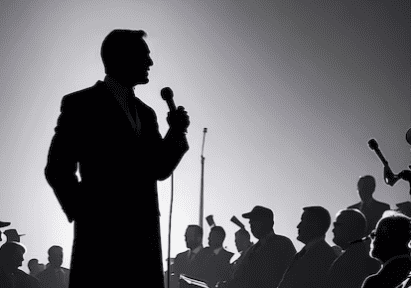
This is why so many trauma survivors gravitate toward dark comedy. The comedian, acting as the archetypal Trickster, speaks the unspeakable. They take the horrifying, repressed elements of the shadow and drag them into the light for public consumption. When a client makes a dark joke about their own trauma, they are breaking the silence. They are asserting that what happened to them is real, and they are refusing to carry the shame of it in secret.
Defensive Sarcasm vs. Metacognitive Distance
It is clinically important to distinguish between humor used as an avoidance tactic and humor used for integration. In modalities like Internal Family Systems (IFS), we recognize that sarcasm can sometimes act as a “protector part”—a psychological shield designed to keep the therapist, and the client themselves, away from the core emotional wound.
However, when the timing is right, humor creates what we call metacognitive distance. Trauma traps you inside the memory, making you feel as though the past is happening right now. Humor requires you to step outside of the experience to observe its absurdity, irony, or tragedy from an external vantage point.
When you can look at your own trauma and find the dark humor in it, you are no longer entirely fused with the pain. You are observing it. This shift from being the victim of a narrative to the author of the narrative is the exact pivot required for deep psychological healing.
Finding Wholeness in the Birmingham Therapy Room
Healing from profound psychological wounds requires us to hold dual realities. We must have deep compassion for the wounded parts of ourselves, while also cultivating the capacity to step back and observe the tragicomedy of the human condition.
Living and recovering in the Birmingham metro area means navigating a culture that often prizes stoicism and politeness. In therapy, we have to dismantle the idea that you must be perfectly serious to be perfectly healed. Rigid, humorless adherence to a single emotional state is often a sign of unresolved trauma, not health.
True healing is expansive. It makes room for the grief, the rage, the profound sadness, and the sudden, surprising laughter that comes when you realize you have survived the worst and lived to tell the tale. If you are looking for a clinical space that honors the full spectrum of your humanity, reach out to Taproot Therapy Collective to begin the work.


















0 Comments