Teach Your Children Well

by | May 16, 2022 | 0 comments

Therapy For Children

Family and Teen Therapy

Growing up is all about accepting the reality of the human condition. All children are born needing and wanting someone to respond to them. Parents are the first responders and the shape and quality of their response will echo in the child’s pattern of relationships for the rest of their life.

Most parents care deeply about how their responses shape their child. They want their child to grow up, to learn to love and to build relationships for themselves. This noble desire is fraught with many challenges. Early in a child’s life, most parents can and do anticipate what their child desires so that any wanting and needing that the child endures isn’t overwhelming. Little by little, however, a parent’s job is to slowly teach their child how to want and need in an expanding world of people who are not devoted to preventing their hurt or disappointment.

Accepting hurt and disappointment as a part of the human condition, is one of the toughest things about growing up. Parents who are able to pass on this acceptance to their child are uniquely positioned to prepare their children to develop the courage and creativity to respond this fundamental part of life. It is a beautiful thing. Curiously though, there is something about becoming a parent that makes all the ways a person hasn’t grown up in this area, come to the surface. Needing and wanting despite the risk of hurt and disappointment is not easy. Talking about it is even harder.

Instead of acceptance, many parents pass on their own childhood legacy of shame, of avoidance, of anger or worst of all, the fantasy of a life without disappointment or hurt. The children of these legacies grow up to be desperate, anxious or angry themselves. It is only through shared acceptance that life doesn’t always turn out as we might like and that sometimes it hurts, that a parent can join their child in learning to form a response to a world that will never quite meet up with their expectations of it.

The possibility for a response opens the window for the true self to emerge, grow and develop. Parenting is a second chance to redeem all the old legacies that hide the true self from this opportunity. It is a gift that life gives to all parents and a gift that only a parent can give to their child.


Becky is a child teen and family therapist at Taproot

Explore the Other Articles by Categories on Our Blog 

Hardy Micronutrition is clinically proven to IMPROVE FOCUS and reduce the effects of autism, anxiety, ADHD, and depression in adults and children without drugsWatch Interview With HardyVisit GetHardy.com and use offer code TAPROOT for 15% off

Naomi Quenk’s Work on the Inferior Function

Naomi Quenk’s Work on the Inferior Function

You've had the experience. You're usually calm, but suddenly you're screaming at your partner over dishes. You're normally logical, but you're sobbing uncontrollably about something that "shouldn't" matter. You're typically easygoing, but you've become rigidly fixated...

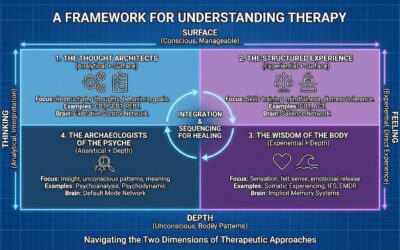
Understanding How the Different Types of Therapy Fit Together

Understanding How the Different Types of Therapy Fit Together

You've tried therapy before. Maybe it helped a little. Maybe you spent months talking about your childhood without anything changing. Maybe you learned coping skills that worked until they didn't. Maybe the therapist was nice but you left each session feeling like...

David Bohm: The Physicist Who Saw Mind in Matter

David Bohm: The Physicist Who Saw Mind in Matter

The Heretic of Copenhagen David Bohm (1917-1992) committed what many physicists considered an unforgivable sin: he took quantum mechanics seriously as a description of reality, not just a calculation tool. While the Copenhagen interpretation (Bohr, Heisenberg)...

Who Is Johnjoe McFadden?

Who Is Johnjoe McFadden?

Explore Johnjoe McFadden’s CEMI field theory, which proposes that consciousness arises from the brain’s electromagnetic field, solving the binding problem and explaining free will.

Active Imagination vs. Meditation: What’s the Difference?

Active Imagination vs. Meditation: What’s the Difference?

If you have ever tried to meditate and found yourself frustrated by a mind that refuses to go blank, you are not alone. The modern wellness industry heavily promotes mindfulness and "quieting the mind" as the gold standard for mental health. But for many...

The Golden Bough and the Voices of the Gods: A Critical Re-evaluation of James George Frazer and Julian Jaynes in the Light of Modern Cognitive Science

The Golden Bough and the Voices of the Gods: A Critical Re-evaluation of James George Frazer and Julian Jaynes in the Light of Modern Cognitive Science

A comprehensive critical analysis of James George Frazer’s The Golden Bough and Julian Jaynes’s Bicameral Mind theory, examining how these “magnificent failures” of anthropology and psychology—while rejected by modern scholarship—accurately described the permanent structures of magical thinking, sympathetic association, and the phenomenology of consciousness. Explores validation through cognitive science (Paul Rozin), depth psychology (Freud, Jung, Peterson), and modern anthropology (René Girard, Harvey Whitehouse).

Manly P. Hall and the Psychological Resurrection of Ancient Wisdom

Manly P. Hall and the Psychological Resurrection of Ancient Wisdom

Explore the life and legacy of Manly P. Hall, author of The Secret Teachings of All Ages, examining his prescient influence on depth psychology, Jungian analysis, Gnostic trauma frameworks, and contemporary therapeutic approaches to psychological transformation and archetypal symbolism.

What are Dreams: The Architecture of the Night

What are Dreams: The Architecture of the Night

The Ontology of the Other World In the landscape of contemporary psychotherapy, the dream is frequently relegated to the status of a "residue"—a nightly data dump of the brain's metabolic waste, or at best, an encoded puzzle regarding waking life anxieties to be...

Paul Tillich and the Soul’s Depth: The Enduring Relevance of an Existentialist Theologian for Depth Psychology and Psychotherapy

Paul Tillich and the Soul’s Depth: The Enduring Relevance of an Existentialist Theologian for Depth Psychology and Psychotherapy

Paul Tillich’s profound influence on depth psychology and psychotherapy through his concepts of ultimate concern, existential anxiety, and the courage to be. This comprehensive guide examines how this existentialist theologian’s work on meaning, faith, and human existence continues to shape therapeutic practice, pastoral counseling, comparative religion, and philosophy. Includes timeline and analysis of psychotherapists influenced by Tillich including Rollo May, Carl Rogers, and Irvin Yalom.

The Emperor’s Inner Work: Marcus Aurelius, Meditations, and the Roots of Psychotherapy

The Emperor’s Inner Work: Marcus Aurelius, Meditations, and the Roots of Psychotherapy

Marcus Aurelius’s Meditations, written nearly 2,000 years ago from Roman military camps, provides foundational insights for modern psychotherapy. Discover the connections between Stoic philosophy and CBT, existential therapy, and depth psychology, and learn why therapists like Irvin Yalom consider this ancient text essential reading for understanding human suffering and resilience. A comprehensive guide for mental health professionals and anyone seeking psychological wisdom from history’s philosopher-emperor.

0 Comments

Submit a Comment

Your email address will not be published. Required fields are marked *