Ken Wilber: Mapping the Integral Vision

by | Jul 10, 2024 | 0 comments

Ken Wilber Integral Theory

The Einstein of Consciousness

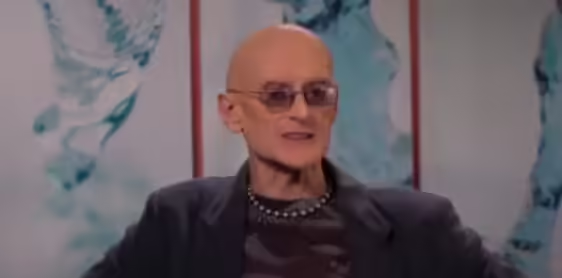
In a fragmented world where science battles religion and psychology ignores spirituality, Ken Wilber (b. 1949) stands as a grand synthesizer. Often called the “Einstein of consciousness,” he is the creator of Integral Theory—a “theory of everything” that attempts to map human potential across all cultures and disciplines. His work integrates the wisdom of the East (meditation, non-dualism) with the knowledge of the West (psychology, evolution, systems theory).

Wilber is not just a philosopher; he is a mapmaker for the soul. He argues that human development doesn’t stop at adulthood. Just as a child grows into an adult, an adult can grow into a sage. His models provide a framework for understanding where we are on the spectrum of consciousness and how to move forward without getting lost.

Biography & Timeline: Ken Wilber

Born in Oklahoma, Wilber began as a brilliant science student, intending to study biochemistry. However, in college, he stumbled upon the writings of Lao Tzu and the mystics. This collision between hard science and deep spirituality defined his life. He dropped out of graduate school to write his first book, The Spectrum of Consciousness, in three months at the age of 23.

Wilber’s life has been marked by both intellectual triumph and personal tragedy. In the 1980s, his wife Treya Killam Wilber was diagnosed with cancer shortly after their wedding. His book Grace and Grit chronicles their five-year struggle, blending a moving love story with profound insights into illness, healing, and death. Since then, he has founded the Integral Institute and continues to write prolifically from his home in Denver.

Key Milestones in the Life of Ken Wilber

Year Event / Publication
1949 Born in Oklahoma City.
1977 Publishes The Spectrum of Consciousness, launching Transpersonal Psychology.
1983-1989 Caretaking for his wife Treya; writes Grace and Grit (published 1991).
1995 Publishes Sex, Ecology, Spirituality, introducing the AQAL model.
2000 Founds the Integral Institute.
2017 Publishes The Religion of Tomorrow.

Major Concepts: AQAL and the Holon

AQAL: All Quadrants, All Levels

Wilber’s most famous contribution is the AQAL Map. He argues that to understand anything (a person, a war, a disease), we must look at it from four perspectives simultaneously:

  • Upper Left (Interior-Individual): Psychology, feelings, beliefs (“I”).
  • Upper Right (Exterior-Individual): Biology, brain states, behavior (“It”).
  • Lower Left (Interior-Collective): Culture, shared values, worldview (“We”).
  • Lower Right (Exterior-Collective): Systems, economics, environment (“Its”).

Clinical Application: A depressed client isn’t just suffering from “bad thoughts” (UL) or “low serotonin” (UR). They are also affected by cultural isolation (LL) and economic stress (LR). Integral therapy addresses all four.

Holons and Hierarchy

Wilber coined the term Holon to describe reality. A holon is something that is simultaneously a whole and a part. An atom is a whole, but it is part of a molecule. A molecule is a whole, but part of a cell.

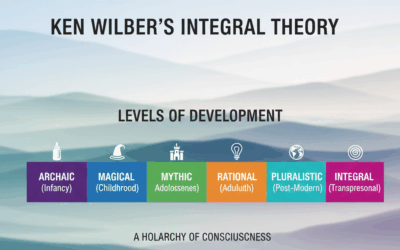
The Insight: Evolution is a “holarchy” of increasing depth. Molecules are more complex than atoms; organisms are more complex than molecules. Human consciousness evolves in the same way, transcending and including previous stages (Egocentric -> Ethnocentric -> Worldcentric -> Kosmocentric).

The Conceptualization of Trauma: The Pre/Trans Fallacy

One of Wilber’s most critical insights for therapy is the Pre/Trans Fallacy. Because both infant states (pre-rational) and mystical states (trans-rational) are non-verbal and non-linear, people often confuse them.

Example: A person might think a chaotic, emotional regression is a “spiritual awakening” (elevating the prepersonal to transpersonal). Or, a skeptic might dismiss a genuine mystical experience as “infantile regression” (reducing the transpersonal to prepersonal).

Healing: We must differentiate between growing up (psychological maturity) and waking up (spiritual enlightenment). You can be a spiritually enlightened person with a lot of childhood trauma (shadow). Integral practice requires working on both tracks.

Legacy: The Integral Vision

Ken Wilber has given us a “theory of everything” for the inner life. He challenges us to stop fighting over who is right—Freud or Buddha, neuroscience or narrative—and see how they fit together.

His legacy is a call for Integral Life Practice: a commitment to exercising body, mind, shadow, and spirit. He teaches that we are the universe becoming conscious of itself, and our growth is the evolution of the Kosmos.


Bibliography

  • Wilber, K. (1977). The Spectrum of Consciousness. Quest Books.
  • Wilber, K. (1991). Grace and Grit: Spirituality and Healing in the Life and Death of Treya Killam Wilber. Shambhala.
  • Wilber, K. (1995). Sex, Ecology, Spirituality: The Spirit of Evolution. Shambhala.
  • Wilber, K. (2000). Integral Psychology: Consciousness, Spirit, Psychology, Therapy. Shambhala.
  • Wilber, K. (2006). Integral Spirituality. Shambhala.
  • Wilber, K. (2017). The Religion of Tomorrow. Shambhala.

Explore More on Consciousness and Integration

Explore the Other Articles by Categories on Our Blog 

Hardy Micronutrition is clinically proven to IMPROVE FOCUS and reduce the effects of autism, anxiety, ADHD, and depression in adults and children without drugsWatch Interview With HardyVisit GetHardy.com and use offer code TAPROOT for 15% off

Somatic Reset Techniques You Can do At Home

Somatic Reset Techniques You Can do At Home

Written by the clinical team at Taproot Therapy Collective, a Birmingham psychotherapy practice specializing in somatic and trauma-focused modalities. Our clinicians are trained in body-based approaches including Brainspotting, EMDR, and somatic trauma resolution....

Why We Recommend Hardy Nutritionals: A Clinical Perspective on the Research That Changed How We Think About Treatment Resistance

Why We Recommend Hardy Nutritionals: A Clinical Perspective on the Research That Changed How We Think About Treatment Resistance

Why Taproot Therapy Collective recommends Hardy Nutritionals Daily Essential Nutrients for treatment-resistant mood disorders, ADHD, and emotional dysregulation. Discovered not through advertising but through patients whose bipolar disorder and other conditions finally responded. Over 40 peer-reviewed studies support the NutraTek chelation technology. Use code TAPROOT at gethardy.com for 15% off for life.

The Second Brain Revolution: How Gut Science Is Rewriting Psychiatric Medicine

The Second Brain Revolution: How Gut Science Is Rewriting Psychiatric Medicine

This 2025 strategic report details the shift from theoretical gut-brain models to clinical applications, analyzing the indole-SK2 channel mechanism in anxiety and the efficacy of oral FMT capsules for refractory depression. It evaluates the diagnostic potential of the gut mycobiome and profiles the pharmaceutical pipelines of key industry players like Kallyope and Bloom Science.

The Metabolic Mind: A 2025 Clinical Update on Nutritional Psychiatry

The Metabolic Mind: A 2025 Clinical Update on Nutritional Psychiatry

A 2025 clinical update on nutritional psychiatry for psychotherapists. Explore the latest research on psychobiotics, vitamin D, magnesium, zinc, omega-3s, amino acid therapies, and herbal interventions—including new safety warnings on ashwagandha and evidence that saffron matches SSRI efficacy for mild depression.

Who Is Victor Lamme?

Who Is Victor Lamme?

The Neuroscientist Who Found Consciousness in the Feedback Loops of the Brain When you look at a face, what happens in your brain? The answer turns out to be surprisingly complex. First, visual information streams forward from your eyes through your visual cortex,...

Manly P. Hall and the Psychological Resurrection of Ancient Wisdom

Manly P. Hall and the Psychological Resurrection of Ancient Wisdom

Explore the life and legacy of Manly P. Hall, author of The Secret Teachings of All Ages, examining his prescient influence on depth psychology, Jungian analysis, Gnostic trauma frameworks, and contemporary therapeutic approaches to psychological transformation and archetypal symbolism.

Paul Tillich and the Soul’s Depth: The Enduring Relevance of an Existentialist Theologian for Depth Psychology and Psychotherapy

Paul Tillich and the Soul’s Depth: The Enduring Relevance of an Existentialist Theologian for Depth Psychology and Psychotherapy

Paul Tillich’s profound influence on depth psychology and psychotherapy through his concepts of ultimate concern, existential anxiety, and the courage to be. This comprehensive guide examines how this existentialist theologian’s work on meaning, faith, and human existence continues to shape therapeutic practice, pastoral counseling, comparative religion, and philosophy. Includes timeline and analysis of psychotherapists influenced by Tillich including Rollo May, Carl Rogers, and Irvin Yalom.

Holy Wood: The Intersection of Forestry and Mythology

Holy Wood: The Intersection of Forestry and Mythology

The Sacred Species and Their Archetypal Meanings In the depths of the human psyche, trees stand as primordial witnesses to our spiritual evolution. They are the axis mundi, the world pillars that connect heaven, earth, and the underworld in virtually every...

Who is Mark Turner?

Who is Mark Turner?

The Literary Mind: Mark Turner's Cognitive Science and Its Implications for Understanding Trauma and Consciousness in Psychotherapy In the quest to understand the complexities of human consciousness and the impact of trauma on the psyche, the work of cognitive...

Who is Cliford Geertz?

Who is Cliford Geertz?

Weaving the Web of Meaning: Clifford Geertz's Cultural Anthropology and Its Implications for Trauma and Consciousness in Psychotherapy In the realm of psychotherapy, understanding the intricate tapestry of human experience is paramount. To truly grasp the complexities...

The Psychology of the Dragon Archetype

The Psychology of the Dragon Archetype

"Perhaps all the dragons in our lives are princesses who are only waiting to see us act, just once, with beauty and courage. Perhaps everything that frightens us is, in its deepest essence, something helpless that wants our love." - Rainer Maria Rilke Dragons have...

Who was Owen Barfield?

Who was Owen Barfield?

 Prophet of the Evolution of Consciousness Owen Barfield (1898-1997) was a British philosopher, poet, and critic whose groundbreaking work focused on the evolution of human consciousness and its relationship to language and imagination. A close friend of C.S. Lewis...
Who was Richard Maurice Bucke?

Who was Richard Maurice Bucke?

Richard Maurice Bucke and Cosmic Consciousness Richard Maurice Bucke (1837-1902) was a Canadian psychiatrist, philosopher, and mystic whose groundbreaking work explored the evolution of human consciousness and the nature of mystical experience. His most famous book,...

The Mystical Roots and Therapeutic Fruits of Initiation Rites

The Mystical Roots and Therapeutic Fruits of Initiation Rites

Is Psychotherapy a Type of Initiation Have you ever been part of a fraternity, sorority, or similar organization? If so, you may have experienced rituals or ceremonies that felt both challenging and transformative. Even if you haven't, you've likely encountered such...

0 Comments

Submit a Comment

Your email address will not be published. Required fields are marked *