
St. John of the Cross: The Psychologist of Divine Darkness
“In the evening of life, we will be judged on love alone.” — St. John of the Cross
In the crucible of 16th-century Catholic reform, one man’s profound mystical insights illuminated the path of spiritual transformation in a way that continues to resonate with seekers across traditions and modern psychologists alike. St. John of the Cross (1542–1591), the renowned Spanish mystic, Carmelite friar, and Doctor of the Church, gifted humanity with a corpus of writings that map the soul’s arduous journey through darkness into divine union.
His masterworks, including The Dark Night of the Soul and The Ascent of Mount Carmel, offer an intricate cartography of the psyche’s hidden depths. While he wrote in the language of 16th-century theology, his insights are startlingly clinical. He describes the mechanisms of attachment, the pain of ego-dissolution, and the necessary disintegration that precedes integration. For the modern trauma survivor or the student of depth psychology, John is not just a saint; he is a guide through the “Nigredo”—the blackening phase of alchemical transformation.
I. The Indefatigable Reformer: Biography of a Mystic
Born into a poor family in Fontiveros, Spain, Juan de Yepes y Álvarez (later John of the Cross) experienced hardship from an early age. Orphaned and impoverished, he understood suffering long before he wrote about it. At 21, John joined the Carmelite Order, where his intellectual gifts and spiritual fervor quickly set him apart.
A fateful meeting with Teresa of Avila in 1567 ignited John’s passion for monastic reform. Teresa, a powerhouse of spiritual pragmatism, recruited the young, contemplative John to help her return the Carmelites to their original, austere roots. This partnership birthed the Discalced (Barefoot) Carmelite movement.
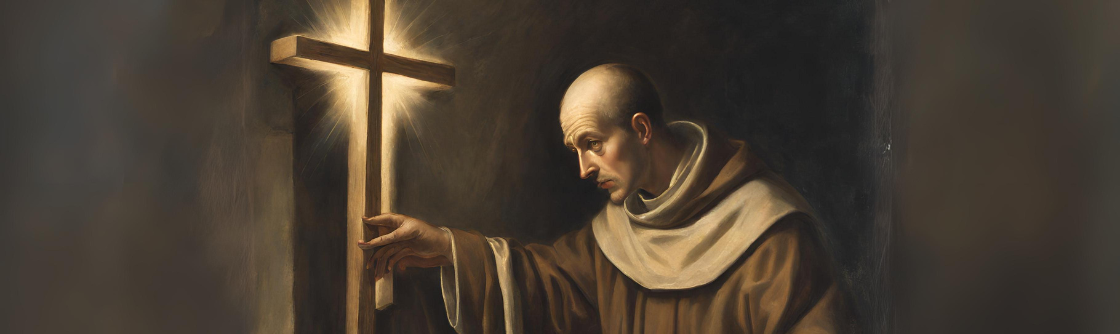
However, reform is rarely welcomed by the establishment. In 1577, John was kidnapped by friars from his own order who opposed the reform. He was imprisoned for nine months in a tiny, unlit cell in Toledo (a closet, essentially), where he was publicly whipped and starved. It was in this crucible of sensory deprivation and systemic abuse that his most profound mystical insights were born. Stripped of all light, comfort, and human dignity, John did not break; he transcended. He composed his greatest poetry, the Spiritual Canticle, within the darkness of that cell.
II. The “Dark Night”: A Map of Psychological Transformation
St. John’s most famous contribution is the metaphor of the “Dark Night.” In modern parlance, this phrase is often used to describe depression or a bad week. For John, it was something far more specific and structural.
He divides the journey into two distinct phases, which parallel the movement from the Jungian Ego to the Self:
1. The Night of the Senses
This is the drying up of sensory satisfaction. The beginner in the spiritual life (or the healing process) no longer finds pleasure in their usual vices, habits, or even their usual religious devotions. Psychologically, this looks like anhedonia. However, John argues this is not a sickness but a “weaning.” The soul is being taught to stop relying on external feedback loops for its identity.
2. The Night of the Spirit
This is the deeper, more terrifying phase. Here, the very structure of the belief system dissolves. The person feels abandoned by God, empty of meaning, and dissolved. In Jungian terms, this is the confrontation with the Shadow and the destruction of the Persona. It is the realization that the “God” you worshipped was just a projection of your own ego. To find the real God (or the Self), the projection must die.
This path aligns with the Apophatic Tradition (Via Negativa) of mysticism—finding the Divine through negation and emptiness. This lineage traces back to Pseudo-Dionysius the Areopagite and Meister Eckhart, who famously prayed, “God, rid me of God.”
III. Trauma, Therapy, and the Dark Night
While John wrote for friars, his work is a manual for trauma recovery. Trauma functions as an involuntary “Dark Night.” It strips away our illusions of safety, our trust in the world, and our sensory regulation.
The Architecture of Detachment
Central to John’s teaching is Detachment (Nada). This is not the cold indifference of a stoic, but the healthy non-attachment of a person who is no longer enslaved by their cravings or fears. In trauma therapy, this mirrors the work of Somatic Experiencing: releasing the “survival energy” that keeps us attached to the traumatic event.
John’s insistence that we must be emptied to be filled resonates with the insights of Simone Weil regarding “Decreation”—the undoing of the ego to make space for reality. For the trauma survivor, this means letting go of the identity of “Victim” to discover the “Survivor,” and eventually, the thriving Self.
Navigating Spiritual Emergencies
Modern transpersonal psychology, led by figures like Stanislav Grof, recognizes that many psychotic breaks or depressive episodes are actually “Spiritual Emergencies”—attempts by the psyche to reorganize at a higher level. St. John provides the clinical differential diagnosis: is this melancholia (depression), or is this the Night of the Spirit? If it is the latter, medication alone will not work; the cure is meaning, endurance, and guidance through the dark.
IV. The Contextual Web: John among the Mystics
St. John of the Cross does not stand alone. To understand his non-dual experience of “Union,” we must look at the constellation of adjacent thinkers who mapped the same territory.
The Christian Mystical Lineage
John represents the summit of Spanish mysticism, but he stands on the shoulders of giants. The German mystics like Meister Eckhart, Johannes Tauler, and Angelus Silesius laid the groundwork for the idea that God is found in the “Ground of the Soul.”
His contemporary, Teresa of Avila, provided the “Cataphatic” (positive/image-based) counterpoint to his “Apophatic” (negative/imageless) austerity. Together, they form a complete picture of the psyche.
The Esoteric and Philosophical Connections
John’s description of the “Living Flame of Love” shares the transformative heat found in the alchemical writings of Gerhard Dorn and Zosimos of Panopolis. Just as the alchemists sought to purify matter, John sought to purify the spirit.
His Neoplatonic influences connect him to the great chain of being described by Plotinus and Pseudo-Dionysius. Furthermore, his insights into the nature of evil and suffering find echoes in the Gnostic struggle for sparks of light in a dark world, and the dualistic cosmology of Mani.
Universal Resonances
When John speaks of the “Dark Night,” he is describing the same territory as the “Void” in Zen Buddhism, explored by D.T. Suzuki and Lao Tzu. The poetic ecstasy of his union with the divine mirrors the Sufi poetry of Rumi. Even the mathematical mysticism of Pythagoras finds a home in John’s precise, structural ascent to truth.
Explore the Wisdom Traditions
St. John of the Cross is a key node in a vast network of mystical thought. Explore the thinkers who influenced him, and those who vibrate at the same frequency.
The Christian Mystics
- Teresa of Avila: The Interior Castle and the ecstatic journey.
- Meister Eckhart: The God beyond God and the birth of the Word in the soul.
- Pseudo-Dionysius: The architect of Apophatic (Negative) Theology.
- Simone Weil: Suffering, gravity, and grace in the modern world.
- Jan van Ruusbroec: The Flemish mystic of the Common Life.
- Johannes Tauler: Dominican mysticism and the ground of the soul.
- Angelus Silesius: The Cherubinic Wanderer and paradoxical poetry.
- Jakob Boehme: The Ungrund and the alchemy of spirit.
- Emanuel Swedenborg: Visions of heaven, hell, and correspondence.
- John Scottus Eriugena: Nature as theophany.
- Nicholas of Cusa: The coincidence of opposites.
- Amalric of Bena: Pantheism and the presence of God in all.
- Robert Grosseteste: Light metaphysics and scientific intuition.
Comparative Mysticism & Esotericism
- Gnosticism: The ancient pursuit of divine knowledge and the spark within.
- Kabbalah: Ein Sof and the Tree of Life.
- Rumi: Sufi poetry and the religion of love.
- Lao Tzu: The Tao, Wu-Wei, and the flow of nature.
- D.T. Suzuki: Zen Buddhism and the West.
- Pythagoras: Number, harmony, and the music of the spheres.
- Plotinus & Neoplatonism: The One and the flight of the alone to the Alone.
- Hermes Trismegistus: As above, so below.
- Mani: Light, darkness, and the Manichaean struggle.
Alchemy and Modern Integration
- Gerhard Dorn: The alchemical union and the Unus Mundus.
- Zosimos: Visions of transformation and the divine water.
- Roberto Assagioli: Psychosynthesis and the Higher Self.
- Martin Buber: I-Thou and the dialogical self.
Bibliography
- John of the Cross. (1578-1579). The Ascent of Mount Carmel.
- John of the Cross. (1578-1579). The Dark Night of the Soul.
- John of the Cross. (1584-1585). The Spiritual Canticle.
- John of the Cross. (1585-1586). The Living Flame of Love.
- Kavanaugh, K. & Rodriguez, O. (1991). The Collected Works of St. John of the Cross. ICS Publications.
- May, G. G. (2004). The Dark Night of the Soul: A Psychiatrist Explores the Connection Between Darkness and Spiritual Growth. HarperOne.
- Merton, T. (1951). The Ascent to Truth. Harcourt, Brace and Company.
- Moore, T. (2004). Dark Nights of the Soul: A Guide to Finding Your Way Through Life’s Ordeals. Gotham Books.
- Peers, E. A. (1989). Studies of the Spanish Mystics. SPCK Publishing.
- Rohr, R. (2011). Falling Upward: A Spirituality for the Two Halves of Life. Jossey-Bass.
- Starr, M. (2002). Dark Night of the Soul: St. John of the Cross. Riverhead Books.
- Wilber, K. (2006). Integral Spirituality. Integral Books.
- Van Der Kolk, B. (2014). The Body Keeps the Score: Brain, Mind, and Body in the Healing of Trauma. Viking.
- Levine, P. A. (1997). Waking the Tiger: Healing Trauma. North Atlantic Books.






0 Comments