
What if Hard Work was Food for the Moon?
Two tape recorders, King Crimson, a lunatic cosmology, and what Carl Jung would have made of Robert Fripp
In 1972 Brian Eno showed Robert Fripp a trick with two tape recorders, and it remains the best diagram of a stuck mind I know.
You put the machines side by side. Tape leaves the first, crosses a few feet of open air, and winds onto the second. Whatever the guitar plays is recorded on the first machine, travels across the gap, plays back off the second a few seconds later, and is fed straight back into the first to be recorded again, underneath whatever is being played now. Every pass degrades a little. The high end goes, the hiss builds, the pitch wanders. So what you hear is a note from a minute ago, still going but blurred, and one from thirty seconds ago, a bit sharper, and the one being played this instant, clean, sitting on top of all of it. The technique came from the minimalist composer Terry Riley, who had been doing it since 1963; Eno had a pair of Revox decks and an idea; Fripp had the guitar. They made a record called No Pussyfooting out of it in 1973, and Fripp later took the rig on the road alone, playing record shops and other small rooms with nothing but a guitar and two machines. He called it Frippertronics.
Anyone who has sat with a person in the grip of a memory will recognize the machine. The old thing keeps coming around. It is less distinct each time, it has picked up noise, and it is still, unmistakably, there, under everything the person tries to play over it. Understanding the loop does not stop it. It stops when the tape runs out, or when something new gets played on top, for long enough, that the old wash turns from foreground into background.
Fripp’s story is usually told as a spiritual one, and it is, but it began as a technical question about how to keep the past from swallowing the present. He answered it with hardware first. Then he found out the problem was inside him, and no amount of tape was going to help.

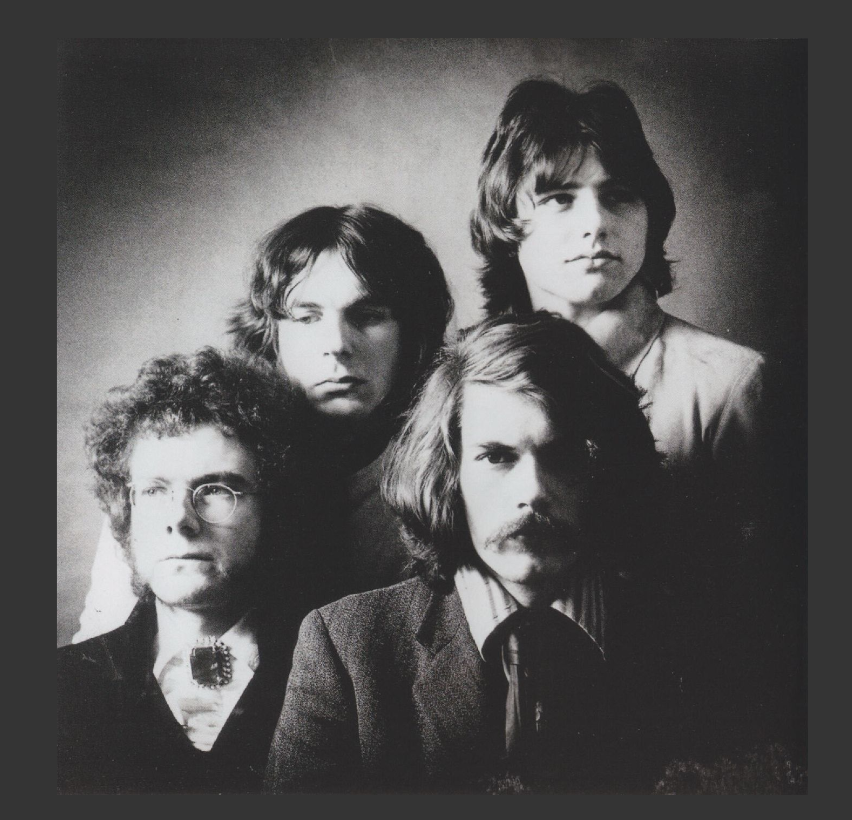
King Crimson formed in London at the end of 1968: Fripp on guitar, Greg Lake singing and playing bass, Ian McDonald on reeds and Mellotron, Michael Giles on drums, and Peter Sinfield writing the words and running the lights. In July 1969, with no album out, they played the Rolling Stones’ free concert in Hyde Park in front of a crowd estimated in the hundreds of thousands, and were by most accounts the thing people talked about on the way home. The record came in October. In the Court of the Crimson King opens with a saxophone and guitar riff snarled in unison under a distorted vocal, then spends the rest of its running time swinging between that violence and passages of Mellotron, a keyboard that plays tape loops of real strings and choirs, so lush they sound like an orchestra weeping in the next room. Nobody had put those two things on one record before. Pete Townshend, who had no reason to flatter a rival, called it an uncanny masterpiece. Progressive rock as a category, with its own audience and its own excesses, more or less dates from it.
Then the band fell apart, which became its habit. McDonald and Giles left within months. Lake left to start Emerson, Lake & Palmer and become rich. Fripp kept the name and hired whoever he needed, and by the time he had made three more albums with rotating personnel he had reached a conclusion about the music itself: the vocabulary was used up. The four-four groove, the chords built from stacked thirds, the verse-chorus-verse architecture that even the ambitious bands were still living inside. All of it had been played to death, by him as much as anyone.
So in 1972 he built a different band on purpose. Bill Bruford walked out of Yes at the height of Yes’s commercial success to join, which people at the time thought was madness. John Wetton came in on bass and vocals, David Cross on violin, and Jamie Muir on percussion, a free improviser who came onstage in furs and played sheet metal and chains as readily as drums. The record they made, Larks’ Tongues in Aspic, came out in 1973 and still sounds like a fight between a string quartet and a foundry. Instruments play in different meters at the same time. Whole sections are grown from live improvisation and then hammered into shape. It is closer to Bartók and to heavy metal than to anything on the radio, and for a certain kind of listener it was the most exciting music in the world. Muir left after that one record to enter a Buddhist monastery in Scotland, which in hindsight looks like a dress rehearsal for what his bandleader was about to do.
Two more albums followed in 1974, Starless and Bible Black and Red, the second recorded essentially as a trio after Fripp let Cross go. Red is the one people now name as the summit: heavy, exact and grieving, with a closing track that builds for twelve minutes toward a climax it has been withholding the entire time. And in September 1974, a month before it came out, Fripp announced that King Crimson had ceased to exist. He said it was over for good, which turned out to be false, but he meant it. The band was about to become a serious commercial proposition in Europe, and its leader had decided the whole enterprise was a dinosaur. He had been reading J.G. Bennett that year and told interviewers that the world was heading into a period of breakdown in which large, slow organisations would give way to small, mobile, intelligent units. He wanted to be one of those.
Underneath the sociology was something he said less about. Somewhere on the last tours he had started watching his hands, and could not find himself anywhere near them. By then he could play passages of a difficulty other guitarists were still trying to transcribe, and that was the trouble: night after night the passages came out perfect while his attention was somewhere else entirely, and the more he watched, the less he could locate the person who was supposedly playing. The virtuosity had become a kind of anaesthesia. He later described the moment of seeing it clearly as the top of his head blowing off. He walked away from the money, and a year after the band ended he checked into Sherborne House in Gloucestershire for ten months of a residential course built on the teaching of G.I. Gurdjieff.
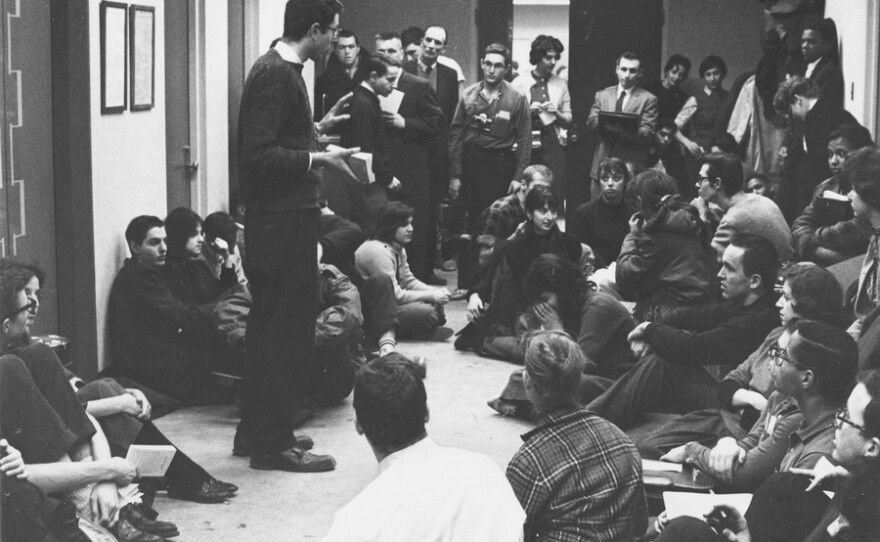
The house belonged to Bennett’s International Academy for Continuous Education. Bennett, an Englishman who had spent decades as a student and interpreter of Gurdjieff and had written the books Fripp was reading, had died the winter before Fripp arrived, so what Fripp got was the institution, the exercises, the people Bennett had trained, and Bennett’s voice on tape. He would later put that voice on his first solo record.
Gurdjieff himself is the sort of figure a psychotherapy blog is supposed to be wary of, with reason. Armenian-Greek, born sometime in the 1860s or 70s (he was vague about it on purpose), he spent his young manhood walking through Central Asia looking for schools of hidden knowledge, came back with a system he called the Work, and taught it to a mixture of wealthy seekers and serious people at a former priory outside Paris. He called his path the way of the sly man, and depending on who you ask he was a real teacher, a magnificent con man, or both at once. Some students came out of it changed for the better. Some came out with nothing but a lighter wallet. Both are usually true of a strong teacher.
The teaching is easier to respect than the man. Its first claim is that you are not awake. Not lazy, not unenlightened: asleep, in the plain sense that things happen to you and you call them decisions afterward. What you experience as “I” is a committee of small I’s, each of which takes the chair for a while, makes promises the others don’t keep, and forgets it was ever there. Man is a machine, Gurdjieff said, and the first exercise, before anything grander, is to catch the machine in motion.
The second claim is that you were born with something real, which he called essence, and that it has been buried over the years under something acquired, which he called personality: the whole apparatus of opinions, mannerisms, ready-made feelings and defenses you picked up from your family, your schooling and your last three jobs. Essence is the only part of you that can actually grow. Personality can only rearrange itself. And what stops you noticing that the personality contradicts itself all day long is a set of internal shock absorbers he called buffers, which make it possible to be cruel at breakfast and sentimental at lunch without the two ever meeting. They make life bearable and change impossible. Any clinician who has watched a client sail past a contradiction in their own account without a flicker knows the mechanism. We call them defenses. We have them too.
And then, sitting on top of this perfectly usable psychology, there is a cosmology that makes Gurdjieff nearly impossible to recommend in polite company. In the version his student Ouspensky wrote down, creation is a descending scale, a great octave running down from the Absolute through the stars and the sun and the planets to the Earth. Below the Earth, at the bottom of the scale, hangs the moon, and the moon is not finished. It is an unborn thing, still growing, and it grows by feeding on what comes off the Earth: the energy given off by mechanical suffering, by negative emotion, by living and dying without ever having woken up. Sleeping humanity is food for the moon. That’s the phrase. The only way off the menu is to wake up, and waking up costs something.
I do not believe the moon is eating anybody. I doubt Fripp believed it either, at least not the way people believe in literal things. But it is one of the more useful pictures of stagnation I have ever been handed, and the person who worked out how to hold it that way was, of all people, a psychiatrist who trained with Jung.
Maurice Nicoll had a practice on Harley Street and had gone to Zurich before the First World War to study with Jung; for a while he was one of Jung’s most visible English supporters. In 1921 he heard Ouspensky lecture in London, and by the following year he was at Gurdjieff’s institute at Fontainebleau, a distinguished physician hauling stones and digging in the garden. He went back to medicine afterward to earn a living, but the rest of his life went into the Work, and into five volumes of Psychological Commentaries that are, read closely, Jungian to the bone. Nicoll never stopped thinking in Jung’s categories. He found a stranger set of pictures to think with, and spent thirty years showing how the two fit.
Set the vocabularies side by side and the rhyme is hard to miss. Gurdjieff’s personality is Jung’s persona, the mask built to face the world that ends up wearing the face. Essence is close to what Jung meant by the Self, or at least to what individuation is supposed to bring forward. Buffers are what keep the shadow in shadow. And the Work itself, that business of catching the machine in the act and bearing what you see, is individuation stripped of its Swiss manners.
Jung’s own position on this kind of material was consistent and underrated. He refused, over and over, to rule on whether a religious image was true in the way a fact is true. That wasn’t his department. His department was what the image did inside a person, and on that he was clear: an image that reorganizes a psyche is real in every way that matters to a psychologist. By that standard “food for the moon” holds up fine. Read as a description of an unexamined life it stops being cosmology and becomes a diagnosis. The moon is the path of least resistance, the least-energy state, the groove everything runs down into when nothing is pushing back. It is the thing you do because your fingers know how. It is every habit that runs without you, quietly converting your one life into fuel for nothing in particular. You don’t have to go anywhere to be eaten. You just have to keep doing what’s easy. Individuation, seen from here, is the refusal to be eaten.
Jung also had reasons of his own to be sympathetic to a man who walks away at the top. In 1913, having broken with Freud, he went into a period of near-collapse he later called his confrontation with the unconscious, and one of the things that carried him through was work with his hands. He went down to the lakeshore and built a miniature village out of stones, the way he had as a boy, and years later at Bollingen he built a real tower, stone by stone, and said the physical labor kept him anchored while the rest of him went places he could not have gone otherwise. He would have understood a guitarist who retuned his instrument in order to feel it again.
The sentence Fripp carried out of Sherborne was Bennett’s: it is impossible to achieve the aim without suffering. In a therapy context that sentence is dangerous if read carelessly. Bennett did not mean that pain is good for you. The Work’s phrase was intentional suffering, and the weight sits on the adjective; it means the discomfort of a chosen difficulty, entered awake, inside a container you are free to leave, and it has nothing to do with pain inflicted or pain endured for its own sake. Jung, from another direction, arrived at almost the same spot. Neurosis, he wrote in Psychology and Religion, is always a substitute for legitimate suffering. The symptom is what turns up when the real thing has been refused. Two men who never met, one at Fontainebleau and one at Küsnacht, doing the same uncomfortable arithmetic.
Gurdjieff’s Law of Three says nothing new can come into being from two forces alone; a third, reconciling force is needed, and the third only shows up if you can stand in the tension of the first two without collapsing into either. Jung called that the transcendent function and thought it was the engine of the whole enterprise of change in psychotherapy. Hold the opposites long enough and something you could not have planned comes up between them. Anyone who has sat in a session and felt the room change knows this isn’t mystical. It’s just rare.
Jung was also famously wary of Westerners who took up Eastern practices wholesale; he thought we tended to borrow the costume and skip the confrontation. Fripp, whether or not he ever read that warning, did not move into a monastery. He went back to the guitar.
The first thing he did with it is the best part of the story. In 1977 Eno got him to Berlin to play on a David Bowie record, and Fripp, out of practice and by his own account not sure he could still do it, got what became the guitar part on “Heroes” in three passes. The sound on that track, the note that seems to cry and never end, isn’t a pedal. It’s feedback, the loop that forms when the amplifier’s sound sets the string vibrating again, and feedback will only hold a given note if you are standing at the right distance from the speaker for that note’s wavelength. So Fripp walked the studio floor with the guitar howling, found the spot where an A would sing forever, and put a piece of tape on the floor. Then he found the spot for a G and taped that. During the take he stepped between the marks. You can hear it as a man playing a guitar. You can also hear it as a man learning that a note only lives if you are exactly where it needs you to be, and that the only way to find that place is to walk around in the noise until you do. There is no better description of therapeutic distance.
Two years later came Exposure, the first record under his own name: a collision of punk, Frippertronics and something close to metal, with Peter Gabriel, Daryl Hall and Peter Hammill singing on it and Terre Roche screaming the title track like someone being pulled out of a burning car. Threaded through it is Bennett’s recorded voice, and the line about the aim and suffering comes around again and again, like the tape. It is the sound of a man making his private conversion public and daring the rock audience to keep up.
When he revived the King Crimson name in 1981 it was with a band first called Discipline, and the music had changed in a way that matters here. Two guitars, his and Adrian Belew’s, play separate repeating figures of different lengths that mesh like gears, the way Balinese gamelan does. Nobody solos over the top. The interest is in the whole pattern, and the pattern only holds if every player is present for every note. It was the first time Fripp built a band around attention rather than virtuosity, and it pointed straight at what came next.
In September 1983 he retuned the instrument. Standard guitar tuning has a whole tradition folded into it: the intervals were chosen centuries ago so that chords would sit comfortably under a human hand, with one deliberate irregularity between the third and second strings to make the common shapes easy, and comfort is destiny. The fingers drop into the shapes the tuning makes easy, and every blues lick and rock riff ever played lives inside those shapes. Fripp’s New Standard Tuning stacks perfect fifths from a low C, down in cello country, up through a high E, with a G on top that sits under so much tension it breaks if you breathe on it. Every chord he had ever known was now wrong. Every pattern in his hands produced nonsense. One of the most fluent guitarists alive chose, deliberately, to become a beginner, because a beginner cannot play asleep. A beginner has to be present for every note or the note simply doesn’t happen. He could not reliably stop his hands from running the old program, so he changed the instrument until the old program failed. Attention was no longer a virtue he had to summon. It was structurally required.
Two years later he made it a school. Guitar Craft opened in 1985 at Claymont Court in West Virginia, a community that had grown out of Bennett’s work, and it was the Work with an acoustic guitar in your lap. Everyone used the new tuning, so accomplished players arrived expert and were helpless within the hour. There was an exercise called the circle, in which the group sat in a ring and passed one note from player to player, around and around, each person responsible for a single moment of the music; one lapse of attention and the whole thing stopped, and everybody knew whose it was. Fripp brought in teachers of the Alexander Technique, the discipline of noticing and undoing the tension you carry in your body without knowing it, on the theory that you cannot be awake in your playing while asleep in your shoulders. And there were aphorisms, which read like the sayings of a strict and unusually kind supervisor. A mistake is always forgivable, rarely excusable and never acceptable. Perfection is impossible, but I may choose to serve it. It is not possible for the musician to play music, but it is possible for the musician to be played by music. Anyone who has done this job long enough knows the best sessions are the ones you didn’t conduct.
“Intentional suffering” has been used to justify a great deal of unintentional cruelty, and Gurdjieff’s groups have not always been immune. The difference between a discipline and an abuse has little to do with the amount of discomfort. It comes down to who chose it, whether it is bounded, whether you can leave, and whether the person setting the terms has done any work on their own shadow. A teacher who cannot see his shadow will hand it to his students and call it a curriculum. Fripp, to his credit, seemed to understand that the friction had to stay inside the music. When he finally started his own record label in the nineties, after a long fight over royalties with his old management, he built it so that the artists own everything, on the grounds that the industry already supplied more than enough involuntary suffering.
Fluency is the most seductive thing that can happen to a person. It feels like mastery. Sometimes it is. It is also exactly what the moon eats.
Fripp never did find a way to stop the loop. Nobody does; the past keeps coming around, blurrier and noisier, under whatever you are doing now. What he found was a way to guarantee that something new was being played on top of it, and played with full attention, because the instrument would not permit anything else. That is close to a description of what actually happens in a good course of therapy. The old story does not get erased. The client whose account of their marriage has come around forty times, in the same words with the same pauses, is not going to have that tape wiped. But something can be played over it that is new enough, and sustained long enough, that the old wash drops back into the mix. Insight alone rarely does that; insight is just another note on the loop. What does it is a change in the instrument, some shift in how the person holds the thing, that makes the old chord shape physically awkward to play.
And the therapist has a loop too, which is the part nobody likes to say out loud. The interventions you have made ten thousand times have shapes, and your fingers know where they go, and there is a version of clinical mastery that is nothing but fluency: the machine running beautifully while nobody is home. Gurdjieff would say that is food for the moon. Jung would say the persona has taken the chair. Fripp’s question, the one from 1974, is the one worth asking mid-session when a familiar move arrives before you’ve decided on it: is anyone actually here?
Gurdjieff had no answer to that except to keep asking it. Jung’s answer was individuation, which is another word for asking it for the rest of your life. Fripp’s answer was a different tuning, and it is the most hopeful of the three, because it suggests the way out of autopilot isn’t heroic self-observation, which fails, but a change to the instrument that makes autopilot fail instead. The tape runs out eventually. The only real question is what you were playing over it while it ran.
















0 Comments