

Updated November 2026 · By Joel Blackstock, LICSW-S
Complex PTSD symptoms are the three core symptoms of PTSD (reliving the trauma in the present, avoiding reminders, and a constant sense of threat) plus three lasting problems known as disturbances in self-organization: severe trouble regulating emotion, a settled belief that you are worthless or defeated, and difficulty staying close to people. ICD-11 lists it as diagnosis 6B41. DSM-5 does not.12
Those three added problems are best read as adaptations, not defects. They are what a nervous system and a sense of self learn when danger is chronic, hard to escape, and often comes from the people who were supposed to provide safety. Recognizing them matters less for the label than for treatment. The pattern tells a therapist what the relationship will have to carry and how to pace the work. It does not, as recent trials suggest, mean that facing the trauma has to wait indefinitely.
What ICD-11 actually lists
The World Health Organization’s ICD-11 defines complex PTSD as a disorder that may develop after an extremely threatening or horrific event or series of events, “most commonly prolonged or repetitive events from which escape is difficult or impossible.” Its examples are torture, slavery, genocide campaigns, prolonged domestic violence and repeated childhood sexual or physical abuse. All the requirements for PTSD must be met. On top of them, the person shows severe and persistent problems in affect regulation; beliefs about the self as “diminished, defeated or worthless,” with shame, guilt or a sense of failure tied to the trauma; and difficulties sustaining relationships and feeling close to others. The symptoms have to cause significant impairment in daily life.1
ICD-11 PTSD itself is narrower than the American version. It has three elements: re-experiencing the trauma in the here and now, avoidance, and a persistent sense of current threat. DSM-5 took a different route. Rather than adding a sibling diagnosis, it widened PTSD to include self-blame, persistent negative mood, irritability and reckless or self-destructive behavior, and it added a dissociative subtype.2 So a person can be diagnosed with PTSD in one system and complex PTSD in the other without anything about them changing. Under ICD-11 you receive one diagnosis or the other, never both.11
The idea is older than the code. In 1992 the psychiatrist Judith Herman, who first proposed complex PTSD, argued that the PTSD diagnosis was built on survivors of circumscribed events and missed what prolonged, repeated trauma does to people held under someone else’s control, whether in political captivity or in a home.3 A version called DESNOS (disorders of extreme stress not otherwise specified) was tested in the DSM-IV field trials but left out, largely because its symptoms rarely appeared without PTSD. ICD-10 had a diagnosis called enduring personality change after catastrophic experience, and that category became the starting point for the ICD-11 diagnosis. The World Health Assembly adopted ICD-11 in May 2019, and it came into effect on 1 January 2022.228
One correction to a common claim: ICD-11 does not require any particular kind of trauma. Prolonged interpersonal trauma is a risk factor, not an entry ticket. Some people develop complex PTSD after a single event, and some people who endured years of abuse develop ordinary PTSD or neither.2 The link is still strong. In a population-based study of 1,839 U.S. adults published in 2019, 3.8% met ICD-11 criteria for complex PTSD and 3.4% for PTSD. Cumulative childhood trauma was more strongly tied to complex PTSD, and sexual and physical abuse by caregivers stood out as risk factors.4 A 2022 review in The Lancet puts population prevalence at 1 to 8% and up to 50% in mental health facilities.5 Factor-analytic studies generally support treating PTSD and complex PTSD as two distinct, related disorders.6
The six symptom clusters, up close
The first three are shared with PTSD, and the article on what PTSD feels like from the inside covers them in more detail.
- Re-experiencing in the here and now. This is more than remembering. Intrusive images, nightmares or flashbacks arrive with the fear, body sensations and urgency of the original moment.
- Avoidance. Steering away from thoughts, feelings, people, places or conversations that bring it back. Over years this can shrink a life without the person noticing.
- Sense of current threat. Hypervigilance and an exaggerated startle response. Children who grew up walking on eggshells around an unpredictable parent often describe this as simply how they are, not as a symptom.
The next three are the disturbances in self-organization:
- Affect dysregulation. This runs in two directions. One is heightened reactivity: small stressors set off rage or despair that is slow to settle, sometimes with self-destructive behavior to get through it. The other is shutdown: numbness, emotional flatness, or dissociating under stress.211 Many people swing between the two.
- Negative self-concept. A steady sense of being worthless, defeated or a failure, often with guilt that sounds like “I should have left” or “I should have stopped it.”2 For a child, believing “I am bad” was often safer than believing “the person I depend on is dangerous,” because it preserved the attachment and a sense that things could be controlled. That is a clinical reading, not a diagnostic criterion, but it explains why the belief resists argument.
- Disturbances in relationships. Trouble sustaining relationships and feeling close, even with people one wants to be close to. Some people stay at a distance. Others keep landing in relationships that repeat old dynamics, a pattern familiar to many adult children of alcoholics.
The three domains feed each other. A surge of shame produces an outburst or a withdrawal. The relationship takes the hit. The rupture becomes fresh evidence of being defective, and the next surge comes faster. This loop is why complex PTSD can feel permanent from the inside. It is also why therapy usually has to work on more than one of the three at a time.
You will often see “emotional flashbacks” listed as a symptom. The term was popularized by the therapist Pete Walker, author of the 2013 book Complex PTSD: From Surviving to Thriving, who describes them as sudden, often prolonged regressions to the fear, shame or despair of childhood, usually without a visual memory, so the person does not realize the past is being relived.7 Many clients find the idea useful. It is a clinical concept, though, not one of the ICD-11 criteria.
Complex PTSD, PTSD and borderline personality disorder
Complex PTSD overlaps with borderline personality disorder (BPD), and people with trauma histories are sometimes given a BPD diagnosis when complex PTSD fits better, or the reverse. The research suggests they are related but distinct. In a latent class analysis of 280 women seeking treatment for childhood abuse, Marylène Cloitre and colleagues found separate PTSD, complex PTSD and BPD groups. Four symptoms sharply raised the odds of being in the BPD group rather than the complex PTSD group: frantic efforts to avoid abandonment, an unstable sense of self, unstable and intense relationships, and impulsiveness.8 A 2021 review by Julian Ford and Christine Courtois reached the same conclusion: the three conditions can co-occur but are distinct syndromes.9
| Feature | PTSD (ICD-11) | Complex PTSD (ICD-11) | Borderline personality disorder |
|---|---|---|---|
| Core picture | Re-experiencing in the present, avoidance, sense of current threat | All PTSD features plus problems with affect regulation, self-concept and relationships | Instability of relationships, self-image and mood, with impulsivity |
| Self-concept | Not a core criterion | Persistently negative: worthless, defeated, ashamed | Unstable; can shift sharply |
| Relationships | Not a core criterion | Difficulty sustaining closeness | Intense and unstable, with fear of abandonment |
| Trauma exposure | Required | Required; prolonged trauma raises risk but is not required | Not required, though childhood adversity is common |
The distinction matters clinically. A steady, negative self-image calls for different work than a self-image that changes with every relationship. Dissociation can show up in all three, which is one reason a careful assessment for dissociation and lost time belongs in any complex trauma evaluation.9
A self-check, and the questionnaire clinicians use
The validated self-report measure for ICD-11 PTSD and complex PTSD is the International Trauma Questionnaire (ITQ), developed by Cloitre and colleagues in 2018.10 It has 18 items: six for PTSD symptoms, six for disturbances in self-organization, and two sets of questions about whether those symptoms impair work, relationships and other parts of life. Items are rated from 0 (“not at all”) to 4 (“extremely”). The measure is free and in the public domain. Even scored correctly, it gives only a provisional diagnosis. A clinician can confirm it with an interview such as the International Trauma Interview.11
The questions below are not the ITQ. They are an informal reflection built on the ICD-11 domains, are not validated, and have no score. They cannot tell you whether you have complex PTSD. Thinking about the past month:
- Do memories of what happened come back as if they were happening now, as images, nightmares, or a rush of the same fear in your body?
- Do you work to keep thoughts, feelings, people or places connected to it out of your life?
- Are you on guard most of the time, scanning rooms and faces, startling easily?
- When you get upset, does it take a very long time to come back down, or do you go numb and blank instead?
- Do you rely on drinking, self-harm, bingeing or other risky behavior to get through overwhelming feelings?
- Do you carry a steady sense of being worthless, defeated or a failure, with shame or guilt about what happened?
- Is it hard to stay close to people, even ones you care about?
- Do these problems interfere with work, school, family or friendships?
If you said yes in each area, and especially to the last question, that is the pattern a trauma-trained clinician would want to assess properly. If question 5 describes you, or you are thinking about suicide, call or text 988, the Suicide & Crisis Lifeline. Veterans can press 1 after dialing 988 or text 838255. Local options are listed on our Birmingham crisis resources page.
What the treatment research shows
Herman’s Trauma and Recovery described recovery in three stages: establishing safety, remembrance and mourning, and reconnection with ordinary life.12 The model was not new. Pierre Janet had laid out a phase-oriented treatment of traumatic stress a century earlier: build a stable therapeutic relationship, retrieve and transform traumatic memories, and help the patient act effectively again.13 In an expert survey run by an International Society for Traumatic Stress Studies task force and published in 2011, 84% of the 50 experts who responded endorsed a phase-based or sequenced approach for complex PTSD.14
That consensus has been challenged. In 2016, Ad de Jongh, Patricia Resick and colleagues argued that the evidence for a required stabilization phase is methodologically weak, and that insisting on one can delay treatment that works.15 The trials point in both directions:
- In a 2010 trial with 104 women with PTSD from childhood abuse, skills training in affect and interpersonal regulation (STAIR) followed by exposure produced more sustained remission than supportive counseling followed by exposure, and fewer cases of worsening than either comparison condition.16
- In a 2021 Dutch trial with 149 adults with childhood abuse-related PTSD, standard prolonged exposure, an intensified version and STAIR followed by exposure all produced large improvements, with no significant difference among them. The STAIR phase did not add gains in emotion regulation, interpersonal problems or self-esteem.17
- In a 2020 German trial with 193 women with childhood abuse-related PTSD and borderline features, both DBT-PTSD and cognitive processing therapy helped. DBT-PTSD did somewhat better: a small advantage on the main outcome, fewer dropouts, and remission in 58% versus 41%.18
Two meta-analyses give the wider view. A 2019 meta-analysis pooled 51 randomized trials of PTSD treatments in samples likely to have clinically significant complex PTSD symptoms, though not formally diagnosed with it. Cognitive behavioral therapy, exposure therapy and EMDR beat usual care on PTSD symptoms. CBT and exposure also had moderate to large effects on negative self-concept, and all three helped relationship problems. Few trials measured affect regulation, the EMDR estimate rested on few trials and was rated low quality, benefits were smaller against non-specific comparison conditions such as befriending, and childhood-onset trauma was associated with poorer outcomes.19 A 2020 component network meta-analysis of adults exposed to complex traumatic events, such as childhood sexual abuse, war and domestic violence, found trauma-focused therapies effective and multicomponent treatments the most effective for PTSD symptoms. Phase-based treatments that combined skills training with trauma-focused work looked most promising for emotional dysregulation and interpersonal problems.20
The most defensible reading is that people with complex PTSD can benefit from established trauma-focused therapies, often as much as people with PTSD.11 Stabilization is better treated as something added when it is needed, not a gate someone has to pass before the real work starts. The 2023 VA/DoD guideline recommends prolonged exposure, cognitive processing therapy and EMDR for PTSD, and recommends manualized psychotherapy over medication.21 For a longer look at that evidence, see whether EMDR is evidence based.
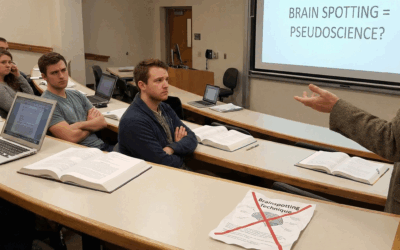
Two common claims need correcting. Trauma-Focused Cognitive Behavioral Therapy (TF-CBT) is a specific model developed by Cohen, Mannarino and Deblinger for children, adolescents and their caregivers, not a general adult treatment.22 Adults are usually offered cognitive processing therapy, prolonged exposure or EMDR. And body-based approaches have early but limited evidence. The first randomized trial of Somatic Experiencing for PTSD, with 63 participants and a waitlist control, reported positive results,23 and a 2021 scoping review called its evidence preliminary and of mixed quality.24 For Internal Family Systems, an uncontrolled pilot study of 17 adults with PTSD and multiple childhood traumas reported large symptom reductions.25 A 2026 randomized trial of an online group IFS program in 60 patients with PTSD then found that symptoms fell in both the IFS group and a matched active comparison group, with no significant difference between them.29 The one Brainspotting comparison study indexed in PubMed tested single sessions in 40 psychologists and physicians with distressing memories, not patients with PTSD.26 The Lifespan Integration studies indexed in PubMed are single-case studies with children.27 A PubMed search finds no controlled trials of Brainspotting or Emotional Transformation Therapy in PTSD or complex PTSD.
No medication treats complex PTSD as such. For PTSD symptoms, the VA/DoD guideline recommends sertraline, paroxetine or venlafaxine and recommends against benzodiazepines and cannabis products.21 Medication can make therapy more workable for some people. Decisions about starting, changing or stopping any medication belong in a conversation with your prescriber.
What this looks like in therapy
Early sessions are mostly assessment and orientation. That means a trauma history taken at a pace the person can manage, a check on current safety (relationships, self-harm, substance use), a measure such as the ITQ or the PCL-5, and an honest conversation about what the person wants to change. Many people with complex PTSD have never had their symptoms explained as a coherent pattern. Hearing that the shame, the shutdowns and the trouble trusting are connected, and that they made sense once, is often the first relief.
From there the work moves between building capacity and processing memories rather than through rigid stages. Capacity means learning to notice when the body is heading into threat or collapse and having ways to come back, which is where body-based somatic therapy and DBT-style skills earn their place. Long silent, eyes-closed practice is not always the right tool; some survivors find it brings up more than it settles, which is the subject of our piece on when meditation can make trauma worse. Processing means going back to specific memories with a structured method such as EMDR or cognitive processing therapy, once the person can stay present enough for it to help.
The negative self-concept usually does not yield to reassurance. It tends to shift when the person can see the belief as a strategy a child needed. Parts-based language helps here. Clients often recognize the inner critic as a protector that learned to strike first so no one else could. The relationship disturbances show up in the therapy room too, as testing, withdrawal or fear of being too much. A therapist who can notice a rupture, name it and repair it gives the client direct experience that closeness can survive conflict. In Herman’s terms, that is reconnection: friendships, intimacy, work and meaning that are no longer organized around the trauma.12 Progress is rarely linear, and experts still disagree about how long treatment should take.14
Getting help for complex PTSD in Birmingham
Taproot Therapy Collective is in Hoover, a short drive from downtown Birmingham, and also offers trauma teletherapy anywhere in Alabama. Our clinicians draw on EMDR, somatic approaches, parts-based therapy, DBT skills, Brainspotting, Lifespan Integration and Emotional Transformation Therapy. We are candid about the evidence: of these, EMDR has the strongest research base for PTSD; somatic and parts-based approaches have a few small trials with preliminary or mixed results; Brainspotting, Lifespan Integration and ETT have little or no controlled research. We use them within a paced, phase-aware plan, not as proven cures. Whoever you see, in Birmingham or elsewhere, it is fair to ask how they assess complex PTSD, how they decide when to process memories, and how they will measure whether therapy is helping.
If this pattern sounds familiar and you want an assessment or a first conversation about treatment, you can contact Taproot Therapy Collective. We will tell you plainly what we think would help, including when that is a referral elsewhere.
References
- World Health Organization. (2022). 6B41 Complex post traumatic stress disorder. In International classification of diseases for mortality and morbidity statistics (11th rev.). https://icd.who.int/
- Larsen, S. E. (n.d.). Complex PTSD: History and definitions. National Center for PTSD, U.S. Department of Veterans Affairs. Retrieved November 8, 2026, from https://www.ptsd.va.gov/professional/treat/essentials/complex_ptsd.asp
- Herman, J. L. (1992). Complex PTSD: A syndrome in survivors of prolonged and repeated trauma. Journal of Traumatic Stress, 5(3), 377–391. https://doi.org/10.1002/jts.2490050305
- Cloitre, M., Hyland, P., Bisson, J. I., Brewin, C. R., Roberts, N. P., Karatzias, T., & Shevlin, M. (2019). ICD-11 posttraumatic stress disorder and complex posttraumatic stress disorder in the United States: A population-based study. Journal of Traumatic Stress, 32(6), 833–842. https://doi.org/10.1002/jts.22454
- Maercker, A., Cloitre, M., Bachem, R., Schlumpf, Y. R., Khoury, B., Hitchcock, C., & Bohus, M. (2022). Complex post-traumatic stress disorder. The Lancet, 400(10345), 60–72. https://doi.org/10.1016/S0140-6736(22)00821-2
- Brewin, C. R., Cloitre, M., Hyland, P., Shevlin, M., Maercker, A., Bryant, R. A., Humayun, A., Jones, L. M., Kagee, A., Rousseau, C., Somasundaram, D., Suzuki, Y., Wessely, S., van Ommeren, M., & Reed, G. M. (2017). A review of current evidence regarding the ICD-11 proposals for diagnosing PTSD and complex PTSD. Clinical Psychology Review, 58, 1–15. https://doi.org/10.1016/j.cpr.2017.09.001
- Walker, P. (2013). Complex PTSD: From surviving to thriving: A guide and map for recovering from childhood trauma. CreateSpace Independent Publishing Platform.
- Cloitre, M., Garvert, D. W., Weiss, B., Carlson, E. B., & Bryant, R. A. (2014). Distinguishing PTSD, complex PTSD, and borderline personality disorder: A latent class analysis. European Journal of Psychotraumatology, 5(1), 25097. https://doi.org/10.3402/ejpt.v5.25097
- Ford, J. D., & Courtois, C. A. (2021). Complex PTSD and borderline personality disorder. Borderline Personality Disorder and Emotion Dysregulation, 8(1), 16. https://doi.org/10.1186/s40479-021-00155-9
- Cloitre, M., Shevlin, M., Brewin, C. R., Bisson, J. I., Roberts, N. P., Maercker, A., Karatzias, T., & Hyland, P. (2018). The International Trauma Questionnaire: Development of a self-report measure of ICD-11 PTSD and complex PTSD. Acta Psychiatrica Scandinavica, 138(6), 536–546. https://doi.org/10.1111/acps.12956
- Larsen, S. E. (n.d.). Complex PTSD: Assessment and treatment. National Center for PTSD, U.S. Department of Veterans Affairs. Retrieved November 8, 2026, from https://www.ptsd.va.gov/professional/treat/txessentials/complex_ptsd_assessment.asp
- Herman, J. L. (1992). Trauma and recovery: The aftermath of violence, from domestic abuse to political terror. Basic Books.
- van der Hart, O., Brown, P., & van der Kolk, B. A. (1989). Pierre Janet’s treatment of post-traumatic stress. Journal of Traumatic Stress, 2(4), 379–395. https://doi.org/10.1002/jts.2490020404
- Cloitre, M., Courtois, C. A., Charuvastra, A., Carapezza, R., Stolbach, B. C., & Green, B. L. (2011). Treatment of complex PTSD: Results of the ISTSS expert clinician survey on best practices. Journal of Traumatic Stress, 24(6), 615–627. https://doi.org/10.1002/jts.20697
- De Jongh, A., Resick, P. A., Zoellner, L. A., van Minnen, A., Lee, C. W., Monson, C. M., Foa, E. B., Wheeler, K., ten Broeke, E., Feeny, N., Rauch, S. A. M., Chard, K. M., Mueser, K. T., Sloan, D. M., van der Gaag, M., Rothbaum, B. O., Neuner, F., de Roos, C., Hehenkamp, L. M. J., Rosner, R., & Bicanic, I. A. E. (2016). Critical analysis of the current treatment guidelines for complex PTSD in adults. Depression and Anxiety, 33(5), 359–369. https://doi.org/10.1002/da.22469
- Cloitre, M., Stovall-McClough, K. C., Nooner, K., Zorbas, P., Cherry, S., Jackson, C. L., Gan, W., & Petkova, E. (2010). Treatment for PTSD related to childhood abuse: A randomized controlled trial. American Journal of Psychiatry, 167(8), 915–924. https://doi.org/10.1176/appi.ajp.2010.09081247
- Oprel, D. A. C., Hoeboer, C. M., Schoorl, M., de Kleine, R. A., Cloitre, M., Wigard, I. G., van Minnen, A., & van der Does, W. (2021). Effect of prolonged exposure, intensified prolonged exposure and STAIR+prolonged exposure in patients with PTSD related to childhood abuse: A randomized controlled trial. European Journal of Psychotraumatology, 12(1), 1851511. https://doi.org/10.1080/20008198.2020.1851511
- Bohus, M., Kleindienst, N., Hahn, C., Müller-Engelmann, M., Ludäscher, P., Steil, R., Fydrich, T., Kuehner, C., Resick, P. A., Stiglmayr, C., Schmahl, C., & Priebe, K. (2020). Dialectical behavior therapy for posttraumatic stress disorder (DBT-PTSD) compared with cognitive processing therapy (CPT) in complex presentations of PTSD in women survivors of childhood abuse: A randomized clinical trial. JAMA Psychiatry, 77(12), 1235–1245. https://doi.org/10.1001/jamapsychiatry.2020.2148
- Karatzias, T., Murphy, P., Cloitre, M., Bisson, J., Roberts, N., Shevlin, M., Hyland, P., Maercker, A., Ben-Ezra, M., Coventry, P., Mason-Roberts, S., Bradley, A., & Hutton, P. (2019). Psychological interventions for ICD-11 complex PTSD symptoms: Systematic review and meta-analysis. Psychological Medicine, 49(11), 1761–1775. https://doi.org/10.1017/S0033291719000436
- Coventry, P. A., Meader, N., Melton, H., Temple, M., Dale, H., Wright, K., Cloitre, M., Karatzias, T., Bisson, J., Roberts, N. P., Brown, J. V. E., Barbui, C., Churchill, R., Lovell, K., McMillan, D., & Gilbody, S. (2020). Psychological and pharmacological interventions for posttraumatic stress disorder and comorbid mental health problems following complex traumatic events: Systematic review and component network meta-analysis. PLOS Medicine, 17(8), e1003262. https://doi.org/10.1371/journal.pmed.1003262
- Schnurr, P. P., Hamblen, J. L., Wolf, J., Coller, R., Collie, C., Fuller, M. A., Holtzheimer, P. E., Kelly, U., Lang, A. J., McGraw, K., Morganstein, J. C., Norman, S. B., Papke, K., Petrakis, I., Riggs, D., Sall, J. A., Shiner, B., Wiechers, I., & Kelber, M. S. (2024). The management of posttraumatic stress disorder and acute stress disorder: Synopsis of the 2023 U.S. Department of Veterans Affairs and U.S. Department of Defense clinical practice guideline. Annals of Internal Medicine, 177(3), 363–374. https://doi.org/10.7326/M23-2757
- de Arellano, M. A. R., Lyman, D. R., Jobe-Shields, L., George, P., Dougherty, R. H., Daniels, A. S., Ghose, S. S., Huang, L., & Delphin-Rittmon, M. E. (2014). Trauma-focused cognitive-behavioral therapy for children and adolescents: Assessing the evidence. Psychiatric Services, 65(5), 591–602. https://doi.org/10.1176/appi.ps.201300255
- Brom, D., Stokar, Y., Lawi, C., Nuriel-Porat, V., Ziv, Y., Lerner, K., & Ross, G. (2017). Somatic experiencing for posttraumatic stress disorder: A randomized controlled outcome study. Journal of Traumatic Stress, 30(3), 304–312. https://doi.org/10.1002/jts.22189
- Kuhfuß, M., Maldei, T., Hetmanek, A., & Baumann, N. (2021). Somatic experiencing: Effectiveness and key factors of a body-oriented trauma therapy: A scoping literature review. European Journal of Psychotraumatology, 12(1), 1929023. https://doi.org/10.1080/20008198.2021.1929023
- Hodgdon, H. B., Anderson, F. G., Southwell, E., Hrubec, W., & Schwartz, R. (2022). Internal Family Systems (IFS) therapy for posttraumatic stress disorder (PTSD) among survivors of multiple childhood trauma: A pilot effectiveness study. Journal of Aggression, Maltreatment & Trauma, 31(1), 22–43. https://doi.org/10.1080/10926771.2021.2013375
- D’Antoni, F., Matiz, A., Fabbro, F., & Crescentini, C. (2022). Psychotherapeutic techniques for distressing memories: A comparative study between EMDR, Brainspotting, and Body Scan Meditation. International Journal of Environmental Research and Public Health, 19(3), 1142. https://doi.org/10.3390/ijerph19031142
- Rensch, C., Kwee, J., Rossen, L., & McDonald, M. (2021). Lifespan Integration therapy with trauma-exposed children: A hermeneutic single case efficacy study. Journal of Child & Adolescent Trauma, 14(3), 401–413. https://doi.org/10.1007/s40653-021-00359-9
- World Health Organization. (2019, May 25). World Health Assembly update, 25 May 2019 (News release). https://www.who.int/news/item/25-05-2019-world-health-assembly-update
- Joss, D., Comeau, A., Chevannes, R., Parry, G., Rea, H. S., Barria, J., Bumpus, C., Rector, A., Rajan, A., Rosansky, J., Rice, F. K., Ward, M. C., Tobiasz Veltz, L., Ally, D., Rosenberg, L. G., Sweezy, M., Lovas, D., & Schuman-Olivier, Z. (2026). A randomized controlled trial of an online group-based internal family systems treatment for posttraumatic stress disorder: The Program for Alleviating and Resolving Trauma and Stress (PARTS) study. Psychological Trauma: Theory, Research, Practice, and Policy. Advance online publication. https://doi.org/10.1037/tra0002089

















0 Comments