Walter Ong: Orality, Literacy, and the Jesuit Worldview

by | Nov 10, 2024 | 0 comments

I. Who was Walter Ong

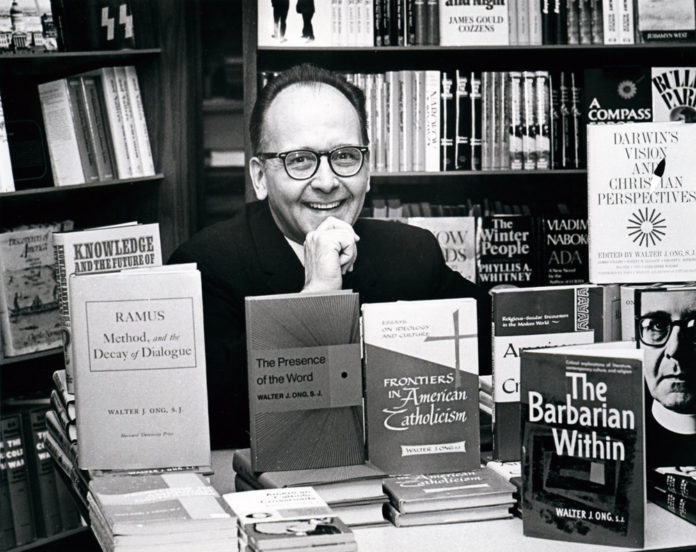
Walter J. Ong (1912-2003) was an American Jesuit priest, professor of English literature, and cultural and religious historian. Ong made groundbreaking contributions to the fields of literacy studies, media ecology, and the evolution of human consciousness. His work explored the profound differences between oral and literate cultures and how the shift from orality to literacy has shaped human thought, expression, and social organization throughout history. As a Jesuit scholar, Ong’s ideas were deeply influenced by his Catholic faith and the Jesuit intellectual tradition.

II. Biography of Walter Ong

Walter Jackson Ong Jr. was born in Kansas City, Missouri in 1912. He attended Rockhurst High School and College before entering the Jesuit order in 1935. Ong earned a master’s degree in English from Saint Louis University and a PhD in English from Harvard University in 1955.

Throughout his academic career, Ong held professorships at Saint Louis University, where he taught from 1959 to 1984. He was also a visiting professor at many universities worldwide, including Yale, Johns Hopkins, Cornell, and the University of Poitiers in France.

Ong’s most influential works include Orality and Literacy: The Technologizing of the Word (1982), The Presence of the Word (1967), and Fighting for Life: Contest, Sexuality, and Consciousness (1981). He was an elected member of the American Academy of Arts and Sciences and served as president of the Modern Language Association in 1978.

Ong passed away in 2003 at the age of 90, leaving behind a rich legacy of scholarship that continues to shape the study of language, media, and culture.

III. Overview of Key Ideas

A. Orality vs. Literacy

The core of Ong’s work centers on the fundamental differences between oral and literate cultures. Oral cultures, he argued, have a different mindset and ways of processing knowledge compared to literate cultures. Oral thought and expression tends to be additive, aggregative, redundant, conservative, close to the human lifeworld, agonistically toned, empathetic and participatory, homeostatic, and situational. In contrast, writing restructures consciousness by promoting analytic, linear, abstract, distant, objective, and complex thought.

B. The Word as Event and Sound

In oral cultures, Ong contended, the spoken word is an event, a happening that occurs in time and engages the whole person. Orality emphasizes the auditory and the interiority of sound. With the advent of writing, the word becomes a thing, a visual artifact that can be analyzed, controlled, and manipulated in space. Literacy enables a new kind of consciousness based on the exteriority and objectivity of the written text.

C. Stages of the Word

Ong proposed that human cultures have gone through successive stages of development in their relationship to the word: from primary orality (pre-writing), to chirographic or manuscript literacy, to typographic or print literacy, and finally to electronic orality enabled by modern communication technologies. Each stage involves different sensory ratios, cognitive styles, and power dynamics between authors, interpreters, and audiences.

D. Media Ecology

Along with Marshall McLuhan and others, Ong was a key figure in the field of media ecology, which studies how communication technologies shape human perception, understanding, feeling, and value. Ong stressed that technologies are not mere exterior aids but interior transformations of consciousness. Different media foster different habits of mind and enable new forms of community, identity, and social control.

E. The Evolution of Consciousness

Ultimately, Ong saw the history of communication as bound up with the evolution of human consciousness itself. The technologizing of the word, from speech to writing to print to digital media, parallels the development of the human psyche from pre-linguistic awareness to symbolic and conceptual thinking to the emergence of the modern, autonomous self. By understanding how media shape our minds, we can better understand who we are and where we may be headed as a species.

IV. The Jesuit Worldview and Christian Orality

A. Ignatian Spirituality

As a Jesuit, Ong was steeped in the spirituality of St. Ignatius of Loyola, the founder of the Jesuit order. Ignatian spirituality emphasizes the use of the imagination in prayer and contemplation, inviting the believer to enter into the biblical narrative and engage with it as a living, embodied reality. This emphasis on the vivid, participatory qualities of religious experience resonates with Ong’s understanding of the oral mindset and its attunement to the “human lifeworld.”

B. The Oral Roots of Christian Tradition

Ong’s work highlights the oral dimensions of the Christian tradition, particularly in its early stages. Jesus himself did not write but spoke, and his teachings were initially transmitted orally by his followers. The Gospels and other New Testament writings bear the marks of their oral composition and circulation, with their use of mnemonic devices, formulaic language, and rhetorical patterning. Ong’s insights into the dynamics of orality shed light on the formation and interpretation of these foundational Christian texts.

C. The Interplay of Orality and Literacy in Christian Practice

While Christianity is a religion of the book, it has always maintained a vital oral culture alongside its textual traditions. The practice of preaching, in which the written word of Scripture is “re-oralized” in the context of the liturgical assembly, is central to Christian worship. Ong’s work illuminates the complex interplay of orality and literacy in Christian practice, with the written text serving as a source and stimulus for oral performance and interpretation.

D. The Eucharist as Oral Event

For Ong, the Eucharist or Lord’s Supper is the supreme instance of Christian orality. In this sacrament, the words of institution (“This is my body,” “This is my blood”) are not merely descriptive but performative, effecting the transformation of bread and wine into the body and blood of Christ. The Eucharist is an oral event in which the word becomes flesh, the text becomes embodied presence. Ong’s understanding of the power of the spoken word illuminates the central mystery of Christian faith.

E. The Jesuit Mission and the Encounter with Orality

The Jesuit order was founded in the 16th century to spread the Christian faith through missionary work and education. Jesuit missionaries encountered oral cultures around the world and grappled with the challenges of communicating the Gospel in non-literate contexts. Ong’s work provides a framework for understanding these cross-cultural encounters and the ways in which the Jesuit mission both transformed and was transformed by the oral traditions it engaged.

V. Selected Quotes

“In the beginning was the Word, and the Word was with God, and the Word was God” (John 1:1). This passage from the prologue to John’s Gospel epitomizes the Christian understanding of the divine Logos, the Word that is both spoken and incarnate. For Ong, this scriptural text points to the deep interconnection of orality, literacy, and embodiment in the Christian tradition.

“The Word of God is not the Bible. The Word of God is Christ. The Bible is a product of the Word of God in a sense, but it is not itself the Word of God. The Word of God is bigger than the Bible.”

“The Jesuit educational system, which was established in about 1540 and reached out around the entire world, had great influence on the development of the teaching of rhetoric and the reinvigoration of the art of rhetoric in modern times.”

“The elements of the Eucharist are an oral-aural event, an encounter of persons with the Word made flesh who took bread and wine and transformed them into his body and blood.”

“By keeping its distance from writing and situating itself in the oral-aural world, theology can remind itself of its own nature as a reflection on the revealed Word and as itself a spoken word, a verbum.”

VI. Ong’s Influence and Legacy

Walter Ong’s groundbreaking work on orality and literacy has had a profound influence across a wide range of disciplines, from literature and history to anthropology and media studies. His insights have been particularly valuable for scholars of religion, illuminating the oral dimensions of sacred texts, liturgical practices, and theological discourse.

In the field of Jesuit studies, Ong’s work has helped to articulate the distinctive characteristics of Ignatian spirituality and pedagogy, with their emphasis on imagination, embodiment, and the interplay of word and image. His analysis of the Jesuit missionary encounter with oral cultures has also enriched our understanding of the global reach and impact of the Jesuit order.

More broadly, Ong’s exploration of the Christian tradition through the lens of orality and literacy has opened up new perspectives on the nature of revelation, the dynamics of faith transmission, and the relationship between Scripture and tradition. His work challenges the tendency to view Christianity as a purely textual religion and invites a renewed appreciation for the oral, embodied, and performative dimensions of Christian practice.

As the Church continues to grapple with the challenges of communicating the Gospel in an increasingly digital and globalized world, Ong’s insights into the technologizing of the word and the evolution of human consciousness remain highly relevant. His vision of a Christian humanism that integrates the best of oral and literate culture offers a compelling model for the future of faith in the 21st century.

Explore the Other Articles by Categories on Our Blog 

Hardy Micronutrition is clinically proven to IMPROVE FOCUS and reduce the effects of autism, anxiety, ADHD, and depression in adults and children without drugsWatch Interview With HardyVisit GetHardy.com and use offer code TAPROOT for 15% off

Somatic Reset Techniques You Can do At Home

Somatic Reset Techniques You Can do At Home

Written by the clinical team at Taproot Therapy Collective, a Birmingham psychotherapy practice specializing in somatic and trauma-focused modalities. Our clinicians are trained in body-based approaches including Brainspotting, EMDR, and somatic trauma resolution....

Why We Recommend Hardy Nutritionals: A Clinical Perspective on the Research That Changed How We Think About Treatment Resistance

Why We Recommend Hardy Nutritionals: A Clinical Perspective on the Research That Changed How We Think About Treatment Resistance

Why Taproot Therapy Collective recommends Hardy Nutritionals Daily Essential Nutrients for treatment-resistant mood disorders, ADHD, and emotional dysregulation. Discovered not through advertising but through patients whose bipolar disorder and other conditions finally responded. Over 40 peer-reviewed studies support the NutraTek chelation technology. Use code TAPROOT at gethardy.com for 15% off for life.

The Second Brain Revolution: How Gut Science Is Rewriting Psychiatric Medicine

The Second Brain Revolution: How Gut Science Is Rewriting Psychiatric Medicine

This 2025 strategic report details the shift from theoretical gut-brain models to clinical applications, analyzing the indole-SK2 channel mechanism in anxiety and the efficacy of oral FMT capsules for refractory depression. It evaluates the diagnostic potential of the gut mycobiome and profiles the pharmaceutical pipelines of key industry players like Kallyope and Bloom Science.

The Metabolic Mind: A 2025 Clinical Update on Nutritional Psychiatry

The Metabolic Mind: A 2025 Clinical Update on Nutritional Psychiatry

A 2025 clinical update on nutritional psychiatry for psychotherapists. Explore the latest research on psychobiotics, vitamin D, magnesium, zinc, omega-3s, amino acid therapies, and herbal interventions—including new safety warnings on ashwagandha and evidence that saffron matches SSRI efficacy for mild depression.

Bill O’Hanlon: The Therapist Who Asked “How Do People Get Happy?”

Bill O’Hanlon: The Therapist Who Asked “How Do People Get Happy?”

Bill O’Hanlon, MS, LMFT, studied with Milton Erickson as his only work/study student (serving as Erickson’s gardener) before co-founding Solution-Oriented/Possibility Therapy in the 1980s. Author of nearly 40 books including the Oprah-featured “Do One Thing Different” and foundational “In Search of Solutions” with Michele Weiner-Davis, O’Hanlon delivered over 3,700 presentations worldwide teaching his collaborative, non-pathologizing approach asking “How do people get happy?” rather than “What’s wrong?” He retired from clinical practice in 2020 to pursue professional songwriting from Santa Fe, New Mexico.

Diane Poole Heller: From Trauma Survivor to Pioneer of Attachment Healing

Diane Poole Heller: From Trauma Survivor to Pioneer of Attachment Healing

Diane Poole Heller, PhD, transformed her own 1988 traumatic car accident into a pioneering career developing DARe (Dynamic Attachment Re-patterning experience), a somatic approach integrating attachment theory and trauma resolution now taught worldwide. After 25 years as Senior Faculty for Peter Levine’s Somatic Experiencing Institute, she created Trauma Solutions and authored The Power of Attachment, teaching that regardless of childhood history, people can develop Secure Attachment Skills through attuned relationships, body-based interventions, and recognizing we’re all biologically hardwired for connection and healing.

Laurence Heller: The Clinical Psychologist Who Mapped How Developmental Trauma Distorts Identity

Laurence Heller: The Clinical Psychologist Who Mapped How Developmental Trauma Distorts Identity

Laurence Heller, PhD, spent over 40 years in private practice recognizing that developmental trauma creates not just nervous system dysregulation but fundamental identity distortions—pervasive shame, self-judgment, and disconnection from authentic self. He developed the NeuroAffective Relational Model (NARM), now taught worldwide, mapping five adaptive survival styles arising from disrupted developmental needs (Connection, Attunement, Trust, Autonomy, Love-Sexuality) and providing framework for healing through disidentification from survival-based identities while working simultaneously with psychology and physiology within attuned therapeutic relationships.

Bruce Perry: From Branch Davidian Waco to “What Happened to You?” – Three Decades Translating Neuroscience into Healing for Maltreated Children

Bruce Perry: From Branch Davidian Waco to “What Happened to You?” – Three Decades Translating Neuroscience into Healing for Maltreated Children

Bruce Perry developed the Neurosequential Model after treating children who survived the 1993 Branch Davidian siege in Waco. His three decades translating neuroscience into practical trauma treatment culminated in the #1 bestseller What Happened to You? with Oprah Winfrey. Perry’s fundamental insight: childhood behavior reflects developmental adaptation to environment rather than defect requiring correction, revolutionizing how thousands of professionals understand trauma.

Judith Herman: The Psychiatrist Who Named Complex Trauma and Challenged a Field’s Convenient Amnesia

Judith Herman: The Psychiatrist Who Named Complex Trauma and Challenged a Field’s Convenient Amnesia

Judith Herman, Harvard psychiatrist, transformed trauma treatment by distinguishing complex PTSD from single-incident trauma and articulating the three-stage recovery model emphasizing safety, remembrance, and reconnection. Her 1992 Trauma and Recovery challenged psychiatry’s “convenient amnesia” about sexual violence, while 2023’s Truth and Repair reimagines justice as healing rather than punishment, asking what survivors actually need: acknowledgment, validation, and community witness rather than retribution.

Gabor Maté: From Budapest Ghetto to Voice of Compassion in Addiction’s Darkest Corners

Gabor Maté: From Budapest Ghetto to Voice of Compassion in Addiction’s Darkest Corners

Gabor Maté, Holocaust survivor turned physician, spent twelve years treating severe addictions in Vancouver’s poorest neighborhood, asking “why the pain?” rather than “why the addiction?” His revolutionary recognition that addiction serves to escape unbearable emotions rooted in childhood trauma, detailed in bestseller In the Realm of Hungry Ghosts, transformed understanding of substance abuse from moral failing to developmental injury.

David Grand: From EMDR Trainer to Brainspotting Pioneer Through a Champion Skater’s Frozen Gaze

David Grand: From EMDR Trainer to Brainspotting Pioneer Through a Champion Skater’s Frozen Gaze

David Grand discovered brainspotting in 2003 when a figure skater’s eye wobble revealed where trauma was stored in her brain. By maintaining fixed eye position on that “brainspot” rather than using bilateral movement, processing accelerated dramatically. His development of this approach, now used by 13,000+ therapists worldwide, demonstrates how careful clinical observation combined with willingness to deviate from protocol can produce genuine therapeutic innovation for treating trauma, the yips, and performance blocks.

Richard Schwartz: From Failed Bulimia Study to Discovering the Internal Family System

Richard Schwartz: From Failed Bulimia Study to Discovering the Internal Family System

Richard Schwartz discovered Internal Family Systems in 1982 when bulimic clients described distinct “parts” battling inside them, leading him to recognize the mind’s natural multiplicity. His development of IFS therapy, which helps Self lead an internal family of managers protecting against exiled pain and firefighters dousing emotional flames, has revolutionized how millions understand their inner conflicts. From failed outcome study to global therapeutic movement, Schwartz demonstrated that beneath protective parts, everyone possesses undamaged Self capable of healing.

Francine Shapiro: From Cancer Diagnosis to Revolutionary Trauma Treatment Through Eye Movements

Francine Shapiro: From Cancer Diagnosis to Revolutionary Trauma Treatment Through Eye Movements

Francine Shapiro discovered EMDR during a walk in 1987 when she noticed eye movements reduced disturbing thoughts. Her development of Eye Movement Desensitization and Reprocessing revolutionized trauma treatment, creating the first therapy to demonstrate rapid resolution of PTSD through bilateral stimulation activating the brain’s adaptive information processing system. Now recommended by WHO and DOD, EMDR has helped millions worldwide process traumatic memories that talking therapy couldn’t reach.

Janina Fisher: Revolutionizing Trauma Treatment Through Structural Dissociation and Parts Work

Janina Fisher: Revolutionizing Trauma Treatment Through Structural Dissociation and Parts Work

Janina Fisher revolutionized complex trauma treatment by integrating structural dissociation theory with parts work and somatic interventions. Discover her Trauma-Informed Stabilization Treatment (TIST) approach showing how recognizing fragmented selves as protective adaptations rather than pathology transforms healing for clients with treatment-resistant symptoms including self-harm, addiction, and chronic suicidality.

0 Comments

Submit a Comment

Your email address will not be published. Required fields are marked *