

To find a counselor near you in Birmingham, shortlist two or three licensed therapists who treat your specific problem, use their free consultation calls to ask how each would work with it, and then judge the first three or four sessions by one question: can you and this person actually work together? Star ratings say very little about that.
A review measures whether someone liked a therapist and was willing to say so in public. Whether therapy helps depends more on the working alliance you build with one particular clinician, on that clinician’s track record with problems like yours, and on whether the method suits both the problem and you. Some of this you can check before you book. The rest shows up in the first few sessions, including in how your body responds in the room: whether you can think and breathe there, or whether you spend the hour braced.
An earlier version of this page sorted readers into four “processing types” (analytical, emotional, creative and action-oriented) and assigned each a therapy. No research supports that typology, so it is gone. What follows sticks to what has been studied, plus the practical details of finding a therapist in Hoover and Birmingham.
What a star rating can and cannot tell you
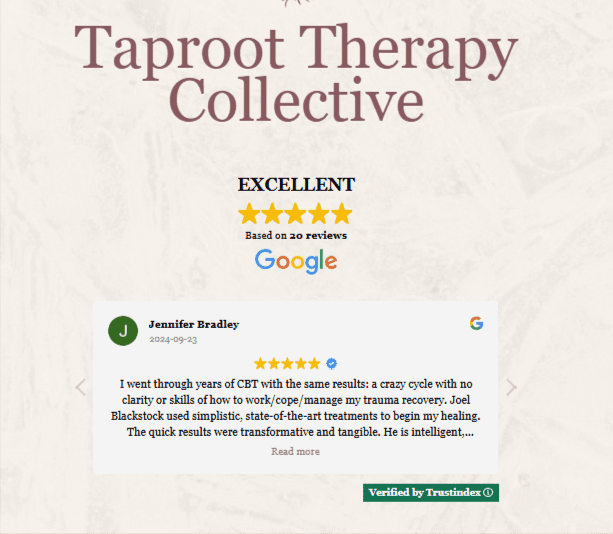
That is our own reviews widget, and we are glad people took the time. It is still a thin and lopsided sample. Most people in therapy never write a review, because writing one means telling the internet you were a client. People for whom therapy went badly often just stop booking. A therapist cannot answer a review with specifics without breaking confidentiality. And professional codes limit how testimonials are gathered: the American Counseling Association’s code says counselors who use testimonials do not solicit them from current clients, former clients or anyone else who may be vulnerable to undue influence.1
Medicine has tested whether star ratings track quality. A 2018 study compared online ratings of 78 specialist physicians across five platforms with their measured quality of care, cost of care and peer-review scores. It found no significant association. A doctor’s score on one site predicted his or her score on another in half the comparisons, which suggests the ratings measure something, just not clinical performance.2 Physicians are not therapists, and we found no equivalent study of therapist ratings, but the gap is a fair warning.
Reviews are useful for logistics. They tell you whether the office returns calls, whether sessions start on time, how billing goes and how the front desk treats people. Those things matter. They do not tell you whether this therapist’s way of working fits your problem or your temperament.
What actually predicts whether therapy helps
One of the most studied predictors is the alliance: agreement on goals, agreement on what you will do together, and a working bond. A 2018 meta-analysis pooled 295 studies covering more than 30,000 patients and found a correlation of r = .278 between alliance and outcome in face-to-face therapy, with almost the same figure for internet-based treatment. The link held across treatment approaches, outcome measures and countries.3 The earlier version of this page called the relationship “the single best predictor of therapy success.” That overstates it. A correlation of .28 accounts for roughly 8 percent of the variation in outcomes, and some of the link may run backward, because people who start feeling better also rate the relationship more warmly. It is one of the most consistent findings in the field, not the whole story.
Who you see also matters. A 2019 systematic review of 20 studies estimated that the individual therapist accounts for about 5 percent of the variation in outcomes on average, with estimates ranging from 0.2 to 29 percent across studies, and the reviewers noted that the size of this effect appeared to be related to how severe patients’ problems were.4 In plain terms, some clinicians get better results than others, and the gap is real even if it is modest on average.
The most direct test of matching came from six community clinics in Cleveland. Researchers used 48 therapists’ past outcomes across 12 problem areas to classify each therapist as effective, neutral or ineffective in each area. Then 288 adult patients were randomly assigned either to a therapist whose record fit their most elevated problems (at best, effective on all three of them; at minimum, not ineffective in any area) or to a therapist assigned the usual way, and 218 of them were included in the main analysis. The matched patients improved more on general impairment, on overall distress and on their most pressing problem.5 It is a single trial, and one of its authors founded the company that owns the outcome measure it used, so it needs replication. Still, it fits a familiar clinical observation: a therapist who is strong with depression may be ordinary with panic. Almost no one shopping for a counselor can see data like that, which is why the questions further down are the practical substitute.
Three kinds of fit you can check
Fit with the problem. Some problems have a clear first-line treatment. For post-traumatic stress disorder, a 2020 meta-analysis of 114 randomized trials found robust evidence for trauma-focused cognitive behavioral therapies, with cognitive processing therapy, cognitive therapy and prolonged exposure strongest among them, and for EMDR. It found some evidence for several other approaches and only emerging evidence for a number of others.6 Ask any therapist you are considering whether they offer the approach with the best evidence for your problem, and if they recommend something else, ask why.
Fit with your preferences. Across 53 studies and more than 16,000 clients, people who got the kind of treatment they preferred were less likely to drop out (odds ratio 1.79) and had somewhat better outcomes (d = 0.28).7 Preferences here means concrete things: talking versus body-based work, homework or none, a structured session or an open one, the therapist’s gender, office or video. That is different from typing yourself as an “analytical” or “emotional” person and matching a therapy to the type. The education version of that idea, learning styles, was reviewed in 2008, and the reviewers found virtually no evidence that matching instruction to a person’s style improves results. Several properly designed studies contradicted it.8 We know of no study that has tested a typology like that in therapy. Say what you want; skip the quiz.
Fit with how you take direction. One personal trait has a small but supportive body of research behind it as a matching variable: reactance, the reflex to push back when someone tells you what to do. A meta-analysis of 13 controlled studies with 1,208 patients found that highly reactant people did better with reflective, nondirective therapists than with directive ones, a large effect (d = .79). To a lesser degree, the reverse held for people low in reactance.9 If instructions make you dig in, say that on the consultation call. If open-ended sessions leave you lost, say that too.
There is one more kind of fit that no phone screen captures, which is how your body responds to this person. Researchers have measured physiological synchrony between therapist and client, such as heart rate and skin conductance moving together, and linked it to empathy and rapport. A 2017 systematic review also found the field’s terms fragmented and its role in the clinical relationship still mostly unknown.10 So treat body cues as information, not proof. Notice whether you can think in the room, whether your shoulders come down by the end of the hour, and whether you leave steadier or more stirred up. Feeling stirred up after trauma work can be expected. Feeling braced against the therapist is a different signal.
Questions to ask before you book
Many practices, ours included, offer a short free call. Use it. Good questions are specific:
- “How would you work with what I’m dealing with?” Every therapist says they treat anxiety. The useful answer says how: thoughts, behavior, body sensation, relationships, or some order of those.
- “What is your main approach, and what is the evidence for it with my problem?” A good clinician can tell you where the evidence is strong and where it is thin.
- “What does a typical session look like?” Ask about structure, homework and how much you will be expected to talk.
- “How do you track whether it’s working?” In a meta-analysis of 24 studies, routinely measuring client progress and feeding it back to the therapist reduced deterioration and nearly doubled the rate of reliable improvement among clients who were predicted to do poorly.11
- “What happens if I tell you this isn’t working?” Listen for curiosity rather than defensiveness.
- “Do you take my insurance, and what will I owe?” Ask before the first session, not after.
Red flags include guaranteed results, one method for every problem, irritation at being asked questions, and pressure to commit to a long package up front. Promises of fast fixes deserve the most suspicion; we have written about why quick fixes in therapy often end up costing more.
What this looks like in therapy
At Taproot the first session covers your history, what you have already tried, what you want to be different, and a first read on which methods fit. Nobody has to retell the worst of it in session one. Somatic work, EMDR and Brainspotting are designed to work with traumatic memory without a detailed retelling, and pacing matters more than the story.
Weeks two through four are where fit becomes visible, and leaving is common. A meta-analysis of 669 studies and 83,834 clients put the average dropout rate at 19.7 percent, about one client in five.12 Some of those exits are silent: the client stops scheduling and never says what went wrong, so the therapist never gets the chance to adjust.
Saying “this isn’t working” is part of therapy, not a breach of manners. Clinicians call strains in the alliance ruptures. Across 11 studies with 1,314 patients, episodes in which a rupture was noticed and repaired were associated with better outcomes (r = .29).13 If the thought of giving your therapist negative feedback makes your chest tighten, that reaction is common, and it is the same threat response that makes performance reviews at work feel so dangerous. Bringing it into the session is often useful work in itself.
In somatic and parts-based work, the therapist is also watching for signs that a session has gone past what you can hold: going blank, losing track of time, agreeing too quickly, a flat voice. A clinician who notices those and slows down is doing the job. Sometimes the honest conclusion is that a different therapist or method would serve you better. A good therapist will say so and help you find one.
Finding a counselor in Birmingham and Hoover
Many people over the mountain find a therapist by word of mouth. A friend’s recommendation is good evidence about logistics and about the clinician’s character. It is weaker evidence about whether that person fits your problem. That is worth remembering in parts of the metro where reputation carries real weight, as in the achievement culture built into Liberty Park, where choosing the therapist everyone uses can feel like the safe move.
Here is how it works at Taproot Therapy Collective:
- Where. The office is in Hoover, off I-65 at the Riverchase exit, about ten minutes from Vestavia Hills, Homewood and Mountain Brook and fifteen from downtown Birmingham, with free parking. Every therapist also sees clients by secure video anywhere in Alabama through our teletherapy for trauma across Alabama. QEEG brain mapping, neurofeedback and Emotional Transformation Therapy are office-only. A 2021 meta-analysis found that outcomes of live video therapy differ negligibly from in-person therapy.14
- Cost. Blue Cross Blue Shield of Alabama is in network for most clinicians. For other plans we are out of network and send a monthly superbill you can file for reimbursement. There is an income-based sliding scale, set on the intake call with no separate application, and it applies to video sessions too. If you are uninsured or are not using insurance for your sessions, you get a good faith estimate before you start, as the federal No Surprises Act requires. Current rates are on our frequently asked questions page on cost and insurance.
- Matching. The first step is a free 15-minute call with our intake coordinator, who matches you with a clinician whose specialty and training fit what you are bringing. If you already know whom you want, say so. You can read each clinician’s background on our therapists page.
- Methods. Every clinician is licensed in Alabama and works somatically and experientially, using some combination of somatic therapy, EMDR, Brainspotting, Internal Family Systems, Lifespan Integration and Jungian depth work. Our overview of the treatments we offer describes each one. Be clear-eyed about the evidence: of these, EMDR has the strongest research base, for PTSD.6 The others have smaller or preliminary research bases, and we say so when we suggest them.
If cost or a wait is holding you back, therapy is not the only support available. Our list of free activities around Hoover and the Birmingham metro covers places to move, meet people and get outside while you sort out care. If you are in danger or thinking about suicide, call or text 988 or go to the nearest emergency room. Our crisis resources for Birmingham lists local options.
If you would like to try this process with us, start with the intake call through our contact page. Tell the coordinator what you are dealing with, what you have tried, and what did not fit last time. That last part is often the most useful thing you can say.
References
- American Counseling Association. (2014). ACA code of ethics (Standard C.3.b, Testimonials). American Counseling Association. https://www.counseling.org/docs/default-source/default-document-library/ethics/2014-aca-code-of-ethics.pdf
- Daskivich, T. J., Houman, J., Fuller, G., Black, J. T., Kim, H. L., & Spiegel, B. (2018). Online physician ratings fail to predict actual performance on measures of quality, value, and peer review. Journal of the American Medical Informatics Association, 25(4), 401–407. https://doi.org/10.1093/jamia/ocx083
- Flückiger, C., Del Re, A. C., Wampold, B. E., & Horvath, A. O. (2018). The alliance in adult psychotherapy: A meta-analytic synthesis. Psychotherapy, 55(4), 316–340. https://doi.org/10.1037/pst0000172
- Johns, R. G., Barkham, M., Kellett, S., & Saxon, D. (2019). A systematic review of therapist effects: A critical narrative update and refinement to review. Clinical Psychology Review, 67, 78–93. https://doi.org/10.1016/j.cpr.2018.08.004
- Constantino, M. J., Boswell, J. F., Coyne, A. E., Swales, T. P., & Kraus, D. R. (2021). Effect of matching therapists to patients vs assignment as usual on adult psychotherapy outcomes: A randomized clinical trial. JAMA Psychiatry, 78(9), 960–969. https://doi.org/10.1001/jamapsychiatry.2021.1221
- Lewis, C., Roberts, N. P., Andrew, M., Starling, E., & Bisson, J. I. (2020). Psychological therapies for post-traumatic stress disorder in adults: Systematic review and meta-analysis. European Journal of Psychotraumatology, 11(1), Article 1729633. https://doi.org/10.1080/20008198.2020.1729633
- Swift, J. K., Callahan, J. L., Cooper, M., & Parkin, S. R. (2018). The impact of accommodating client preference in psychotherapy: A meta-analysis. Journal of Clinical Psychology, 74(11), 1924–1937. https://doi.org/10.1002/jclp.22680
- Pashler, H., McDaniel, M., Rohrer, D., & Bjork, R. (2008). Learning styles: Concepts and evidence. Psychological Science in the Public Interest, 9(3), 105–119. https://doi.org/10.1111/j.1539-6053.2009.01038.x
- Beutler, L. E., Edwards, C., & Someah, K. (2018). Adapting psychotherapy to patient reactance level: A meta-analytic review. Journal of Clinical Psychology, 74(11), 1952–1963. https://doi.org/10.1002/jclp.22682
- Kleinbub, J. R. (2017). State of the art of interpersonal physiology in psychotherapy: A systematic review. Frontiers in Psychology, 8, Article 2053. https://doi.org/10.3389/fpsyg.2017.02053
- Lambert, M. J., Whipple, J. L., & Kleinstäuber, M. (2018). Collecting and delivering progress feedback: A meta-analysis of routine outcome monitoring. Psychotherapy, 55(4), 520–537. https://doi.org/10.1037/pst0000167
- Swift, J. K., & Greenberg, R. P. (2012). Premature discontinuation in adult psychotherapy: A meta-analysis. Journal of Consulting and Clinical Psychology, 80(4), 547–559. https://doi.org/10.1037/a0028226
- Eubanks, C. F., Muran, J. C., & Safran, J. D. (2018). Alliance rupture repair: A meta-analysis. Psychotherapy, 55(4), 508–519. https://doi.org/10.1037/pst0000185
- Fernandez, E., Woldgabreal, Y., Day, A., Pham, T., Gleich, B., & Aboujaoude, E. (2021). Live psychotherapy by video versus in-person: A meta-analysis of efficacy and its relationship to types and targets of treatment. Clinical Psychology & Psychotherapy, 28(6), 1535–1549. https://doi.org/10.1002/cpp.2594























0 Comments