
How a Young City’s Architectural Ambition Mirrors Our Own Psychological Struggles
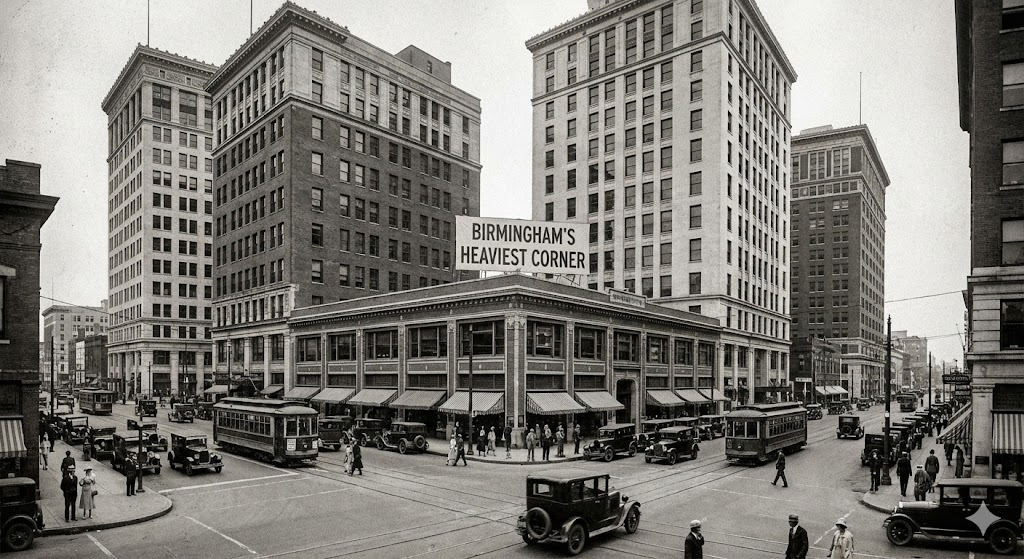
If you have ever driven through downtown Birmingham and looked up at the historic buildings clustered around 20th Street and 1st Avenue North, you have witnessed something remarkable. In the early 1900s, this single intersection became known as “The Heaviest Corner on Earth.” Four massive steel skyscrapers rose from the red clay in such rapid succession that some people genuinely feared the combined weight would crack the earth’s crust or sink the entire city into the ground below.
The fear never materialized. The ground held. But the psychology behind why Birmingham built so aggressively in those years tells us something profound about the human experience of feeling like we do not quite belong, of wondering whether we truly deserve our place in the world.
For those of us living in Birmingham, Homewood, Vestavia Hills, and Mountain Brook today, this history is more than a quirky footnote. It is a mirror.
A City Without a Past Trying to Build a Future
Birmingham was founded in 1871, making it younger than most of the people reading this article’s grandparents. While cities like Savannah and Charleston could trace their histories back centuries, Birmingham was essentially a mining camp that had incorporated itself into existence. There were no antebellum mansions, no Revolutionary War monuments, no family names stretching back generations.
What Birmingham had was iron ore, coal, and limestone, the three ingredients necessary to make steel, all found within a few miles of each other. This geological accident transformed a patch of Alabama farmland into the “Pittsburgh of the South” almost overnight.
But here is the psychological truth that the city’s founders understood intuitively: having resources is not the same as having legitimacy. Birmingham was wealthy and productive, but it did not feel real in the way that older Southern cities felt real. The anxiety of being new, of being seen as less than, of wondering whether the prosperity would last, drove the city’s leaders to do what many of us do when we feel inadequate.
They overcompensated.
The Psychology of Building Up
Between 1902 and 1912, four skyscrapers rose on that single downtown corner: the Woodward Building, the Brown Marx Building, the Empire Building, and the American Trust and Savings Bank Building. These were not modest structures. They were statements, declarations of permanence written in steel and stone.
The architectural historian would call this urban development. The psychologist would recognize something else: compensation behavior driven by profound insecurity.
When we feel uncertain about our worth or our place in the world, we often respond by trying to make ourselves bigger, louder, more visible. We accumulate credentials, achievements, and external markers of success. We build our personal skyscrapers, hoping that if we stack enough accomplishments on top of each other, the gnawing sense of fraudulence will finally quiet down.
It rarely does.
This is the essence of what psychologists now call imposter syndrome, the persistent feeling that we do not deserve our success, that we have somehow fooled everyone around us, and that we are moments away from being exposed as inadequate. Research suggests that up to 70 percent of people experience these feelings at some point in their lives.
Civic Imposter Syndrome and Personal Imposter Syndrome
Birmingham’s early building boom was civic imposter syndrome made manifest in concrete and steel. The city was trying to prove something, not just to the rest of the South or the nation, but to itself. Every floor added to those skyscrapers was an argument against the whispered fear that Birmingham was just a lucky accident, a boomtown that would eventually bust.
The parallel to individual psychology is striking. Many people in our community, including high achievers in Homewood’s business districts, professionals in Mountain Brook’s corporate offices, and families in Vestavia Hills who have worked hard to build comfortable lives, carry a private burden of self-doubt that their external success does not match.
The attorney who wonders if she really knows the law as well as her colleagues think she does. The business owner who attributes his success to luck rather than skill. The parent who worries that everyone else seems to have figured out this family thing while she is barely holding it together. The executive who sits in meetings terrified that someone will finally ask the question that reveals how little he actually knows.
These feelings do not discriminate by zip code or tax bracket. They are as common in the tree-lined streets of Mountain Brook as they are anywhere else. In fact, there is evidence that high-achieving environments can actually intensify imposter feelings, because the stakes of exposure feel higher and the comparison points seem more intimidating.
The Foundation Holds
Here is what the anxious observers of 1912 got wrong about Birmingham’s Heaviest Corner: the foundation was stronger than they feared. The earth did not crack. The city did not sink. The buildings still stand more than a century later, anchored to bedrock that proved entirely capable of bearing their weight.
This is often the case with imposter syndrome as well. The catastrophic exposure we fear almost never materializes, because the fear itself is built on a distortion. We are not frauds pretending to be competent. We are competent people struggling with a painful feeling that does not match reality.
The work of therapy for imposter syndrome is not about convincing you that you are actually amazing and should feel confident all the time. That kind of toxic positivity is just another skyscraper built on shaky ground. Instead, the work involves examining the foundations of your self-concept, understanding where these feelings originated, and developing a more accurate and compassionate relationship with your own capabilities and limitations.
The View from Red Mountain
From certain vantages in Birmingham, particularly along Red Mountain where so many Homewood and Vestavia Hills residents live, you can look down at the city and see both what it was and what it has become. The steel mills that once defined the city are largely gone now, but Birmingham did not collapse without them. It evolved, diversified, and found new reasons to exist beyond the geological accident of its founding.
People can do this too. The identities and achievements we build in one phase of life can serve as foundations for growth rather than monuments to defend. We do not have to keep building higher and higher to outrun our insecurity. We can learn to stand on the ground we have already claimed and trust that it will hold.
Finding Help in the Birmingham Area
If you recognize yourself in any of this, if you carry that persistent whisper that you are not quite enough despite evidence to the contrary, know that you are not alone and that help is available.
Therapy offers a space to examine these patterns with curiosity rather than judgment. A skilled therapist can help you trace the origins of your imposter feelings, challenge the cognitive distortions that maintain them, and develop practical strategies for responding differently when self-doubt arises.
At Taproot Therapy Collective, we work with individuals throughout the Birmingham metro area, including Homewood, Vestavia Hills, Mountain Brook, and surrounding communities. Our approach integrates contemporary neuroscience with depth psychology, recognizing that patterns of self-doubt often have roots in early experiences and relationships that shaped how we learned to see ourselves.
You do not have to keep building higher to prove your worth. Sometimes the most profound growth comes from learning to trust the ground beneath your feet.
If you would like to explore how therapy might help you work through imposter syndrome or related concerns, we invite you to reach out. The Heaviest Corner on Earth still stands, and so can you.
Taproot Therapy Collective provides psychotherapy services to individuals in Birmingham, Homewood, Vestavia Hills, Mountain Brook, and throughout Jefferson County and Shelby County, Alabama. To learn more about our approach or to schedule a consultation, visit our website or contact our office directly.
















0 Comments