
Am I Autistic? A Deep Dive into Masking, Monotropism, and the Neurodivergent Mind
You are not broken. Discover the modern neurobiology of late-diagnosed Autism and AuDHD, and learn how to stop surviving and start thriving with neuro-affirming care.
Executive Summary: The 2026 Paradigm Shift
Autism is not a "behavioral disorder" that needs to be fixed. It is a distinct neurotype characterized by Bottom-Up Processing. While neurotypical brains filter out details to immediately grasp the "gist," autistic brains process raw sensory data first, leading to intense depth, hyper-focus, and inevitable nervous system overwhelm.
Key Clinical Concepts:
- Monotropism: The defining feature of autism is likely not "social deficits," but an "attention tunnel" style of focus. Autistic brains devote massive resources to a single interest, making task-switching physically painful.
- The Double Empathy Problem: Research proves autistics communicate perfectly well with other autistics. Social friction is caused by a mismatch between neurotypes, not a deficit in the autistic person.
- Autistic Burnout: A severe state of neurological exhaustion caused by years of "Masking." It often presents in adults as regression, severe executive dysfunction, or treatment-resistant depression.
For decades, the clinical understanding of Autism Spectrum Disorder (ASD) was entirely shaped by behavioral stereotypes based on studies of young boys. These stereotypes have left an entire generation of adults—particularly women, non-binary individuals, and high-masking professionals—completely unaware of their own neurology.
Many adults arrive at Taproot Therapy Collective in Birmingham, AL seeking treatment for severe anxiety, clinical depression, or Complex PTSD, only to realize that their root struggle is not mental illness. It is undiagnosed autism or AuDHD (the co-occurrence of Autism and ADHD).
They are exhausted not because they are broken, but because they have spent a lifetime trying to run a Linux operating system on Windows hardware.
Part I: The Neurobiology of Bottom-Up Processing
To understand the autistic experience, you must understand how the brain filters sensory information.
Neurotypical Brains are "Top-Down" processors. They rely on prior concepts to filter out sensory details. When they walk into a room, they see "a meeting." They automatically filter out the hum of the HVAC unit, the pattern on the rug, and the flickering fluorescent light.
Autistic Brains are "Bottom-Up" processors. They take in the raw data first. They hear the HVAC, see the flicker, feel the texture of the chair, and then construct the concept of "a meeting."
The Consequence: Intensity & Overload
Because the autistic brain filters less, it processes significantly more.
- The Strength: This leads to incredible attention to detail, advanced pattern recognition, deep empathy, and systemic thinking.
- The Cost: It leads to Sensory Overload. The world is literally louder, brighter, and more chaotic. Meltdowns and shutdowns are not "tantrums"; they are a biological response to a flooded autonomic nervous system.
Part II: Monotropism (The Interest-Based Nervous System)
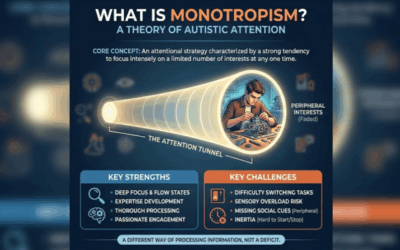
The most compelling modern theory of autism is Monotropism.
Most neurotypical minds are Polytropic—they can maintain low-level attention on many things at once. The autistic mind is Monotropic—it focuses intense, laser-like energy on one thing at a time.
The "Attention Tunnel"
When an autistic person engages with a special interest, they enter an "Attention Tunnel." Entering the tunnel requires massive inertia (often misdiagnosed as ADHD procrastination), but leaving the tunnel is physically painful (task-switching). Many perceived "social deficits" are actually just the neurological pain of being ripped out of an attention tunnel. It feels like waking a sleepwalker.
Part III: The Masking Epidemic
If you made it to adulthood without a diagnosis, you likely survived by Masking (or Camouflaging). Masking is the conscious, exhausting suppression of autistic instincts to appear neurotypical. It involves:
- Forcing eye contact (even if it feels physically burning or distracting).
- Manually scripting conversations before they happen.
- Mimicking facial expressions and gestures to appear "engaged."
- Suppressing "stims" (self-regulatory movements like fidgeting or rocking).
The Cost: Autistic Burnout
Masking requires massive amounts of prefrontal cortex energy. Eventually, the battery dies. Autistic Burnout is entirely distinct from workplace burnout. It involves severe loss of skills (e.g., suddenly being unable to speak or drive), extreme sensory sensitivity, and chronic exhaustion that sleep does not fix. Many high-achieving adults are diagnosed only after hitting this wall in their 30s or 40s.
Part IV: The Signs in Adults (The Hidden Profile)
The DSM-5 checklist often fails adults. The internalized profile of high-masking autism often looks like:
- Deep Justice Sensitivity: An intense, visceral inability to tolerate unfairness or arbitrary hierarchy. You might frequently be the "whistleblower" at work.
- Pattern Recognition: You see systems, flaws, and connections others miss.
- Social Exhaustion: You can "perform" excellent social skills, but you require days of isolation to recover your nervous system after a party.
- Special Interests: You don't just "like" things; you consume them. You become an encyclopedia on your topic of choice.
Part V: Neuro-Affirming Therapy in Birmingham
If you are neurodivergent, traditional therapy (like CBT) can often be harmful if the therapist tries to "challenge" your sensory reality ("The lights aren't that bright"). You do not need to be fixed; you need Neuro-Affirming Care.
Assessment: QEEG Brain Mapping
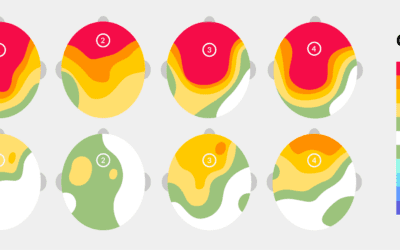
Under the direction of Dr. Jason Mishalanie, QEEG Brain Mapping can visualize the "hyper-connectivity" typical of the autistic brain. We objectively map sensory cortex activity and the specific Theta/Beta ratios associated with AuDHD, providing profound validation.
Somatic Regulation
Treatment starts with the body. We use Somatic Experiencing to release the "freeze" states caused by years of sensory trauma and masking, helping you safely reconnect with your physical needs.
DBT for Distress Tolerance
DBT is excellent for neurodivergent adults because it is highly skills-based. It provides concrete neurological tools to manage the intensity of a meltdown or sensory overload without self-harm.
Metabolic Psychiatry
Because autistic brains process significantly more data, they burn through massive amounts of trace minerals. We partner with Hardy Nutritionals to provide the metabolic foundation required to prevent severe burnout.
The Validity of Self-Diagnosis
In the neurodivergent community, self-diagnosis is widely accepted as valid. The barriers to formal adult diagnosis (prohibitive cost, clinician bias, lack of specialists) are incredibly high. If understanding yourself through the lens of autism helps you accommodate your needs, unmask, and be kinder to yourself, the label is doing its job.
Stop Masking. Start Thriving.
You have spent your entire life trying to fit into a neurotypical mold. It is time to work with a clinical team that understands your brain and affirms your reality.
Schedule a Neuro-Affirming Consultation













0 Comments