
Common signs of autism in adults include strong sensory sensitivities, deep and narrow interests, a need for routine and predictability, trouble with unspoken social rules, and needing long recovery time after social contact. Many adults, women especially, hide these traits by masking, so the clearest sign is often the gap between how well someone copes in public and how depleted they are afterward.
That gap is the argument of this article. In adulthood, autism is often easier to see in what coping costs than in how a person behaves. Recognizing the cost is useful. Turning it into brain myths or a quiz score is not. Self-identification is a reasonable place to start, and a careful assessment is still worth having, because anxiety, ADHD, trauma and depression can look a lot like autism and often arrive alongside it.
Why autism in adults is so often missed
Autism is diagnosed on behavior and developmental history. The DSM-5 describes two clusters: what it calls persistent deficits in social communication and social interaction, and restricted, repetitive patterns of behavior, interests or activities, a cluster that since 2013 has included over- or under-reactivity to sensory input.1 One line in the criteria matters most for adults. Symptoms must be present in early development, “but may not become fully manifest until social demands exceed limited capacities, or may be masked by learned strategies in later life.”1
That sentence describes many adults who first ask about autism later in life. Some got through school by being bright, quiet or very well behaved. They learned the rules of conversation the way other people learn a second language. The strain showed later, when a job, a marriage, children or a move stacked more demands on a system that was already running near capacity.
The research record shows how many people were missed. Meng-Chuan Lai and Simon Baron-Cohen wrote about a “lost generation” of adults who had been excluded from a diagnosis of classic autism, and listed why a first diagnosis in adulthood is hard: there may be no one left to give a developmental history, people have learned camouflaging strategies, and co-occurring conditions crowd the picture.2 A 2017 meta-analysis of 54 prevalence studies found that the male-to-female ratio among children who meet criteria is closer to 3:1 than the 4:1 usually quoted, and concluded that girls who meet criteria are at disproportionate risk of never receiving a diagnosis.3 In UK primary-care records, new autism diagnoses rose 787% between 1998 and 2018, with the steepest rises among adults and females. The authors read this mainly as better recognition rather than a surge in autism itself.4
The United States has no surveillance system that counts autistic adults. A modeling study by CDC researchers estimated that about 2.21% of U.S. adults were autistic in 2017, diagnosed or not. Its estimate for Alabama was 2.12%, or roughly 78,000 adults.5
A missed diagnosis often means a wrong one. In a Dutch register of 1,211 autistic adults, 24.6% reported at least one earlier psychiatric diagnosis they now regarded as a misdiagnosis, most often a personality disorder, then anxiety and mood disorders. The figure was 31.7% for women and 16.7% for men.6 An Italian study of adults diagnosed at two university centers found a median gap of 11 years between a first evaluation by a mental health professional and the autism diagnosis.7
Signs of autism in adults that are easy to miss
None of the signs below is diagnostic on its own, and plenty of non-autistic people will recognize one or two. What matters is the pattern, how long it has been there, and what it costs.
Social contact that runs on effort
Many autistic adults hold conversations well. They do it by hand: rehearsing before a phone call, scripting small talk, watching faces and copying expressions, working out afterward what a pause or a joke meant. Eye contact is a common example. In a qualitative study of first-hand accounts from teens and adults who described themselves as autistic, eye contact brought adverse emotional and physical reactions, a feeling of being invaded and sensory overload, on top of the work of reading nonverbal signals.8
Part of the difficulty does not sit inside the autistic person. Damian Milton’s “double empathy problem” argues that misunderstanding between autistic and non-autistic people runs both ways.9 Experiments since then support a careful version of the idea. When a story was passed along chains of eight people, all-autistic chains kept as much detail as all-non-autistic chains, while mixed chains lost more detail and reported lower rapport.10 In paired conversations, autistic pairs reported more rapport than mixed pairs, although non-autistic pairs reported the most.11 A 2025 group study found that autistic participants’ rapport fell as more non-autistic people were added to the group, while non-autistic participants’ rapport stayed fairly steady.12 The fair summary is that the mismatch matters and autistic people often communicate well with each other. It does not show that autistic adults never have social difficulties of their own.
A sensory world turned up, or down
Sensory differences are part of the diagnostic criteria, and they cut both ways: over-reactivity, under-reactivity, or unusual interest in sensory experience.1 The adult complaints are familiar: fluorescent lights, overlapping conversations, clothing seams, smells in a shared office, the cumulative drain of a day in an open-plan space. In an online survey of 221 autistic and 181 non-autistic adults, the autistic group reported more sensory over-responsivity across vision, hearing, touch, smell, taste and proprioception.13 That is self-report. It shows how the world feels from the inside, which matters clinically, but it does not by itself show that autistic ears or eyes receive a “louder” signal. For more on how rooms act on the nervous system, see our essay on how spatial design shapes the psyche.
Meltdowns and shutdowns belong here too. Clinically they make more sense as overload states than as tantrums or sulking: the person has run out of capacity to take in more, and pushing harder makes it worse.
Deep interests and hard transitions
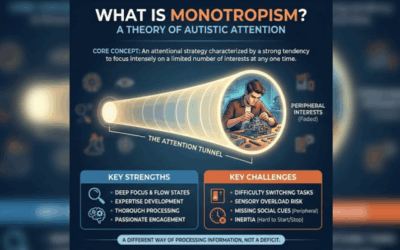
The DSM describes restricted, fixated interests that are unusual in intensity or focus.1 A more sympathetic account comes from monotropism, a theory Dinah Murray developed with autistic collaborators, notably Wenn Lawson. Murray first presented the idea publicly in 1992, at the Durham autism conference, in a talk titled “Attention Tunnelling and Autism,” and the key paper, written with Mike Lesser and Lawson, appeared in 2005.14 It argues that the way attention is allocated is central to autism: attention gathers strongly on a few interests at a time, leaving less for everything else, and several of the diagnostic features follow from that.15 In daily life it can look like hours happily lost in a subject, real difficulty dropping one task to start another, and distress at being interrupted. We cover the theory in more depth in What is monotropism?
Two cautions. Monotropism is a theory with early empirical work behind it, not an established brain mechanism. And intense focus is not unique to autism. In a 2024 study of 492 adults, hyper-focus was elevated in autistic, ADHD and autistic-plus-ADHD groups alike, and it rose together with inattention rather than replacing it.16 That overlap is one reason autism and adult ADHD and AuDHD can be hard to tell apart, and why one can be missed when both are present.
Feelings that are hard to name
Alexithymia, difficulty identifying and describing one’s own feelings, is common in autism but not universal. A meta-analysis of studies using the Toronto Alexithymia Scale found it in about 50% of autistic participants, compared with about 5% of non-autistic comparison groups.17 In practice it can look like knowing something is wrong without knowing what, noticing anger only once it has become a headache, or answering “How do you feel?” with an account of what happened.
Routine, rules and fairness
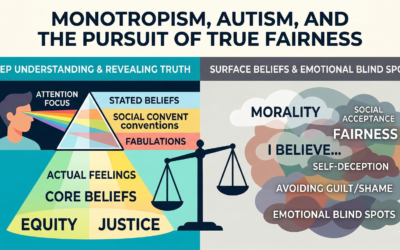
Insistence on sameness is in the criteria: routines that make the day predictable, distress at sudden changes of plan, the same meals or the same route.1 Many autistic adults also describe a strong, sometimes costly reaction to unfairness or to rules applied inconsistently. It comes up often in therapy and in autistic community writing, and we explore it in a separate essay on autism and ethics. It is not a diagnostic criterion and the research on it is thin, so treat it as a pattern worth noticing, not a test.
Recovery time
The last pattern is the one adults often raise first: needing hours or days alone after a party, a conference or a family holiday, even one that went well. On its own it could be introversion or social anxiety. Next to the others, it can show how much masking is costing.
Masking, and what it costs
Researchers usually call it camouflaging. In accounts from 92 autistic adults, Laura Hull and colleagues described it as a mix of masking, which hides autistic traits, and compensation, which uses learned strategies to work around difficulties, done to fit in and to connect with people. The costs participants reported included exhaustion and threats to their sense of who they were.18 A 2021 systematic review of 29 studies found wide variation between studies but three preliminary findings that much of the literature supported: adults with more self-reported autistic traits report more camouflaging, there are sex and gender differences in it, and more camouflaging goes with worse mental health. The reviewers also noted that the samples were limited and do not represent the whole autistic community.19
The stakes can be serious. In an online survey recruited mainly through a Cambridge research database, 72% of 164 autistic adults scored above the screening cut-off for suicide risk, compared with 33% of general-population adults, and camouflaging and unmet support needs were among the predictors of suicidality in the autistic group.20 If you are thinking about suicide, our Birmingham crisis resources page lists who to contact now, and anywhere in the U.S. you can call or text 988.
Autistic burnout is the term autistic adults use for what happens when that load is carried too long. In a community-based participatory study, Dora Raymaker and colleagues identified its core features as chronic exhaustion, loss of skills and reduced tolerance of stimulation. Participants traced it to life stress piling up and to barriers that kept them from getting relief, until expectations outran abilities. What helped, they said, was acceptance and support, time off or reduced expectations, and doing things in an autistic way, including unmasking.21 A later Delphi study with autistic adults reached a similar definition, adding withdrawal, problems with thinking and an increase in visible autistic traits, and cautioned that psychological treatments for depression could potentially make autistic burnout worse.22 Burnout is still being defined, mostly from lived-experience research, and it is not a DSM diagnosis. It is still worth knowing about, because it can resemble depression, and researchers are still working out how the two differ.
Depth psychology has an old word for part of this. Jung called the face we present to the social world the persona, after the Latin word for a theatrical mask. He described it as a kind of mask that both makes an impression on others and conceals the individual’s true nature, and he thought a workable persona was a normal part of adapting to adult life.23 Everyone has one. The danger, for Jung, was becoming identical with it. Autistic masking is related but harsher. The role is often learned under pressure, worn most of the day, and held in place by conscious effort rather than habit. Many late-identified adults say they are no longer sure which parts are mask and which are them, which fits the threats to self-perception reported in Hull’s study.18 Sorting that out is real therapeutic work, and it takes time.
Popular claims the evidence does not support
“Autistic brains are bottom-up processors.” There is real research behind the idea that autistic perception attends more to detail and leans less on expectation, but it is a family of competing theories. Weak central coherence describes a detail-focused processing style; its authors’ review of more than 50 studies found robust evidence of a local bias and mixed evidence for weaker global processing.24 Enhanced perceptual functioning proposes stronger low-level perception.25 Bayesian and predictive-coding accounts propose weaker prior expectations, called hypo-priors, or an unusually high, inflexible weight on prediction errors.26, 27 These hypotheses are still being tested against each other. None of them supports the flat claim that autistic people take in “the raw data first” while everyone else sees the gist.
“Leaving an attention tunnel is physically painful, and that explains most social difficulties.” Difficulty with transitions is one of the DSM’s own examples,1 and being pulled out of deep focus can be distressing. Pain as a general rule, and the idea that most social difficulty is really interrupted focus, have no research behind them.
“Masking burns prefrontal energy until the battery dies.” Masking is effortful and is linked with exhaustion in self-report research.18, 19 No study has measured a battery. The image works as a metaphor; it is not neuroscience.
“A QEEG brain map can show autistic hyper-connectivity, or the theta/beta ratio of AuDHD.” The DSM-5 criteria are behavioral and include no EEG or brain-imaging test.1 The connectivity research is also less tidy than the claim. A systematic review of EEG and MEG studies found relatively strong support for long-range under-connectivity in autism, an unclear picture for local connectivity, and so much variation between studies that a meta-analysis was not possible.28 The theta/beta ratio has its own history: a meta-analysis of studies in children and adolescents concluded that an elevated ratio “cannot be considered a reliable diagnostic measure of ADHD,” though it may carry prognostic information for a subgroup.29 Group averages in research do not let anyone read a diagnosis off one person’s recording. For a wider look at what brain-based tools can and cannot do, see our clinician’s guide to neuro-tech in the therapy room.
“Autistic brains burn through trace minerals, so supplements prevent burnout.” We found no study showing this. No supplement has been shown to prevent autistic burnout. If you are considering supplements for mood, energy or anything else, talk with your prescriber or physician first, especially if you take other medication.
“Your real problem is autism, not anxiety or depression.” Autism is a lifelong neurodevelopmental condition, not an episode of illness that comes and goes, and some earlier diagnoses do turn out to be wrong.6 But co-occurring conditions are common and real. A meta-analysis across ages estimated that about 20% of autistic people have a diagnosed anxiety disorder and 11% a depressive disorder; in studies of adults, the pooled current rates were 27% for anxiety and 23% for depression.30, 31 A new autism diagnosis explains a great deal. It does not make depression or trauma go away, and both still deserve treatment.
Self-identification, screening quizzes and formal assessment
Many adults first recognize themselves in autistic writers’ accounts. In a study of 37 adults who identified as autistic without a formal diagnosis, the themes were feeling “othered,” managing self-doubt, a sense of belonging, understanding oneself, and questioning whether a formal diagnosis was needed at all.32 A 2024 scoping review noted that adults increasingly self-identify as autistic and report trouble getting referred for assessment, and argued that what they learn about themselves could improve how referral and assessment are done.33
So self-identification is a reasonable starting point, and the autistic community’s acceptance of it makes sense given how hard adult assessment can be to reach. It also has limits worth being honest about.
- Screening questionnaires are blunt. The Autism-Spectrum Quotient (AQ) is a self-report measure of autistic traits that UK NICE guidelines have supported for adult assessment. Among 476 adults referred to a UK specialist service, AQ scores did not significantly predict who was diagnosed. Specificity was only 0.29, and in this already-referred group 64% of people who scored below the cut-off were in fact autistic, and generalized anxiety appeared to inflate scores and produce false positives.34
- Look-alikes are common. Lai and Baron-Cohen list anxiety, depression, OCD, psychosis, personality disorders and other neurodevelopmental conditions among the overlaps and differential diagnoses to weigh.2 Trauma can look similar too. In a Delphi study, 106 international professionals reached consensus on features that overlap between autism, complex PTSD and emotionally unstable personality disorder in adults, and on ways to tell them apart.35 A watchful, carefully managed social style can also be learned in an unpredictable home, a pattern we describe in eggshell parenting and hypervigilant adults.
- Overlap is common. About 28% of autistic people also carry an ADHD diagnosis.30
A good adult assessment takes a developmental history, ideally with input from someone who knew you as a child, may use structured instruments such as the ADOS-2 or ADI-R, and screens for co-occurring conditions. It can support requests for workplace or academic accommodations and sharpen treatment for anxiety or depression. It can also bring grief. In interviews with women diagnosed after 40, diagnosis helped several move from self-criticism toward self-compassion, but adjusting to a new identity so late was painful.36
What this looks like in therapy
Therapy with an autistic adult, diagnosed or self-identified, starts from the premise that the neurotype is not the thing being treated. The targets are what hurts: anxiety, depression, burnout, trauma, and the habit of masking in places where it is no longer needed. We describe that stance in what neurodivergent-affirming therapy is, and why it isn’t about fixing you. In practice it comes down to a few concrete things.
- Adjusting the room and the format. Softer lighting, fewer surprises, written summaries, permission to look away, stim or take a break, and, where they are an option, video sessions when travel and waiting rooms cost too much.
- Adapting, not abandoning, evidence-based therapy. A network meta-analysis of 71 randomized trials found that some forms of CBT and mindfulness therapy may help autistic people without intellectual disability, but the trials were short-term and the evidence limited, and the authors advised following the evidence for non-autistic people until there is more.37 Adapted CBT means plain language, concrete examples and no pressure to reframe a sensory experience as imagined. The light really is too much for you. The question is what to do about it.
- Skills for overload and crisis. DBT has been tested in randomized trials with autistic adults. Among 123 Dutch outpatients with suicidal behavior, DBT reduced suicidal ideation and suicide attempts more than usual care by the end of treatment. That advantage was no longer statistically significant at the 12-month follow-up, while the improvement in depression held. There was no effect on social anxiety.38 A smaller French trial of 63 autistic adults with emotion dysregulation and self-harm or suicidal behavior found that DBT reduced emotion dysregulation compared with a waiting list, with gains still present six months later. A waiting list is a weaker comparison than usual care, and both trials need replicating.39
- Body-based and parts-based work, with honest expectations. Somatic approaches may help some people notice early signs of overload, which matters when alexithymia makes feelings hard to name. The research on Somatic Experiencing is preliminary and of mixed quality even for trauma, and we know of no controlled trials in autistic adults.40 Parts-based work offers a useful language for the masked self and the self underneath, as long as it is never used to suggest that autism is a part to be healed.
- Re-reading the story. Late recognition often sends people back through their own history: the friendships that did not hold, the jobs that wore them out, the years of being called rude or too sensitive. That re-reading is often where shame starts to loosen, and it is the kind of work depth-oriented therapy is built for.
If this article describes you or someone you love, you do not need a diagnosis to start therapy, and you do not need to arrive with the right words. Our page on autism therapy for adults in Hoover explains how we work with autistic and possibly autistic adults, and you can contact us with questions before deciding anything.
References
- American Psychiatric Association. (2013). Diagnostic and statistical manual of mental disorders (5th ed.). American Psychiatric Publishing. https://doi.org/10.1176/appi.books.9780890425596
- Lai, M.-C., & Baron-Cohen, S. (2015). Identifying the lost generation of adults with autism spectrum conditions. The Lancet Psychiatry, 2(11), 1013–1027. https://doi.org/10.1016/S2215-0366(15)00277-1
- Loomes, R., Hull, L., & Mandy, W. P. L. (2017). What is the male-to-female ratio in autism spectrum disorder? A systematic review and meta-analysis. Journal of the American Academy of Child & Adolescent Psychiatry, 56(6), 466–474. https://doi.org/10.1016/j.jaac.2017.03.013
- Russell, G., Stapley, S., Newlove-Delgado, T., Salmon, A., White, R., Warren, F., Pearson, A., & Ford, T. (2022). Time trends in autism diagnosis over 20 years: A UK population-based cohort study. Journal of Child Psychology and Psychiatry, 63(6), 674–682. https://doi.org/10.1111/jcpp.13505
- Dietz, P. M., Rose, C. E., McArthur, D., & Maenner, M. (2020). National and state estimates of adults with autism spectrum disorder. Journal of Autism and Developmental Disorders, 50(12), 4258–4266. https://doi.org/10.1007/s10803-020-04494-4
- Kentrou, V., Livingston, L. A., Grove, R., Hoekstra, R. A., & Begeer, S. (2024). Perceived misdiagnosis of psychiatric conditions in autistic adults. eClinicalMedicine, 71, 102586. https://doi.org/10.1016/j.eclinm.2024.102586
- Fusar-Poli, L., Brondino, N., Politi, P., & Aguglia, E. (2022). Missed diagnoses and misdiagnoses of adults with autism spectrum disorder. European Archives of Psychiatry and Clinical Neuroscience, 272(2), 187–198. https://doi.org/10.1007/s00406-020-01189-w
- Trevisan, D. A., Roberts, N., Lin, C., & Birmingham, E. (2017). How do adults and teens with self-declared autism spectrum disorder experience eye contact? A qualitative analysis of first-hand accounts. PLOS ONE, 12(11), e0188446. https://doi.org/10.1371/journal.pone.0188446
- Milton, D. E. M. (2012). On the ontological status of autism: The “double empathy problem.” Disability & Society, 27(6), 883–887. https://doi.org/10.1080/09687599.2012.710008
- Crompton, C. J., Ropar, D., Evans-Williams, C. V., Flynn, E. G., & Fletcher-Watson, S. (2020). Autistic peer-to-peer information transfer is highly effective. Autism, 24(7), 1704–1712. https://doi.org/10.1177/1362361320919286
- Crompton, C. J., Sharp, M., Axbey, H., Fletcher-Watson, S., Flynn, E. G., & Ropar, D. (2020). Neurotype-matching, but not being autistic, influences self and observer ratings of interpersonal rapport. Frontiers in Psychology, 11, 586171. https://doi.org/10.3389/fpsyg.2020.586171
- Foster, S. J., Ackerman, R. A., Wilks, C. E., Dodd, M., Calderon, R., Ropar, D., Fletcher-Watson, S., Crompton, C. J., & Sasson, N. J. (2025). Rapport in same and mixed neurotype groups of autistic and non-autistic adults. Autism, 29(7), 1700–1710. https://doi.org/10.1177/13623613251320444
- Tavassoli, T., Miller, L. J., Schoen, S. A., Nielsen, D. M., & Baron-Cohen, S. (2014). Sensory over-responsivity in adults with autism spectrum conditions. Autism, 18(4), 428–432. https://doi.org/10.1177/1362361313477246
- Murray, F., & Lawson, W. (2022). History of monotropism. Monotropism.org. https://monotropism.org/history/
- Murray, D., Lesser, M., & Lawson, W. (2005). Attention, monotropism and the diagnostic criteria for autism. Autism, 9(2), 139–156. https://doi.org/10.1177/1362361305051398
- Dwyer, P., Williams, Z. J., Lawson, W. B., & Rivera, S. M. (2024). A trans-diagnostic investigation of attention, hyper-focus, and monotropism in autism, attention dysregulation hyperactivity development, and the general population. Neurodiversity, 2, 27546330241237883. https://doi.org/10.1177/27546330241237883
- Kinnaird, E., Stewart, C., & Tchanturia, K. (2019). Investigating alexithymia in autism: A systematic review and meta-analysis. European Psychiatry, 55, 80–89. https://doi.org/10.1016/j.eurpsy.2018.09.004
- Hull, L., Petrides, K. V., Allison, C., Smith, P., Baron-Cohen, S., Lai, M.-C., & Mandy, W. (2017). “Putting on my best normal”: Social camouflaging in adults with autism spectrum conditions. Journal of Autism and Developmental Disorders, 47(8), 2519–2534. https://doi.org/10.1007/s10803-017-3166-5
- Cook, J., Hull, L., Crane, L., & Mandy, W. (2021). Camouflaging in autism: A systematic review. Clinical Psychology Review, 89, 102080. https://doi.org/10.1016/j.cpr.2021.102080
- Cassidy, S., Bradley, L., Shaw, R., & Baron-Cohen, S. (2018). Risk markers for suicidality in autistic adults. Molecular Autism, 9, 42. https://doi.org/10.1186/s13229-018-0226-4
- Raymaker, D. M., Teo, A. R., Steckler, N. A., Lentz, B., Scharer, M., Delos Santos, A., Kapp, S. K., Hunter, M., Joyce, A., & Nicolaidis, C. (2020). “Having all of your internal resources exhausted beyond measure and being left with no clean-up crew”: Defining autistic burnout. Autism in Adulthood, 2(2), 132–143. https://doi.org/10.1089/aut.2019.0079
- Higgins, J. M., Arnold, S. R., Weise, J., Pellicano, E., & Trollor, J. N. (2021). Defining autistic burnout through experts by lived experience: Grounded Delphi method investigating #AutisticBurnout. Autism, 25(8), 2356–2369. https://doi.org/10.1177/13623613211019858
- Jung, C. G. (2014). Two essays in analytical psychology (R. F. C. Hull, Trans.; Collected Works of C. G. Jung, Vol. 7). Princeton University Press. https://doi.org/10.1515/9781400850891
- Happé, F., & Frith, U. (2006). The weak coherence account: Detail-focused cognitive style in autism spectrum disorders. Journal of Autism and Developmental Disorders, 36(1), 5–25. https://doi.org/10.1007/s10803-005-0039-0
- Mottron, L., Dawson, M., Soulières, I., Hubert, B., & Burack, J. (2006). Enhanced perceptual functioning in autism: An update, and eight principles of autistic perception. Journal of Autism and Developmental Disorders, 36(1), 27–43. https://doi.org/10.1007/s10803-005-0040-7
- Pellicano, E., & Burr, D. (2012). When the world becomes “too real”: A Bayesian explanation of autistic perception. Trends in Cognitive Sciences, 16(10), 504–510. https://doi.org/10.1016/j.tics.2012.08.009
- Van de Cruys, S., Evers, K., Van der Hallen, R., Van Eylen, L., Boets, B., de-Wit, L., & Wagemans, J. (2014). Precise minds in uncertain worlds: Predictive coding in autism. Psychological Review, 121(4), 649–675. https://doi.org/10.1037/a0037665
- O’Reilly, C., Lewis, J. D., & Elsabbagh, M. (2017). Is functional brain connectivity atypical in autism? A systematic review of EEG and MEG studies. PLOS ONE, 12(5), e0175870. https://doi.org/10.1371/journal.pone.0175870
- Arns, M., Conners, C. K., & Kraemer, H. C. (2013). A decade of EEG theta/beta ratio research in ADHD: A meta-analysis. Journal of Attention Disorders, 17(5), 374–383. https://doi.org/10.1177/1087054712460087
- Lai, M.-C., Kassee, C., Besney, R., Bonato, S., Hull, L., Mandy, W., Szatmari, P., & Ameis, S. H. (2019). Prevalence of co-occurring mental health diagnoses in the autism population: A systematic review and meta-analysis. The Lancet Psychiatry, 6(10), 819–829. https://doi.org/10.1016/S2215-0366(19)30289-5
- Hollocks, M. J., Lerh, J. W., Magiati, I., Meiser-Stedman, R., & Brugha, T. S. (2019). Anxiety and depression in adults with autism spectrum disorder: A systematic review and meta-analysis. Psychological Medicine, 49(4), 559–572. https://doi.org/10.1017/S0033291718002283
- Lewis, L. F. (2016). Exploring the experience of self-diagnosis of autism spectrum disorder in adults. Archives of Psychiatric Nursing, 30(5), 575–580. https://doi.org/10.1016/j.apnu.2016.03.009
- Overton, G. L., Marsà-Sambola, F., Martin, R., & Cavenagh, P. (2024). Understanding the self-identification of autism in adults: A scoping review. Review Journal of Autism and Developmental Disorders, 11(4), 682–702. https://doi.org/10.1007/s40489-023-00361-x
- Ashwood, K. L., Gillan, N., Horder, J., Hayward, H., Woodhouse, E., McEwen, F. S., Findon, J., Eklund, H., Spain, D., Wilson, C. E., Cadman, T., Young, S., Stoencheva, V., Murphy, C. M., Robertson, D., Charman, T., Bolton, P., Glaser, K., Asherson, P., … Murphy, D. G. (2016). Predicting the diagnosis of autism in adults using the Autism-Spectrum Quotient (AQ) questionnaire. Psychological Medicine, 46(12), 2595–2604. https://doi.org/10.1017/S0033291716001082
- Sarr, R., Spain, D., Quinton, A. M. G., Happé, F., Brewin, C. R., Radcliffe, J., Jowett, S., Miles, S., González, R. A., Albert, I., Scholwin, A., Stirling, M., Markham, S., Strange, S., & Rumball, F. (2025). Differential diagnosis of autism, attachment disorders, complex post-traumatic stress disorder and emotionally unstable personality disorder: A Delphi study. British Journal of Psychology, 116(1), 1–33. https://doi.org/10.1111/bjop.12731
- Leedham, A., Thompson, A. R., Smith, R., & Freeth, M. (2020). “I was exhausted trying to figure it out”: The experiences of females receiving an autism diagnosis in middle to late adulthood. Autism, 24(1), 135–146. https://doi.org/10.1177/1362361319853442
- Linden, A., Best, L., Elise, F., Roberts, D., Branagan, A., Tay, Y. B. E., Crane, L., Cusack, J., Davidson, B., Davidson, I., Hearst, C., Mandy, W., Rai, D., Smith, E., & Gurusamy, K. (2023). Benefits and harms of interventions to improve anxiety, depression, and other mental health outcomes for autistic people: A systematic review and network meta-analysis of randomised controlled trials. Autism, 27(1), 7–30. https://doi.org/10.1177/13623613221117931
- Huntjens, A., van den Bosch, L. M. C. W., Sizoo, B., Kerkhof, A., Smit, F., & van der Gaag, M. (2024). The effectiveness and safety of dialectical behavior therapy for suicidal ideation and behavior in autistic adults: A pragmatic randomized controlled trial. Psychological Medicine, 54(10), 2707–2718. https://doi.org/10.1017/S0033291724000825
- Bemmouna, D., Rabot, E., Coutelle, R., Lefebvre, F., Weibel, S., & Weiner, L. (2025). Dialectical behaviour therapy to treat emotion dysregulation in autistic adults without intellectual disability: A randomised controlled trial. Psychotherapy and Psychosomatics, 94(4), 247–262. https://doi.org/10.1159/000544717
- Kuhfuß, M., Maldei, T., Hetmanek, A., & Baumann, N. (2021). Somatic experiencing: Effectiveness and key factors of a body-oriented trauma therapy: A scoping literature review. European Journal of Psychotraumatology, 12(1), 1929023. https://doi.org/10.1080/20008198.2021.1929023






0 Comments