
Architecture as Archaeological Layer of the Mind
When we examine Birmingham, Alabama’s built environment, we witness something far more profound than a catalog of buildings and styles. We observe the materialization of a collective psyche, a city’s unconscious made manifest in brick, steel, and stone. Unlike cities that evolved organically over centuries, Birmingham erupted from the earth in 1871, a fully-formed industrial organism born from the geological trinity of iron ore, coal, and limestone. This sudden emergence created a unique psychological condition: a city without memory, desperately seeking to construct both identity and history through its architecture.
The Psychology of Architecture teaches us that buildings are never merely functional structures; they are psychological containers that shape and reflect the mental states of their inhabitants. In Birmingham’s case, the architecture reveals a persistent tension between material reality and aspirational fantasy, between the grimy authenticity of industry and the sanitized dreams of escape.
Part I: The Vernacular Foundation (1871-1900)
The Shotgun House as Psychological Container
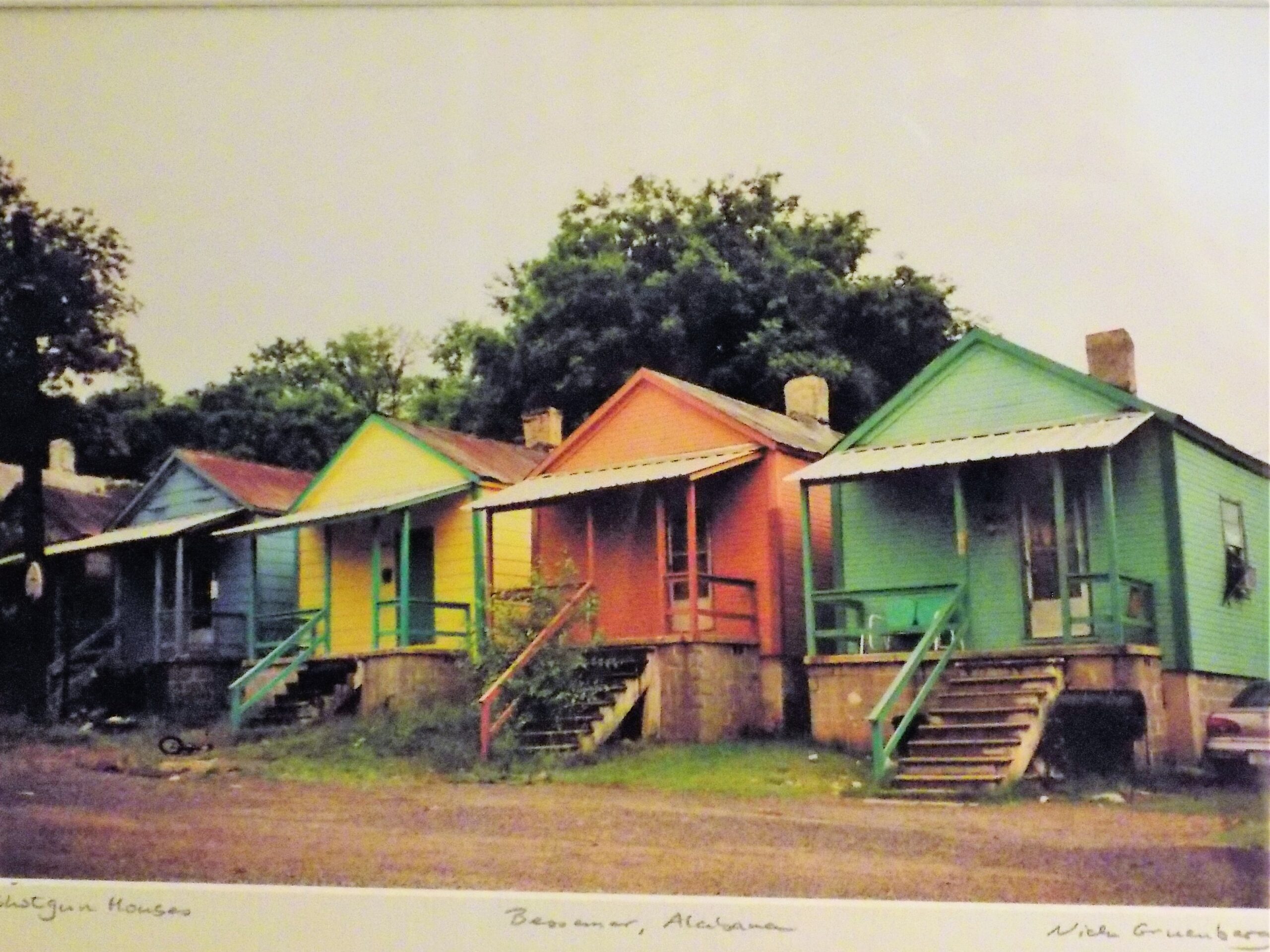
Birmingham’s earliest residential architecture emerged from immediate necessity rather than aesthetic consideration. The shotgun house, that narrow, linear structure where rooms opened directly into one another, became the dominant form for working-class housing. These buildings, constructed rapidly from local timber and increasingly from locally-produced brick, embodied a particular psychological state: provisional existence.
The shotgun’s layout, where one could theoretically fire a shotgun through the front door and hit the back wall without obstruction, created a unique spatial psychology. Privacy was impossible; family life unfolded in a continuous flow of interconnected spaces. This architectural form enforced a collectivist mentality among the working class, where individual boundaries dissolved into communal existence. The Graves Brick Company, whose stamps marked countless structures throughout the city, literally impressed Birmingham’s industrial identity into the very walls that contained its workers’ lives.
The Cottage as Transitional Object
Slightly more elaborate than the shotgun, the cottage form represented the first psychological step toward permanence. These structures, often featuring small front porches and separated rooms, introduced the concept of differentiated space, and with it, the possibility of differentiated identity. The cottage served as what psychoanalyst Donald Winnicott might call a “transitional object,” a bridge between the raw immediacy of camp life and the settled existence of an established city.
The psychological function of these early vernacular forms cannot be overstated. They created the physical matrix within which Birmingham’s working-class consciousness developed. The proximity enforced by these structures, their material sameness, and their rapid construction all contributed to a particular form of collective identity: industrial, provisional, and fundamentally oriented toward survival rather than flourishing.
Part II: The Vertical Ambition (1900-1920)
The Heaviest Corner on Earth: Skyscrapers as Ego Monuments
The intersection of 20th Street and 1st Avenue North, dubbed the “Heaviest Corner on Earth,” represents Birmingham’s first architectural attempt at psychological verticality. Between 1902 and 1912, four massive structures arose here: the Woodward Building, the Brown-Marx Building, the Empire Building, and the John A. Hand Building. These were not merely buildings; they were ego monuments, assertions of permanence in a city that had existed for barely thirty years.
The Woodward Building (1902), Birmingham’s first steel-frame skyscraper, marked a crucial psychological shift. The building utilized the city’s own product, steel, to achieve heights previously impossible. This was architecture as industrial narcissism, the city literally building itself from its own extracted materials. The Chicago School style employed here connected Birmingham to a national architectural conversation, asserting that this Southern industrial city belonged in the same category as Chicago or Pittsburgh.
The psychological impact of this vertical density cannot be understated. For a population accustomed to single-story shotguns and cottages, these towers created a new spatial psychology. They introduced the concept of looking up, of aspiration made literal in built form. The Beaux Arts detailing on many of these structures, with their classical columns and ornate cornices, wrapped industrial might in the clothing of ancient empires, creating a psychological bridge between Birmingham’s raw newness and the established civilizations of history.
Terminal Station: The Byzantine Gateway to Transformation
No structure better embodied Birmingham’s psychological aspirations than the Terminal Station, completed in 1909. Designed by P. Thornton Marye in an exotic Byzantine Revival style modeled after Istanbul’s Hagia Sophia, the station was a radical departure from the industrial vernacular. Its massive central dome, twin 130-foot towers, and elaborate tile work created what environmental psychologists would recognize as a “liminal space,” a threshold between worlds.
The station functioned as Birmingham’s primary psychological gateway. For visitors arriving by rail, it offered a counter-narrative to the industrial city’s reputation. The Byzantine style, completely foreign to the American South, suggested connections to deep history and global empires. This was architecture as psychological compensation, using exotic grandeur to mask the city’s shallow roots and industrial grime. The station’s vast interior spaces, with their soaring ceilings and filtered light, created what Gaston Bachelard might call “intimate immensity,” a psychological state where personal scale dissolves into cosmic awareness.
Part III: The Residential Psyche (1920s-1930s)
Mountain Brook: The Tudor Fantasy of Permanence
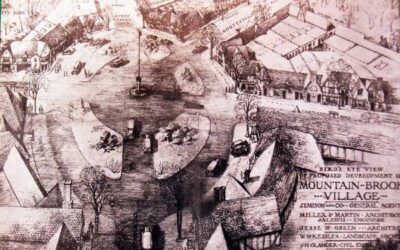
The development of Mountain Brook in 1929 by Robert Jemison Jr. represents one of the most psychologically significant architectural movements in Birmingham’s history. Working with landscape architect Warren H. Manning, Jemison created not just a suburb but a complete psychological ecosystem designed to negate the industrial city below.
The overwhelming embrace of Tudor Revival architecture in Mountain Brook served specific psychological needs. In a city where fortunes were made overnight in steel and coal, the Tudor style appropriated centuries of British aristocratic history. Half-timbered facades, steep gabled roofs, and leaded glass windows created an instant patina of age and stability. This was architecture as temporal displacement, allowing Birmingham’s nouveau riche to inhabit a fantasy of old money permanence.
Manning’s street design amplified this psychological separation. Unlike the rational grid of downtown Birmingham, Mountain Brook’s curvilinear roads followed natural topography, creating what Kevin Lynch would call “illegible space.” This deliberate confusion served as architectural exclusion, a spatial barrier that psychologically reinforced social boundaries. The neighborhood became what Carl Jung might recognize as a “temenos,” a sacred, protected space separated from the profane world of industry below.
The Romantic Architecture principles embedded in Mountain Brook’s design connected residents to idealized nature while maintaining careful control over that natural experience. This controlled romanticism allowed the industrial elite to maintain a connection to the pastoral without sacrificing the conveniences of modern life, creating what might be called a “curated unconscious.”
Hollywood: The Spanish Colonial Dream
While Mountain Brook looked to England for its architectural identity, the Hollywood district of Homewood, established in 1926, turned to the Mediterranean. Developer Clyde Nelson enforced a strict Spanish Colonial Revival aesthetic: white stucco walls, red tile roofs, and arched doorways that evoked California and Florida rather than Alabama.
This architectural choice represented pure psychological escapism. Named “Hollywood” to capture the glamour of the film industry, the neighborhood promised a life of perpetual leisure and sunshine. The Spanish Colonial style, with its emphasis on outdoor living, courtyards, and flowing indoor-outdoor relationships, stood in direct opposition to the enclosed, defensive architecture of industrial Birmingham. This was architecture as wish fulfillment, creating a physical environment that denied the industrial reality that funded it.
The psychological impact extended beyond mere aesthetics. The Spanish Colonial style’s emphasis on leisure and display created new social dynamics. The courtyard house plan, borrowed from Mediterranean traditions, turned domestic life inward while maintaining a carefully curated public facade. This dual orientation reflected the psychological split of Birmingham’s middle class: public success and private retreat, industrial wealth and leisured lifestyle.
Vestavia Hills: The Temple Complex
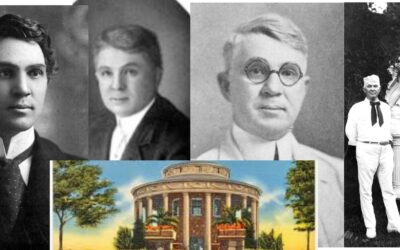
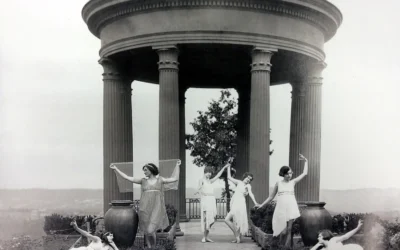
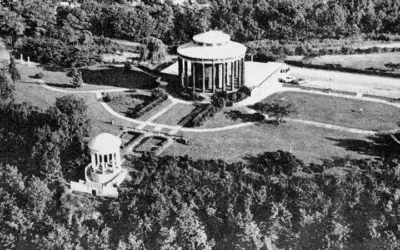
Perhaps the most psychologically revealing suburban development was Vestavia Hills, anchored by George Ward’s estate atop Shades Mountain. Ward, a former Birmingham mayor, constructed a replica of the Temple of Vesta from Rome, later adding a “Sibyl Temple” that still stands today.
Ward’s Roman obsession reveals a particular psychological condition: the need to connect Birmingham’s civic leadership to the great empires of history. The temple, positioned high on the mountain, functioned as a panopticon of privilege, looking down upon the industrial city from a remove of classical purity. This was architecture as psychological elevation, literally rising above the smoke and grime to occupy a space of imagined classical virtue.
The temple also embodied what James Hillman might call “archetypal inflation,” the dangerous psychological tendency to identify with godlike images. By building a Roman temple on an Alabama mountain, Ward created a physical manifestation of imperial fantasy that would define Vestavia Hills’ subsequent development as a community that sees itself as fundamentally separate from and above the city below.
Part IV: The Art Deco Transformation (1920s-1930s)
The Alabama Power Building: Electra and the New Mythology
The completion of the Alabama Power Building in 1925 marked a crucial psychological shift in Birmingham’s architectural narrative. Designed by Warren, Knight & Davis in the Art Deco style, the building represented the transition from heavy industry to the lighter, cleaner economy of electricity.
The building’s most significant feature was the golden statue of Electra, “The Divinity of Light,” crowning its apex. Electra, holding lightning bolts aloft, became part of Birmingham’s emerging mythology, cast as the lover of Vulcan, the iron god who stood watch over the city from Red Mountain. This mythological pairing served a crucial psychological function: it created a narrative bridge between the dirty, industrial past (Vulcan) and the clean, electrical future (Electra).
The Art Deco style itself represented a psychological revolution. Unlike the heavy, earth-bound neoclassicism of earlier skyscrapers, Art Deco emphasized verticality, speed, and futurity. The Alabama Power Building’s setbacks and vertical lines drew the eye upward, away from the street level’s industrial grime. The building’s elaborate lobby, with its marble and bronze details, created what Mircea Eliade might call a “sacred space” within the profane commercial world.
Part V: The Modernist Intervention (1945-1970)
Mid-Century Modernism: Transparency in the Woods
The post-war period brought a new architectural voice to Birmingham, one that challenged both the historical revivals of the suburbs and the heavy classicism of downtown. Architects like Fritz Woehle and Lawrence Whitten introduced Mid-Century Modernism, a style that emphasized transparency, simplicity, and connection to nature.
Woehle’s residential designs, with their walls of glass and open floor plans, represented a radical psychological shift. These houses rejected the fortress mentality of Tudor Revival Mountain Brook, instead embracing what Frank Lloyd Wright called “organic architecture.” The transparency of these modernist homes suggested psychological openness, a willingness to dissolve boundaries between inside and outside, self and nature.
However, this transparency was only possible within the already-exclusive enclaves of the suburbs. The glass walls that suggested openness actually depended on the exclusionary zoning and topographical barriers that kept the “wrong” elements out. This created a paradox: architectural openness within social closure, transparency predicated on invisible barriers.
Lawrence Whitten’s Bank for Savings Building (1962), now Two North Twentieth, brought International Style modernism to downtown Birmingham. As the first skyscraper built since the Great Depression, its glass curtain walls and clean lines attempted to align Birmingham with the corporate modernism of the North. This was architecture as image management, trying to shed the “Old South” identity as the Civil Rights movement intensified.
The influence of The Eames can be seen in Birmingham’s mid-century commercial interiors, where the psychological principles of comfort, efficiency, and democratic design began to influence office spaces and public buildings. This represented a democratization of design psychology, suggesting that good design could improve lives across social classes.
Part VI: The Trauma of Demolition (1960s-1970s)
Terminal Station’s Destruction: The Erasure of Memory
The demolition of Terminal Station in 1969 represents the central trauma in Birmingham’s architectural psychology. This act of civic self-destruction, driven by perceived obsolescence and a desperate desire for “modernization,” revealed what Christopher Alexander might call a “pattern of death”: the systematic destruction of meaningful places in favor of parking lots and vacant spaces.
The psychological impact reverberated throughout the city. The station had served as Birmingham’s grand entrance, its liminal space of transformation. Its destruction left a void not just in the urban fabric but in the collective psyche. The city had literally demolished its own gateway, suggesting an unconscious desire to prevent entry, to close itself off from the outside world during the tumultuous Civil Rights era.
This event catalyzed Birmingham’s preservation movement, as citizens recognized that architectural demolition equated to psychological erasure. The loss of Terminal Station became a cautionary tale about the danger of severing connections to the past, of what happens when a city attempts to delete its own memory.
The Brutalist Response: BJCC as Fortress
In the wake of Civil Rights turmoil and Terminal Station’s demolition, Birmingham turned to Brutalism for its major civic project. The Birmingham-Jefferson Convention Complex (BJCC), completed in the 1970s, embodied what Reyner Banham called “architecture of the megastructure.”
Brutalism, with its raw concrete surfaces and massive, fortress-like forms, created what environmental psychologists recognize as “hard architecture”: spaces that resist human scale and comfort. The BJCC turned inward, creating controlled interior environments separated from the perceived chaos of the street. This was architecture as defensive mechanism, a literal concretization of social anxieties about public space and racial integration.
The psychological message was clear: retreat from the public realm into managed, surveilled interiors. The BJCC represented the opposite of the Terminal Station’s welcoming gateway; it was a bunker, suggesting that the city’s future lay not in openness but in fortification.
Part VII: The Contemporary Reconciliation (1990s-Present)
The Civil Rights Institute: Architecture as Truth-Telling
The Birmingham Civil Rights Institute (1992), designed by Max Bond Jr., represents a fundamental shift in Birmingham’s architectural psychology. Unlike previous civic buildings that either ignored or actively suppressed the city’s racial history, the BCRI makes that history central to its design narrative.
Bond’s design creates what psychologist James Pennebaker might call “architectural disclosure,” using built form to acknowledge and process collective trauma. The building’s relationship to the 16th Street Baptist Church and Kelly Ingram Park creates a spatial narrative of the Civil Rights movement. The entrance sequence, requiring visitors to climb a long, ascending path, physically embodies the struggle for civil rights.
The building’s transparency, with its extensive use of glass, suggests a new psychological openness about Birmingham’s past. This is architecture as therapeutic intervention, creating spaces for what Judith Herman calls “testimony and witness.” The BCRI demonstrates how buildings can facilitate collective healing by providing physical spaces for confronting difficult histories.
Adaptive Reuse: Inhabiting the Industrial Past
The current trend toward Adaptive Reuse in Birmingham’s Loft District and Automotive Historic District represents another form of psychological reconciliation. Rather than demolishing industrial structures or fleeing to the suburbs, a new generation is choosing to inhabit the shells of Birmingham’s industrial past.
This trend reflects what psychoanalyst Christopher Bollas might call “transformational object relating”: taking something that was once source of shame or trauma and transforming it into something generative. The exposed brick, steel beams, and industrial fixtures that were once hidden are now celebrated as “authentic” design elements. This represents a psychological integration of Birmingham’s industrial identity, no longer something to escape but something to embrace and transform.
The New Urbanism principles advocated by Andres Duany have influenced recent developments that attempt to recreate walkable, mixed-use neighborhoods. These projects represent an attempt to heal the psychological wounds created by suburban flight and urban highway construction, recreating the connected urban fabric that was destroyed in the name of progress.
Part VIII: Architectural Styles as Psychological States
The Colonial Compensation Complex
Birmingham’s embrace of Colonial Architecture reveals a particular psychological condition: the desire for a historical narrative that predates the city’s actual founding. Colonial Revival homes in neighborhoods like Highland Park appropriate the architectural language of America’s founding, creating what Benedict Anderson might call “imagined community” connections to a past Birmingham never experienced.
This architectural choice serves as psychological compensation for the city’s lack of colonial history. By building Georgian and Federal style homes, Birmingham’s residents could participate in a national narrative of American identity that transcended their city’s industrial origins.
Greek Revival and Democratic Aspirations
The presence of Greek Revival architecture in Birmingham’s civic and religious buildings reveals democratic aspirations filtered through classical forms. The columns, pediments, and symmetrical facades of Greek Revival buildings suggest order, reason, and democratic ideals, providing psychological anchoring in a city often characterized by industrial chaos.
The First Presbyterian Church of Birmingham, with its imposing Greek Revival facade, creates what Yi-Fu Tuan calls “topophilia”: the love of place generated through architectural dignity. These buildings served as psychological anchors, suggesting that Birmingham, despite its youth and industrial character, participated in the grand tradition of Western civilization.
Gothic Revival and the Sacred Vertical
Birmingham’s numerous Gothic Revival churches, particularly in the Highland and Five Points areas, reveal a psychological need for vertical transcendence. The pointed arches, ribbed vaults, and soaring spires of Gothic Revival architecture create what Rudolf Otto called the “numinous”: architectural experiences of the holy that transcend rational explanation.
These churches served as psychological counterweights to industrial materialism. Their vertical emphasis drew consciousness upward, away from the horizontal sprawl of industry. The Gothic Revival style’s emphasis on craftsmanship also provided an architectural antidote to mass production, suggesting that human hands could still create beauty in an age of machines.
The Victorian Eclectic Personality
The Eclectic Victorian houses scattered throughout Birmingham’s older neighborhoods reveal what Robert Jay Lifton might call “protean” psychology: the ability to shift between multiple identities. These houses, combining elements of Queen Anne, Romanesque, and Gothic styles, refused architectural purity in favor of expressive individualism.
This eclecticism served important psychological functions. It allowed Birmingham’s emerging middle class to express individual identity through architectural choice, selecting and combining elements that resonated with personal taste rather than adhering to strict stylistic rules. The Victorian eclectic house became a form of architectural self-portrait, revealing the complex, sometimes contradictory psychological states of their inhabitants.
Arts and Crafts as Therapeutic Response
The Arts and Crafts Movement found expression in Birmingham’s Craftsman bungalows, particularly in neighborhoods like Avondale and Forest Park. These houses, with their emphasis on natural materials, handcrafted details, and connection to nature, represented a therapeutic response to industrial alienation.
The Craftsman bungalow’s low, horizontal profile, deep porches, and exposed structural elements created what Clare Cooper Marcus calls “house as symbol of self”: architecture that reflects authentic being rather than social pretense. These houses offered psychological refuge from both the industrial city and the pretensions of revival styles, suggesting that dignity could be found in simplicity and craft.
Part IX: The Post-Industrial Imagination
Post-Modern Experiments
Birmingham’s scattered examples of Post Modern Classicism reveal an architectural psychology comfortable with irony and historical quotation. Buildings like the Harbert Plaza (1989) combine classical elements with modern materials and exaggerated proportions, creating what Charles Jencks called “double coding”: architecture that speaks simultaneously to multiple audiences.
This post-modern sensibility reflects Birmingham’s mature psychological state: no longer needing to prove its legitimacy through serious classical revival, the city could play with historical forms, acknowledging them as quotations rather than truths. This represents a form of architectural psychoanalysis, where the city’s historical complexes could be acknowledged and even celebrated rather than repressed.
The influence of Leon Krier‘s ideas about traditional urbanism can be seen in recent developments that attempt to recreate pre-automobile urban patterns. These projects represent a desire to return to what Krier calls “architectural archetypes”: forms that resonate with deep psychological patterns of human habitation.
The Corporate Post-Modern Office
Birmingham’s Corporate Post-Modern Office buildings from the 1980s and 1990s reveal the psychological transformation from industrial to service economy. Buildings like the SouthTrust Tower (now Shipt Tower) combine modern office functionality with historical references, creating what Fredric Jameson might call “pastiche”: history as style rather than substance.
These buildings served important psychological functions during Birmingham’s deindustrialization. They suggested continuity with the past while embracing the future, allowing the city to maintain architectural dignity while transforming its economic base. The use of reflective glass and granite veneers created what Jean Baudrillard might call “simulacra”: copies without originals, perfect surfaces that concealed the messy reality of economic transformation.
Sustainable Futures and Biophilic Design
Recent developments incorporating Biophilic Design principles represent Birmingham’s growing ecological consciousness. Projects like Railroad Park and the Rotary Trail create what E.O. Wilson called “biophilia”: the innate human affinity for nature, integrated into urban fabric.
These green interventions serve crucial psychological functions in a post-industrial city. They transform industrial scars into healing landscapes, suggesting that Birmingham’s future lies not in denying its industrial past but in transforming it through ecological intervention. The Oil Crisis Architecture principles of passive solar design and energy efficiency, once seen as purely practical, now carry psychological weight as symbols of environmental responsibility.
Part X: The Digital and Algorithmic City
Parametric Possibilities
While Birmingham has yet to fully embrace Parametricism, the influence of computational design can be seen in recent projects that use Algorithmic Design to optimize building performance. These approaches represent a new psychological relationship to architecture: buildings as responsive systems rather than static objects.
The potential for Post Digital architecture in Birmingham suggests a future where the physical and virtual merge, creating what might be called “augmented psychological space.” This could allow Birmingham to overcome its physical limitations, creating architectural experiences that transcend material constraints.
New Materialism and Material Agency
The principles of New Materialism are beginning to influence Birmingham architecture, recognizing materials not as passive substances but as active agents in creating architectural experience. This represents a return to Birmingham’s foundational relationship with materials (iron, coal, limestone) but with a new psychological awareness of material agency.
This shift suggests a more collaborative relationship between human consciousness and material reality, moving beyond the domination model of industrial extraction toward what might be called “material dialogue.” Buildings become collaborations between human intention and material possibility, creating architecture that emerges from rather than imposes upon place.
Neo-Modernist Clarity
Recent examples of Neo Modernism in Birmingham, particularly in institutional buildings like the UAB campus expansions, reveal a renewed faith in modernist clarity and rationality. These buildings, with their clean lines, honest materials, and functional expression, suggest a psychological desire for transparency and authenticity after decades of post-modern irony.
This neo-modernist sensibility reflects Birmingham’s growing confidence in its identity. No longer needing to hide behind historical quotation or suburban fantasy, the city can embrace architectural honesty. This represents what psychologist Carl Rogers might call “congruence”: alignment between inner reality and outer expression.
Part XI: The Healing City
Architecture as Collective Therapy
Birmingham’s architectural evolution from industrial boomtown to post-industrial city reveals a process of collective psychological development. The early skyscrapers represented ego formation, asserting identity through vertical dominance. The suburban enclaves revealed shadow projection, creating “pure” spaces that denied the industrial source of wealth. The demolition of Terminal Station marked a traumatic rupture, while the Civil Rights Institute began a process of integration and healing.
Today’s Birmingham, with its adaptive reuse projects, green interventions, and honest modernism, suggests a city moving toward what Jung called “individuation”: the integration of conscious and unconscious, light and shadow, into a more complete whole. The architecture no longer denies the industrial past but transforms it, creating what might be called “therapeutic spaces” that acknowledge history while enabling future growth.
The City Beautiful Legacy
The influence of the City Beautiful movement can still be seen in Birmingham’s parks and boulevards, reminders of an era when cities were understood as therapeutic environments. The curved roads of Olmsted’s park designs, the grand boulevards of early 20th-century planning, and the civic monuments scattered throughout the city create what might be called “architectural medicine”: built environments designed to heal and uplift.
Many of these were the visions and products of George B Wards Mayordom. These spaces serve crucial psychological functions in contemporary Birmingham. They provide respite from urban density, create democratic spaces where diverse populations can meet, and suggest that beauty is not luxury but necessity for psychological wellbeing. The City Beautiful legacy reminds us that cities are not just economic engines but environments for human flourishing.
Part XII: Future Architectures of Consciousness
The Adaptive City
Birmingham’s embrace of Adaptive Architecture suggests a psychological maturity: the recognition that transformation is more sustainable than demolition, that memory can be preserved while function evolves. This adaptive approach reflects what developmental psychologist Robert Kegan calls “self-transforming mind”: the ability to step outside one’s own ideology and see it as object rather than subject.
The city’s industrial buildings, once sources of shame, become canvases for creative transformation. This represents a form of architectural alchemy, transforming base materials into gold, trauma into beauty. The adaptive city suggests that psychological healing happens not through erasure but through creative reinterpretation of the past.
Toward an Integrated Architecture
As Birmingham moves forward, its architecture increasingly reflects psychological integration rather than splitting. The strict segregation between city and suburb, industry and nature, black and white, is slowly dissolving into more complex, nuanced relationships. Mixed-use developments, greenways connecting previously separated neighborhoods, and cultural institutions that acknowledge the full complexity of Birmingham’s history all suggest a city moving toward psychological wholeness.
This integration doesn’t mean homogenization. Rather, it suggests what psychologist Daniel Siegel calls “differentiated integration”: maintaining distinct identities while recognizing fundamental interconnection. Birmingham’s architecture increasingly reflects this principle, creating spaces that honor diversity while fostering connection.
The Mirror and the Window
Birmingham’s architecture serves as both mirror and window: reflecting the city’s psychological state while opening possibilities for transformation. From the shotgun houses that contained working-class dreams to the suburban temples that elevated industrial wealth to classical heights, from the Brutalist bunkers that expressed social anxiety to the transparent museums that facilitate healing, Birmingham’s buildings tell the story of a city’s psychological journey.
Understanding this architectural psychology is not merely academic exercise. It reveals how built environments shape consciousness, how design decisions create psychological realities that persist across generations. Birmingham’s architecture teaches us that cities are not just physical entities but psychological organisms, constantly evolving through the dialectic between human consciousness and material form.
As we look toward Birmingham’s architectural future, we see possibilities for what might be called “conscious architecture”: design that intentionally supports psychological wellbeing, facilitates social connection, and enables both individual and collective flourishing. The city that once built itself from iron and coal now has the opportunity to build itself from awareness and intention, creating architecture that not only shelters bodies but nurtures souls.
The story of Birmingham’s architecture is ultimately a story of psychological development: from unconscious reaction to conscious creation, from splitting to integration, from trauma to healing. In this sense, Birmingham’s buildings are not just structures but teachers, showing us how the material world both reflects and shapes the landscape of the mind. The city’s architecture reminds us that we are always building two things simultaneously: external structures and internal realities, physical spaces and psychological states.
The Magic City’s true magic lies not in its rapid growth from farmland to metropolis, but in its ongoing transformation from an industrial machine into a human habitat, from a site of extraction into a place of dwelling, from a city that builds things into a city that builds consciousness itself. In the end, Birmingham’s architecture reveals the profound truth that how we build shapes who we become, and who we become shapes how we build, in an endless spiral of mutual creation that is the essence of urban life.










0 Comments