
Key Takeaways: Seven Against Thebes & Depth Psychology
- The Hostile Brothers Archetype: Eteocles and Polynices represent the split within the psyche (Ego vs. Shadow). When the self is divided against itself, the result is total annihilation (Mutually Assured Destruction).
- Intergenerational Trauma (The Curse): The play illustrates how the sins of the father (Oedipus) manifest as a compulsion to repeat violence in the sons.
- Simone Weil & The Empire of Force: The play exemplifies Weil’s concept of “Force”—the mechanism that turns a human into a thing. Eteocles is possessed by the force of the curse, losing his agency.
- The City as Self: Thebes represents the structure of the personality under siege by its own repressed contents (the seven attackers).
What Happens in Seven Against Thebes? A Jungian Analysis of the Fratricidal Shadow
Aeschylus’ Seven Against Thebes (467 BC) is the final act of the tragic saga of the House of Oedipus. While Oedipus Rex deals with the individual’s discovery of the Shadow, Seven Against Thebes deals with the Collective Explosion of that Shadow.
It tells the story of two brothers, Eteocles and Polynices, who are cursed by their father to “divide their inheritance with the sword.” They are the sons of incest, and their war for the throne of Thebes is the ultimate archetypal representation of the Split Psyche. From the perspective of Simone Weil and Carl Jung, this play is a warning: when the Ego refuses to integrate the Shadow, it leads to a civil war within the soul.
Summary: The Siege of the Soul
The narrative is claustrophobic, set entirely within the walls of the besieged city.
- The Context: After Oedipus was exiled, his two sons agreed to share the throne, ruling in alternating years. Eteocles ruled first but refused to step down. Polynices, the exiled brother, raised an army from Argos to attack his own home.
- The Seven Gates: The play consists largely of a scout describing the seven enemy champions attacking the seven gates of Thebes. Eteocles, with cool rationality, assigns a Theban defender to each gate.
- The Seventh Gate: The scout reveals that the seventh attacker is Polynices himself. Eteocles realizes the curse is upon him. He must face his brother. The Chorus begs him not to go, but he is possessed by the fatalism of the family curse.
- The Double Fratricide: The brothers meet in single combat and kill each other simultaneously. The city is saved, but the royal bloodline is extinguished (until Antigone steps in).
Archetypal Figures: The Architecture of Conflict
The Hostile Brothers: The Split Self
Eteocles and Polynices are not just siblings; they are the Hostile Brothers archetype (like Cain and Abel, or Romulus and Remus).
* Eteocles (The Ego): He is the ruler, the defender of order, and the rational planner. However, his rationality is brittle. He suppresses his emotions (scolding the Chorus for their fear).
* Polynices (The Shadow): He is the exile, the invader, the “Many-Strifes.” He represents the repressed anger and entitlement that returns to burn the house down.
In therapy, we see this in clients who are “at war with themselves.” One part of them wants to be good and productive (Eteocles), while another part wants to destroy everything (Polynices). Because they are twins, they are equal in strength, leading to a deadlock.
The City of Thebes: The Mandala of the Self
Thebes is a walled city with seven gates. In Jungian psychology, the city is a symbol of the Self—the total structure of the personality.
The “Seven Gates” represent the seven chakras or openings of perception. The siege represents a Psychotic Break or a panic attack—the moment when the defenses of the Ego are overwhelmed by unconscious forces (the Argive army).
Simone Weil and the empire of Force
The French mystic and philosopher Simone Weil offers a profound lens for understanding this tragedy. In her famous essay on the Iliad, she defined Force as “that x that turns anybody who is subjected to it into a thing.”
Gravity vs. Grace
Weil distinguished between two laws of the universe:
1. Gravity: The natural tendency to exert power, to seek revenge, and to fall downward into violence. Eteocles is ruled by Gravity. When challenged, his instinct is to crush. He cannot step down because gravity only pulls down.
2. Grace: The supernatural capacity to stop, to yield, and to create a “Void” where God can enter.
The tragedy of Seven Against Thebes is a tragedy of total Gravity. There is no Grace. Eteocles accepts the “Curse” as inevitable. He says, “Since the gods send this wind, let the ship run before it.” He surrenders his agency to the momentum of trauma.
The Void at the Center
Weil argued that power is an illusion. Eteocles thinks he is powerful, but he is a puppet of the curse. True power, for Weil, is Decreation—the ability to undo the ego to make space for the other. If Eteocles had possessed the capacity for Decreation, he would have opened the gate and embraced his brother. Because he could not, they both died. This mirrors the clinical reality that Narcissism (inflation) is a defense against the Void, but it eventually collapses into it.
Deep Psychological Themes
1. The Curse of the Father (Intergenerational Trauma)
The “Curse of Oedipus” is not magic; it is psychology. Oedipus, traumatized and exiled, cursed his sons in a fit of rage.
In family systems theory, this is the Transmission of Trauma. The father, unable to process his own shadow, projects it onto his sons. The sons, identifying with the father’s rage, act it out against each other.
Clinical Insight: The curse only ends when one generation refuses to pass it on. Antigone attempts this by choosing love (burial) over law, but even she is consumed by the gravity of the family death drive.
2. The Shields: The Persona and the Symbol
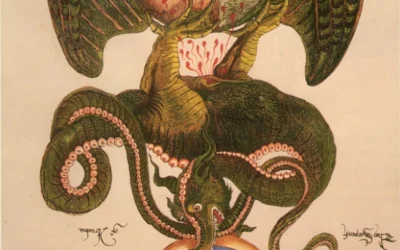
A large portion of the play describes the shields of the attackers. Each shield bears a terrifying image (a dragon, a naked man with fire).
This is a study in Psychological Warfare and the Persona. The attackers try to win by projecting fear (Shadow). Eteocles counters this by interpreting the symbols rationally. He strips the magic away from the images.
However, he fails to interpret his own brother. He sees Polynices only as an enemy, not as his mirror reflection. He can analyze the symbols of others, but he is blind to his own symbol.
3. The Failure of the Masculine
The play is dominated by toxic masculinity—war, honor, steel, and blood. The feminine voice (the Chorus of women) is constantly silenced by Eteocles (“You women, shut up, you are spreading panic!”).
This repression of the Feminine/Anima is fatal. The women represent the feeling function—the fear that tells us “This is wrong.” By silencing the Anima, Eteocles cuts off his only connection to life. He marches to his death because he has killed his capacity to feel fear or love.
The End of the Heroic Age
Seven Against Thebes marks the exhaustion of the Heroic Ego. The hero (Eteocles) does not save the day; he destroys himself.
For the modern client, the play asks: Are you fighting a war that was started by your father?
To heal, we must stop defending the “Seventh Gate” (the core wound) with violence. We must recognize that the enemy outside is actually the rejected brother inside.
Read About Other Classical Greek Plays and Their Influence on Depth Psychology
Taproot Therapy Collective Podcast
The House of Oedipus Cycle
Oedipus Rex: The Discovery of the Self
Oedipus at Colonus: The Redemption of the Father
Antigone: The Conflict of Law and Love
War, Trauma, and Mysticism
Ajax: The Suicide of the Warrior
Simone Weil: Gravity and Grace
The Oresteia: The End of the Blood Feud
Prometheus Bound: The Cost of Consciousness
Bibliography
- Aeschylus. Seven Against Thebes. (Various Translations).
- Weil, S. (1940). The Iliad, or the Poem of Force. (Mary McCarthy, Trans.).
- Jung, C. G. (1956). Symbols of Transformation. Princeton University Press.
- Neumann, E. (1954). The Origins and History of Consciousness. Princeton University Press.
- Zeitlin, F. I. (1982). Under the Sign of the Shield: Semiotics and Aeschylus’ Seven Against Thebes.



0 Comments