

Executive Summary: Oedipus at Colonus & The Psychology of Redemption
The Core Premise: This play is the final chapter of the Oedipus cycle, written by Sophocles at the age of 90. It details the transformation of Oedipus from an exiled “monster” into a “DAIMON”—a protective spirit.
Jungian Analysis:
- The Pharmakos to Mana-Personality: Oedipus illustrates how the “Scapegoat” (the rejected part of the psyche) can become the “Medicine” if integrated properly.
- The Sacred Grove: The setting represents the Temenos—the protected psychological space where the conscious and unconscious meet.
- Theseus as the Healthy Ego: Unlike Creon (Tyranny), Theseus represents the mature Ego that welcomes the Shadow (Oedipus) without fear.
Clinical Relevance: A profound study of Gerotranscendence—the shift in perspective during the final stage of life, where the individual moves from ego-ambition to cosmic communion.
What Happens in Oedipus at Colonus? A Jungian Analysis of the Holy Death

If Oedipus Rex is the tragedy of the **Ego’s Destruction**, then Oedipus at Colonus is the story of the **Self’s Resurrection**. Written by Sophocles just before his own death at age 90, it is a mystical, strange, and deeply spiritual play that defies the standard rules of tragedy.
From the perspective of Carl Jung and Edward Edinger, this play maps the final stage of Individuation. It answers the question: What happens after the fall? When a person has lost everything—their status, their sight, their home—what is left? Sophocles argues that what remains is something numinous, powerful, and divine. The old, blind beggar becomes more powerful than kings.
Part I: Summary – The Beggar Becomes the Blessing
The narrative arc is one of spiritual ascent, contrasting the political squabbles of the world with the deep silence of the grove.
- The Arrival: Oedipus, blind and ragged, arrives at Colonus (a suburb of Athens) led by his daughter Antigone. They accidentally trespass into a “Sacred Grove” dedicated to the Eumenides (The Furies). The locals try to chase him out, but Oedipus refuses to move. He recognizes this as the place of his prophesied death.
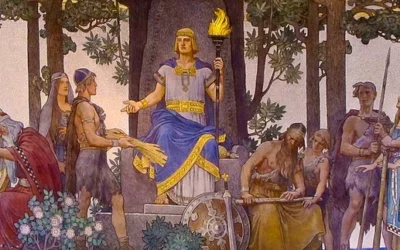
- The Protection: Theseus, King of Athens, arrives. Instead of rejecting the “polluted” Oedipus, Theseus grants him citizenship and protection. This act of grace changes Oedipus’s fate.
- The Temptation of the Past: Creon arrives from Thebes. He tries to drag Oedipus back—not out of love, but because a prophecy says Oedipus’s bones will protect the city where they are buried. Creon wants to use Oedipus as a magical talisman. Theseus intervenes and drives Creon away.
- The Curse of the Son: Polynices (Oedipus’s son) arrives, begging for his father’s blessing in his war against his brother Eteocles. Oedipus, seeing his son’s narcissism, delivers a terrifying curse: that the brothers will kill each other.
- The Transfiguration: A thunderstorm signals the end. Oedipus, suddenly regaining his inner sight, leads the way into the grove. He does not die in a normal sense; he vanishes into the earth, becoming a “Hero” (a local deity) who will protect Athens forever.
Part II: The Archetypal Cast
Oedipus: The Mana-Personality
In Oedipus Rex, Oedipus was the Hero who solved the riddle. Now, he is the riddle. He has become a Mana-Personality—a figure charged with supernatural energy.
He represents the psychological truth that The Wound is the Source of Power. Because he has suffered more than any human, he has touched the divine. He is “Taboo”—both cursed and holy. In therapy, this mirrors the client who, having survived deep trauma, possesses a gravity and wisdom that “normal” people lack.
The Sacred Grove: The Temenos
The play takes place on the threshold of a grove sacred to the Furies. The Furies are the goddesses of guilt and vengeance.
Psychological Insight: Oedipus finds his rest in the home of his guilt. He does not run from the Furies anymore; he dwells with them. This symbolizes the final integration of the Shadow. The scary monsters of the unconscious (Furies) become the “Kindly Ones” (Eumenides) once they are acknowledged and honored.
Theseus: The Integrated Ego
Theseus is the only character who can look Oedipus in the eye without fear. He represents the Mature Ego.
A weak Ego (like Creon) tries to control or exploit the unconscious. A mature Ego (Theseus) respects it. Theseus says, “I too am a man, and I know that I have no more power over tomorrow than you.” This humility allows him to receive the blessing of the Self (Oedipus).
Part III: Deep Psychological Themes
1. The Pharmakos (Scapegoat) Transformation
In ancient Greece, a Pharmakos was a scapegoat exiled to cleanse the city. Oedipus is the ultimate Pharmakos.
However, Colonus reveals the paradox: The thing you throw away becomes the cornerstone.
The “pollution” of Oedipus becomes the “blessing” of Athens. This is the core of Alchemical Psychology: the Prima Materia (the despised, messy part of the soul) is the only thing that can be turned into Gold.
Clinical Application: Clients often want to “get rid of” their anxiety or their trauma. The therapist helps them see that this “symptom” carries their unique destiny and value.
2. Gerotranscendence: The Wisdom of Age
Oedipus is physically helpless but spiritually omnipotent. This illustrates the theory of Gerotranscendence (Lars Tornstam).
In the second half of life, the psyche shifts from “Agency” (doing things) to “Being” (understanding things). Oedipus curses his sons because they are still stuck in the ego-game of power and war. He has moved beyond it. He sees the vanity of worldly conquest.
3. The Rejection of the False Self (Polynices)
Why is Oedipus so cruel to his son Polynices?
Polynices represents the False Self—the ambitious, power-hungry persona that Oedipus used to be. By cursing Polynices, Oedipus is finally cutting the cord to his own past vanity. He refuses to give his “energy” (blessing) to the ego’s futile wars. It is a harsh, but necessary, act of psychic hygiene.
Part IV: The Mystery of the Death
Oedipus does not die of sickness or old age. He is “taken.”
The messenger reports:
> “But some attendant from the train of Heaven came for him; or else the underworld opened in love the unlit door of earth. For he was taken without lamentation, illness or suffering; indeed his end was wonderful if mortal’s ever was.”
This is the Coniunctio (Union). The Ego (Oedipus) merges back into the Mother Earth (The Unconscious) not in defeat, but in love. It suggests that the goal of life is to build a consciousness strong enough to enter death with eyes open.
Part V: Conclusion
Oedipus at Colonus is a play about the dignity of the human soul. It asserts that a person is not defined by their worst mistake (incest/parricide), but by how they carry the burden of that mistake. Oedipus carries it all the way to the gods.
For the modern reader, it offers a vision of hope. Even if we are blind, exiled, and broken by life, there is a “Sacred Grove” waiting for us—if we have the courage to stop running and sit still.
Read About Other Classical Greek Plays and Their Influence on Depth Psychology
Taproot Therapy Collective Podcast
The Oedipus Cycle
Oedipus Rex: The Trauma of Awakening
Antigone: The Conflict of Law and Love
Seven Against Thebes: The War of the Brothers
The Hero’s End
Ajax: The Suicide of the Warrior
Philoctetes: The Wound that Will Not Heal
Alcestis: Death and Resurrection
The Feminine & The Divine
The Oresteia: The Evolution of Justice
Medea: The Shadow of the Mother
Hippolytus: The Rejection of Aphrodite
The Bacchae: The Madness of the God
Iphigenia in Aulis: The Sacrifice of Innocence
Iphigenia in Tauris: The Return of the Exile
The Suppliants: The Refugee Soul
Prometheus Bound: The Light Bringer
Greek Tragedies Influence on Jung
The Psychology of the Peloponesian War
Bibliography
- Sophocles. Oedipus at Colonus. (Robert Fagles, Trans.). Penguin Classics.
- Edinger, E. F. (1972). Ego and Archetype: Individuation and the Religious Function of the Psyche. Shambhala.
- Hillman, J. (1990). Oedipus Variations. Spring Publications.
- Knox, B. M. W. (1964). The Heroic Temper: Studies in Sophoclean Tragedy. University of California Press.





0 Comments