
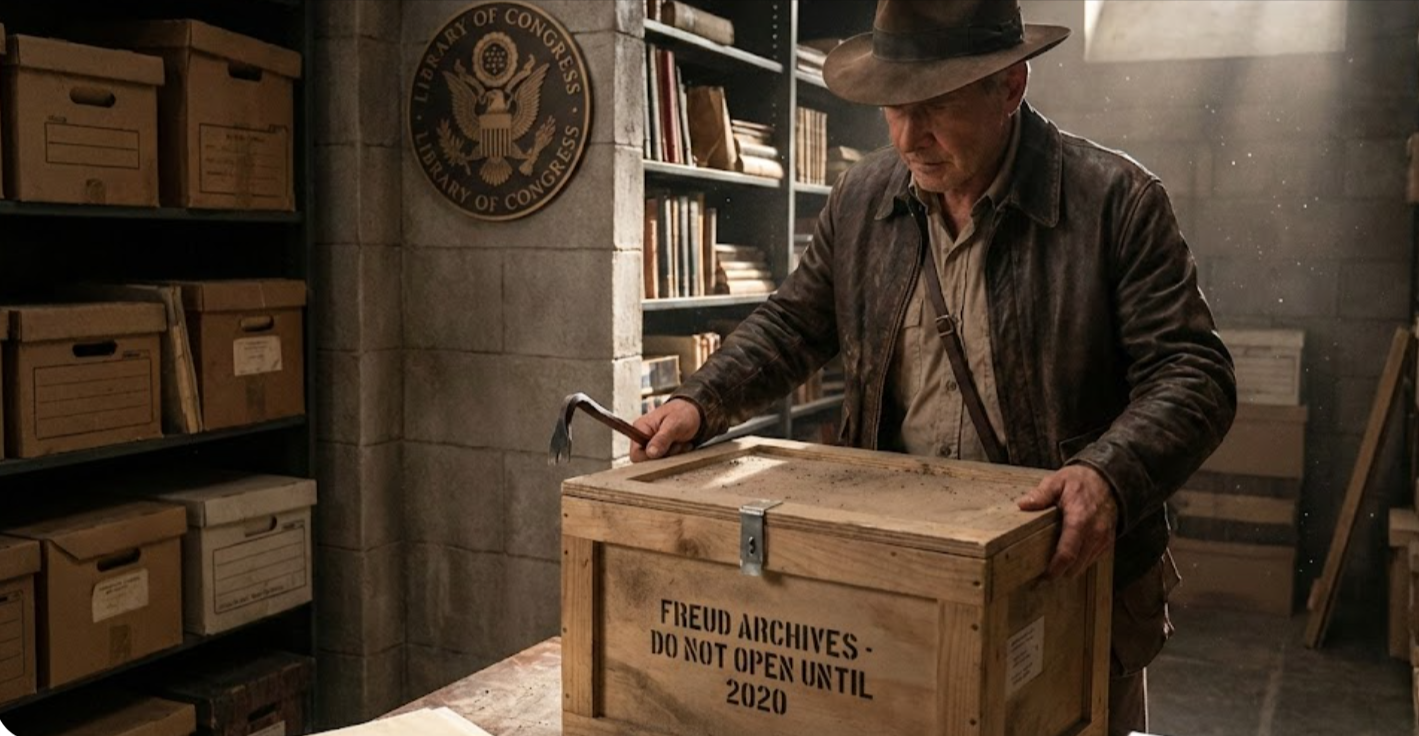
Somewhere in the Library of Congress sits a collection of documents that has shaped how we understand the human mind. The Sigmund Freud Papers contain letters, case notes, interviews, and personal correspondence spanning the birth of psychoanalysis. They should be among the most studied archives in the history of psychology.
Instead, for most of the past century, large portions of these papers have been locked away. Some documents were sealed until the year 2000. Others until 2013. Some remain restricted until 2038 or 2057. A few, according to researchers who have studied the archive’s structure, may not be accessible until 2113, over a century and a half after Freud’s death.
Why would the papers of a scientist, a man who claimed to have discovered objective truths about human psychology, need to be hidden for generations? What could possibly require that kind of protection?
As seals have broken and documents have emerged, we’ve started to get answers. And they’ve fundamentally changed how we understand both Freud and the field he created.
The Architecture of Secrecy
The story begins in 1951, when a group of loyal psychoanalysts founded an organization called Sigmund Freud Archives, Inc. This wasn’t a neutral scholarly body. It was a private corporation with a specific mission: protecting Freud’s legacy.
The Archives donated Freud’s papers to the Library of Congress, a public institution. But they retained what’s called “donor control,” meaning they decided who could see what, and when. The papers were physically in a government building, but they were effectively privatized.
The architect of this arrangement was Dr. Kurt Eissler, an Austrian-American analyst who served as the Archives’ gatekeeper for decades. In private correspondence, Eissler referred to the archives as a “tomb” or a “crypt” where the “radioactive waste” of the psychoanalytic movement could be safely buried until the world was ready to handle it.
He wasn’t speaking metaphorically. Eissler genuinely believed that future generations, enlightened by psychoanalysis, would understand Freud properly. His contemporaries, he felt, were too “hostile” and “neurotic” to be trusted with the raw data. So he locked it away.
The Restriction Schedule
The sealed materials were organized into complex series, with the most sensitive documents segregated into restricted sections. The finding aids, the catalogs that tell researchers what’s in the collection, often listed items simply as “Closed” with release dates that seemed almost arbitrary: 2000, 2013, 2038, 2057, 2113.
These dates weren’t arbitrary at all. They were actuarial calculations. The restrictions were designed to ensure that no living participant, and often no children or grandchildren of participants, would be alive when the documents became public.
The official justification was always “patient confidentiality.” But as documents have been unsealed, a different picture has emerged. “Confidentiality” often meant “reputation management.” The seals protected Freud and his inner circle from scrutiny, not patients from exposure.
The First Major Breach: The Fliess Letters
The first significant crack in the archival wall came in the early 1980s, triggered by an ambitious young analyst named Jeffrey Masson. Appointed by Eissler as the future director of the Freud Archives, Masson was granted unprecedented access to restricted materials, specifically the unexpurgated correspondence between Freud and his closest friend during the 1890s, Wilhelm Fliess.
Published versions of these letters, edited by Anna Freud and Ernst Kris, had been heavily redacted. The unsealed originals told a radically different story about the birth of psychoanalysis.
The standard narrative was that Freud abandoned his “Seduction Theory,” the hypothesis that hysteria was caused by childhood sexual abuse, because he courageously recognized that his patients’ memories were actually fantasies. This “discovery” of psychic reality, the idea that imagined events could be as psychologically powerful as real ones, was hailed as the foundational moment of psychoanalysis.
The unsealed letters revealed something different. Freud never claimed to have clinical evidence that the abuse didn’t happen. He abandoned the theory because his treatments weren’t working, because maintaining it would require accusing respectable Viennese fathers of perverse acts, and because he needed to stay aligned with Fliess’s biological theories to preserve their friendship.
The shift from “real abuse” to “fantasy” wasn’t a scientific discovery. It was a strategic retreat.
The Emma Eckstein Horror
The most disturbing revelation from the Fliess letters involved a patient named Emma Eckstein. Freud had referred her to Fliess for nasal surgery based on Fliess’s theory that the nose was directly connected to the genitals and that operating on it could cure neurosis.
Fliess botched the surgery badly, leaving a half-meter strip of surgical gauze inside Eckstein’s nasal cavity. This caused massive, life-threatening hemorrhaging and permanent disfigurement.
The sealed letters revealed how Freud responded: not by condemning Fliess for malpractice, but by exonerating him. Freud wrote to Fliess that Eckstein’s bleeding was “wish-bleeding,” a hysterical symptom caused by her longing for Fliess’s affection. Her near-death from surgical error was reinterpreted as a psychosomatic manifestation of desire.
This finding was devastating for the moral authority of psychoanalysis. It demonstrated that the concept of “hysterical fantasy,” the mechanism used to dismiss women’s reports of abuse for the next century, was invented by Freud specifically to protect his friend from accountability. The shift from trauma to fantasy wasn’t science. It was a cover-up.
The Masson Affair and the Archives Go Public
When Masson published these findings in The Assault on Truth, he was immediately fired from the Archives and effectively excommunicated from the profession. The controversy exploded when journalist Janet Malcolm wrote about it in The New Yorker, and Masson sued her for libel in a case that went to the Supreme Court.
The trial itself didn’t resolve the historical questions, but the discovery process forced the Freud Archives into public view. The existence of the sealed documents, and the lengths to which the Archives would go to silence critics, became a matter of public record. Pressure to unseal materials increased dramatically.
The trial shattered the illusion that the Archives were a neutral scholarly body. They looked instead like a politicized organization willing to destroy careers to protect the orthodox narrative.
What the Opened Files Have Revealed
As restrictions have lifted, scholars have used the newly available materials to fundamentally reassess Freud’s legacy. The literary critic and historian Frederick Crews has been the most systematic. His work, drawing on the unsealed archives, argues that psychoanalysis wasn’t a science that progressed through accumulated knowledge, but a rhetorical enterprise that constantly shifted its claims to avoid falsification.
When the archives revealed that Freud’s early treatments were failures, defenders argued that “cure” was never really the goal, only “insight.” When the seduction theory abandonment was exposed, defenders argued that “narrative truth” mattered more than “historical truth.” Crews demonstrated that this wasn’t progress but evasion, and that Freud himself was acutely aware of his failures but promoted his methods anyway through what Crews calls “rhetorical sleight-of-hand.”
The Case Histories Revisited
The unsealed materials allowed researchers to reassess Freud’s famous case histories, the clinical evidence he presented as proof of his theories.
Take the case of “Dora” (Ida Bauer). Freud presented it as a brilliant analysis where he uncovered a young woman’s repressed desire for her father’s friend. The archival context reveals something different: Dora was a teenage girl being sexually harassed by an older man, with her father’s tacit approval (he was having an affair with the man’s wife). When Dora complained, Freud didn’t listen. He insisted her disgust was a “reaction formation” concealing desire. He pressured her to accept that she actually wanted the harassment.
The “Wolf Man” case is even more damning. Freud claimed to have cured Sergius Pankejeff of his neurosis. The archives reveal that Pankejeff remained severely disturbed, dependent, and occasionally psychotic for the rest of his life, requiring repeated re-analyses by Freud’s followers. Most striking: financial records showed that Pankejeff received a monthly stipend from the Archives for decades, essentially hush money to keep the “poster child” of psychoanalysis from revealing publicly that his treatment hadn’t worked.
The Minna Bernays Affair
For decades, the “Freud Legend” maintained that Freud was a monogamous, puritanical family man. Rumors of an affair with his wife’s sister, Minna Bernays (who lived with the family), were dismissed as malicious gossip.
In 2006, a document emerged that the Archives couldn’t suppress because they didn’t control it: a hotel ledger from Switzerland. The entry for August 13, 1898, shows Freud and Minna Bernays registering as a married couple and staying in a double room.
This forced a re-reading of the sealed letters in the archives. Researchers like Peter Swales had previously argued, based on coded references and suspicious gaps in correspondence, that Minna may have become pregnant by Freud and had an abortion during a trip to Meran in 1900. The “missing” letters from this period remain a subject of intense speculation.
The confirmation of the affair shattered Freud’s image of domestic integrity. His theories on repression and family dynamics were constructed by a man living a profound lie.
The Horace Frink Scandal
One of the most disturbing revelations involves the American psychiatrist Horace Frink. In the early 1920s, Frink traveled to Vienna for analysis with Freud. Freud diagnosed his unhappiness as stemming from repressed homosexuality and advised him to divorce his wife and marry a wealthy patient named Angelika Bijur, who was also in analysis with Freud.
The unsealed letters contain Freud’s explicit encouragement of this union. In one letter, Freud notes that Bijur’s wealth would benefit “the psychoanalytic fund.” The marriage took place at Freud’s urging. Frink’s first wife committed suicide. Frink himself suffered a mental collapse and was institutionalized.
These documents reveal Freud manipulating vulnerable patients for financial gain, prioritizing the solvency of his movement over human welfare. This episode was completely absent from official histories until the archives opened.
The Suicide of Victor Tausk
Victor Tausk was one of the most brilliant early analysts, but also a rival Freud found threatening. The archives reveal the extent of Freud’s hostility. Freud refused to analyze Tausk personally, referring him instead to Helene Deutsch. But Deutsch was simultaneously in analysis with Freud. Freud then forced Deutsch to terminate Tausk’s treatment because it was taking time away from her sessions with Freud.
Abandoned by both Freud and Deutsch, Tausk committed suicide in 1919. The sealed correspondence contains Freud’s chilling reaction in a letter to Lou Andreas-Salomé: “I confess I do not really miss him; I had long taken him to be useless, indeed a threat to the future.”
The Gatekeepers: Anna Freud and the Culture of Suppression
Understanding the sealed archives requires understanding the people who sealed them. Anna Freud, Sigmund’s youngest daughter, inherited control of his legacy. Her devotion to her father was absolute, and she viewed any criticism of his theories or character as a personal attack.
Anna Freud admitted to burning her own papers and significant portions of her father’s correspondence, in 1938 before fleeing Nazi Vienna and again later in life. She destroyed her own diaries, which likely contained details of her own analysis by her father, an arrangement that modern ethics would recognize as a severe boundary violation.
From her base at the Hampstead Clinic in London, she controlled access to the papers. She authorized Ernest Jones’s official biography but strictly vetted its content, ensuring that embarrassing material was minimized. She systematically marginalized critics. When Paul Roazen sought to investigate the Tausk suicide, Anna Freud blocked his access and attempted to discredit his work.
The “Secret Committee” that Freud had established, a group of loyal followers who received golden rings and pledged to protect the “cause,” evolved into an institutional apparatus of suppression. The Archives weren’t preserving history. They were curating a legend.
What Remains Sealed
Despite significant releases, important documents remain restricted. Based on the patterns researchers have identified, we can make informed speculation about what they contain.
The 2038 Materials
An interview conducted by Eissler in 1956, designated only as “Interviewee A,” carries one of the longest restrictions in the archive. The 82-year seal suggests protection of a victim’s lifetime privacy. Speculation centers on a patient or family member who experienced severe boundary violations, possibly sexual in nature, involving a senior member of Freud’s circle or Freud himself.
The 2057 Materials
The sealed interview with Judith Bernays Heller, Freud’s niece, likely confirms details of the Minna affair and describes the domestic dynamics of the Freud household. Freud’s mother Amalia was known for her domineering personality, and the sealed materials may document patterns of patriarchal control that shaped Freud’s theories about family and sexuality.
Also sealed until 2057 are letters between Freud and Edoardo Weiss, who consulted Freud about analyzing his own children. These likely contain advice that would be considered grossly unethical by contemporary standards.
The “Missing” Documents
The gaps in the archives are as revealing as the sealed files. There’s a suspicious absence of correspondence from the period of the proposed Minna Bernays pregnancy and abortion. Given how compulsively Freud wrote, the missing letters from the 1900 Meran trip suggest a deliberate purge.
Anna Freud was analyzed by her father from 1918 to 1922 and again later. There are no detailed process notes or transcripts of this analysis in the open archives. These records were almost certainly destroyed, as they would reveal the mechanics of her indoctrination and the problematic nature of her position as both daughter and patient.
The Translation as Censorship
The suppression of Freud extended beyond physical documents to the very language of his texts. The Standard Edition, edited by James Strachey under Anna Freud’s supervision, became the canonical English translation. But as scholars like Mark Solms (editor of the Revised Standard Edition) have documented, Strachey systematically mistranslated Freud to make him sound more scientific.
Freud used ordinary German words: Das Es (The It), Das Ich (The I), Das Über-Ich (The Over-I). Strachey turned these into Latin abstractions: Id, Ego, Superego. Freud wrote Trieb (drive, impulse). Strachey translated it as “instinct,” implying biological determinism. Strachey invented pseudo-scientific terms like “cathexis” for ordinary German words.
This translation strategy ensured that English readers encountered a “Doctor Freud” who spoke the language of science rather than a philosopher-writer working in the German tradition of Goethe and Nietzsche. It was another form of archival control, shaping how an entire language community understood the field.
The Collapse of the Legend
The cumulative effect of the opened archives has been the collapse of the “Freud Legend”. It’s no longer possible for serious scholars to view Freud as a dispassionate scientist who discovered objective truths about the mind. The archives reveal a man who falsified case histories, covered up clinical failures, violated the ethics he ostensibly established, and maintained a public image dramatically at odds with his private behavior.
This doesn’t mean Freud was without insight or influence. But it does mean that his legacy is better understood through the lens of literature, philosophy, and cultural history than empirical science. The archives prove that psychoanalysis advanced not through the accumulation of clinical data but through the rhetorical reformulation of failure.
The central question of Freud scholarship has shifted from “What did Freud discover?” to “What did Freud need to invent, and why?”
What This Means for Therapy Today
For those of us who work in the therapeutic professions, the Freud archives are more than historical curiosity. They’re a cautionary tale about the dangers of orthodoxy, the importance of transparency, and the ethical obligations we have to our patients.
Freud’s boundary violations, his manipulation of patients for institutional gain, his willingness to cover up harm to protect colleagues, these weren’t incidental to his work. They were enabled by a culture of secrecy and loyalty that prioritized the movement over the individuals it claimed to help.
The archives remind us that no founder, no theory, no institution should be beyond scrutiny. The health of any field depends on its willingness to examine its own history honestly, including the parts that are uncomfortable.
The documents sealed until 2057 will eventually open. Whatever they contain, the lesson is already clear: the greatest repression in the history of psychoanalysis wasn’t sexual. It was historical. The movement that claimed to uncover hidden truths spent a century hiding its own.
Joel is a Licensed Independent Clinical Social Worker (LICSW-S) and Clinical Director of Taproot Therapy Collective in Birmingham, Alabama. His practice integrates depth psychology with contemporary neuroscience and trauma treatment, informed by a critical engagement with the history of the field.









0 Comments