
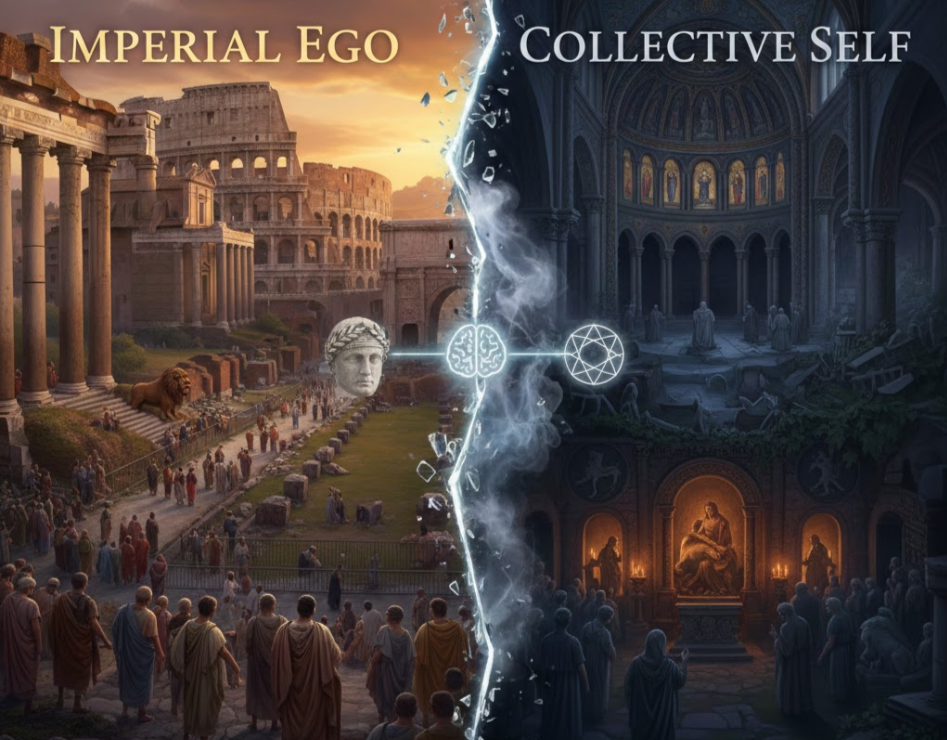
The Ego-Self Axis: The Architecture of Meaning
Edward Edinger, in his seminal work Ego and Archetype, describes the fundamental psychological dynamic governing both individual and collective development: the ego must separate from the unconscious matrix to achieve consciousness, yet it must maintain connection to the Self—the archetype of wholeness and meaning—or risk inflation and subsequent collapse.
This process, which Edinger calls the ego-Self axis, operates not merely at the individual level but manifests in the rise and fall of civilizations themselves. What Rome experienced in its decline, and what we appear to be experiencing now, is the catastrophic severing of this axis on a collective scale—the shattering of what we might call the Imperial Ego and its disconnection from the sustaining archetypal ground of meaning.
Erich Neumann, one of Jung’s most prominent intellectual heirs, establishes in The Origins and History of Consciousness that individual ego consciousness undergoes the exact archetypal stages of development as human collective consciousness throughout history. At the collective level, the emergence of the heroic archetype represents the evolving ego consciousness of a civilization asserting its independence, codifying its laws, and establishing mastery over nature and its neighbors.
However, this necessary separation is inherently fraught with peril. When the collective ego achieves monumental success—as the Roman Republic did in its transition to Empire—it frequently succumbs to what Edinger calls “inflation.” The ego arrogates to itself the qualities of the transcendent Self, believing it is the absolute totality of the psyche, fatally confusing temporal achievements with eternal mandates.
James Hillman critically observes that the Western model of consciousness relies heavily on this “conquering ego” or “imperial ego,” which views the unconscious not as a partner in dialectic but as territory to be dominated. A civilization operating under an inflated Imperial Ego becomes hyper-rational, rigid, and identified entirely with its persona of absolute power. It loses the flexible, life-giving connection to the deeper unconscious forces that originally fueled its ascent—setting the psychological stage for inevitable collapse.
The Imperial Ego: When a Civilization Becomes a Self
The Roman Empire at its height functioned as a vast psychological organism, a collective projection screen upon which millions of individuals could see their own significance reflected and magnified. This wasn’t merely political allegiance or economic interdependence. It was something deeper: what anthropologist Lucien Lévy-Bruhl called participation mystique—an unconscious psychological state where the individual ego merges with a collective identity.
The shopkeeper in the Subura, the farmer in Gaul, the soldier on the Danube frontier—all participated in a shared psychological reality where personal limitation was transcended through identification with imperial greatness. Their individual anxieties, their awareness of mortality, their existential dread—all contained by the larger container of Roma Aeterna.
This Imperial Ego wasn’t an abstraction. It was maintained through concrete psychological mechanisms that we might now recognize as ritual technologies for shadow integration.
The gladiatorial games, for instance, weren’t entertainment in our modern sense. They were profound rituals of death and rebirth, where the collective could witness and master mortality itself. The arena was a temenos—a sacred, psychologically bounded space where chaos could be observed and temporarily mastered. When a gladiator faced death with stoic resolve, every spectator participated in that confrontation with the ultimate shadow. The crowd’s thumbs up or down wasn’t bloodlust but participation in divine judgment.
The Imperial Cult provided another mechanism. When citizens burned incense to the genius of the Emperor, they were actively maintaining the psychological bridge between their personal ego and the transcendent Self as embodied in the state. The Emperor as Pontifex Maximus—literally “greatest bridge-builder”—was the living instantiation of the ego-Self axis. As long as this architecture held, the individual could feel tethered to a divinely ordered cosmos, insulated from the terror of existential randomness.
The Crisis of the Third Century: A Civilizational Nervous Breakdown
What occurred between 235 and 284 CE wasn’t merely political fragmentation or economic collapse. It was a fundamental breakdown of the collective individuation process—what we might diagnose as a civilizational nervous breakdown characterized by massive traumatic dissociation.
The capture of Emperor Valerian by the Persian King Shapur I in 260 CE represents what psychologists would now recognize as a profound narcissistic injury to the collective consciousness. An emperor had never before been captured alive and enslaved. If the Emperor was the bridge between human and divine, his capture meant that bridge had collapsed. The unthinkable had become real: Roma was not eternal, the gods were not protecting the empire, and the entire psychological structure upon which millions had built their identity was revealed as fragile fiction.
The economic dimension carried its own psychological violence. The debasement of the denarius—from nearly pure silver to less than five percent silver content—was not merely inflation. As sociologist Georg Simmel understood, money is “crystallized trust.” When currency collapses, it’s not just purchasing power that evaporates but trust itself—the basic faith that promises will be kept, that effort will be rewarded, that the future has some relationship to the present.
The middle class that formed the backbone of Roman civic life found their savings decimated, their social identities erased, their status as responsible citizens rendered meaningless. This was what Durkheim identified as anomie—the terrifying condition where social norms lose their hold and individuals become disconnected from collective meaning.
The empire literally split apart, with the Gallic Empire breaking away in the West and the Palmyrene Empire in the East. This political fragmentation was an external manifestation of psychological splitting—the dissociative defense mechanism that occurs in severely traumatized individuals who can no longer integrate conflicting realities into a single ego structure.
The Retreat into Mystery Cults: Seeking the Lost Self
As the public sphere collapsed and the Imperial Ego shattered, the Roman populace underwent a massive intrapsychic migration. Unable to find meaning in a civic religion that had become a hollow shell, they turned inward, seeking in the mystery cults what the state could no longer provide: a direct, personal connection to the numinous.
The mystery religions that flourished during this period weren’t merely alternative religious options. They were sophisticated psychological technologies for individual transformation in the absence of collective stability. Each offered what the collapsing empire could not: a structured path of individuation that didn’t depend on external political or economic security.
Mithraism, popular among soldiers, provided a graded hierarchy of spiritual advancement through seven levels. In a world where military merit had devolved into assassination and coup, where a soldier might see five emperors in as many years, Mithraism offered a stable, eternal hierarchy based on spiritual rather than temporal achievement. The underground Mithraea—designed to resemble caves, symbolic wombs of rebirth—provided psychological sanctuary. Here, in the darkness beneath the crumbling empire, initiates encountered the primal drama of light conquering darkness.
The Cult of Cybele and Attis offered something different but equally necessary: emotional catharsis and integration of the feminine. The public Roman religion had been predominantly masculine, focused on order, hierarchy, and control. As that order collapsed, the repressed feminine burst forth in ecstatic rites. This apparent madness was psychologically necessary—a compensation for centuries of rigid masculine control.
The Eleusinian Mysteries, imported from Greece, promised initiates a blessed afterlife through direct experience of continuity beyond death. In a world where collective immortality through the empire was no longer believable, the mysteries offered personal immortality through gnosis.
Christianity ultimately triumphed because it combined elements from all of them while adding a crucial dimension: it historicized the mystery. While Mithras and Osiris were mythical figures whose dramas occurred in illo tempore (mythical time), Christ was claimed to have lived, died, and resurrected in historical time, under Pontius Pilate. This grounding in history while maintaining the mystery structure proved irresistible to a population that needed both transcendent meaning and concrete hope.
The Gnostic Turn: When Reality Becomes Prison
The rise of Gnosticism represents perhaps the most extreme psychological response to the collapse of the Imperial Ego. Gnosticism posited a terrifying thesis: the entire visible world—including the Roman Empire itself—was a prison created by a false god, the Demiurge. The true God existed entirely beyond this corrupted realm. Salvation came not through participation in civic life but solely through gnosis—secret knowledge that revealed the illusory nature of physical reality.
From a Jungian perspective, this represents complete alienation of ego from Self, projected onto cosmological mythology. The ego, traumatized by the collapse of its identifications, declares the entire world to be false. This isn’t escapism—it’s a desperate attempt to preserve some kernel of meaning in the face of overwhelming nihilistic threat.
Cognitive scientist John Vervaeke identifies this as a response to “domicide”—the literal and conceptual destruction of one’s home, leading to profound existential entrapment and the dawn of a “meaning crisis.”
Gnosticism provided initiates with a sense of superiority and recovered agency. They might be powerless against hyperinflation, plague, and barbarian invasion, but they possessed the secret key to reality itself. They knew what others did not: that this world was a trap, and they alone had found the exit.
This Gnostic consciousness didn’t perish with antiquity. It represents a permanent psychological archetype that resurfaces at moments of acute cultural crisis—in the Cathars of medieval France, in Renaissance esotericism, and crucially, in the conspiracy theories of our current moment.
The Gladiator and the Last Man
The transformation of the gladiatorial games during Rome’s decline provides a perfect metaphor for psychological deterioration. In the early empire, gladiatorial combat had been highly ritualized—dangerous but rule-bound encounters that facilitated genuine shadow integration. The crowd’s participation was active and discerning, appreciating skill and courage regardless of victory or defeat.
By the late empire, the games had degenerated into pure spectacle, mass slaughter without meaning. Prisoners were thrown to beasts not as ritual sacrifice but as distraction. The crowd no longer participated in cosmic judgment but merely consumed violence as escape from powerlessness. The arena became what philosopher Jean Baudrillard would later call a “simulacrum”—an image without reference to underlying reality.
This degradation parallels what Nietzsche identified as the emergence of the “Last Man”—the human type that seeks only comfort and distraction, that has lost the capacity for genuine struggle or transcendence. A culture that had defined itself through virtus had been reduced to passive consumption. The very activities that had once maintained the ego-Self axis had become empty performances emphasizing the absence of genuine meaning.
Constantine’s Solution: The Birth of the Therapeutic State
The resolution Constantine provided was not restoration of the old order but its final burial beneath a new psychological paradigm. Constantine didn’t revive the Imperial Ego; he replaced it with what sociologist Philip Rieff would later identify as the “Therapeutic State”—where the government’s primary function was no longer to embody collective greatness but to provide spiritual comfort and salvation.
The adoption of Christianity as state religion was simultaneously a psychological masterstroke and an admission of defeat. The empire could no longer offer glory, expansion, or security—but it could offer salvation. The City of Man had failed, but the City of God remained eternal. The ego-Self axis was reconstituted, but now the Self was located entirely beyond this world, in a transcendent realm that no barbarian could conquer and no economic crisis could devalue.
This represents what Edinger calls the transition from the heroic ego to the religious ego. The heroic ego seeks establishment through conquest and achievement in the external world. When that becomes impossible, the ego must turn inward and upward, seeking connection to the Self through surrender rather than victory.
The Architecture of Decline: From Forum to Basilica
The architectural transformation of this period provides concrete evidence of psychological shift. The Roman Forum—the heart of civic life where citizens gathered for politics and commerce—gradually emptied and fell into ruin. Meanwhile, the Christian basilica emerged as the new center of communal life.
But the basilica was fundamentally different from the forum. Where the forum was open, horizontal, and democratic in spatial arrangement, the basilica was enclosed, vertical, and hierarchical. Its architecture directed attention not outward to fellow citizens but upward to the divine and forward to the altar. The individual entering a basilica was meant to feel small, to experience their ego as insignificant compared to divine majesty. This was architecture designed not to empower the civic ego but to humble it—to create psychological conditions for surrender to a higher power.
The proliferation of monasteries represents the ultimate form of what cultural historian Morris Berman calls “internal emigration”—deliberate withdrawal from a failing society to preserve psychological integrity. The monastery was complete withdrawal from the failed Imperial Ego. Prayer replaced politics. The cultivation of the soul replaced the cultivation of empire.
Yet this withdrawal was also preservation. The monasteries became repositories of classical learning, copying manuscripts that would otherwise have been lost. The monks were like psychological seed banks, preserving cultural DNA for a future renaissance they could not imagine but somehow intuited would come.
Cyclical Theories of Civilizational Decay
The depth-psychological trajectory proposed by Edinger aligns intimately with cyclical theories of history developed by prominent twentieth-century thinkers:
Oswald Spengler in The Decline of the West argued that civilizations possess organic lifecycles. He delineated a fatal transition from Kultur (a spiritually vital, creative phase) to Zivilisation (a hyper-rational, materialistic, sterile phase). Once a society reaches the Zivilisation stage, its “soul” is exhausted and irreversible decline is guaranteed.
Arnold Toynbee in A Study of History proposed the “Challenge-and-Response” model. Civilizations rise when a “creative minority” successfully responds to challenges. Over time, this group ossifies into a “dominant minority” relying on force rather than inspiration, alienating the masses and creating internal and external “proletariats” leading to a “Time of Troubles.”
Pitirim Sorokin in Social and Cultural Dynamics argued that civilizations fluctuate between dominant “cultural mentalities”—the Ideational (perceiving reality as spiritual) and the Sensate (perceiving reality as purely material). Decadent, overly Sensate cultures inevitably collapse under the weight of their own materialism.
These frameworks collectively assert that a civilization is not merely an aggregation of economic transactions but a shared “cultural mentality” or integrated psychological organism. For Spengler, Rome represented the sterile Zivilisation phase of earlier Greek Kultur. For Toynbee, Rome was a “Universal State” erected by a rigid dominant minority desperately attempting to arrest decay.
Modern Parallels: The Return of the Repressed
The psychological trajectory of Rome provides a chillingly accurate diagnostic mirror for contemporary Western civilization.
Like its Roman predecessor, the modern Western (and specifically American) Imperial Ego was constructed upon perpetual expansion—territorial, economic, technological. The closing of frontiers and the realization of planetary limits have induced an identical crisis: what happens to a collective identity built on indefinite growth when growth becomes impossible?
John Vervaeke identifies our current epoch as suffering from a profound “Meaning Crisis,” historically and psychologically analogous to the domicide of late Rome. Modernity—driven by the scientific revolution, secularization, and postmodern deconstruction—has systematically dismantled what Augustine built: the sacred canopy providing coherence, significance, and purpose. Modern ideologies attempt to generate meaning through propositional beliefs, but meaning is fundamentally participatory. A civilization cannot simply think its way out of a meaning crisis.
The retreat into what we might call “digital mystery cults” follows exactly the Roman pattern. QAnon functions precisely like ancient Gnosticism, offering initiates secret knowledge about malevolent powers controlling the world. The Demiurge has been updated to the Deep State, but the psychological function remains identical: providing agency and understanding in a world that feels chaotic and hostile.
Our entertainment mirrors the degradation of the Roman arena. Superhero cinema and hyper-realistic video games function as modern simulacra of gladiatorial games—but representing an even deeper dissociation. Where Romans watched actual humans confront actual death, we watch CGI gods battle CGI monsters in conflicts where death is always reversible and stakes are purely abstract. It’s a double dissociation, removing the modern ego entirely from physical limitation, mortality, and genuine shadow integration.
The pervasive culture of ideological purity testing, public shaming, and “cancellation” functions as modern secularized excommunication—maintaining group purity in the exact manner of early traumatized Christian communities protecting themselves from the contaminating pagan shadow.
What This Means for Therapy
Understanding these historical patterns transforms clinical work.
When patients present with what looks like depression or anxiety but feels more like existential untethering, I’m now seeing something the Romans would recognize: the severing of the ego-Self axis, the collapse of the psychological architecture that once provided meaning. The symptoms aren’t pathology in the traditional sense—they’re accurate perceptions of a genuine cultural crisis.
This has several clinical implications:
First, symptom reduction alone isn’t sufficient. The modern meaning crisis requires what Vervaeke calls “relevance realization”—helping patients develop practices that reconnect them to the deeper Self, practices that function as modern equivalents of mystery initiations. This is why approaches like Brainspotting, Jungian analysis, and somatic therapy often work where traditional CBT fails: they access the sub-propositional, participatory dimensions of meaning that cognitive approaches cannot reach.
Second, the Gnostic temptation is always present. When collective meaning collapses, the psyche naturally gravitates toward conspiracy theories and elaborate alternative realities. Understanding this as a predictable trauma response—not stupidity or moral failure—allows for more compassionate intervention. The patient drawn to QAnon or cult-like thinking is attempting to solve a genuine problem: the unbearable absence of meaning.
Third, ritual matters. The Romans understood that psychological integration requires structured, embodied practice—not just insight. Modern therapy that ignores the ritualistic dimension is attempting to heal without one of the most powerful tools available. This is why I’ve integrated practices that might seem unconventional—qEEG brain mapping, structured somatic interventions, attention to the architecture of therapeutic space.
Fourth, the goal isn’t restoration of the old order. Rome couldn’t revive the Imperial Ego; it had to transform into something new. Similarly, therapy for the meaning crisis isn’t about returning patients to pre-crisis functioning. It’s about helping them develop what Jung called the transcendent function—the ability to hold opposites in tension until a new synthesis emerges.
The Individuation of Civilizations
From a Jungian perspective, civilizational collapse may be a structural psychological necessity for renewal of collective consciousness. The ego, whether individual or collective, tends toward rigidity over time. It builds defenses against change, creates elaborate justifications for its limitations, and loses connection to the creative unconscious. Sometimes only complete breakdown can create conditions for genuine transformation.
The alchemists, whom Jung studied extensively, understood this through the formula solve et coagula—dissolve and coagulate. The old form must be completely dissolved before the new form can crystallize. The Roman Imperial Ego had to be shattered for medieval Christendom to be born.
Rome’s failure to achieve healthy integration resulted from specific psychological rigidities. The Roman ego was too identified with power, too dependent on expansion, too attached to its self-image as eternal. When these identifications proved false, it had no psychological resources for transformation. The mystery cults and Christianity offered individual salvation but not collective renewal. They were symptoms of the failure, not solutions to it.
A successful civilizational individuation would require maintaining creative tension between ego and Self, between conscious achievement and unconscious wisdom, between progress and tradition. This is precisely what our current civilization seems unable to achieve, splitting instead into polarized extremes that mirror each other’s shadow projections.
The Mirror and the Lamp
The image haunting this entire analysis is the shattered mirror—the Imperial Ego that can no longer reflect back to its citizens a coherent image of themselves. But perhaps the problem was always the mirror itself, the dependence on external reflection for identity.
What if civilizational maturity means moving from mirror to lamp—from seeking identity in reflection to generating it from within?
The mystery cults intuited this but located the inner light in transcendent realms beyond this world. Modern depth psychology suggests the light exists within the psyche itself, in the Self that transcends but includes the ego.
This is what I’m ultimately working toward with patients: not dependence on external validation or cultural containers that will inevitably fail, but development of an internal locus of meaning that can survive collective dissolution. Not rugged individualism—which is just another form of ego inflation—but what we might call psychological democracy: individuals who have done enough inner work to contribute consciously to collective life rather than simply projecting their shadows onto it.
The Roman watching the last gladiatorial games, sensing but not understanding that an entire world was ending, could only suffer blindly through the transformation. We have the possibility of suffering consciously—of understanding our symptoms as symbols, our collapse as potential transformation.
The mirror is shattered. Perhaps it needed to shatter. Perhaps only in the fragments can we begin to see not our idealized reflection but our actual face—scarred and beautiful, ancient and new, dying and being born. Perhaps the real transformation begins not when we restore the mirror but when we realize we no longer need it, that we have become, each of us and all of us together, our own source of light.
Joel Blackstock, LICSW-S, is the Clinical Director of Taproot Therapy Collective in Birmingham, Alabama. He specializes in complex trauma treatment using qEEG brain mapping, Brainspotting, Jungian analysis, and somatic approaches.
References
- Edinger, E. F. (1972). Ego and Archetype: Individuation and the Religious Function of the Psyche. Shambhala.
- Neumann, E. (1954). The Origins and History of Consciousness. Princeton University Press.
- Vervaeke, J. (2019). Awakening from the Meaning Crisis. YouTube Lecture Series.
- Rieff, P. (1966). The Triumph of the Therapeutic. Harper & Row.
- Toynbee, A. (1934-1961). A Study of History. Oxford University Press.
- Spengler, O. (1918-1922). The Decline of the West. Alfred A. Knopf.
- Sorokin, P. (1937-1941). Social and Cultural Dynamics. American Book Company.
- Jung, C. G. (1951). Aion: Researches into the Phenomenology of the Self. Princeton University Press.
- Berman, M. (2000). The Twilight of American Culture. W.W. Norton.
- Hillman, J. (1975). Re-Visioning Psychology. Harper & Row.












0 Comments