
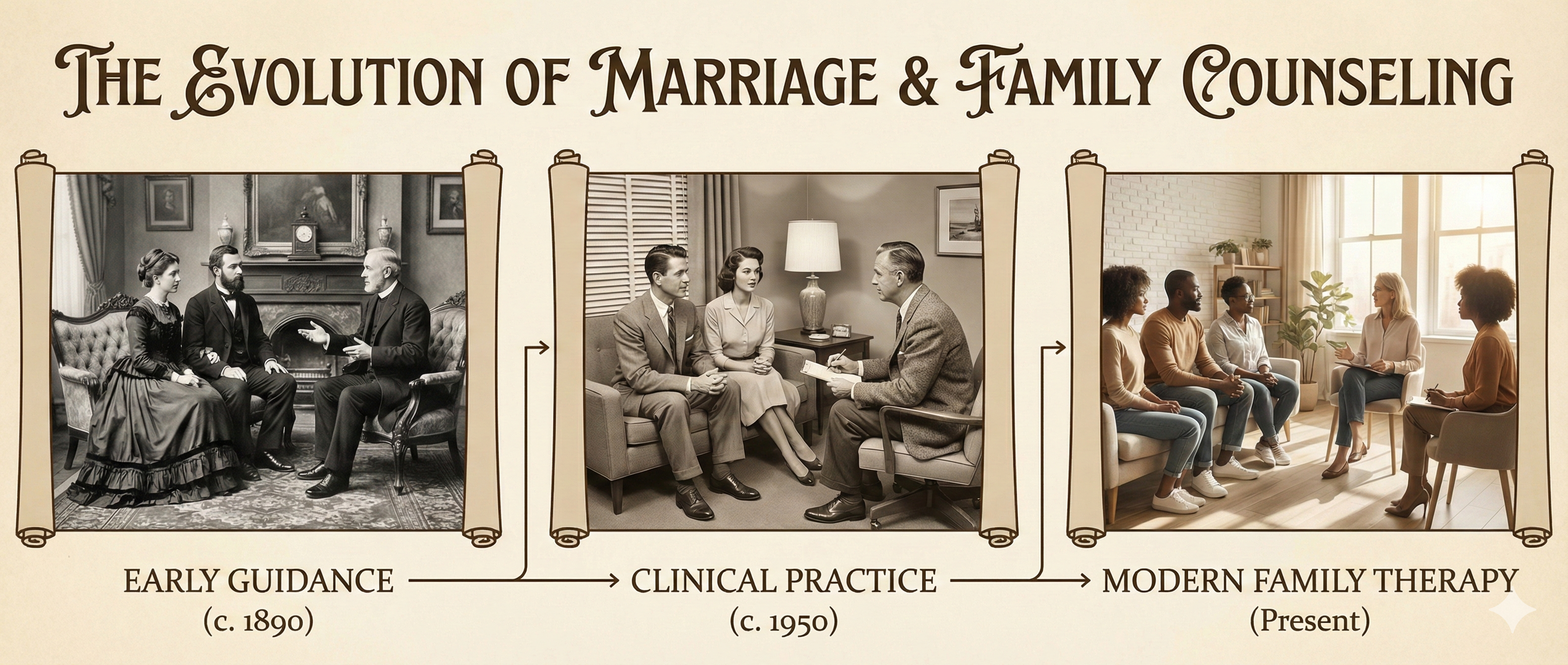
Comprehensive Analysis of Family Systems Theory and Practice: Schools, Evolution, and Clinical Efficacy
The emergence of family therapy represented a seismic epistemological shift in the mental health sciences—a departure from the monadic, intrapsychic view of human distress that had dominated psychiatry since Freud.
1. The Systemic Paradigm Shift
The emergence of family therapy in the mid-20th century represented a seismic epistemological shift in the mental health sciences, marking a departure from the monadic, intrapsychic view of human distress that had dominated psychiatry and psychology since Freud. Rather than conceptualizing pathology as residing solely within the individual—mediated by internal conflicts, defense mechanisms, or neurochemical imbalances—the systemic paradigm posits that psychological symptoms are frequently maintained, and sometimes generated, by the interactional patterns of the family unit.
This “systems thinking” drew heavily from cybernetics, anthropology, and general systems theory, fundamentally reframing the “identified patient” (IP) not as the sole locus of the problem but as the symptom-bearer for a dysregulated system.
The evolution of this field is not merely a collection of techniques but a history of shifting worldviews regarding the nature of reality, causality, and change. To understand the major schools of family therapy—from the structural architects of the 1960s to the narrative co-authors of the 1990s—one must first grapple with the underlying assumptions that differentiate them.
1.1 First-Order Cybernetics: The Observed System
In the foundational years of the field (1950s–1970s), early models such as Structural and Strategic therapy operated under the epistemology of First-Order Cybernetics. Influenced by the Macy Conferences and the work of Norbert Wiener, early theorists viewed the family as a homeostatic machine governed by feedback loops. The core assumption was that families seek stability (morphostasis) and will utilize symptomatic behavior to prevent change.
In this paradigm, the therapist was conceptualized as an objective expert observing the system from the outside—akin to a mechanic diagnosing an engine. The therapist’s role was to act upon the system, utilizing power and expertise to alter its structure or interrupt dysfunctional feedback loops.
1.2 Second-Order Cybernetics: The Observing System
As the field matured into the late 1970s and 1980s, influenced heavily by Gregory Bateson and the evolution of the Milan School, a shift occurred toward Second-Order Cybernetics. This epistemological leap challenged the notion of objectivity. It posited that the therapist cannot be an external observer because their presence, biases, and interventions inevitably perturb the system they are observing.
The system is no longer just the family; it is the “therapeutic system,” encompassing the family plus the therapist. This shifted the clinical focus from “fixing” the family to “perturbing” the system to find its own new organization.
1.3 Social Constructionism: The Linguistic Turn
The postmodern turn of the 1980s and 90s, exemplified by Narrative and Solution-Focused therapies, moved away from biological and mechanical metaphors entirely. Instead, it embraced a linguistic and hermeneutic metaphor: reality is socially constructed through language, stories, and cultural discourses. Pathology was re-envisioned not as a functional error in the system’s machinery but as a result of “problem-saturated stories” or dominant social discourses that marginalize the client’s lived experience.
2. Transgenerational Models: Bowen Family Systems Theory
Developed by Dr. Murray Bowen, a psychiatrist who initially researched schizophrenia, Bowen Family Systems Theory stands distinct among the major schools for its emphasis on history, biology, and the “emotional unit” of the family spanning multiple generations. Unlike strategic or structural models that focus intensely on “here-and-now” interaction, Bowen theory posits that the past is actively alive in the present.
2.1 Core Concepts
Bowen theory assumes that the fundamental human dilemma is the balancing act between two life forces: togetherness (the biological drive to connect) and individuality (the drive to be an autonomous self). Families differ in their ability to handle anxiety, which Bowen defined as an infectious emotional process that binds members together.
The Nuclear Family Emotional System: When tension rises, the system attempts to stabilize itself using four primary mechanisms:
Emotional Distance: Members withdraw from each other to reduce intensity.
Marital Conflict: The anxiety is absorbed in the conflict between spouses.
Dysfunction in One Spouse: One partner over-functions while the other under-functions, absorbing the system’s anxiety.
Impairment of a Child (Family Projection Process): Parents transmit their anxiety to the most susceptible child, focusing their worry on them. The child becomes “symptomatic,” which paradoxically calms the parents’ relationship.
Differentiation of Self: This is the cornerstone concept of the model. It refers to an individual’s capacity to separate their own intellectual and emotional functioning from that of the family group.
Intrapsychic Differentiation: The ability to distinguish thoughts from feelings. A differentiated person can choose to act on principle rather than emotional reactivity.
Interpersonal Differentiation: The ability to maintain autonomy while remaining emotionally connected to the group. A poorly differentiated person is “fused” with the family emotional mass, making them highly reactive to others’ approval or disapproval.
Triangulation: Bowen asserted that the dyad (two-person relationship) is inherently unstable under stress. When anxiety rises between two people, they inevitably “triangle in” a third party (a child, an affair, a job, a substance, or even a therapist) to stabilize the relationship. While this reduces immediate tension, it freezes the conflict in place and prevents resolution.
Multigenerational Transmission Process: Levels of differentiation are transmitted across generations. People tend to marry partners with similar levels of differentiation. Over several generations, this downward spiral can result in severe pathology appearing in a descendant who has the lowest level of differentiation in the lineage. This concept connects deeply to intergenerational trauma patterns.
2.2 Techniques
The Therapist’s Stance (Neutrality/Coaching): The therapist acts as a “coach” or researcher, helping the client observe their own role in the family system. By maintaining a neutral, non-anxious presence, the therapist models differentiation.
Genograms: The primary assessment and intervention tool is the detailed mapping of the family tree (typically three generations). The genogram allows the family to track patterns of illness, conflict, cutoff, and triangulation, transforming “personal” problems into systemic patterns.
De-triangulation: The therapist coaches individual members to communicate directly with others without triangulating third parties.
“I” Positions: Interventions focus on encouraging clients to speak from their own perspective (“I think,” “I feel,” “I believe”) rather than reacting to what others do or blaming.
2.3 Critique
The model has been criticized for being overly intellectual and potentially detached. Its emphasis on “rationality” over “emotional reactivity” has been critiqued by feminist scholars for potentially devaluing emotional expression. Furthermore, asking a client to “differentiate” in a family system characterized by abuse or severe power imbalances can be dangerous without first establishing safety.
3. The Structural School: Architecture of the Family
Developed by Salvador Minuchin in the 1960s, primarily through his work with delinquent boys at the Wiltwyck School and later with psychosomatic families in Philadelphia, Structural Family Therapy (SFT) focuses on the organization of the family unit. It is arguably the most influential model for working with chaotic, multi-problem families.
3.1 Core Concepts
SFT operates on the premise that a family’s well-being depends on the integrity of its organizational structure. Symptoms are viewed as a sign that the family’s structure is maladaptive to current demands.
Boundaries: The most famous concept in SFT. Boundaries regulate the flow of information and contact between family members:
Diffuse Boundaries (Enmeshment): Boundaries are too porous; family members are over-involved in each other’s lives. Autonomy is compromised. This structure is typical of psychosomatic families (e.g., anorexia).
Rigid Boundaries (Disengagement): Boundaries are too impermeable; family members are isolated and unsupported. This structure is often seen in families with delinquent youth.
Clear Boundaries: The ideal state, allowing for both autonomy and connection.
Subsystems and Hierarchy: Families are differentiated into subsystems (spousal, parental, sibling) that must perform specific functions. A healthy system requires a functional hierarchy where parents hold authority and protect the spousal boundary from the children. Pathology arises when these hierarchies are inverted (e.g., a “parentified” child taking care of an incompetent parent) or when cross-generational coalitions occur.
3.2 Techniques
Joining and Accommodating: Before challenging the structure, the therapist must build a strong alliance by “joining” the family’s culture, language, and style (mimesis). This creates the leverage necessary for confrontation.
Enactment: This is the signature technique of SFT. Instead of letting the family tell the therapist about a problem, the therapist asks the family to show the problem by interacting with each other in the session. The therapist then intervenes in the live transaction to modify the pattern.
Unbalancing: The therapist may temporarily join one subsystem or individual (e.g., supporting a disempowered father against a dominant mother and child) to unsettle a rigid stalemate and force the system to reorganize.
Boundary Making: The therapist physically or verbally separates members to strengthen appropriate boundaries. This might involve changing the seating arrangement or blocking interruptions.
3.3 Clinical Applications
SFT is famously effective for psychosomatic disorders (anorexia, asthma, diabetes) where enmeshment exacerbates physical illness. Research demonstrated that changing family interactions could directly impact physiological markers in diabetic children.
SFT is also the theoretical foundation for Brief Strategic Family Therapy (BSFT) and Multisystemic Therapy (MST), which apply structural concepts of parental hierarchy to treating conduct disorder and substance abuse.
4. The Strategic School: Problem-Solving, Paradox, and Power
Influenced by the hypnotic techniques of Milton Erickson and the cybernetic theories of the Palo Alto Mental Research Institute (MRI), Strategic Family Therapy is pragmatic, brief, and solely focused on symptom resolution.
4.1 Core Assumptions
Strategic therapy assumes that problems are maintained by the very solutions the family uses to try to solve them. This concept, derived from the “Double Bind” theory of Gregory Bateson, suggests that families get stuck in recursive feedback loops.
The Symptom as Function: Symptoms are often viewed as communicative acts or metaphors for a systemic problem. For example, a child’s misbehavior might function to distract parents from their marital conflict, effectively “protecting” the family unit.
Positive Feedback Loops: Problems are maintained by “more of the same” solutions. A parent nagging a withdrawing child causes more withdrawal, which causes more nagging. Change requires interrupting this loop.
4.2 Techniques
Prescribing the Symptom (Paradox): The therapist instructs the client to perform the symptomatic behavior (e.g., “I want you to schedule a time to worry for 30 minutes every night”). This places the client in a therapeutic double bind: if they comply, they are voluntarily controlling the “uncontrollable” symptom; if they refuse, they stop the symptom.
Ordeals: Making the symptom harder to keep than to give up (e.g., “Every time you have an insomnia episode, you must wax the kitchen floor”).
Reframing: Changing the meaning of a behavior to alter the emotional response. For example, relabeling an adolescent’s “rebellion” as “trying to help his parents learn to be stricter.”
Restraining: Telling the family to go slow or warning them of the “dangers of improvement,” which utilizes their resistance to prove the therapist wrong by improving faster.
5. The Milan Systemic School: From Strategic Paradox to Curiosity
The Milan School (founded by Mara Selvini-Palazzoli, Luigi Boscolo, Gianfranco Cecchin, and Giuliana Prata) represents the most sophisticated application of cybernetics to family therapy. It is distinct in its intellectual rigor and its evolution from a strategic, power-based model to a collaborative, linguistic model.
5.1 Early Milan: The Strategic Phase (1970s)
Initially, the Milan associates focused on “family games”—complex, often secretive interactional patterns that maintained severe pathology like schizophrenia and anorexia. Their approach was highly strategic, using a team behind a one-way mirror.
Positive Connotation: Unlike simple reframing, positive connotation ascribes a positive motive to all behaviors in the system, including the symptom. The symptom is framed as a noble sacrifice to preserve family stability.
The Invariable Prescription: A specific intervention for families with schizophrenic or anorectic members. The parents are instructed to secretly go out together for increasing periods, keeping their whereabouts mysterious from the child. This technique aims to break cross-generational coalitions and restore the parental boundary.
5.2 Post-Milan and the Second-Order Shift (1980s)
In the 1980s, the team split. Boscolo and Cecchin moved toward second-order cybernetics, emphasizing the therapist’s curiosity over control.
Hypothesizing: The team creates a systemic hypothesis before the session—not a “truth” about the family but a starting point for inquiry.
Circular Questioning: This is the signature technique. Instead of asking linear questions (“Why are you depressed?”), the therapist asks questions that highlight differences and relationships (e.g., “Who gets more upset when Mom cries, Dad or your brother?” or “If your son were to leave home, who would miss him the most?”). This technique itself is the intervention, as it forces the family to see new connections.
Neutrality (later Curiosity): The therapist avoids taking sides. In the later model, Cecchin revised “neutrality” to “curiosity”—an aesthetically engaged stance of exploring multiple perspectives without attachment to a specific outcome.
6. Experiential and Humanistic Models
Led by Virginia Satir and Carl Whitaker, these models emphasize emotional expression, authenticity, and the “use of self” by the therapist. They assume that humans are naturally growth-oriented but become blocked by fear, suppression of affect, and rigid rules.
6.1 Satir’s Human Validation Process Model
Virginia Satir, often called the “mother of family therapy,” focused on self-worth and communication. She identified four defensive communication stances:
Placater: Acts as a pleaser, apologizing, never disagreeing.
Blamer: Acts self-righteously, accusing others.
Computer: Emotionally detached, hyper-rational.
Distracter: Unfocused, changing the subject to avoid conflict.
The goal of therapy is Congruence, where internal feelings, words, and actions align. Satir used highly active techniques like Family Sculpting, where family members physically arrange each other in poses to represent emotional closeness, power, and distance. This non-verbal technique bypasses intellectual defenses and reveals the emotional truth of the system.
6.2 Whitaker’s Symbolic-Experiential Therapy
Carl Whitaker believed that the therapist must be fully present and even “crazy” to help the family break out of their emotional deadness. He focused on the symbolic meaning of experience rather than symptom reduction.
The Battle for Structure vs. Initiative: Whitaker argued the therapist must win the battle for structure (setting the rules of therapy) so the family can win the battle for initiative (deciding what to change).
Use of Countertransference: Whitaker used his own boredom, anger, or fantasies as therapeutic tools, sharing them with the family to provoke a reaction and increase emotional intensity.
6.3 Modern Evolution: Emotionally Focused Therapy (EFT)
While pure experiential therapy is less common today, its legacy lives on in Emotionally Focused Therapy (EFT), developed by Sue Johnson. EFT integrates experiential techniques (accessing deep emotion) with Attachment Theory.
It views family distress as a result of insecure attachment bonds and negative cycles of interaction (e.g., pursue/withdraw). The therapist helps the family access vulnerable emotions (fear of abandonment) to restructure interactions and create “safe haven” bonding events. EFT currently has the strongest evidence base for couples therapy.
7. The Postmodern Turn: Narrative and Solution-Focused Therapies
The 1980s and 90s saw a rejection of the “mechanistic” view of families in favor of a “meaning-making” view. These models are termed Social Constructionist.
7.1 Narrative Therapy (White & Epston)
Narrative therapy asserts that identity is formed by the stories people tell about themselves. Problems arise when people internalize “dominant discourses” (e.g., sexism, racism, medical labels) that do not fit their lived experience.
Externalization: The mantra of Narrative therapy is “The person is not the problem; the problem is the problem.” The therapist separates the client from the symptom linguistically (e.g., “How long has ‘The Anorexia’ been lying to you?” or “When does ‘The Temper’ try to take over?”). This reduces shame and allows the family to unite against the problem.
Unique Outcomes (Sparkling Moments): The therapist listens for moments when the problem did not dominate. These moments serve as the foundation for a new, preferred story.
Re-Authoring: The goal is to help the family “re-write” their narrative to highlight their agency, values, and commitments.
Critique: Narrative therapy is highly effective for trauma and effects of oppression. However, it is critiqued for potentially ignoring biological drivers of illness if applied too rigidly.
7.2 Solution-Focused Brief Therapy (SFBT)
SFBT (de Shazer & Berg) operates on the assumption that knowing the cause of a problem is unnecessary to solve it. It focuses entirely on the “solution” and the future.
The Miracle Question: “Suppose tonight, while you slept, a miracle occurred and the problem was gone. When you awake, what would be the first small thing you would notice that would tell you the miracle happened?” This technique bypasses problem-talk and helps the client visualize the goal state.
Scaling Questions: “On a scale of 1-10, where 10 is the miracle, where are you now?”
Exceptions: “Tell me about a time the problem wasn’t happening.”
Critique: SFBT is highly effective for specific behavioral problems and in managed care settings due to its brevity. However, it is often criticized as “superficial” or invalidating for clients with deep trauma who need their pain witnessed before moving to solutions.
8. Integrative and Evidence-Based Models
Current “best practice” in family therapy has largely moved toward integrative models tailored for specific diagnoses. These represent the merging of historical schools with behavioral techniques and ecological systems theory.
8.1 Multisystemic Therapy (MST) & Functional Family Therapy (FFT)
These are the gold standards for juvenile delinquency, conduct disorder, and substance abuse.
Multisystemic Therapy (MST):
Origins: Merges Structural/Strategic family therapy with Bronfenbrenner’s social-ecological theory.
Mechanism: It assumes that “bad behavior” is driven by the intersection of family, peer, school, and community systems. Interventions are intensive and home-based (therapists often available 24/7). The therapist works to empower parents to disengage youth from deviant peers and improve school performance.
Evidence: Extensive meta-analyses show MST significantly reduces out-of-home placement and recidivism compared to individual therapy.
Functional Family Therapy (FFT):
Origins: Combines systems theory with behavioral parent training.
Mechanism: FFT focuses on the relational function of the behavior (what interpersonal need does the delinquency meet?) before moving to behavioral change. It proceeds in distinct phases: Engagement/Motivation (reducing blame/reframing), Behavior Change (parenting skills), and Generalization.
8.2 Family-Based Treatment (FBT) for Eating Disorders
Also known as the Maudsley Method, FBT is an integration of Structural and Strategic concepts specifically for anorexia nervosa.
Assumption: The parents are not the cause of the disorder but are the best resource for recovery. The illness is externalized (Narrative influence) as a force taking over the child.
Phase 1: Parents are placed in full charge of re-feeding the child, temporarily suspending the adolescent’s autonomy over food. This restores the Structural hierarchy regarding health and safety.
Phase 2: Control is gradually handed back to the adolescent as weight is restored.
Evidence: It is the leading evidence-based treatment for adolescent anorexia, showing superior outcomes to individual therapy.
8.3 Psychoeducational Family Intervention for Schizophrenia
Moving away from the “mother-blaming” of early theories (e.g., the “schizophrenogenic mother”), current models focus on Expressed Emotion (EE).
Theory: High levels of criticism, hostility, or emotional over-involvement (High EE) in the family are robust predictors of relapse in schizophrenia.
Intervention: This model combines education about the illness (acknowledging the biological reality), stress management, and problem-solving training. It does not try to “cure” the schizophrenia systemically but to manage the environment to prevent relapse.
Evidence: Meta-analyses confirm that family psychoeducation reduces relapse rates by over 20% compared to medication alone.
9. Comparative Analysis: Table of Major Schools
| Feature | Structural / Strategic | Bowenian | Milan / Narrative | Solution-Focused |
|---|---|---|---|---|
| Primary Assumption | Structure dictates function; failed solutions maintain problems | Anxiety spreads in systems; past dictates present via multigenerational transmission | Reality is constructed via language; problems are external dominant discourses | Change is inevitable; focus on solutions/future, not problems |
| Role of Therapist | Expert, Director, Choreographer | Coach, Neutral Observer | Co-author, Curious Inquirer | Cheerleader, Co-constructor |
| Time Orientation | Present (Here-and-Now) | Past & Present (Multi-generational) | Present & Future (Re-writing history) | Future (Miracle Question) |
| View of Pathology | Dysfunctional structure or feedback loop | Lack of differentiation; emotional fusion | Problem-saturated story; oppression | Stuckness in “problem-talk” |
| Key Techniques | Enactment, Unbalancing, Paradox | Genograms, I-positions, De-triangulation | Circular Questioning, Externalization | Scaling, Miracle Question |
| Best For | Conduct disorders, Psychosomatic families, Crisis | High-functioning families, Intergenerational patterns | Trauma, Identity issues, Oppression | Goal-oriented behavioral change |
10. Outdated Concepts vs. Best Practices
The field has matured by discarding theories that were scientifically invalid or ethically problematic.
10.1 Outdated and Rejected Concepts
Linear Causality & Blame: The idea that parents “cause” schizophrenia, autism, or homosexuality (e.g., the “schizophrenogenic mother” or “refrigerator mother”) has been thoroughly debunked by biological and genetic research. Holding such views is now considered unethical.
Rigid Neutrality in Abuse: The early Milan/Systemic idea that a therapist must remain neutral in all cases is now seen as dangerous in cases of Domestic Violence or child abuse. “Neutrality” in the face of violence is viewed as collusion with the perpetrator.
The “Black Box” Metaphor: The early cybernetic view of the family where internal psychological states were irrelevant has been replaced by a Bio-Psycho-Social perspective that integrates individual psychology and biology with the system.
10.2 Current Best Practices
Cultural Safety & The “Social Graces”: Modern therapy must account for Gender, Race, Age, Class, Ethnicity, Sexuality. Acknowledging power differentials in society and the therapy room is crucial.
Evidence-Based Adaptation: Using manualized adaptations like MST, FBT, or FFT for specific high-risk disorders rather than applying a generic “family therapy” model to every case.
The “Both/And” Perspective: Integrating biological realities (medication for ADHD/Bipolar) with systemic understanding, rather than seeing them as mutually exclusive.
11. Clinical Indications and Contraindications
11.1 Superior Efficacy (What Works Best)
Behavioral Problems (ODD, Conduct Disorder): Structural, Strategic, MST, FFT. These models provide the containment, supervision, and hierarchy restoration needed to manage impulsive behavior.
Eating Disorders (Anorexia/Bulimia in Adolescents): Family-Based Treatment (FBT). The evidence is overwhelming that family control of re-feeding is superior to individual therapy.
Schizophrenia / Bipolar Disorder: Psychoeducational Family Intervention. Crucial adjunctive treatments to medication, proven to reduce relapse.
Trauma / Effects of Abuse: Narrative Therapy and trauma-focused approaches. Externalization helps survivors separate their identity from the abuse.
Marital Distress: Emotionally Focused Therapy (EFT). Addresses the attachment root of conflict more effectively than behavioral negotiation.
11.2 Contraindications (What to Avoid)
Active Domestic Violence (IPV): Conjoint family or couples therapy is generally contraindicated when there is ongoing, unmanaged intimate partner violence. Safety planning and individual treatment are the priority until safety is established.
Unmanaged Psychosis / Acute Mania: While family therapy helps management, attempting deep systemic restructuring during an acute psychotic break is ineffective and potentially harmful. Stabilization (often medical) is the priority.
Severe Paranoia: Highly distinct insight-oriented models may be too stimulating or perceived as threatening by individuals with paranoid ideation. Supportive, transparent, and psychoeducational approaches are better suited.
12. The Integration Imperative
The field of family therapy has traversed a long arc from the mechanistic confidence of the 1950s—where therapists acted as engineers fixing broken family structures—to the collaborative humility of the 21st century. The major schools (Structural, Strategic, Bowenian, Milan, Experiential, Narrative, SFBT) have not merely competed; they have cross-pollinated. The rigid “school wars” of the past have largely dissolved into a landscape of integration and evidence-based specificity.
Today, a skilled family therapist does not rigidly adhere to one dogma. Instead, they might utilize Structural containment for an out-of-control adolescent, switch to Narrative externalization when discussing the youth’s trauma, employ Psychoeducation to help the family understand ADHD, and use Bowenian self-reflection to help the parents manage their own anxiety during the process.
The therapist is no longer just a cybernetic mechanic, but a culturally attuned, scientifically informed partner in the family’s evolution.
Key Takeaways
Structure matters for behavior: For externalizing disorders (conduct, substance abuse), restoring parental hierarchy is the active ingredient of change.
Meaning matters for identity: For internalizing disorders (depression, trauma), Narrative and Attachment approaches that reshape the self-story are superior.
Context is Queen: No model works in a vacuum; successful therapy must address power dynamics and the family’s wider ecological context.
Biology is a partner, not a villain: The field has successfully moved from blaming families for mental illness to partnering with them to manage biological vulnerabilities.
As clinicians who inherit these diverse traditions, we hold the tools of each school. Every time we build Rogerian alliance while tracking somatic responses, every time we honor intergenerational patterns while maintaining empirical humility, we embody the integration that the field has earned through decades of conflict and synthesis.
















0 Comments