

Why you’re exhausted but still working—and what your nervous system is trying to tell you
You’re getting the work done. The laundry gets folded. The emails get answered. The kids get fed. From the outside, everything looks fine—maybe even impressive. But something feels deeply wrong.
You move through your days with a strange heaviness, like you’re watching yourself from behind glass. You’re present enough to check boxes, but not present enough to feel anything. Your body keeps showing up to life while your soul seems to have quietly checked out.
If this describes you, you may be experiencing what therapists and social media alike are now calling functional freeze—a state that reveals one of the most profound failures of how modern medicine understands trauma.
The Productivity Paradox: When “Fine” Is a Survival Strategy
Functional freeze describes a paradox that the biomedical model of mental health has largely failed to recognize: the person who appears highly productive while being profoundly dissociated. You’re not lying in bed unable to move—that would be visible, diagnosable, something the DSM-5 could code and insurance could cover. Instead, you’re performing functionality while your nervous system has essentially gone offline.
This is not laziness wearing a mask. It is not depression’s “lesser cousin.” Functional freeze is a sophisticated survival adaptation that keeps your body going to work while protecting your psyche from overwhelm. It is, in the language of polyvagal theory, a blended autonomic state—part dorsal vagal shutdown, part sympathetic mobilization—that allows you to drive with the parking brake on.
The person in functional freeze often reports:
- Feeling like they’re “going through the motions”
- Completing tasks without remembering doing them
- A pervasive sense of numbness or flatness
- Physical exhaustion disproportionate to activity level
- Difficulty accessing emotions, especially positive ones
- A nagging sense that “something is wrong with me”
- Getting everything done but feeling no satisfaction from it
What makes this state so insidious is that it often looks like success. The functional freeze response can sustain high achievement for years—even decades—before the system finally collapses.
What the Biomedical Model Gets Wrong
Walk into most psychiatrists’ offices with functional freeze and you’ll likely walk out with a prescription. The symptom checklist points toward depression, perhaps with an anxiety comorbidity. Here’s your SSRI; here’s your benzodiazepine for acute episodes. Come back in six weeks.
This approach fundamentally misunderstands what is happening in the body.
Functional freeze is not primarily a chemical imbalance. It is a physiological state—a specific configuration of the autonomic nervous system that cannot be talked out of, thought out of, or medicated out of in isolation. The problem isn’t serotonin. The problem is that your nervous system learned to sacrifice presence for survival, and it has forgotten how to come back.
The biomedical model’s focus on symptoms divorced from their somatic context means that millions of people receive treatment for the effects of nervous system dysregulation without ever addressing the dysregulation itself. It’s like treating the smoke alarm while ignoring the fire.
Dr. Stephen Porges, the neuroscientist who developed Polyvagal Theory, describes this hierarchical organization of our stress responses in his 2025 paper published in Clinical Neuropsychiatry:
“Flexible movement between autonomic states is lost, and individuals may oscillate between sympathetic mobilization and dorsal vagal shutdown without reliable access to the VVC [ventral vagal complex]. This pattern underlies clinical conditions such as post-traumatic stress disorder (PTSD), generalized anxiety disorder, depression, and borderline personality disorder.”
What Porges describes is the neurophysiological mechanism underlying functional freeze. The ventral vagal complex—the evolutionarily newest part of our autonomic nervous system that enables social engagement, calm presence, and the feeling of safety—becomes inaccessible. The person becomes stuck oscillating between anxious mobilization (which keeps them productive) and dorsal shutdown (which makes them feel dead inside).
The Nervous System’s Wisdom: Why You Froze in the First Place
Before we go further, let’s be clear: functional freeze is not a character flaw. It is your nervous system’s intelligent, adaptive response to conditions that overwhelmed its capacity to cope.
In Polyvagal Theory, our autonomic responses follow an evolutionary hierarchy. When we perceive safety, we can access the ventral vagal state—calm, connected, socially engaged. When we perceive manageable threat, we mobilize sympathetically—fight or flight. But when the threat is overwhelming or inescapable, when fighting or fleeing isn’t possible, the oldest part of our nervous system kicks in: the dorsal vagal complex.
This dorsal vagal response evolved in our ancient vertebrate ancestors as a last-ditch survival mechanism. When a predator has you in its jaws, playing dead might be your only chance. The system shuts down metabolic activity, dissociates from pain, and waits for the danger to pass.
The problem is that humans can get stuck in this state—especially when the overwhelming threat was chronic rather than acute, relational rather than physical, inescapable because it came from caregivers we depended on for survival.
Functional freeze often develops in people who:
- Grew up in households where emotions were ignored or punished
- Had caregivers whose moods were unpredictable (“eggshell parenting”)
- Were parentified children who learned to suppress their needs
- Experienced chronic stress without adequate support or co-regulation
- Faced trauma while maintaining responsibilities (working through grief, caregiving during crisis)
- Were taught that their value lies entirely in productivity
In these contexts, full shutdown wasn’t an option. You couldn’t collapse completely—there was homework to do, younger siblings to care for, appearances to maintain. So your nervous system found a middle path: productive dissociation. It learned to keep the body moving while the self retreated somewhere safer.
This was adaptive. This kept you alive. The problem is that your nervous system never got the message that the threat has passed.
The Instagram Version vs. The Clinical Reality
If you’ve encountered functional freeze on social media, you’ve probably seen it framed as a “relatable” experience, sandwiched between posts about cortisol face and morning routines. There’s nothing wrong with finding community in shared experience—the validation that comes from seeing your invisible struggle named can be profound.
But the TikTok version of functional freeze often stops at identification. “This is me!” followed by a heart emoji doesn’t address what’s actually happening in your nervous system or offer a path forward that goes deeper than bubble baths and journaling.
The clinical reality is more complex and, ultimately, more hopeful.
Functional freeze isn’t a personality type or an identity to claim. It is a treatable physiological state. The nervous system that learned to protect you through dissociation can also learn to feel safe enough to come back online. But this requires interventions that speak the language of the nervous system—interventions that work with the body, not just the mind.
Why Talk Therapy Alone Often Fails
If you’ve been in traditional talk therapy while in functional freeze, you may have noticed something strange: you can discuss your childhood trauma with remarkable equanimity. You can analyze your patterns, identify your triggers, articulate insights that would make your therapist proud. And somehow, nothing changes.
This is because the freeze response exists primarily in the subcortical brain—the brainstem and limbic structures that process threat and safety below the level of conscious thought. These structures don’t speak in words. They speak in sensation, in nervous system activation, in patterns of muscular tension and physiological arousal.
Talking about your trauma from a freeze state is like trying to describe a fire while standing in the middle of it with your eyes closed. The insights are accurate but disembodied. The narrative is there, but the somatic reality remains untouched.
This is why Bessel van der Kolk, in his landmark work The Body Keeps the Score, emphasizes that trauma treatment must engage the body:
“Neuroscience research shows that the only way we can change the way we feel is by becoming aware of our inner experience and learning to befriend what is going inside ourselves.”
The shadow, as Carl Jung understood, is stored in the body. The frozen places in our psyche correspond to frozen places in our soma—held breath, tight shoulders, collapsed chest, numb belly. These are not metaphors. They are the physical substrate of dissociation, and they require approaches that can meet them directly.
A Different Path: Somatic and Brain-Based Approaches
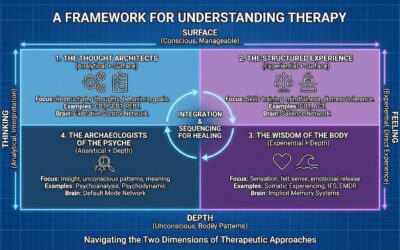
The good news is that the nervous system’s capacity to learn is bidirectional. The same neuroplasticity that allowed your system to get stuck in functional freeze also allows it to find its way back to regulation. But this requires approaches that work from the bottom up—from the body to the brain—rather than exclusively top down.
Brainspotting: Finding Where the Freeze Lives
Brainspotting, developed by Dr. David Grand, uses fixed eye positions to access and process the subcortical sources of emotional and physical distress. The principle is elegant: “Where you look affects how you feel.” By locating a “brainspot”—an eye position that corresponds to the held activation in your nervous system—the approach allows processing to occur at the level where trauma is actually stored.
For someone in functional freeze, Brainspotting can be particularly effective because it doesn’t require verbal narrative or cognitive analysis. You don’t need to “figure out” your trauma. You simply need to allow your body to complete processes that were interrupted, to discharge energy that has been held frozen, sometimes for decades.
In the focused, reflective state that Brainspotting induces—similar to the brain’s natural state during REM sleep—the nervous system can finally do what it’s been trying to do all along: process, integrate, and return to baseline.
Somatic Experiencing: Completing the Stress Cycle
Developed by Dr. Peter Levine, Somatic Experiencing (SE) is based on the observation that wild animals rarely develop trauma symptoms despite facing life-threatening situations regularly. The difference is that animals complete their stress responses—they shake, they run, they discharge the survival energy that mobilized to protect them.
Humans, with our complex social brains, often interrupt this completion. We tell ourselves to “be strong,” to “hold it together,” to not make a scene. The survival energy that mobilized for fight or flight gets trapped, eventually settling into freeze.
SE works by gradually building capacity to tolerate sensation and allowing the body to complete what Levine calls “thwarted survival responses.” This isn’t about reliving trauma. It’s about helping the nervous system discover—somatically, experientially—that the threat has passed and mobilization is now safe.
Parts-Based Approaches: Meeting the Protectors
Internal Family Systems (IFS), developed by Dr. Richard Schwartz, offers another powerful lens. In IFS understanding, the dissociative aspects of functional freeze might be understood as protective “parts” that are trying to keep you safe.
The part that keeps you productive is a manager, working overtime to prevent collapse. The frozen, numb quality is an exile that holds unbearable pain locked away. And sometimes, when the system gets overwhelmed, firefighter parts emerge—perhaps in the form of numbing behaviors, overwork, or emotional eating.
The goal isn’t to fight these parts or eliminate them. It’s to understand their protective function, appreciate how they’ve been trying to help you survive, and gradually help them trust that it’s safe to let go a little. When the protective parts feel met and understood, they can relax their grip, allowing more access to your core Self—the essence of compassion and clarity that exists beneath the adaptive strategies.
EMDR: Reprocessing Stuck Memories
Eye Movement Desensitization and Reprocessing (EMDR) has robust empirical support for trauma treatment. By pairing bilateral stimulation (traditionally eye movements) with traumatic memory activation, EMDR appears to support the brain’s natural memory consolidation processes.
For those in functional freeze, EMDR can help process the specific experiences that trained the nervous system to dissociate. The memories don’t disappear, but their emotional charge reduces. They become stories from the past rather than present-moment threats.
Signs That You’re Coming Out of Freeze
The journey out of functional freeze isn’t linear. You won’t wake up one day suddenly “healed.” Instead, you’ll likely notice subtle shifts:
- Moments of genuine laughter that surprise you
- Feeling irritated or sad when before you felt nothing
- A sense of being “more here” in your body
- Actually tasting your food, noticing colors, hearing music
- The return of desires, preferences, opinions
- Tiredness that feels earned rather than existential
- Capacity for genuine connection, even briefly
Paradoxically, you might also notice yourself feeling worse in some ways. This is often a good sign. Emotions that were frozen begin to thaw. Grief that was buried starts to surface. The numbness that protected you from pain also protected you from joy, and as one comes back, so does the other.
This is where having skilled support matters. A somatic or trauma-trained therapist can help you titrate this process—thawing slowly enough that you don’t flood, building capacity for sensation and emotion incrementally.
Moving Forward: A Different Kind of Productivity
If you recognize yourself in functional freeze, the path forward isn’t about trying harder, pushing through, or adding more wellness practices to your already full plate. It’s about a fundamental reorientation—from productivity as survival to presence as healing.
This doesn’t mean abandoning your responsibilities or collapsing into dysfunction. It means recognizing that the strategy that kept you alive through overwhelming circumstances may now be keeping you from actually living. It means understanding that your exhaustion isn’t weakness—it’s the bill coming due for years of running on an empty tank.
The work of coming out of freeze is the work of learning to feel safe. Not safe because you’ve controlled every variable. Not safe because you’re performing acceptably. Safe in your body. Safe in the present moment. Safe enough to actually be here.
This kind of safety isn’t found in achievement. It’s cultivated in relationship—with a therapist who can co-regulate your nervous system, with somatic practices that speak to your body, with the gradual, patient work of teaching your system that the war is over.
You’ve been getting things done from very far away. Perhaps it’s time to come home.
When to Seek Help
If functional freeze is significantly impacting your quality of life—if you feel like you’re watching your life through a window, if the numbness has become unbearable, if you’ve tried to “snap out of it” and can’t—working with a trauma-trained therapist who uses somatic approaches can help.
At Taproot Therapy Collective in Birmingham, Alabama, we specialize in the somatic and brain-based approaches discussed in this article. Our therapists are trained in Brainspotting, EMDR, Somatic Experiencing, and Internal Family Systems to address trauma at its source—the nervous system—rather than just managing symptoms.
You don’t have to keep driving with the parking brake on.
Related Articles
- 20 Fast Interventions for Panic and Dissociation
- The Somatic and Neurological Experience of Brainspotting Therapy
- Navigating Neurodivergent Burnout
- Parts-Based Therapy in Alabama
- Somatic Trauma Mapping
- Carl Jung’s Shadow: Holding the Tension of Opposites in Depth Psychology
- Heal Yourself By Finding Your Inner Child
- The 3 Neurotic Personality Styles: Insights from Karen Horney
- Donald Kalsched: Archetypal Defenses and the Healing of Trauma
- Mapping Your Shadow: A Somatic Approach to Jungian Shadow Work
References
Porges, S. W. (2025). Polyvagal Theory: Current Status, Clinical Applications, and Future Directions. Clinical Neuropsychiatry, 22(3), 175-191. https://pmc.ncbi.nlm.nih.gov/articles/PMC12302812/
Porges, S. W. (2011). The Polyvagal Theory: Neurophysiological Foundations of Emotions, Attachment, Communication, and Self-regulation. W. W. Norton & Company.
Porges, S. W., & Porges, S. (2023). Our Polyvagal World: How Safety and Trauma Change Us. W. W. Norton & Company.
Porges, S. W. (2011). The polyvagal theory: New insights into adaptive reactions of the autonomic nervous system. Cleveland Clinic Journal of Medicine, 76(Suppl 2), S86-S90. https://pmc.ncbi.nlm.nih.gov/articles/PMC3108032/
Dana, D. (2018). The Polyvagal Theory in Therapy: Engaging the Rhythm of Regulation. W. W. Norton & Company.
Van der Kolk, B. A. (2014). The Body Keeps the Score: Brain, Mind, and Body in the Healing of Trauma. Viking.
Grand, D. (2013). Brainspotting: The Revolutionary New Therapy for Rapid and Effective Change. Sounds True.
Levine, P. A. (2010). In an Unspoken Voice: How the Body Releases Trauma and Restores Goodness. North Atlantic Books.
Schwartz, R. C. (2021). No Bad Parts: Healing Trauma and Restoring Wholeness with the Internal Family Systems Model. Sounds True.
Shapiro, F. (2017). Eye Movement Desensitization and Reprocessing (EMDR) Therapy: Basic Principles, Protocols, and Procedures (3rd ed.). Guilford Press.
Ogden, P., & Fisher, J. (2015). Sensorimotor Psychotherapy: Interventions for Trauma and Attachment. W. W. Norton & Company.
Polyvagal Institute. (n.d.). What is Polyvagal Theory? Retrieved from https://www.polyvagalinstitute.org/whatispolyvagaltheory




















0 Comments